
The Solar Generator UPS Standard and How 20ms Switchover Protects Your Electronics
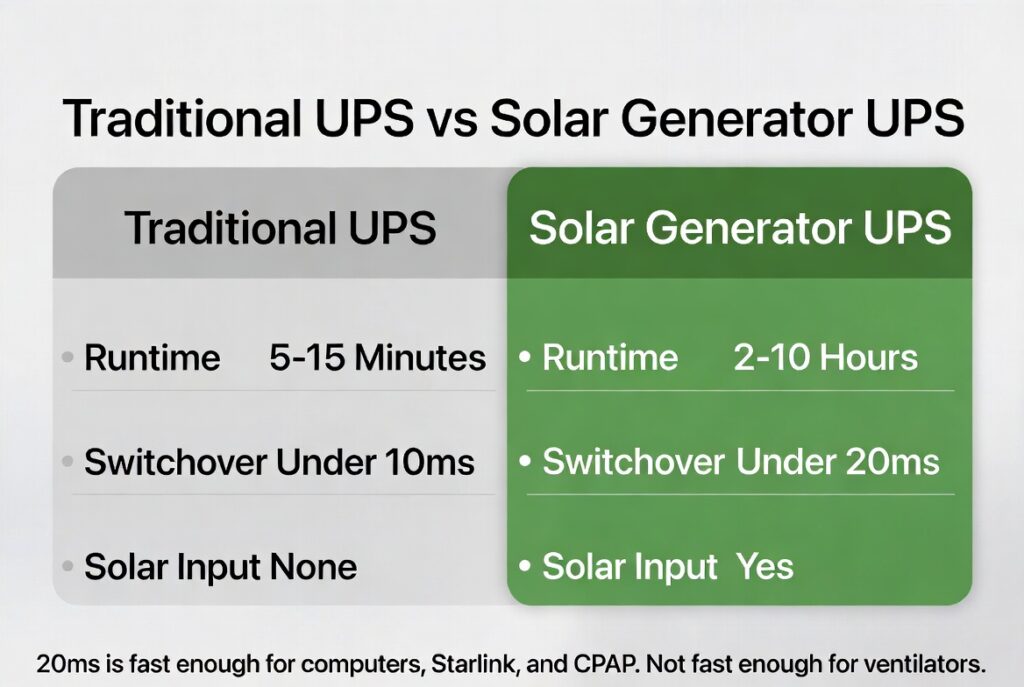
Determining if a solar generator UPS mode is sufficient for your electronics depends entirely on the switchover speed and whether your equipment can tolerate a 20ms power gap. When grid power fails, a solar generator with UPS mode switches to its internal battery within 20 milliseconds. That is 0.02 seconds. To the human eye, it is instantaneous. To a desktop computer, a Starlink dish, or a CPAP machine, it is fast enough to maintain operation without interruption.
A traditional office UPS switches in under 10ms, which is faster. However, it provides only 5 to 15 minutes of runtime on a small lead-acid battery. A solar generator UPS provides 2 to 10 hours of sustained operation on an LFP battery. The traditional UPS gives you time to save your work and shut down. The solar generator UPS gives you time to finish your workday, sleep through the night, and keep your fridge cold until morning.
The 20ms gap is safe for all standard residential electronics including computers, monitors, routers, CPAP machines, and televisions. It is not safe for medical equipment requiring zero-transfer-time such as ventilators and infusion pumps. For those applications, a true online double-conversion UPS with 0ms transfer is required. For a broader overview, see our solar generator Ontario guide.
Solar Generator UPS Versus Traditional Office UPS and Why Runtime Wins
The comparison between a solar generator UPS and a traditional office UPS comes down to one number: runtime. A traditional UPS gives 5 to 15 minutes. A solar generator gives 2 to 10 hours. That is a factor of 10 to 40 times more runtime for a higher upfront cost. The traditional UPS wins on switchover speed at under 10ms versus 20ms. For most residential electronics, the 10ms difference is irrelevant.
| Feature | Traditional UPS | Solar Generator UPS |
|---|---|---|
| Battery Type | Lead-acid | LiFePO4 (LFP) |
| Runtime | 5 to 15 minutes | 2 to 10 hours |
| Switchover | Under 10ms | Under 20ms |
| Solar Input | None | Yes (free recharging) |
| Cost | $100 to $300 CAD | $900 to $4,500 CAD |
The additional cost of a solar generator UPS is justified by sustained operation, not just graceful shutdown. A $200 traditional UPS gives you 10 minutes to save and close. A $900 Anker SOLIX C1000 gives you 8 hours to keep working. The solar generator also recharges from solar panels, which a traditional UPS cannot do.
What a Solar Generator UPS Can and Cannot Protect
The 20ms switchover is fast enough for desktop computers, laptops, monitors, Starlink dishes, WiFi routers, CPAP machines, LED and OLED televisions, phone chargers, and small kitchen appliances. These devices either have internal capacitors that bridge the 20ms gap or do not require continuous power to maintain their state. A computer’s power supply holds enough charge internally to bridge 20ms without the motherboard ever detecting a power loss.
The 20ms switchover is not fast enough for medical ventilators, infusion pumps, or high-end servers with ultra-sensitive power supplies that require true online double-conversion UPS at 0ms transfer. Passthrough charging means the battery does not cycle during normal grid operation. Grid power flows directly to the connected loads. The battery only activates when the grid fails. This means UPS standby adds negligible wear to the LFP cells. For load limits during battery operation, see our solar generator surge wattage guide.
The Ontario Starlink Factor and Why Micro-Outages Cost More Than Blackouts
Rural Ontario experiences frequent micro-outages caused by wind and ice hitting overhead power lines. A 20-second power blink is barely noticeable for lights and appliances. For a Starlink dish, it triggers a full reboot cycle that takes 3 to 5 minutes to reacquire satellites and restore internet connectivity. Three micro-outages per month means at least 15 minutes of lost internet. For a remote worker on a client video call, one blink costs the meeting.
A solar generator UPS eliminates this problem entirely. The 20ms switchover keeps the Starlink power supply energized through every blink. The dish never loses power, never reboots, and never drops the connection. For rural Ontario remote workers who depend on Starlink for income, the solar generator UPS pays for itself the first time it saves a client meeting. For medical backup, see our solar generator for CPAP guide.
The Rural Ontario Starlink Save
A remote worker in rural Ontario was losing his internet connection for 5 to 10 minutes every time the power blinked because his Starlink dish had to reboot and reacquire satellites. His area experienced micro-outages 3 to 4 times per month from wind and ice hitting overhead lines. Each 20-second power blink cost him a 5-minute Starlink reboot. He lost two client video calls in one month because of these brief interruptions.
He plugged his Starlink power supply and router into a Bluetti AC200L in UPS mode. During a spring thunderstorm, the grid power cut out three times in one hour. The Starlink stayed online through all three outages without dropping a single packet. He finished his video call without the client knowing his grid power had failed three times during the meeting.
A solar generator UPS for Starlink is like a dual-battery setup in a work truck. When the main battery drops offline, the auxiliary battery takes over without the accessories ever seeing a voltage dip. The radio keeps playing. The GPS stays on. For rural Ontario remote workers, the solar generator UPS is not a luxury. It is the difference between keeping a client and losing one.
The Rockwood Non-UPS Blackout
A DIYer in Rockwood bought a budget solar generator without UPS mode and left his computer plugged into it. He assumed the unit would automatically switch to battery when the grid failed. He was running a 3-hour CAD rendering job that could not be interrupted. The unit was plugged into the wall and his computer was plugged into the unit.
When the grid went down during a summer storm, the unit’s inverter did not activate automatically. It required a physical button press to wake the AC outlets. His computer lost power instantly and crashed. He lost 3 hours of unsaved CAD work because the unit had passthrough charging but not UPS mode with automatic switchover.
He bought a manual-start generator when he needed an automatic standby system. A manual-start unit requires someone to physically turn it on when the power fails. An automatic system watches the grid and starts itself. The solar generator UPS feature is the automatic start. Without it, the unit is just a battery that happens to be plugged into the wall. Always verify the unit has dedicated UPS mode with automatic inverter activation before relying on it for uninterrupted power. For setup protocol, see our solar generator elderly guide.
The Solar Generator UPS Verdict and Who Needs Automatic Switchover
This solar generator UPS verdict splits into three profiles based on what you need to protect and how long your outages typically last.
- Remote workers with Starlink who cannot tolerate reboots should buy an Anker SOLIX C1000 or Bluetti AC200L with UPS mode. Plug Starlink, router, and laptop into the unit. Leave it plugged into the wall. The 20ms switchover keeps everything online through every micro-outage. For panel-level backup, see our transfer switch guide.
- CPAP users who need uninterrupted airflow overnight should buy an Anker SOLIX C1000 with UPS mode and quiet mode enabled. The 20ms switchover is fast enough that the CPAP never stops and the user never wakes up. The quiet mode keeps fan noise below the sleep disruption threshold at light loads.
- Home office and fridge protection users should buy a Bluetti AC200L or EcoFlow DELTA Pro 3 for extended runtime. The 2,048Wh to 4,096Wh battery sustains a fridge and home office for 8 to 17 hours without grid power. UPS mode means you do not need to wake up at 2 AM to plug in the fridge when the power fails.
Frequently Asked Questions
Q: Does UPS mode wear out the battery?
A: No. In UPS mode, grid power passes through to the connected loads and the battery only activates when grid power fails. The battery does not cycle during normal operation. UPS standby adds negligible wear compared to regular charge-discharge cycling.
Q: Can I use a solar generator UPS for my OLED TV?
A: Yes. The 20ms switchover is fast enough for all consumer TVs including OLED and QLED. The pure sine wave output protects sensitive display electronics from power quality issues. This is one of the best use cases for solar generator UPS mode.
Q: Is it louder in UPS mode than normal?
A: In UPS standby, the unit is silent because the inverter is not active. The fans only activate when the unit switches to battery and begins delivering power. At light loads under 200W, most units stay silent even during battery operation.
NEC Article 700 covers emergency power systems and transfer equipment requirements including switchover timing for life safety and critical operations equipment. All UPS and automatic transfer equipment must comply with applicable switchover speed standards. Current standards are published at nfpa.org.
CEC Section 64 governs emergency power transfer equipment and UPS requirements in Ontario. All automatic switchover equipment must provide reliable transfer from grid to battery without exceeding rated switchover time. The Electrical Safety Authority (ESA) provides current compliance guidelines at esasafe.com.
This build is engineered within the 48V DC Safety Ceiling. Diagnostic logic is based on 20+ years of technical service experience. All structural and electrical installations must be verified by a Licensed Professional and comply with your Local AHJ. See our legal and safety disclosure for full scope.
About the Author
Robert Bertrand spent 20 years as a service advisor in the automotive industry (Lexus and Nissan), where precision diagnostics, wiring integrity, and documentation standards were non-negotiable. He brings that same technical discipline to GridFree Guide, where he researches, tests, and documents off-grid solar systems for Ontario conditions. Based in Rockwood, Ontario, every article is built on verified specifications, manufacturer data, and the real-world climate constraints of Canadian off-grid living.
As an Amazon Associate I earn from qualifying purchases. This site also contains affiliate links to other products and services. GridFree Guide earns a small commission at no extra cost to you.