
The Solar Panel Guide for Ontario and Why Arizona Advice Does Not Work Here
This solar panel guide covers every decision from technology selection to 25-year degradation management because Ontario conditions demand different choices than the guides written for Arizona and California. Ontario gets 1.5 peak sun hours in January versus 6+ in Arizona. Cold weather increases panel voltage above STC ratings. Snow covers panels for days after each storm. The tilt angle that works in the southwest fails completely in a province where the sun sits 20 degrees above the horizon in December.
The same 100W panel produces 500Wh per day in July and 150Wh per day in January. That is a 70 percent seasonal swing that no Arizona-based guide accounts for. If you size your system for July production, you will have zero usable power by the third gray day in January. If you size for January, every other month is a surplus. This solar panel guide sizes for January because that is when Ontario systems fail.
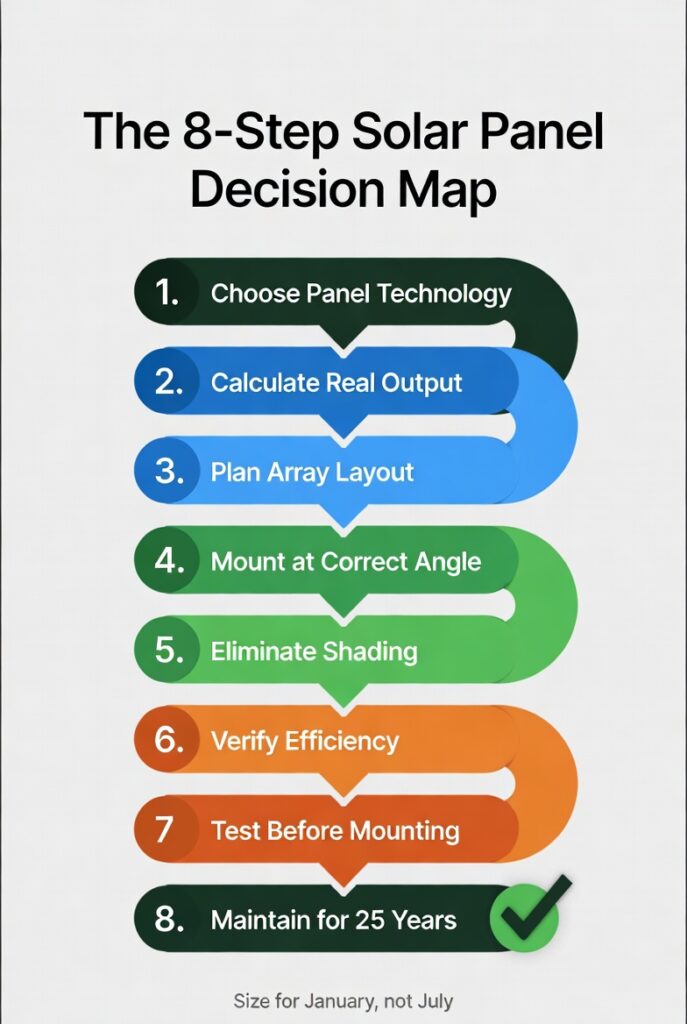
This article is the master map for the entire Solar Panels category. Each section summarizes a critical decision and links to the full detailed guide. Follow the 8 steps in order because panel technology, output calculations, array layout, tilt angle, and shading all interact. For a broader system overview, see our solar generator Ontario guide.
Panel Technology Selection and Output Reality for Ontario Conditions
Step 1 is choosing panel technology. Monocrystalline PERC is the standard for Ontario because it offers the highest efficiency at 20 to 22 percent and the best low-light performance on cloudy days. Bifacial panels add 5 to 15 percent production from ground albedo, which is highest in winter when snow reflects sunlight onto the rear of the panel. Flexible panels are for vans and boats only where rigid mounting is impossible. For detailed comparisons, see our best solar panels Ontario guide, our bifacial solar panels guide, and our flexible solar panels guide.
Step 2 is understanding output reality. A Renogy 100W panel produces 500Wh in July at 5 PSH and 150Wh in January at 1.5 PSH. Nameplate watts are measured under Standard Test Conditions in a lab at 25 degrees C and 1,000 W/m2 irradiance. Ontario rooftop reality delivers 70 to 85 percent of nameplate due to temperature derating, dust, and angle losses. Size your array for January production, not July. For the complete output analysis, see our solar panel watt guide and our solar panel output guide.
The Solar Panel Guide for Array Layout, Mounting, and the Ontario Tilt Angle
Step 3 is array layout and string configuration. Series wiring increases voltage. Parallel wiring increases current. Series strings must stay below the charge controller’s maximum input voltage including the cold-weather VOC spike at minus 25 degrees C. Parallel wiring is safer for portable generators with 60V input limits because voltage stays at the single-panel level regardless of how many panels you add. For the full layout guide, see our solar array guide and our panel wiring guide.
Step 4 is mounting and tilt angle. Ground mount wins the Ontario winter test because you can adjust tilt seasonally and clear snow manually. Roof mount works for summer-dominant production but cannot be adjusted and stays snow-covered for days. Optimal tilt in Ontario is 60 degrees in winter for maximum January production and automatic snow shedding, 30 degrees in summer for peak output, and 45 degrees as a year-round fixed compromise. Snow shedding requires a minimum 30-degree tilt. For the complete mounting guide, see our solar panel mounting guide and our solar panel angle guide.
Shading, Efficiency, and Testing Before You Mount
Step 5 is eliminating shading. One shaded cell in a series string acts as a resistor and reduces the entire string’s output. A 600W string with one panel 40 percent shaded can drop to 150W. Bypass diodes reduce the damage but do not eliminate it. Tree trimming is the cheapest fix. Micro-inverters or power optimizers solve partial shading on complex rooflines. For the complete shading analysis, see our solar panel shading guide. Step 6 is verifying efficiency. Panel efficiency ranges from 18 to 22 percent for monocrystalline. Low-light performance matters more than peak efficiency in Ontario because 60 percent of the year is cloudy or overcast. MPPT charge controllers extract 30 percent more energy from low-light conditions than PWM controllers. For the efficiency breakdown, see our solar panel efficiency guide.
Step 7 is testing panel output before mounting. Use a clamp meter to measure open-circuit voltage (VOC) and short-circuit current (ISC) on each panel before installation. Compare measured values to the spec sheet. If output is below 80 percent of the rated values, the panel is defective or damaged and should be returned. Testing takes 5 minutes per panel and prevents mounting a dead panel on a roof where replacement requires disassembly. For the testing protocol, see our test solar panel guide.
The Rockwood Ground Mount Tilt Win
A homeowner in Rockwood installed a 1,200W ground-mount array on adjustable tilt brackets. He set the tilt to 60 degrees for winter and 30 degrees for summer. His neighbor installed the same 1,200W array on a flat roof at a fixed 20-degree tilt because the roofer said steeper would create wind load issues. Both systems used identical panels and identical charge controllers.
In January, the Rockwood ground mount at 60 degrees produced 180Wh per 100W panel per day. The neighbor’s 20-degree roof mount produced 75Wh per 100W panel per day. The ground mount produced 240 percent more energy from the same panels in the same town in the same month. The tilt angle alone was worth 2.4 times more production. The 60-degree tilt also shed snow automatically while the neighbor’s flat panels stayed snow-covered for 3 days after each storm.
Panel tilt in Ontario winter is like wheel alignment on a vehicle. The same tires, the same engine, the same road. But a car with 5 degrees of misalignment wears its tires unevenly and loses fuel economy. Correct alignment costs nothing extra and delivers full performance. This solar panel guide starts with Ontario-specific tilt angles because the correct angle at 60 degrees winter produces more than double the output of the wrong angle at 20 degrees.
The Milton Shading Disaster
A DIYer in Milton installed a 6-panel series string on his south-facing roof. The panels produced 600W at noon in clear sun. A maple tree on the west side of the property shaded the last panel in the string starting at 2 PM every afternoon. He noticed production dropped but assumed it was normal afternoon decline.
When one panel in a series string is shaded, it acts as a resistor and reduces the entire string’s output. His 600W string dropped to approximately 150W after 2 PM every day because one panel was 40 percent shaded. He was losing 450W of production for 4 hours every afternoon. Over a month, that equated to 54,000Wh of lost production, which is 54kWh. That is enough energy to run a fridge for 28 days.
One shaded panel in a series string is like one fouled spark plug in a 6-cylinder engine. The engine does not lose one-sixth of its power. It loses half because the misfiring cylinder disrupts the entire combustion sequence. Trimming the maple tree branch restored full output instantly. This solar panel guide covers shading in step 5 because a $50 tree trimming can recover more production than a $400 panel addition.
The Solar Panel Guide Verdict on Degradation, Cost, and 25-Year Ownership
Step 8 is degradation management and long-term ownership. Panels degrade 0.3 to 0.5 percent per year under normal conditions. A 400W panel produces 340W to 360W at year 25. That is still enough to run most systems at reduced but functional capacity. Annual cleaning removes dust, pollen, and bird droppings that reduce output by 5 to 10 percent. For the degradation curve and cost analysis, see our solar panel degradation guide and our solar panel cost guide.
Connection inspection is the other half of annual maintenance. MC4 connectors can loosen from freeze-thaw cycling in Ontario. A loose MC4 connection creates resistance, generates heat, and can melt the connector housing. Check every connection annually and replace any connector showing discolouration or deformation. A Renogy 100W Starter Kit includes replacement connectors and cables. For the complete wiring context, see our off-grid electrical wiring guide. For battery storage decisions, see our solar battery guide.
Frequently Asked Questions
Q: What type of solar panel is best for Ontario?
A: Monocrystalline PERC for any fixed installation because it has the highest efficiency and best low-light performance. Bifacial adds 5 to 15 percent from snow albedo on ground mounts. Flexible panels only for vans and boats where rigid mounting is impossible.
Q: What tilt angle should I use in Ontario?
A: 60 degrees in winter for maximum January production and automatic snow shedding. 30 degrees in summer for peak output during long days. 45 degrees as a year-round fixed compromise if you cannot adjust seasonally.
Q: How long do solar panels actually last?
A: 25 to 30 years with annual cleaning and connection inspection. Panels degrade 0.3 to 0.5 percent per year, so a 400W panel still produces 340 to 360W at year 25. The panel will outlast every other component in your solar system including the battery and charge controller.
NEC Article 690 covers PV module installation and mounting requirements including maximum voltage ratings under cold temperatures, grounding, and environmental load specifications. All panel installations must withstand local wind and snow load conditions. Current standards are published at nfpa.org.
CEC Section 64 governs PV system installation requirements in Ontario including panel mounting, conductor sizing, and overcurrent protection. All installations must comply with ESA guidelines for structural and electrical safety. The Electrical Safety Authority (ESA) provides current compliance guidelines at esasafe.com.
This build is engineered within the 48V DC Safety Ceiling. Diagnostic logic is based on 20+ years of technical service experience. All structural and electrical installations must be verified by a Licensed Professional and comply with your Local AHJ. See our legal and safety disclosure for full scope.
About the Author
Robert Bertrand spent 20 years as a service advisor in the automotive industry (Lexus and Nissan), where precision diagnostics, wiring integrity, and documentation standards were non-negotiable. He brings that same technical discipline to GridFree Guide, where he researches, tests, and documents off-grid solar systems for Ontario conditions. Based in Rockwood, Ontario, every article is built on verified specifications, manufacturer data, and the real-world climate constraints of Canadian off-grid living.
As an Amazon Associate I earn from qualifying purchases. This site also contains affiliate links to other products and services. GridFree Guide earns a small commission at no extra cost to you.