
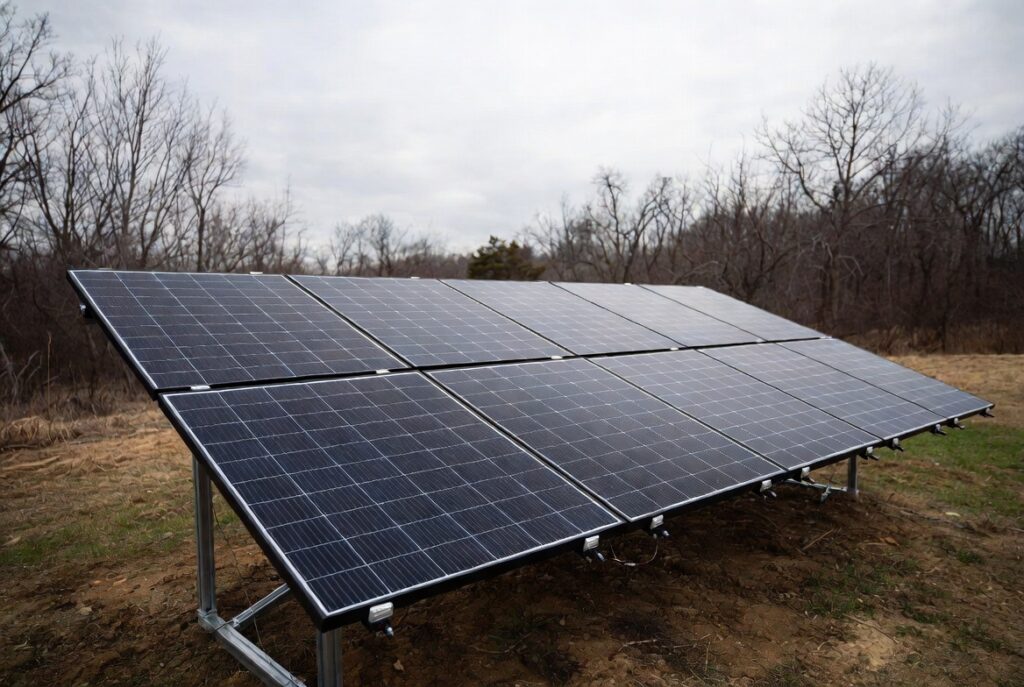
A solar array is multiple panels wired as one unit, and the layout decides whether it survives Ontario winter. The term sounds simple, but the wiring configuration determines voltage, amperage, and charge controller compatibility. Wire a solar array wrong in Ontario and the system triggers an over-voltage fault on the coldest morning. The difference between a working system and a dead one is a $12 set of branch connectors.
Cold temperatures cause open-circuit voltage to rise well above the panel’s STC rating. Four 100W panels in series produce 97.2V at STC but hit 114V at negative 15 degrees C. That exceeds the Victron MPPT 100/50’s 100V input limit and shuts the system down. Every solar array in Ontario must be designed for the coldest day, not the sunniest one.
This guide covers series, parallel, and hybrid string layouts with the cold Voc calculation that protects your investment. If you are building your first solar array, start with our solar power system guide for the full sizing sequence.
| Configuration | Panels | STC Voc | Cold Voc (1.15x) | Safe on 100V MPPT? |
|---|---|---|---|---|
| 2S (series) | 2 | 48.6V | ~56V | Yes |
| 3S (series) | 3 | 72.9V | ~83.8V | Yes |
| 4S (series) | 4 | 97.2V | ~114V | No |
| 2S2P (hybrid) | 4 | 48.6V | ~56V | Yes |
| 3S2P (hybrid) | 6 | 72.9V | ~83.8V | Yes |
| 6S (series) | 6 | 145.8V | ~167V | No |
What a solar array actually is and why layout matters
A solar array is multiple panels wired together as one power-producing unit. Its configuration determines voltage output under real-world conditions. In Ontario, open-circuit voltage rises dramatically when temperatures fall below zero. A system that works perfectly in summer can stop producing power on a January morning.
This is not just a performance issue. It is a safety concern. Wiring a solar array without considering voltage rise can trigger over-voltage protection and shut down the entire system. The charge controller, batteries, and wiring all depend on correct voltage management from the array side.
Series versus parallel wiring and the Ontario trade-off
Series wiring increases voltage while holding amperage steady. That allows smaller wire gauge for long cable runs. However, in Ontario, four 100W panels in series hit approximately 114V at negative 15 degrees C. That far exceeds the Victron MPPT 100/50 charge controller’s 100V input limit.
Parallel wiring keeps voltage low and stable regardless of temperature. However, amperage adds up, requiring thicker wire to handle the current. The best approach for Ontario is hybrid wiring in 2S2P or 3S2P configurations. Our solar panel wiring guide covers the full series-parallel decision logic.
The cold Voc calculation every Ontario solar array must pass
The cold correction factor is 1.15. Multiply the STC Voc by 1.15 to estimate the real-world maximum voltage in Ontario winter. A single Renogy 100W Monocrystalline Panel has a Voc of 24.3V at STC. At negative 15 degrees C, it climbs to approximately 29V.
Four of those panels in series produce 116V at cold temperatures. That exceeds any 100V MPPT charge controller input limit. Always calculate cold Voc before wiring any string. The formula is simple: STC Voc times number of panels in series times 1.15 must stay below the controller’s maximum.
Tier 1, Tier 2, and Tier 3 sizing for Ontario builds
Tier 1 is two panels wired in series for sheds, trail cameras, or small trailers. Two Renogy 100W panels produce 48.6V at STC and approximately 56V at cold. That sits safely under any 100V controller. Simple series wiring works here without risk.
Tier 2 covers cottages and workshops with four to six panels. These builds require 2S2P or 3S2P hybrid layouts to keep string voltage between 56V and 84V at cold temperatures. MC4 Branch Connectors join the parallel strings safely. Our solar panel sizing guide covers the full Tier 2 layout.
Tier 3 systems with ten or more panels need a ground mount installation and a 150V or 250V rated controller. Cold Voc on a 10-panel series string exceeds 280V. These builds require professional design and ESA permitting before any wiring begins.
The Wellington County 3S2P ground mount
I laid out a 6-panel solar array using six Renogy 100W panels on a ground-mount rack in Wellington County. The owner wanted one long series string for simplicity. I knew the November frost was coming. I wired the array as two parallel strings of three panels each in a 3S2P configuration.
At STC, each three-panel series string produced 72.9V open-circuit voltage. When the first November cold snap hit negative 5 degrees C, the Victron SmartShunt logged 83.8V per string. That sat safely under the MPPT 100/50’s 100V limit with 16.2V of margin.
The parallel configuration doubled the solar array amperage to 9.82A total while keeping voltage safe. The system produced reliably through the entire winter without a single over-voltage event. The 3S2P layout is now my standard for any 6-panel solar array on a 100V controller in Ontario. The MC4 branch connectors added $12 to the build and prevented a $500 controller replacement.
The Hastings County over-voltage fault
A homeowner in Hastings County wired four Renogy 100W panels in a single series string for his cottage. The string produced 97.2V at STC. He believed that was safely under his MPPT 100/50’s 100V limit. He did not account for Ontario’s cold voltage correction factor of 1.15.
On a clear January morning at negative 15 degrees C, the SmartShunt logged 114V at 9:00 AM. The MPPT 100/50 triggered its over-voltage protection and shut down completely. The panels were producing power, but the controller refused to accept it. The system was useless on the clearest, coldest morning of the year.
I rewired the solar array into a 2S2P configuration with two strings of two panels each. String voltage dropped to 48.6V at STC and approximately 56V at negative 15 degrees C. The system has not faulted since the rewire. The owner spent $12 on MC4 branch connectors and saved his $500 charge controller.
NEC and CEC code requirements for array installations
NEC 690.7 governs maximum voltage calculations for all photovoltaic source and output circuits. All DC conductors must be rated for the cold-temperature corrected Voc, not just the STC rating. An array exceeding the charge controller’s input voltage violates NEC 690.7 and creates a fire risk. Contact the NFPA at nfpa.org for current NEC 690 requirements.
CEC Section 64 governs all permanent photovoltaic installations in Ontario and requires an ESA permit before connection. The ESA inspector will verify that string voltage calculations include the cold correction factor. An installation that fails the voltage check requires rewiring before the permit closes. Contact the Electrical Safety Authority at esasafe.com before beginning any permanent array installation.
Pro Tip: Before wiring any solar array in Ontario, write this formula on a piece of tape and stick it to your charge controller: panel Voc times number of panels in series times 1.15. If that number exceeds the controller’s max input voltage, split the string into parallel groups using MC4 branch connectors. The $12 branch connector is the cheapest insurance in any off-grid build.
Solar array verdict: wire for cold, not for convenience
- Tier 1 builders with 2 panels: Series wiring is safe. Two Renogy 100W panels in series produce 48.6V at STC and approximately 56V at cold. No risk on any 100V controller. Wire in series and move on.
- Tier 2 builders with 4 to 6 panels: Use a 2S2P or 3S2P hybrid configuration. Keep string voltage under 85V at the cold calculation. Buy MC4 branch connectors for $12 and protect your charge controller from over-voltage faults.
- Tier 3 builders with 10 or more panels: Do not use a 100V controller. Upgrade to a 150V or 250V rated charge controller. The cold Voc on a 10-panel series string exceeds 280V and requires professional design and ESA permitting.
Frequently asked questions
Q: What is a solar array?
A: A solar array is multiple panels wired together as one power-producing unit. Its layout determines voltage and amperage output based on whether panels connect in series, parallel, or hybrid configurations. Without proper sizing based on your charge controller’s max input, even well-placed panels will fail when Ontario temperatures drop.
Q: How many solar panels do I need for an off-grid array in Ontario?
A: Tier 1 shed builds use 2 panels at 200W total. Tier 2 cottage builds use 4 to 6 panels at 800W to 1,200W. Tier 3 full off-grid homes need 10 to 16 panels at 2,000W or more. Always design around January’s 1.5 PSH, not summer production peaks.
Q: Can I wire all my solar panels in series?
A: Only if the cold Voc stays under your charge controller’s max input voltage. In Ontario, multiply STC Voc by 1.15 as a minimum safety factor. Four 100W panels in series hit 114V at cold temperatures and exceed most 100V controllers. Split into parallel strings using MC4 branch connectors to stay safe.
This build is engineered within the 48V DC Safety Ceiling. Diagnostic logic is based on 20+ years of technical service experience. All structural and electrical installations must be verified by a Licensed Professional and comply with your Local AHJ. See our legal and safety disclosure for full scope.
About the Author
Robert Bertrand spent 20 years as a service advisor in the automotive industry (Lexus and Nissan), where precision diagnostics, wiring integrity, and documentation standards were non-negotiable. He brings that same technical discipline to GridFree Guide, where he researches, tests, and documents off-grid solar systems for Ontario conditions. Based in Rockwood, Ontario, every article is built on verified specifications, manufacturer data, and the real-world climate constraints of Canadian off-grid living.
As an Amazon Associate I earn from qualifying purchases. This site also contains affiliate links to other products and services. GridFree Guide earns a small commission at no extra cost to you.