
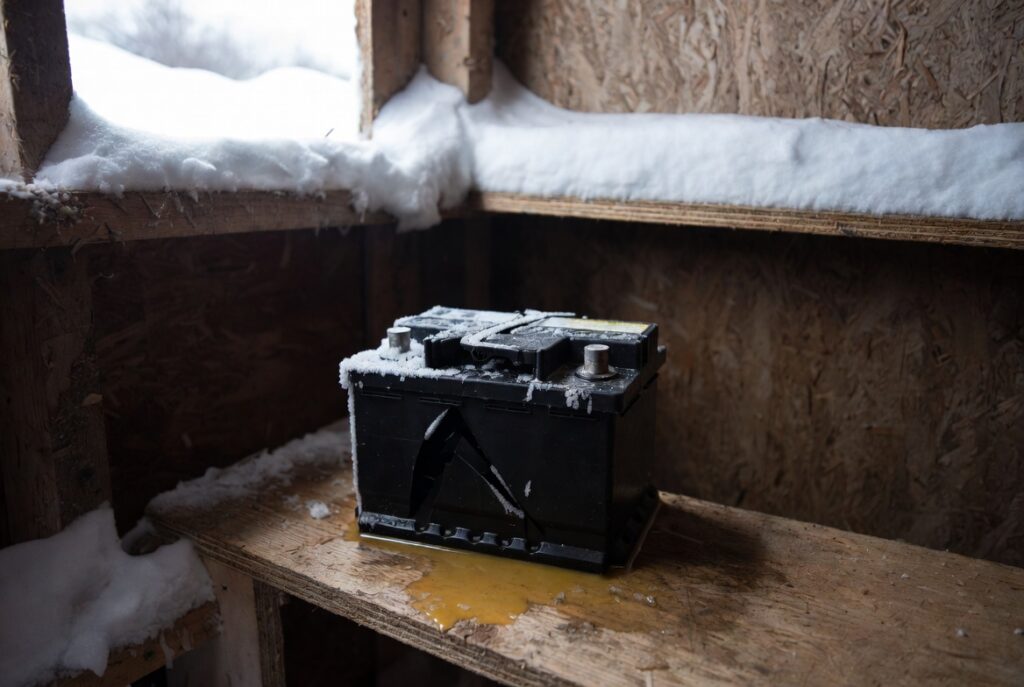
A car battery solar setup looks like a bargain until the SmartShunt shows 40 percent capacity loss in four months. Starter batteries are engineered for a 3 to 5 second burst of current to crank an engine. They are not built for the daily deep cycling that solar storage demands. In Ontario, this mistake leads to frozen, cracked batteries leaking acid in your shed.
The chemistry difference is fundamental. SLI batteries use hundreds of thin lead plates to maximize cold cranking amps. Deep-cycle batteries use fewer thick plates that resist warping under sustained discharge. A car battery with 800 CCA and 65Ah is worse for solar than a deep-cycle with 100Ah and zero CCA.
This guide covers why a car battery solar setup fails and the freeze physics that make it dangerous. The cost math proves the $150 battery is the most expensive option over time. If you are choosing a storage battery, start with our solar battery guide for Ontario for the full comparison.
| Battery Type | Cost | Usable Ah | Cycle Life | 5-Year Cost |
|---|---|---|---|---|
| Car battery (SLI) | $150 | 32.5Ah | 50 to 100 | $750+ |
| Deep-cycle AGM | $250 | 50Ah | 400 to 600 | $375 |
| LFP (Battle Born) | $400 | 100Ah | 3,000+ | $200 |
Why a car battery solar setup fails in Ontario
Car batteries use thin lead plates designed to deliver maximum surface area for a burst of cold cranking amps. When deep cycled daily, those thin plates warp and shed active material within 50 to 100 cycles. A 65Ah car battery at 50 percent max depth of discharge delivers only 32.5Ah usable. Capacity drops 30 to 40 percent within four months of solar use.
A car battery solar setup appears to work for the first few weeks because the initial capacity masks the degradation. By month two, the Victron SmartShunt reveals the declining trend. By month four, the battery cannot hold enough charge to run LED lights past 9:00 PM. The $150 purchase becomes a $150 loss.
SLI plates versus deep-cycle plates and the chemistry difference
SLI batteries use hundreds of thin lead grids to maximize surface area for peak CCA output. That design excels at cranking a cold engine in January. However, sustained discharge causes the thin grids to bend, crack, and shed lead particulate into the electrolyte. After 50 to 100 deep cycles, the plates lose enough material to permanently reduce capacity.
Deep-cycle batteries use fewer but thicker plates that resist warping under repeated discharge. Our LFP versus AGM comparison covers both chemistries in detail. CCA is irrelevant for solar storage because Ah at the C20 rate determines usable energy. Always ignore the CCA number when selecting a solar battery.
The freeze point that makes car battery solar dangerous in Ontario
As a lead-acid battery discharges, sulfuric acid migrates into the plates. That leaves mostly water behind in the electrolyte casing. A fully charged lead-acid battery is safe to negative 50 degrees C. At 30 percent SOC, the diluted electrolyte freezes at approximately negative 15 degrees C.
Ontario winters routinely drop below negative 15 degrees C for days at a time. A car battery solar system stays at low SOC because limited winter sunlight cannot fully recharge it daily. One frozen battery means a cracked casing, leaked acid, and contaminated surfaces. Understanding battery voltage and SOC prevents this failure entirely.
The true cost comparison over five years
A car battery costs $150 upfront but lasts only four to six months in solar use. Replacing it annually totals $750 over five years for just 32.5Ah of usable capacity. A deep-cycle AGM at $250 delivers 50Ah usable and lasts three to five years. That drops the five-year cost to approximately $375.
An LFP battery like the Battle Born 100Ah LFP costs $400 but delivers 100Ah usable with 3,000 or more cycles. It lasts a decade or longer, reducing the annual cost to approximately $40. Our solar battery lifespan guide covers the full cycle-life math. The cheapest upfront option is always the most expensive over time.
The Dufferin County shed build failure
Last April in Dufferin County, a builder used a $150 car battery from his truck for a 2-panel shed system. The system fed LED lighting and a phone charger through a Victron MPPT 100/30. He expected the 65Ah car battery to handle daily cycling. The total system cost with the car battery was $518.
By August, the SmartShunt showed the battery holding only 38Ah of its original 65Ah. That is a 40 percent loss in just 120 daily discharge cycles to 40 percent SOC. The thin SLI plates had warped and shed active material. The LED lights started cutting out by 9:00 PM nightly.
He replaced the car battery with a Battle Born 100Ah LFP at $400. After 14 months and over 400 cycles, the LFP holds 99.8 percent of rated capacity. The car battery cost $150 for four months of declining performance. The LFP has delivered 3.5 times the service life at 2.7 times the upfront cost.
The Northumberland County ice hut disaster
An angler in Northumberland County wired an old car battery to a Renogy 100W Monocrystalline Panel for his ice hut. The system ran a fish finder and an LED strip through daily winter use. He discharged the battery to 30 percent SOC regularly because short winter days limited recharge. He did not know the freeze point changes with state of charge.
On a clear night at negative 18 degrees C, the car battery froze solid. A lead-acid battery at 30 percent SOC freezes at approximately negative 15 degrees C. The expanding ice cracked the plastic casing from the inside. When temperatures rose above freezing, the battery leaked sulfuric acid onto the plywood floor.
The angler lost the battery, the plywood floor, and two days of fishing to cleanup. A deep-cycle AGM at 30 percent SOC would not freeze until negative 40 degrees C. An LFP battery has no liquid electrolyte and cannot freeze-crack, as covered in our lithium battery safety guide. The $150 car battery solar setup cost him $150 in battery, $120 in plywood, and a lost weekend.
NEC and CEC code requirements for battery installations
NEC 706.21 mandates proper overcurrent protection for all battery installations in off-grid systems. A car battery solar setup creates unpredictable internal resistance as thin plates degrade, which standard fuses cannot compensate for. All battery storage circuits must use conductors and protection devices rated for the specific battery chemistry. Contact the NFPA at nfpa.org for current NEC 706 requirements.
CEC Section 64 requires all battery storage systems in Ontario to use approved equipment installed by licensed technicians. A car battery does not meet the certified thermal management or deep-cycle design standards required for solar storage. Your local ESA inspector will flag an SLI battery in a permanent solar installation. Contact the Electrical Safety Authority at esasafe.com before installing any battery system.
Pro Tip: If you already have a car battery in your solar shed, check its capacity today with a SmartShunt or a simple load test. If usable Ah has dropped below 70 percent of the rated capacity, replace it immediately with a deep-cycle AGM or LFP. A degraded car battery at low SOC in Ontario winter is a freeze risk, not a storage solution.
Car battery solar verdict: spend more now or spend more forever
- Budget builders needing the lowest upfront cost: Buy a deep-cycle AGM at $250 instead of a car battery at $150. The $100 difference gives you 3 to 5 years of service instead of 4 to 6 months. The AGM is the true budget option for any car battery solar replacement.
- Builders wanting the lowest long-term cost: Buy a Battle Born 100Ah LFP at $400. It delivers 100Ah usable, 3,000 or more cycles, and a decade of service. Annual cost is $40 compared to $150 for yearly car battery replacement.
- Ice fishing, hunting, and cabin owners: Never run a car battery solar setup below negative 10 degrees C. The freeze risk at low SOC is real. An LFP has no liquid electrolyte and cannot crack. An AGM resists freezing far better than SLI.
Frequently asked questions
Q: Can I use a car battery for solar panels?
A: Technically yes for a few weeks, but capacity drops sharply from plate degradation. After two to four months of daily deep cycling, usable energy falls below 60 percent. Always use a certified deep-cycle AGM or LFP for any off-grid solar system in Ontario.
Q: Will a car battery freeze in an off-grid cabin?
A: Yes, if discharged below 50 percent SOC. At 30 percent state of charge, lead-acid electrolyte freezes at approximately negative 15 degrees C. Ontario winter temperatures routinely exceed that threshold for days at a time.
Q: What is the best battery for solar storage in Ontario?
A: For long-term value, choose an LFP battery like the Battle Born 100Ah. It delivers full usable capacity, lasts over a decade, and carries no freeze risk. For tight budgets, a deep-cycle AGM lasts 3 to 5 years and resists freezing far better than any car battery.
This build is engineered within the 48V DC Safety Ceiling. Diagnostic logic is based on 20+ years of technical service experience. All structural and electrical installations must be verified by a Licensed Professional and comply with your Local AHJ. See our legal and safety disclosure for full scope.
About the Author
Robert Bertrand spent 20 years as a service advisor in the automotive industry (Lexus and Nissan), where precision diagnostics, wiring integrity, and documentation standards were non-negotiable. He brings that same technical discipline to GridFree Guide, where he researches, tests, and documents off-grid solar systems for Ontario conditions. Based in Rockwood, Ontario, every article is built on verified specifications, manufacturer data, and the real-world climate constraints of Canadian off-grid living.
As an Amazon Associate I earn from qualifying purchases. This site also contains affiliate links to other products and services. GridFree Guide earns a small commission at no extra cost to you.