
Depth of discharge determines how many cycles your solar battery will survive before it needs replacement. A 100Ah AGM battery at 50 percent max DoD gives you only 50Ah of usable energy. Push that same battery to 75 percent DoD and the cycle life drops from 600 to 200 cycles. The number on the label is not the number you get to use.
LFP chemistry changes this equation completely. A 100Ah LFP battery delivers 100Ah usable at 100 percent depth of discharge with 3,000 or more cycles. The cost per cycle drops from $0.83 for AGM to $0.13 for LFP. The upfront price is higher, but the lifetime cost is six times lower.
This guide covers how depth of discharge controls cycle life in Ontario’s grey streak winters. The cost math settles the AGM versus LFP debate. For the full battery comparison, see our solar battery guide for Ontario.
| Battery Type | Capacity | Max Safe DoD | Usable Ah | Cycles | Cost/Cycle |
|---|---|---|---|---|---|
| 100Ah AGM (at 50% DoD) | 100Ah | 50% | 50Ah | 600 | $0.83 |
| 100Ah AGM (at 75% DoD) | 100Ah | 75% | 75Ah | 200 | $1.67 |
| 100Ah LFP (at 80% DoD) | 100Ah | 80% | 80Ah | 3,000+ | $0.13 |
| 100Ah LFP (at 100% DoD) | 100Ah | 100% | 100Ah | 2,500+ | $0.16 |
What depth of discharge means and how to calculate it
Depth of discharge measures the percentage of total capacity that has been used. A battery at 70 percent state of charge has a 30 percent depth of discharge. DoD and SOC always add to 100 percent. This single number sets the real limit for how much energy you can draw safely.
A 100Ah battery does not mean 100Ah usable. The maximum safe depth of discharge is 50 percent for AGM and 80 to 100 percent for LFP. The chemistry determines the limit, not the label. The battery spec sheet guide shows where to find the DoD rating on any battery.
How depth of discharge determines AGM cycle life
At 30 percent depth of discharge, an AGM battery delivers approximately 1,200 cycles. At 50 percent DoD, that drops to 600 cycles. At 75 percent DoD, it falls to just 200 cycles. Every 10 percent increase beyond 50 percent roughly halves the remaining life.
The lead plates suffer sulphation from sustained deep discharge. This is chemistry, not opinion. The solar battery lifespan guide documents how one week of high DoD can erase months of service. AGM banks in Ontario are routinely forced into this by grey streaks.
Why LFP chemistry handles 100 percent DoD without damage
LFP batteries do not use lead plates and do not suffer from sulphation. Their flat discharge curve holds stable voltage down to 10 percent SOC. At 80 percent depth of discharge, LFP delivers 3,000 to 5,000 cycles. At 100 percent DoD, it still delivers 2,500 to 3,000 cycles.
The LFP versus AGM comparison explains why this changes everything for Ontario winters. A Battle Born 100Ah LFP at $400 costs $0.13 per cycle. The same capacity in AGM at $250 costs $0.83 per cycle. The cheaper battery is six times more expensive to operate.
The Ontario grey streak and why DoD management saves your bank
A typical January grey streak in Ontario lasts 3 to 7 consecutive cloudy days. Solar recharge drops to 0.8 to 1.2 PSH daily during overcast periods. AGM batteries get forced into 70 to 80 percent depth of discharge nightly because recharge cannot keep pace. One grey streak week at 75 percent DoD strips six months off an AGM bank’s life.
LFP handles the same period without degradation. The solar battery life in Ontario guide confirms this with long-term data. Depth of discharge management during grey streaks is the single biggest factor in battery survival. A Victron SmartShunt tracks DoD in real time so you know exactly where you stand.
The Peterborough County grey streak failure
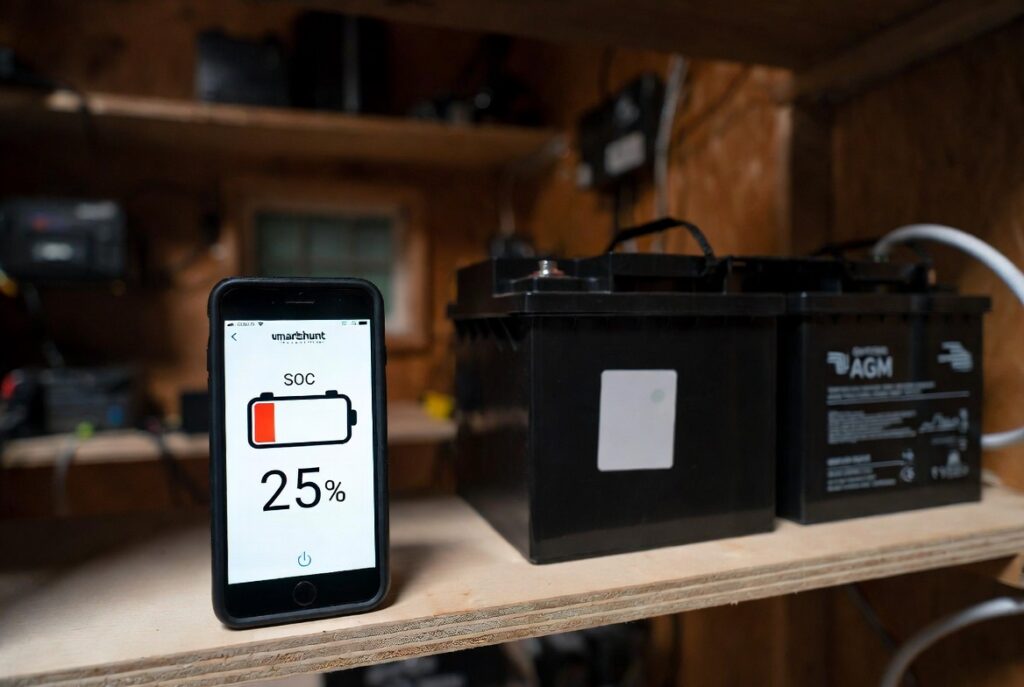
In Peterborough County, a cottage owner ran two 100Ah AGM batteries through a 5-day March grey streak. Solar recharge averaged only 1.8 PSH during the overcast period. The SmartShunt logged both batteries dropping to 25 percent SOC each evening. That is a 75 percent depth of discharge repeated five nights in a row.
At 75 percent DoD, AGM cycle life drops from 600 to approximately 200 cycles. Five consecutive nights at that depth consumed nearly 30 cycles of effective life in one week. The lead plates suffered accelerated sulphation from sustained deep discharge. Capacity dropped permanently with no way to recover it.
By the following October, both batteries showed 30 percent permanent capacity loss. The $500 AGM pair lasted only 14 months instead of the expected 4 years. That works out to $4.76 per usable cycle. An LFP bank would have delivered the same energy at $0.13 per cycle over a decade.
The Renfrew County 7-day winter test
A homeowner in Renfrew County ran a 400Ah LFP bank through a 7-day January grey streak. Solar recharge averaged only 1.2 PSH daily. The system powered a fridge, CPAP, router, and LED lights at 280W nightly draw. By day five, the SmartShunt logged 8 percent SOC.
That is a 92 percent depth of discharge on the deepest night. The BMS never triggered a low-voltage cutoff because LFP holds stable voltage at that level. Lights stayed bright and the fridge kept cold with no performance drop. On day six, partial sun returned 180 Wh and the bank recovered fully by day eight.
After 14 months and 500 cycles at 80 to 90 percent average DoD, capacity loss stayed under 1 percent. The LFP chemistry absorbed brutal cycling without plate damage. An AGM bank would have failed after one such week. The $1,600 LFP investment protected itself through the hardest test Ontario delivers.
NEC and CEC code requirements for battery discharge limits
NEC 480.5 requires all battery installations to include overcurrent protection sized for the maximum discharge current of the system. Operating a battery at extreme depth of discharge increases internal resistance and heat generation. Sustained deep cycling without proper protection creates thermal runaway risk. Contact the NFPA at nfpa.org for current battery installation requirements.
CEC Section 64 mandates that all battery systems in Ontario include monitoring equipment to track state of charge. The ESA inspector will verify that the system includes a certified monitoring device capable of displaying real-time SOC. Systems without monitoring fail the permit inspection regardless of battery chemistry. Contact the Electrical Safety Authority at esasafe.com before installing any battery bank.
Pro Tip: Set a low-voltage alarm on your Victron MPPT 100/50 or SmartShunt at 50 percent SOC for AGM banks. When the alarm triggers, stop all non-essential loads immediately. For LFP, set the alarm at 20 percent SOC as a safety buffer. The alarm costs nothing to configure and saves hundreds in premature battery replacement.
Depth of discharge verdict: buy for the grey streak, not the sunny day
- Budget builders choosing AGM: Size your bank for twice your daily need to stay under 50 percent depth of discharge. A 100Ah AGM gives only 50Ah usable. Monitor with a SmartShunt daily and stop non-essential loads when SOC drops below 50 percent.
- Cottage and cabin builders planning for grey streaks: Buy LFP. The 100 percent depth of discharge capability means your full capacity is usable. One grey streak week will not destroy the investment. A Renogy 100W panel paired with LFP recovers faster than AGM after deep cycling.
- Full off-grid home builders in Ontario: LFP is mandatory. Size the bank for 3 to 5 days of autonomy at 80 percent depth of discharge. A 400Ah LFP bank handles a 7-day grey streak at 92 percent DoD with under 1 percent loss.
Frequently asked questions
Q: What is a safe depth of discharge for solar batteries?
A: For AGM, never exceed 50 percent depth of discharge or you risk cutting cycle life by two-thirds. LFP safely handles 80 to 100 percent DoD without degradation. Exceeding 50 percent on AGM permanently damages the lead plates through sulphation.
Q: Does depth of discharge affect battery lifespan?
A: Yes, directly. An AGM at 75 percent depth of discharge loses over two-thirds of its rated cycle life. LFP retains nearly all cycles at the same DoD because it avoids sulphation entirely. DoD is the core factor in how long your battery bank survives.
Q: How do I monitor depth of discharge on my system?
A: Use a Victron SmartShunt connected via Bluetooth to your phone. It gives real-time SOC and DoD readings updated every few seconds. The battery spec sheet guide shows where to find the DoD rating in your battery documentation.
This build is engineered within the 48V DC Safety Ceiling. Diagnostic logic is based on 20+ years of technical service experience. All structural and electrical installations must be verified by a Licensed Professional and comply with your Local AHJ. See our legal and safety disclosure for full scope.
About the Author
Robert Bertrand spent 20 years as a service advisor in the automotive industry (Lexus and Nissan), where precision diagnostics, wiring integrity, and documentation standards were non-negotiable. He brings that same technical discipline to GridFree Guide, where he researches, tests, and documents off-grid solar systems for Ontario conditions. Based in Rockwood, Ontario, every article is built on verified specifications, manufacturer data, and the real-world climate constraints of Canadian off-grid living.
As an Amazon Associate I earn from qualifying purchases. This site also contains affiliate links to other products and services. GridFree Guide earns a small commission at no extra cost to you.