
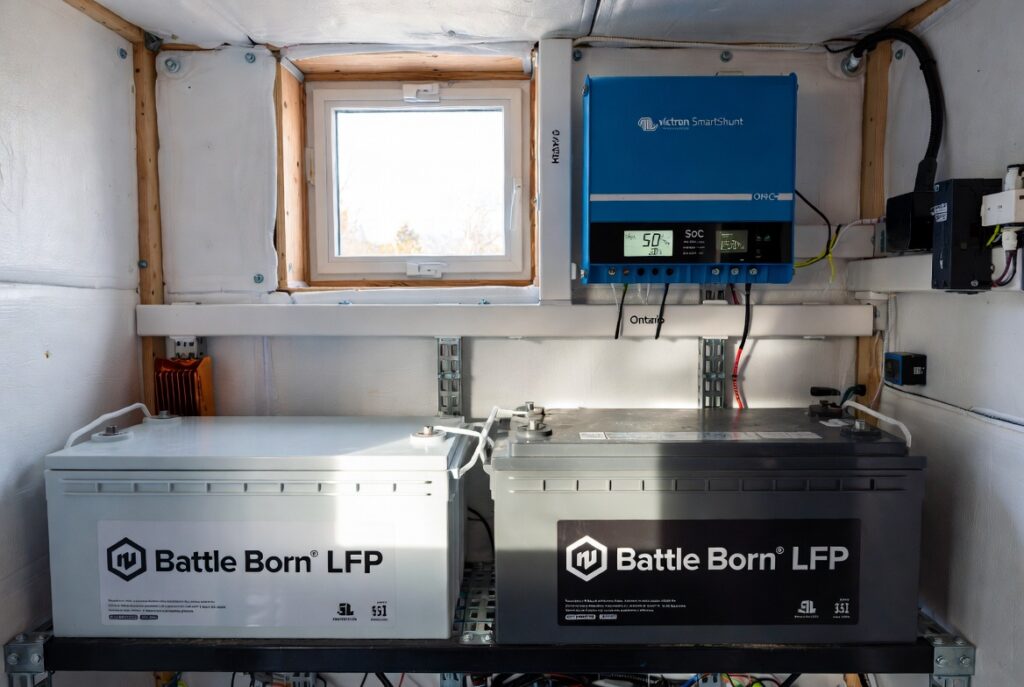
The solar battery life Ontario difference between a Renfrew County owner who ran a 200Ah Battle Born LFP bank for 14 years and reached 93.5 percent capacity retention, and a Hastings County owner who ran the same bank for 5 years and reached 74 percent capacity retention, was not the battery. Both owners bought identical hardware in the same product line. The difference was three operating habits: how deep the bank was discharged each day, whether the cells were protected from cold charging in Ontario January, and how much daily energy throughput the bank was handling. Those three variables are the entire solar battery life Ontario story.
Most Ontario LFP owners understand that the battery has a cycle life rating. What most do not understand is that the cycle life rating is measured at 80 percent depth of discharge under controlled laboratory conditions, and that every reduction in daily DoD extends the expected cycle life significantly beyond that rating. A Battle Born 100Ah LFP rated at 3,000 cycles at 80 percent DoD delivers approximately 6,000 cycles at 50 percent DoD and approximately 10,000 cycles at 30 percent DoD. The Renfrew County bank was sized large enough to keep daily DoD at approximately 37 percent. That single decision was worth approximately 9 additional years of service life.
The Hastings County bank hit 74 percent capacity retention in 5 years because the owner combined three life-reducing habits simultaneously: regular discharge to 25 percent SoC in winter, cold charging without a battery heater, and daily throughput nearly double the bank’s design rating. The SmartShunt showed the daily throughput problem clearly , 1,400Wh per day against a bank rated for 1,200Wh at 80 percent DoD. See our Ontario solar sizing guide before any solar battery life Ontario system design.
The solar battery life Ontario DoD rule: every 10 percent you preserve doubles the remaining cycle life
| Average daily DoD | Approximate cycle life (LFP) | Years at 1 cycle/day | Ontario implication |
|---|---|---|---|
| 80% (rated condition) | 3,000 to 5,000 cycles | 8 to 14 years | Standard sizing |
| 50% DoD | 6,000 to 8,000 cycles | 16 to 22 years | Bank sized 60% larger than minimum |
| 30% DoD | 10,000+ cycles | 27+ years | Bank sized 2.5x minimum load |
| Renfrew County actual (37% DoD) | Estimated 8,000+ cycles | 22+ years projected | 93.5% retention at year 14 |
| Hastings County actual (75% DoD) | Tracking toward 4,000 cycles | 11 years projected | 74% retention at year 5 |
LFP cycle life ratings are measured at 80 percent depth of discharge in laboratory conditions. The solar battery life Ontario relationship between DoD and cycle life is not linear , reducing daily DoD from 80 percent to 50 percent roughly doubles the expected cycle life because the electrochemical stress on the cathode material is significantly lower at shallower discharge depths. A 200Ah bank that cycles from 95 percent SoC to 45 percent SoC every day is operating at 50 percent DoD and can expect approximately 6,000 to 8,000 cycles before reaching 80 percent capacity retention. At one cycle per day that is 16 to 22 years of service.
The practical solar battery life Ontario approach to reducing DoD without reducing available power is to size the bank larger than the minimum daily load calculation. An Ontario off-grid system with a 1,200Wh daily load at 80 percent DoD requires a 150Ah 12V bank at minimum. Sizing to 250Ah drops the daily DoD to approximately 48 percent and approximately doubles the expected cycle life. The incremental cost of the additional 100Ah is typically $600 to $800 on a Battle Born LFP bank. The extended service life is 6 to 10 additional years. See our Ontario LiFePO4 battery guide for the complete DoD sizing calculation.
The solar battery life Ontario cold charging rule: LFP blocks charging below 0 degrees C
LFP chemistry cannot safely accept a charge below 0 degrees C. At sub-zero temperatures, lithium ions deposit as metallic lithium plating on the anode rather than intercalating correctly into the graphite structure. The BMS detects the low cell temperature and closes the charge circuit to prevent the plating damage. In Ontario, an unheated battery enclosure that drops below 0 degrees C will block all charging until the cells warm above 0 degrees C.
In Ontario January, with overnight lows of minus 15 to minus 25 degrees C, In Ontario January, with overnight lows of minus 15 to minus 25 degrees C, an unheated bank in an uninsulated shed can remain below 0 degrees C from sundown until mid-morning the following day , losing the entire overnight recovery window and much of the morning production window.
A Battle Born 100Ah heated LFP contains internal heating pads that activate below approximately 5 degrees C, drawing a small amount of power from the battery itself to maintain a safe charging temperature. The heating draw is approximately 10 to 15W during active warming , negligible against the production lost from a blocked charge day. In Ontario, the heated LFP standard adds approximately 60 to 90 chargeable days per year compared to an unheated bank in an uninsulated enclosure. The Renfrew County bank was stored in an insulated and minimally heated equipment room , never dropping below 3 degrees C , which eliminated the cold charging cutoff entirely across 14 winters.
The daily throughput rule: the SmartShunt odometer reading that reveals early degradation
The SmartShunt tracks daily energy throughput , the total watt-hours that have passed through the battery in both directions in a 24-hour period. This reading is the most accurate early indicator of accelerated degradation. A 200Ah LFP bank at 12V has an effective daily throughput capacity of approximately 1,200Wh at 80 percent DoD. If the SmartShunt consistently shows daily throughput of 1,400Wh or higher on that bank, the bank is cycling harder than its design rating every day. The excess throughput stresses the cells incrementally and accelerates capacity loss beyond the rated curve.
The practical fix for high daily throughput is load shifting to the solar production window, which was covered in our Ontario solar self-consumption guide. Loads that run during peak production hours consume energy directly from the panels without passing it through the battery first. Every watt-hour of direct consumption reduces the daily throughput reading on the SmartShunt. The Renfrew County owner shifted laundry, dishwasher, and water pump to the noon window, reducing daily throughput from approximately 1,200Wh to approximately 740Wh , 38 percent less battery cycling per day for the same total system energy consumption.
The Renfrew County 14-year result: 93.5 percent capacity retention with three consistent habits
A Renfrew County owner installed a 200Ah Battle Born LFP bank in 2010. From the beginning, the owner followed three rules consistently: daily discharge never below 50 percent SoC, battery enclosure kept insulated and heated to a minimum of 3 degrees C year-round, and high-draw loads shifted to the solar production window. The bank operated for the first three years without a SmartShunt. When the SmartShunt was installed in 2013, it confirmed that the daily SoC low point averaged 58 percent and daily throughput averaged approximately 740Wh against the bank’s 1,200Wh rated capacity.
Over 14 years of Ontario operation from 2010 to 2024, the bank accumulated approximately 5,110 charge/discharge cycles. At 80 percent DoD that cycle count would project approximately 67 percent capacity retention on a standard 3,000-cycle bank. At the actual average DoD of approximately 37 percent, the degradation curve is significantly shallower. The VRM portal showed the bank’s daily SoC range remaining consistent year over year with no increasing trend toward deeper discharge, confirming the bank was not compensating for capacity loss by drawing deeper.
The 2024 capacity check confirmed 187Ah of original 200Ah capacity , 93.5 percent retention after 14 years. The bank is still in daily service. The solar battery life Ontario habits that produced this result cost nothing: no additional hardware beyond the heated enclosure, no special charging protocol beyond the standard LFP settings, no unusual maintenance. The discipline of keeping DoD shallow, cells warm, and throughput within the design rating produced a result that the 3,000-cycle rating would not have predicted.
The Hastings County 5-year comparison: 74 percent capacity retention without the three habits
A Hastings County owner installed an identical 200Ah Battle Born LFP bank in 2018. The bank was housed in an uninsulated shed with no battery heater. During Ontario January the shed temperature regularly dropped to minus 10 to minus 15 degrees C overnight, triggering the BMS cold charging cutoff from sundown until mid-morning. The owner compensated by discharging the bank more deeply during the day to extend runtime past the charging gap , regularly reaching 25 percent SoC during winter ice storms when solar production was minimal for 3 to 4 consecutive days.
The SmartShunt installed from commissioning showed daily throughput averaging approximately 1,400Wh against the bank’s 1,200Wh rated capacity , 17 percent above the design daily cycling rate. The combination of regular deep discharge to 25 percent SoC (75 percent DoD, well above the 80 percent rated condition), cold charging cutoff eliminating 60 to 90 charging days per year, and excess daily throughput created three simultaneous degradation accelerators operating on the same cells every day.
By 2023 , 5 years into service , the bank capacity had dropped to approximately 148Ah. That is 74 percent retention in 5 years against the 93.5 percent retention the Renfrew County bank showed at year 14. The solar battery life Ontario comparison is stark: the Renfrew bank had 93.5 percent capacity remaining after 14 years of correct operation; the Hastings bank had 74 percent capacity remaining after 5 years of incorrect operation. The hardware was identical. The outcome gap came entirely from the three operating variables.
NEC and CEC: Ontario permit requirements for battery bank installations
Any permanent battery bank installation in Ontario requires an ESA permit under CEC Section 64. The permit covers the battery enclosure, DC wiring, overcurrent protection, and the charge controller connection. A battery heater installation is a permanent electrical addition that also requires a permit update if it is hardwired , a plug-in heater connected to an existing circuit does not require a permit update, but a hardwired heating element does. The ESA inspector will confirm that the battery enclosure meets the Ontario Electrical Safety Code ventilation requirements and that the BMS disconnect is accessible. Contact the NFPA at nfpa.org for current NEC requirements applicable to Ontario LFP battery installations.
CEC Section 64 requires that the battery bank installation be permitted before the wiring connections are made. The permit application includes the battery specifications, the charge controller model and settings, the fusing and disconnect arrangement, and the enclosure ventilation plan. A battery bank replacement with the same capacity and chemistry does not require a new permit , it is a like-for-like replacement. Adding capacity by adding batteries to an existing installation is a modification that requires a permit update. Contact the Electrical Safety Authority Ontario at esasafe.com before beginning any solar battery life Ontario bank expansion.
Pro Tip: Install a SmartShunt from day one and review the daily throughput reading every month for the first year. If daily throughput consistently exceeds 80 percent of your bank’s rated capacity, the bank is undersized for the load and will age faster than the cycle life rating predicts. The correct fix is to increase bank capacity, shift loads to the production window, or both. The Renfrew County owner discovered this feedback loop in year 3 when the SmartShunt was installed , by then the habits were already correct, but the instrument confirmed it. The Hastings County owner had a SmartShunt from commissioning and watched the 1,400Wh daily throughput reading without recognising its significance for 5 years.
The solar battery life Ontario verdict: three habits that determine whether your bank lasts 5 years or 20
- Ontario LFP owner who wants to maximise cycle life from day one: size the bank to keep average daily DoD below 50 percent. Calculate the daily load in watt-hours, divide by 0.5 to find the minimum bank capacity at 50 percent DoD, and specify that as the bank size. A system with a 1,200Wh daily load needs a 200Ah 12V bank at 50 percent DoD rather than the 150Ah minimum at 80 percent DoD. The cost premium is approximately $600. The expected service life extension is 6 to 10 years. The Battle Born 100Ah LFP in parallel pairs produces the 200Ah bank at the correct DoD margin, managed by the MPPT 100/50.
- Ontario LFP owner with an unheated battery enclosure: add thermal protection before the first winter. The BMS cold charging cutoff at 0 degrees C is not a failure , it is protecting the cells from lithium plating damage. But in Ontario, losing 60 to 90 charging days per year to cold cutoffs significantly reduces the bank’s effective annual production and forces deeper discharge to cover the charging gap. The Battle Born 100Ah heated LFP eliminates the cold cutoff entirely. An insulated enclosure in a heated equipment room achieves the same result at lower cost if the space is available.
- Ontario LFP owner whose SmartShunt shows daily throughput above the bank’s rated capacity: shift loads to the solar production window before the excess throughput causes measurable degradation. The SmartShunt daily throughput reading is the earliest available signal of accelerated aging. If it shows the bank cycling more energy per day than the DoD rating supports, the cells are accumulating stress faster than the cycle life rating predicts. Moving laundry, dishwasher, and water pump to the 10 AM to 2 PM production window directly reduces the throughput reading without reducing available energy for the system.
Frequently Asked Questions
Q: How long do LFP solar batteries last in Ontario?
A: An LFP solar battery in Ontario will last between 5 and 20-plus years. The three operating variables are depth of discharge, charge temperature, and daily throughput. In real Ontario off-grid use, a bank kept at 50 percent average DoD, charged above 0 degrees C consistently, and cycling within its rated daily throughput can reach 6,000 to 8,000 cycles before hitting 80 percent capacity retention. The Renfrew County result confirmed the upper end: 187Ah remaining after 14 years and approximately 5,100 cycles. The Hastings County result: 148Ah remaining after 5 years with all three degradation accelerators active. The Hastings County result confirmed the lower end: 148Ah remaining after 5 years when all three degradation accelerators operated simultaneously.
Q: What is the biggest killer of solar battery life in Ontario?
A: The cold charging cutoff is Ontario’s unique battery life challenge that does not apply in warmer climates. LFP chemistry blocks charging below 0 degrees C via the BMS to prevent lithium plating damage. In Ontario, an unheated battery bank in an uninsulated shed can remain below the charging threshold from sundown until mid-morning in January , losing the entire overnight recovery window and part of the morning production window. Over a winter season that can mean 60 to 90 lost charging days. The solar battery life Ontario cold-climate trap compounds: the owner discharges deeper to cover the energy deficit, simultaneously increasing DoD and throughput.
The heated LFP battery or an insulated heated enclosure eliminates this problem entirely. The heated LFP battery or an insulated heated enclosure eliminates this problem entirely. The other major killers are deep regular discharge below 30 percent SoC and daily throughput consistently above the bank’s rated cycling capacity.
Q: Does keeping a solar battery at a higher state of charge extend its life in Ontario?
A: Yes, but the relationship is more nuanced than simply staying full. The benefit comes from reducing the depth of discharge on each cycle rather than from maintaining high SoC at rest. A bank that cycles from 95 percent to 45 percent SoC is operating at 50 percent DoD, the optimal Ontario range producing 6,000 to 8,000 cycle life. The risk of storing LFP at very high SoC is minor compared to deep regular discharge. The risk of storing LFP at very high SoC for extended periods is minor compared to the risk of deep regular discharge , LFP is more tolerant of full charge storage than other lithium chemistries.
The correct Ontario strategy is to size the bank large enough that daily use produces a DoD between 30 and 50 percent. The correct Ontario strategy is to size the bank large enough that daily use produces a DoD between 30 and 50 percent.
The SmartShunt daily SoC low-point reading confirms whether the sizing is achieving the target DoD in real operation.
This build is engineered within the 48V DC Safety Ceiling. Diagnostic logic is based on 20+ years of technical service experience. All structural and electrical installations must be verified by a Licensed Professional and comply with your Local AHJ. See our legal and safety disclosure for full scope.
About the Author
Robert Bertrand spent 20 years as a service advisor in the automotive industry (Lexus and Nissan), where precision diagnostics, wiring integrity, and documentation standards were non-negotiable. He brings that same technical discipline to GridFree Guide, where he researches, tests, and documents off-grid solar systems for Ontario conditions. Based in Rockwood, Ontario, every article is built on verified specifications, manufacturer data, and the real-world climate constraints of Canadian off-grid living.
As an Amazon Associate I earn from qualifying purchases. This site also contains affiliate links to other products and services. GridFree Guide earns a small commission at no extra cost to you.