
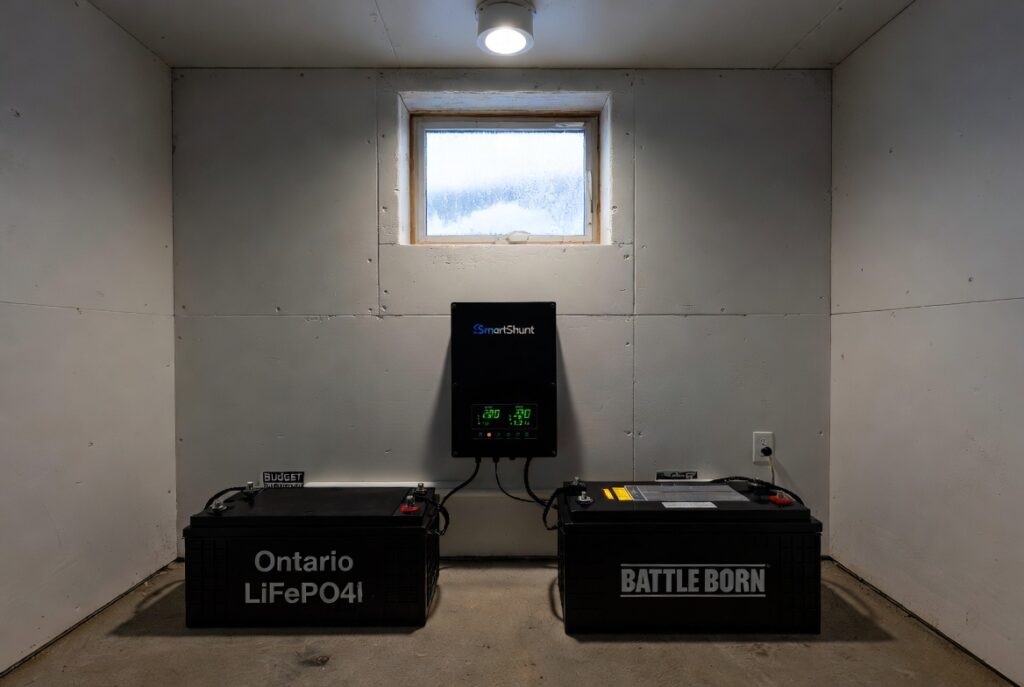
The lifepo4 battery ontario question that most property owners get wrong is whether the $280 price difference between a Chins 100Ah and a Battle Born 100Ah heated LFP represents a real specification difference or just brand premium, because a cottage owner in Northumberland County installed a Chins 100Ah to save that $280, confirmed via SmartShunt that the Chins delivered exactly the same 1,024Wh of usable capacity across two full Ontario summer seasons, and used the $280 saving to buy an additional Renogy 100W panel that increased his array output by 50 percent. The SmartShunt cannot distinguish between a Chins and a Battle Born by capacity alone in the first year of operation.
Both units deliver 100Ah at 12V nominal and provide approximately 1,024Wh of usable energy at 80 percent depth of discharge. Both units use lithium iron phosphate chemistry with a BMS that protects against overcharge, overdischarge, and short circuit.
The difference becomes visible in October. A year-round cabin owner in Haliburton County installed a Chins 100Ah as the power bank for a security camera system and discovered that every morning from October onward, the SmartShunt showed zero charging current from the 200W array from sunrise until approximately 9 to 10 AM. The unheated cabin dropped to -2 degrees C overnight, and the Chins BMS blocked all charging input until the cells warmed above 0 degrees C by ambient conduction. The solar array was producing and the SmartShunt confirmed the production, but none of it was entering the bank.
The lifepo4 battery ontario cold charging limitation applies to every standard LFP battery regardless of brand. The BMS charge block at 0 degrees C cell temperature is a protection mechanism, not a defect: charging a lithium cell below 0 degrees C causes lithium plating on the anode and permanently reduces capacity. The Battle Born heated LFP eliminates the October-to-April charge block by self-heating the cells to 5 degrees C before the BMS block can engage, drawing a small amount of energy from the bank itself to maintain the cells above the charging threshold. See our Ontario solar sizing guide before any lifepo4 battery ontario bank decision.
Chins vs Battle Born: the Ontario comparison table
| Feature | Chins 100Ah | Battle Born 100Ah heated LFP |
|---|---|---|
| Price (approx) | $320 to $380 | $750 to $800 |
| Usable capacity | 1,024Wh at 80% DoD | 1,024Wh at 80% DoD |
| Cycle life | 2,000 cycles | 3,000 cycles |
| Years at 1 cycle/day | 5.5 years | 8.2 years |
| Min charge temperature | 0 degrees C (BMS blocks below) | -20 degrees C (self-heater active) |
| Self-heater | None | Yes, activates at 2 degrees C |
| Warranty | 5-year limited | 10-year full |
Both units deliver the same 1,024Wh of usable energy at 80 percent DoD in year one in a heated application. The capacity difference between budget and premium lifepo4 battery ontario options is zero in the first year of operation in any heated space. The price difference is approximately $370 to $420. That premium buys 1,000 additional rated cycles, 5 extra warranty years, and the self-heating element that keeps the cells above 0 degrees C through an Ontario winter without any heated enclosure or external heat source.
The decision framework for any Ontario property owner is a single question: will the battery be stored in a space that drops below 0 degrees C at any point between October and April? If yes, the Battle Born heated LFP is the only correct lifepo4 battery ontario specification regardless of cost. If no, the Chins delivers identical capacity and performance at approximately half the price. See our Ontario solar storage guide for the full LFP bank specification and temperature chemistry detail.
The Northumberland County seasonal result: what Chins delivers in a heated cottage
A seasonal cottage owner in Northumberland County wanted to build a Tier 1 off-grid system for his May to September cottage. He compared the Chins 100Ah at approximately $350 against the Battle Born 100Ah heated LFP at approximately $780 and chose the Chins, saving approximately $430. The SmartShunt installed on the battery negative terminal confirmed 1,024Wh of usable capacity on the first full charge cycle in May 2023. His daily cottage load was approximately 190Wh (LED lights + water pump + phone charging), giving approximately 5.4 days of gray streak autonomy at the confirmed usable capacity.
Across two full summer seasons, the SmartShunt never showed a capacity anomaly. Zero BMS trips, zero cold charging issues, and no measurable difference from a premium bank during the May to September operating window. The cottage interior never dropped below 5 degrees C while the system was active, eliminating the only scenario where the Chins specification falls short of Battle Born. The $430 saving went toward an additional Renogy 100W panel, increasing his array from 200W to 300W and summer production by 50 percent.
The Northumberland result confirms the lifepo4 battery ontario seasonal decision framework. A May-to-September cottage owner who stores the battery in a heated garage or brings it indoors for winter will never encounter the cold charging limitation that separates Chins from Battle Born. For this owner, the Chins is not a compromise , it is the correct specification. The cycle life difference (5.5 years versus 8.2 years at daily cycling) is irrelevant for a seasonal system cycling 3 to 4 times per week for 5 months per year: at that rate, the Chins will last approximately 17 years before reaching 80 percent capacity. See our Ontario cabin solar guide for the full Tier 1 seasonal specification.
The lifepo4 battery ontario cold charging test: why October is the deciding month
The Haliburton County year-round cabin owner installed a Chins 100Ah as the dedicated power bank for a 4-camera security system in September 2022. The system performed correctly through September. On the first cold October morning when the unheated cabin dropped to -2 degrees C overnight, the SmartShunt showed zero charging current from the 200W array from sunrise to approximately 9:30 AM. The Chins BMS had blocked all charging input the moment the cell temperature reached 0 degrees C the previous evening and remained blocked until ambient conduction warmed the cells above 0 degrees C mid-morning. The 200W array was producing at full October output , approximately 180Wh per clear morning , and none of it was entering the bank.
The lost morning production totaled approximately 2 to 4 hours per cold day across October through April, representing approximately 300 to 600 hours of wasted panel production per year. Over a 3-year period, that is approximately 900 to 1,800 hours of production that the array generated and the bank could not accept. He switched to the Battle Born 100Ah heated LFP in fall 2023. The self-heater activates at 2 degrees C cell temperature, warming the cells to 5 degrees C before the BMS charge block threshold is reached, and draws energy from the bank itself to maintain this temperature during cold overnight periods.
The SmartShunt confirmed full morning charging current on the first October morning after the switch, even at -10 degrees C cabin ambient. The cameras maintained 100 percent SoC through the entire winter without any generator backup. His comment: “Two hours of free panels every morning, wasted for a whole winter. The $370 premium is recovered in under 2 seasons.” See our Ontario battery inverter guide for the full DC wiring specification for any lifepo4 battery ontario installation.
The lifepo4 battery ontario cycle life math: 5.5 years versus 8.2 years and who it matters to
Chins delivers approximately 2,000 rated cycles to 80 percent capacity. At one full discharge and recharge cycle per day, 2,000 cycles divided by 365 days equals approximately 5.5 years before the bank capacity drops to 820Wh usable. Battle Born delivers 3,000 rated cycles at the same threshold: 3,000 divided by 365 equals approximately 8.2 years. The difference of 2.7 years represents 1,095 additional full cycles. For a full-time off-grid property owner drawing the bank down to 80 percent DoD daily, those 1,095 cycles are real operating capacity that the Chins does not provide.
For a weekend-only cottage owner cycling the bank 3 times per week, the math changes substantially. Chins at 3 cycles per week: 2,000 divided by 156 equals approximately 12.8 years. Battle Born at the same rate: 3,000 divided by 156 equals approximately 19.2 years. Neither unit reaches its cycle limit within a realistic ownership period for a seasonal property. The MPPT 100/30 charge controller optimises each charge cycle for LFP chemistry regardless of which battery brand is installed, extending effective cycle life by avoiding overcharge. The correct lifepo4 battery ontario cycle life decision is: daily full-depth cycling favours Battle Born; seasonal or weekend use favours Chins on both cycle life and cost grounds.
NEC and CEC: Ontario permit requirements for LiFePO4 battery bank installations
NEC 690 and NEC 690.9 cover battery bank installations in off-grid Ontario solar systems. All DC conductors from the battery bank must be sized for 125 percent of maximum continuous current, and the Class T fuse must be installed within 18 inches of the battery positive terminal per NEC 690.9. These requirements apply equally to Chins and Battle Born installations , neither brand affects the wiring standard or the permit requirement. The conductor sizing and fuse placement standards are set by the inverter and system specifications, not the battery brand. Contact the NFPA at nfpa.org for current NEC 690 requirements.
CEC Section 64 governs all permanent Ontario electrical installations. A permanently wired LiFePO4 battery bank connected to an Ontario solar array requires an ESA permit before installation begins. The ESA inspector will verify conductor sizing, overcurrent device placement, and battery enclosure ventilation. The Battle Born heated LFP requires no special ventilation beyond standard LFP requirements , the internal heater element is a low-voltage DC circuit contained within the battery casing. Contact the Electrical Safety Authority Ontario at esasafe.com before beginning any permanently wired Ontario lifepo4 battery ontario bank installation.
Pro Tip: Before purchasing any lifepo4 battery ontario bank, determine the minimum ambient temperature the battery enclosure will reach between October and April. If the answer is below 0 degrees C at any point, the Battle Born heated LFP is the correct choice regardless of cost. If the answer is always above 0 degrees C (heated garage, climate-controlled utility room, brought indoors for winter), the Chins is the correct choice and the $370 to $420 saving is better spent on additional panel capacity. The SmartShunt will confirm the correct choice in both cases: it shows zero charging anomalies in a heated Chins installation and full morning charging current in a Battle Born heated installation at -10 degrees C ambient.
The lifepo4 battery ontario verdict: Chins for seasonal, Battle Born for year-round unheated
- Ontario seasonal cottage owner (May to September only, battery stored in heated space October to April): buy Chins. The SmartShunt confirms identical 1,024Wh usable in year one. Use the $370 to $430 saving to buy an additional Renogy 100W panel or a second Chins unit for a 200Ah bank. The Northumberland result: two full seasons, zero issues, battery performing identically to the Battle Born in a heated application. At 3 seasonal cycles per week, Chins lasts approximately 17 years before reaching 80 percent capacity , well beyond any realistic ownership horizon.
- Ontario year-round cabin owner or any application where the battery is stored in an unheated space October through April: buy Battle Born heated LFP. The Haliburton result confirms the cost of not doing this: 2 to 4 hours of lost morning production per cold day across 6 months equals approximately 300 to 600 hours of wasted panel production per year. The $370 to $420 premium is recovered in preserved production within 2 to 3 Ontario winters. The SmartShunt confirmed this with full morning charging current at -10 degrees C ambient on the first day after the switch.
- Ontario full-time off-grid property owner cycling the bank daily at 80 percent DoD: buy Battle Born. At one cycle per day, Chins reaches 80 percent capacity in 5.5 years and Battle Born in 8.2 years. The 2.7 extra years of full-capacity operation from Battle Born is worth the premium for any application drawing the bank down to full depth daily. At 80 percent of original capacity, the Chins bank delivers approximately 819Wh , sufficient for a lights-only cabin load but insufficient for a fridge load. The MPPT 100/30 confirms daily cycle depth via the SmartShunt charge log.
Frequently Asked Questions
Q: Is the Chins LiFePO4 battery suitable for Ontario off-grid use?
A: Yes, for seasonal applications where the battery is stored in a heated space between October and April. The SmartShunt confirms that the Chins 100Ah delivers the same 1,024Wh usable capacity as premium lifepo4 battery ontario brands in year one in a heated application. The Northumberland County result confirms this: two full summer seasons, zero BMS trips, zero cold charging issues, and identical SmartShunt readings to a premium bank. The Chins is not suitable for year-round Ontario applications where the battery is stored in an unheated space , the BMS charge block at 0 degrees C cell temperature will eliminate all morning solar production on cold days from October through April, as the Haliburton County result confirmed.
Q: Why does my LiFePO4 battery stop charging in Ontario winter mornings?
A: The BMS charge block at 0 degrees C cell temperature is a protection mechanism built into all standard LFP batteries including Chins. Charging a lithium cell below 0 degrees C forces lithium ions to plate on the graphite anode surface rather than intercalating into the graphite structure, permanently reducing cell capacity.
The BMS detects this temperature and blocks all charging current until the cells warm above 0 degrees C. In an unheated Ontario cabin at -2 degrees C overnight, this means zero solar charging from sunrise until mid-morning when ambient conduction warms the cells , typically 2 to 4 hours of lost production per cold day. The Battle Born heated LFP solves this by activating an internal heater element at 2 degrees C cell temperature, maintaining the cells above the charge block threshold regardless of ambient temperature.
Q: How long will a 100Ah LiFePO4 battery last in an Ontario off-grid system?
A: The service life depends on the cycling rate. At one full cycle per day, Chins 100Ah reaches 80 percent of original capacity in approximately 5.5 years and Battle Born in approximately 8.2 years. At 3 cycles per week (typical weekend cottage use), Chins lasts approximately 12.8 years and Battle Born approximately 19.2 years. For seasonal cottage use at 3 to 4 cycles per week from May to September only, the Chins will reach approximately 17 years before the 80 percent threshold , well beyond any realistic cottage ownership period. For full-time daily cycling, the lifepo4 battery ontario choice shifts in favour of Battle Born for the additional 2.7 years of full-capacity operation.
This build is engineered within the 48V DC Safety Ceiling. Diagnostic logic is based on 20+ years of technical service experience. All structural and electrical installations must be verified by a Licensed Professional and comply with your Local AHJ. See our legal and safety disclosure for full scope.
About the Author
Robert Bertrand spent 20 years as a service advisor in the automotive industry (Lexus and Nissan), where precision diagnostics, wiring integrity, and documentation standards were non-negotiable. He brings that same technical discipline to GridFree Guide, where he researches, tests, and documents off-grid solar systems for Ontario conditions. Based in Rockwood, Ontario, every article is built on verified specifications, manufacturer data, and the real-world climate constraints of Canadian off-grid living.
As an Amazon Associate I earn from qualifying purchases. This site also contains affiliate links to other products and services. GridFree Guide earns a small commission at no extra cost to you.