
The solar storage ontario location that costs Ontario property owners the most is a standard unheated garage in November, because a property owner in Rockwood, Wellington County stored his RV with a 100Ah standard LFP bank in an unheated detached garage from November through April and discovered in May that the bank would not accept a single amp from the solar panels , not because the panels had failed or the charge controller had failed, but because the cells had spent five months at -20 degrees C and the BMS had blocked all charging current for the duration.
The standard LFP BMS activates charge block protection at 0 degrees C cell temperature to prevent lithium plating damage. At -20 degrees C, the cells are 20 degrees below the threshold and the block is absolute. His Victron MPPT 100/30 had been presenting full voltage at the battery terminals on every clear winter day.
He brought the batteries inside the house for 24 hours to warm the cells above 0 degrees C by ambient conduction. The next morning, the Victron SmartShunt confirmed the BMS had unlocked and the bank accepted a full charge cycle without any cell damage. The storage had not harmed the cells , the -20 degrees C temperature had simply made them unavailable for charging throughout the entire Ontario winter. He specified Battle Born heated LFP for the following season. The internal self-heating element activates at 2 degrees C cell temperature, raises cells to 5 degrees C, and then opens the BMS to charging current regardless of ambient temperature down to -20 degrees C.
The solar storage ontario temperature requirement is the most important specification decision for any Ontario system stored in an unheated space. LFP chemistry requires a cell temperature between 0 degrees C and 40 degrees C for charging to proceed. Below 0 degrees C, charging is blocked by the BMS. Above 40 degrees C, charging accelerates cell degradation. In Ontario, the unheated garage violation is far more common than the overheating violation , the province reliably delivers temperatures well below the 0 degrees C threshold from November through March. See our Ontario solar sizing guide before any solar storage ontario location decision.
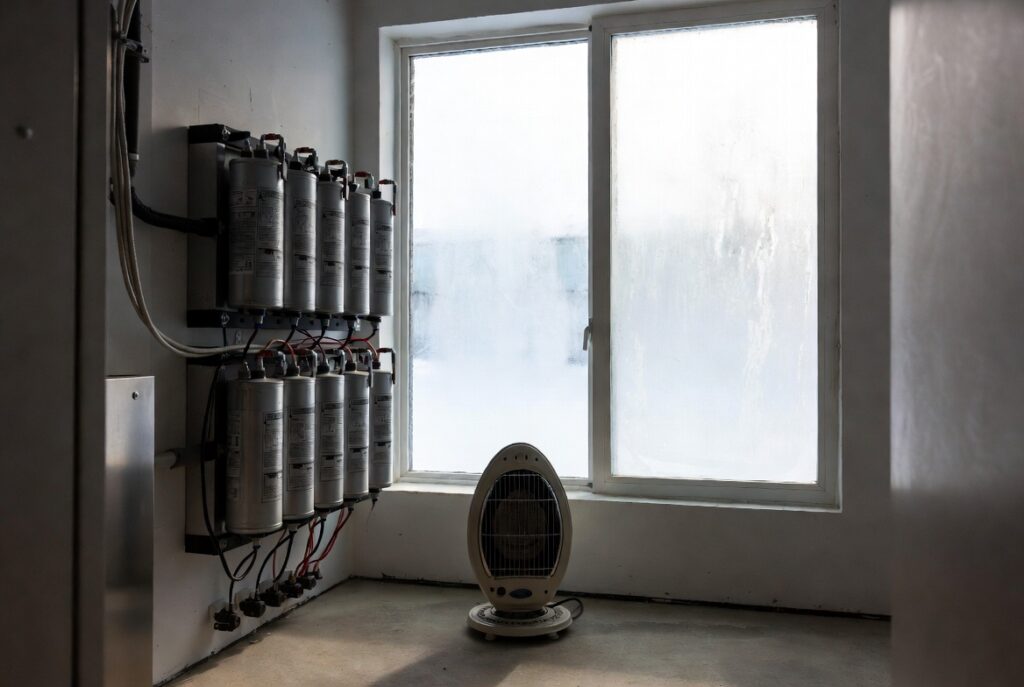
[Feature image: Ontario utility room with battery bank on wall, visible frost on exterior window, small ceramic heater on floor, no brand logos readable, photorealistic, 16:9]
Alt text: solar storage Ontario
The solar storage ontario temperature rule: 0 degrees C is the charging floor for any LFP bank in Ontario
| Storage location | Winter temp range | LFP charging? | Solution | Ontario verdict |
|---|---|---|---|---|
| Unheated detached garage | -15 to -25°C | No , BMS blocks at 0°C | Heated LFP or ceramic heater at 5°C | Only works with one of the two fixes |
| Heated utility room (10°C min) | 8-12°C | Yes , always above 0°C | No change needed | Correct solar storage Ontario standard |
| Insulated crawlspace | 0-5°C | Marginal , depends on insulation | Add ceramic heater on thermostat | Verify with thermometer before committing |
| RV exterior compartment | -15 to -25°C | No , same as unheated garage | Heated LFP mandatory | Rockwood result: 5 months of blocked charging |
LFP batteries must maintain a cell temperature between 0 and 45 degrees C to accept charging current. In Ontario, an unheated garage regularly reaches -15 to -25 degrees C from November through March, well below the charging threshold. The BMS charge block at 0 degrees C is not a warning level: it is a hard cutoff that protects cells from irreversible lithium plating damage.
Two solutions exist for Ontario property owners with unheated storage spaces. The first is to specify Battle Born heated LFP, which self-heats at 2 degrees C and accepts full charging current down to -20 degrees C ambient. The second is to install a 500W ceramic cube heater on a thermostat set to 5 degrees C in the battery room. Either solution ensures the bank is available for charging every morning of every Ontario winter.
A property owner in Guelph specified the correct solar storage ontario setup from day one of her fall 2024 Tier 2 build. The battery room is a small utility room adjacent to the main house interior, maintained at a minimum of 10 degrees C year-round by the house heating system supplemented by a 500W ceramic cube heater on a thermostat. The system uses a 200Ah 48V Battle Born heated LFP bank, Victron MultiPlus-II, MPPT 100/30, and SmartShunt.
Over two full Ontario winters, the SmartShunt confirmed the bank cycled normally through every month without a single BMS charge block event or low-temperature protection trigger. The MPPT 100/30 delivered charging current on every clear January day without interruption because the cell temperature never dropped below 10 degrees C. Her comment: “The ceramic heater runs for maybe 30 minutes a day in January. The bank has never once refused a charge.” See our solar battery heater Ontario guide for the complete Battle Born heated LFP specification and winter charging protocol.
The ventilation requirement: what LFP actually needs and what it does not need
LFP batteries do not produce hydrogen gas during normal charge and discharge cycles , this distinguishes them from lead-acid batteries and makes them safe for indoor storage without dedicated outdoor ventilation. The correct solar storage ontario location is a standard ventilated room with normal air exchange: a utility room, mechanical room, or insulated garage bay with a louvered interior door. A completely sealed airtight enclosure is not appropriate because any thermal event , extremely rare under a correctly fused system , can produce gases that need a path to escape. Standard room ventilation provides adequate protection against this scenario.
The practical Ontario ventilation standard for an LFP battery bank is the same standard as any other electrical equipment room: normal air exchange, no combustibles stored in immediate proximity, and accessible for periodic inspection. No HVAC ducting, no exhaust fan, and no outdoor vent pipe is required for an LFP bank under normal operating conditions. The utility room adjacent to the Guelph house interior is the correct solar storage ontario model , enclosed enough to hold heat from the ceramic cube heater, ventilated enough through normal air exchange around the doorframe, and accessible for monthly SmartShunt checks. See our off-grid setup guide for the complete utility room layout and component placement.
The solar storage ontario permit requirement: why a battery bank is a permanent electrical installation
Any permanent battery bank installation in Ontario is a permanent electrical installation requiring an ESA permit. The permit scope covers the battery bank wiring, DC disconnect switch, charge controller connections, inverter AC output wiring, and any generator input connections. The permit application must be submitted and approved before any permanent wiring begins. A licensed electrician must complete the installation and schedule the ESA inspection. A portable power station or plug-in suitcase-style solar system does not require an ESA permit , the permit requirement is triggered by permanent wiring to the building’s electrical system.
The Guelph property owner submitted an ESA permit covering the full Tier 2 build before any wiring began. The permit scope included the heated utility room wiring, the ceramic cube heater circuit, the battery bank DC wiring, and all MultiPlus-II AC connections. The ESA inspector confirmed the installation before the system was commissioned. This is the correct solar storage ontario approach , the permit is not a bureaucratic obstacle but confirmation that the wiring is sized correctly for the bank’s maximum discharge current and that the overcurrent protection will operate as designed if a fault occurs. See our solar battery monitor Ontario guide for the SmartShunt spring recommissioning protocol.
The SmartShunt storage protocol: monitoring self-discharge and confirming spring re-commissioning
LFP batteries self-discharge at approximately 2 to 3 percent per month at room temperature. A 100Ah bank stored at 50 percent SoC (50Ah stored) loses approximately 1 to 1.5Ah per month through self-discharge. After 5 months of winter storage, the bank should show approximately 43 to 47Ah remaining , still well above the 10 to 20Ah minimum safe level. The SmartShunt confirms this on spring recommissioning: check the SoC reading when reconnecting and compare it to the stored SoC. If the reading has dropped more than 15 to 20Ah from the stored level after 5 months, investigate for a parasitic load or cell anomaly before charging.
The correct solar storage ontario practice for any system taken offline for extended storage is 50 to 60 percent SoC before disconnection. Storing at 100 percent SoC causes minor long-term capacity loss from continuous cell voltage stress. Storing at 0 percent SoC risks deep discharge damage if self-discharge continues unchecked for multiple months. Set the bank to 50 to 60 percent SoC, disconnect the main DC breaker, leave the SmartShunt connected to track self-discharge through the storage period, and reconnect in spring with confidence in the data. See our winter solar Ontario guide for the full Ontario seasonal context.
NEC and CEC: Ontario permit requirements for battery bank installations
NEC 690 and NEC 70 (NFPA 70, the National Electrical Code) govern battery bank installations in Ontario. The battery bank must be installed with conductors sized for 125 percent of maximum continuous discharge current, a Class T fuse on the battery positive terminal sized for 125 percent of maximum discharge current, and an accessible DC disconnect switch between the battery bank and the rest of the system. All indoor battery bank wiring must meet the conductor insulation temperature rating for the installation environment , in a heated utility room at 10 degrees C minimum, standard 90-degree C rated THWN or RW90 conductors are appropriate. Contact the NFPA at nfpa.org for current NEC 690 requirements for Ontario battery bank installations.
CEC Section 64 governs Ontario electrical installations. The complete solar storage ontario battery bank installation , wiring, fusing, disconnect switch, charge controller connections, and inverter integration , requires an ESA permit at $300 to $400 before installation begins. An unpermitted permanent battery bank installation voids the property’s electrical insurance coverage for any fault in that installation. A licensed electrician must complete the installation and schedule the ESA inspection. Contact the Electrical Safety Authority Ontario at esasafe.com before beginning any permanent solar storage ontario installation.
Pro Tip: If you are taking your solar storage ontario system fully offline for the winter , not using it for RV, backup, or any load , charge the bank to 50 to 60 percent SoC before disconnecting. This is the electrochemically stable storage point for LFP: low enough to reduce cell voltage stress versus 100 percent SoC storage, high enough to survive 5 months of 2 to 3 percent monthly self-discharge without approaching the 0 percent deep discharge risk. The Rockwood property owner now stores his bank at 55 percent SoC each November, disconnects the main breaker, and checks the SmartShunt reading each March before spring recommissioning. His May SoC on reconnection has been within 8Ah of the stored level both years since switching to heated LFP and the 55 percent storage protocol.
The solar storage ontario verdict: heated room or heated battery, ESA permit, SmartShunt from day one
- Ontario property owner storing a battery bank in an unheated garage or exterior compartment: switch to Battle Born heated LFP or install a 500W ceramic cube heater on a thermostat set to 5 degrees C before next October. The Rockwood result confirms what happens without either solution: five months of blocked charging, a depleted bank on recommissioning, and a 24-hour warming period before the system is functional again. Store at 50 to 60 percent SoC, disconnect the main breaker, leave the SmartShunt connected to track self-discharge, and check the SoC reading on spring recommissioning. If the reading has dropped more than 15Ah from the stored level, investigate before charging.
- Ontario property owner building a new Tier 2 system: specify the battery room location as part of the system design before any components are ordered. The correct solar storage ontario room is maintained above 5 degrees C year-round by house heat supplemented by a 500W ceramic cube heater on a thermostat. Apply for the ESA permit before installation begins , the permit scope covers all battery bank wiring, DC disconnect, MPPT 100/30 connections, and MultiPlus-II AC integration. The Guelph result: two winters, zero BMS events, SmartShunt confirms normal cycling throughout, “the bank has never once refused a charge.”
- Ontario property owner who has already installed a battery bank without an ESA permit: apply for an after-the-fact permit amendment through the ESA before the system is used further. An unpermitted permanent battery bank installation voids the property’s electrical insurance coverage for any fault in that installation. The ESA permit process is straightforward for a correctly installed system , the inspection confirms the wiring is correct and the permit is issued. Contact esasafe.com to initiate the process. If the wiring does not meet code on inspection, correct it before the system is commissioned , this is the purpose the permit serves, not a penalty.
Frequently Asked Questions
Q: Can I store LFP solar batteries in an unheated Ontario garage in winter?
A: Not safely for charging purposes. An unheated Ontario garage regularly reaches -15 to -25 degrees C from November through March , well below the 0 degrees C cell temperature threshold at which the LFP BMS activates charge block protection. The Rockwood property owner confirmed this the hard way: five months of blocked charging, zero amps accepted despite functioning panels and MPPT, and a 24-hour indoor warming period required before the bank would accept any charge in May. The two correct solar storage ontario solutions for unheated spaces are a Battle Born heated LFP bank that self-heats at 2 degrees C, or a 500W ceramic cube heater on a thermostat set to 5 degrees C in the storage room.
Q: Do LFP batteries need ventilation in an Ontario home?
A: LFP batteries do not produce hydrogen gas during normal charge and discharge cycles and do not require dedicated outdoor ventilation or exhaust ducting. The correct solar storage ontario ventilation standard is a standard ventilated room with normal air exchange , a utility room, mechanical room, or insulated garage bay with a louvered interior door is adequate. A completely sealed airtight enclosure is not recommended because any thermal event, while extremely rare under a correctly fused system, can produce gases that need a path to escape. No HVAC, no exhaust fan, and no outdoor vent pipe is required for an LFP bank under normal operating conditions.
Q: What is the correct SoC for storing an LFP battery bank over winter in Ontario?
A: Store at 50 to 60 percent SoC for any extended offline period. This is the electrochemically stable storage point for LFP chemistry: low enough to reduce cell voltage stress versus 100 percent SoC long-term storage, high enough to survive 5 months of 2 to 3 percent monthly self-discharge without approaching the 0 percent deep discharge risk. For a 100Ah bank stored at 55 percent SoC (55Ah stored), the self-discharge of approximately 1.5Ah per month leaves approximately 47.5Ah remaining after 5 months , well within safe range. Leave the SmartShunt connected during storage to track the self-discharge rate and confirm the bank’s condition on spring recommissioning.
This build is engineered within the 48V DC Safety Ceiling. Diagnostic logic is based on 20+ years of technical service experience. All structural and electrical installations must be verified by a Licensed Professional and comply with your Local AHJ. See our legal and safety disclosure for full scope.
About the Author
Robert Bertrand spent 20 years as a service advisor in the automotive industry (Lexus and Nissan), where precision diagnostics, wiring integrity, and documentation standards were non-negotiable. He brings that same technical discipline to GridFree Guide, where he researches, tests, and documents off-grid solar systems for Ontario conditions. Based in Rockwood, Ontario, every article is built on verified specifications, manufacturer data, and the real-world climate constraints of Canadian off-grid living.
As an Amazon Associate I earn from qualifying purchases. This site also contains affiliate links to other products and services. GridFree Guide earns a small commission at no extra cost to you.