
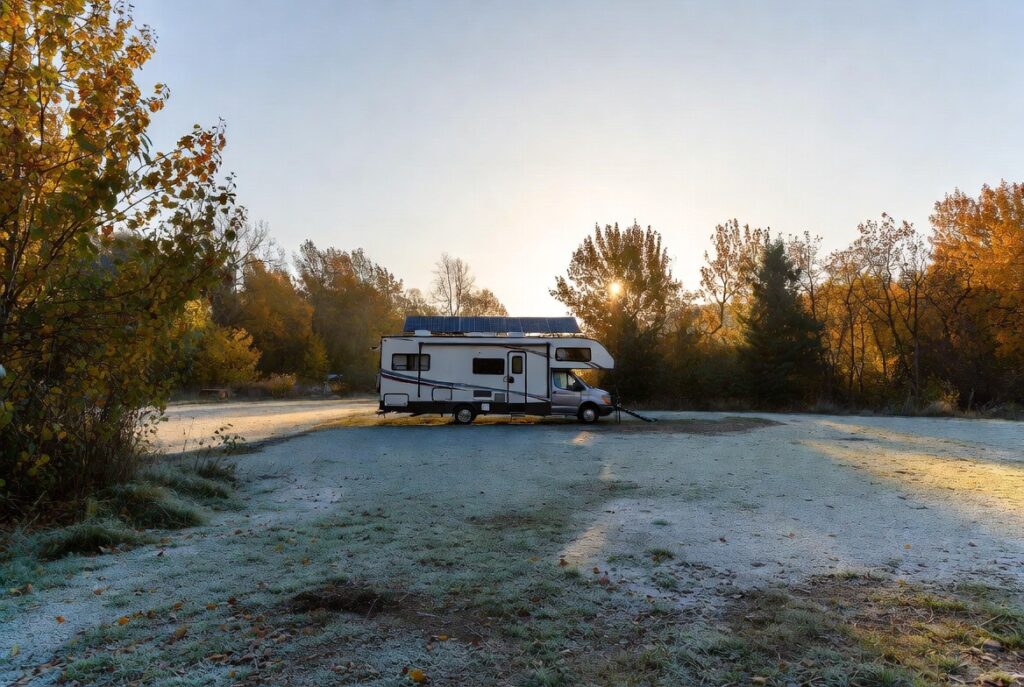
The rv solar ontario system that fails every October morning is not the system with the wrong panels or the wrong controller, but the system with a standard LFP battery in an unheated exterior compartment, because a camper at Elora Gorge Conservation Area in Wellington County ran a 200W array on a late-October weekend and his Victron SmartShunt recorded zero amps entering the 100Ah LFP bank, confirming that the battery’s BMS had blocked all charging current after the exterior compartment dropped to -3 degrees C overnight.
The panels were not faulty. The MPPT 100/30 was operating normally, presenting 14.6V at the battery terminals with available current. The BMS had activated the low-temperature protection circuit at 0 degrees C cell temperature and would not permit any charging current regardless of available panel voltage. His panels had produced power he could not use.
He drove home that Sunday with a 38 percent SoC bank that should have been at 90 percent after a morning of clear October sun. The panels had produced approximately 480Wh over 5 hours. None of it entered the battery. The next weekend he returned to the same site with a Battle Born heated LFP installed in the same exterior compartment. The internal self-heating element activated at 2 degrees C cell temperature, raised the cells to 5 degrees C, and the SmartShunt confirmed 31A of charging current flowing into the bank by 9 AM.
The RV solar Ontario heated LFP requirement is not a luxury upgrade. It is the minimum specification for any Ontario RV system used between October and April. Standard LFP is correct for year-round indoor residential battery banks where the ambient temperature never drops below 5 degrees C. In an unheated RV exterior compartment, a standard LFP bank is a functional summer system and a non-functional autumn system. See our Ontario solar sizing guide before any RV solar Ontario bank specification.
The Ontario Tier 1 RV solar spec: 200W, MPPT 100/30, and SmartShunt
| Component | Spec | Ontario reason |
|---|---|---|
| Array | 200W (2x Renogy 100W mono) | Permanent roof mount, vibration-resistant, monocrystalline for fall diffuse light |
| Charge controller | Victron MPPT 100/30 | Tracks low October and January sun angle , extracts 20% more than PWM in diffuse light |
| Battery | Battle Born 100Ah heated LFP (12V) | Self-heats at 2°C , mandatory for October through April in unheated compartments |
| Monitor | Victron SmartShunt | Time-to-empty tells you if the bank will last the trip before you need a generator |
| Array cable | 10 AWG solar cable | Correct for 200W 12V array run to charge controller |
The rv solar ontario Tier 1 spec is the standard for reliable year-round RV camping in Ontario. It includes a 200W monocrystalline array on a permanent roof mount using two Renogy 100W panels, a Victron MPPT 100/30 for maximum extraction from fall and winter low-angle Ontario sun, and a Battle Born 100Ah heated LFP at 12V providing 1,280Wh usable capacity at 80 percent DoD and thermal protection down to -20 degrees C ambient. The Victron SmartShunt provides Coulomb counting and time-to-empty management. A 10 AWG solar cable connects the array to the controller.
The 12V architecture matches most RV lights, fans, and 12V appliances and is correct for the standard Tier 1 rv solar ontario build. For systems planning to run an induction cooktop or microwave through an inverter, 24V is the better architecture. A 12V inverter running 1,000W draws approximately 83A, requiring very heavy cable throughout the RV body. A 24V system running the same load draws approximately 42A, using smaller and lighter cable. For the complete wire gauge selection framework, see our solar wire gauge Ontario guide.
The rv solar ontario heated LFP requirement: why October ends the standard LFP season
The rv solar ontario heated LFP requirement is absolute for any system used between October and April. A standard LFP battery in an unheated RV exterior compartment drops to ambient overnight temperature when the RV is stationary and the compartment has no heat source. The BMS activates the charge protection circuit at 0 degrees C cell temperature to prevent lithium plating damage. The next morning, the MPPT 100/30 presents full voltage and available current at the battery terminals, but the BMS rejects every amp of it. The panels produce. The controller runs. The battery accepts nothing.
The Battle Born heated LFP solves the charge block with an internal self-heating element that activates at approximately 2 degrees C cell temperature, drawing a small amount of energy from the battery itself to raise cells to 5 degrees C before opening to charging current. At -20 degrees C ambient in a Wellington County November overnight, the heated LFP accepts full charging current while a standard LFP bank in the same compartment remains completely unavailable. See our solar battery heater Ontario guide for the complete Battle Born heated LFP specification.
A camper in Halton Hills, Halton Region specified the correct rv solar ontario system from day one of her fall 2024 build: Battle Born 100Ah heated LFP, MPPT 100/30, SmartShunt, and 200W array. On a 4-day October rainy trip, the SmartShunt tracked approximately 15 to 20Ah net daily deficit.
Overcast days produced only 40 to 80Wh from the 200W array against an overnight consumption of approximately 510Wh. The bank ended at approximately 20 percent SoC on day 4. No generator was needed because the bank was sized for the full trip before the panels were specified. Her comment: “I sized for the trip, not the sunny day. Four days of rain and I still made it home without a generator.”
The January reality check: what a 200W array actually produces on a clear Ontario winter day
The January rv solar ontario reality is the clearest argument for bank-first sizing. A 200W array at 1.5 Ontario January PSH produces approximately 255Wh on the clearest possible January day. One overnight of RV operation consumes approximately 510Wh: LED lights (100Wh), water pump (30Wh), furnace fan (320Wh), and device charging (60Wh). The 200W array covers approximately 50 percent of one overnight’s consumption on the best possible January day. On an overcast January day with 10 percent irradiance, the array produces approximately 25 to 50Wh and covers approximately 5 to 10 percent of overnight consumption. The battery bank carries the load from November through February.
The correct rv solar ontario sizing for multi-day winter trips is: calculate the daily load, multiply by trip duration, confirm the bank provides that usable capacity plus a 20 percent reserve. For a 510Wh daily load on a 4-day Ontario winter trip: 510 times 4 equals 2,040Wh required. At 1,280Wh usable from a 100Ah 12V Battle Born bank, a 4-day trip at full daily load depletes the bank completely. A 200Ah bank at 2,560Wh usable covers the 4-day load with approximately 25 percent reserve. See our winter solar Ontario guide for the full Ontario January 1.5 PSH context.
The rv solar ontario bank sizing rule: design for the trip duration, not the sunny day
The rv solar ontario bank sizing rule is to design for the trip duration with zero solar input and verify the solar contribution as a bonus. The Halton Hills 4-day October result confirms this approach: 15 to 20Ah net daily deficit, SmartShunt confirmed the bank progressed from 100 percent to 20 percent SoC over 4 days , consistent with an 18Ah average daily deficit from an 80Ah usable bank. The solar contribution from 4 days of October overcast added approximately 40 to 80Wh per day, slowing the depletion but not reversing it. The bank was sized for the full trip before any panels were specified, which is why no generator run was needed.
The SmartShunt time-to-empty display is the rv solar ontario fuel gauge that makes this bank-first approach practical. At any point during the trip, check the time-to-empty reading and confirm whether the bank will last the remaining trip days. If the reading shows less than 18 hours at current net deficit on day 3 of a 4-day trip, plug into shore power at the campsite or run the generator for a 90-minute bulk charge before the bank reaches the BMS low-voltage cutoff. See our solar battery monitor Ontario guide for the complete SmartShunt time-to-empty management protocol.
NEC and CEC: Ontario permit requirements for permanent RV solar installations
NEC 690 and NEC 70 (NFPA 70, the National Electrical Code) govern permanently installed solar systems on recreational vehicles in Ontario. A permanently wired rv solar ontario system , panels mounted to the roof, cables routed through the RV body, charge controller and battery bank permanently installed , is a permanent electrical installation that must comply with NEC 690 conductor sizing, fusing, and disconnecting requirements. Array wiring must be rated for outdoor UV exposure and sized for 125 percent of the maximum continuous current at the array’s short-circuit current.
Portable suitcase-style solar systems that connect through existing charge ports are not subject to NEC 690 permanent installation requirements. Contact the NFPA at nfpa.org for current NEC 690 requirements for RV solar installations.
CEC Section 64 governs Ontario electrical installations. A permanent rv solar ontario installation requires an ESA permit at $300 to $400 before installation begins. A licensed electrician must complete the installation and schedule the ESA inspection. Portable systems connecting through existing RV charge ports do not require an ESA permit but are less efficient and less reliable than permanent roof-mount systems with dedicated wiring. Contact the Electrical Safety Authority Ontario at esasafe.com before beginning any permanent rv solar ontario installation.
Pro Tip: For Ontario RVers who want the simplest possible 12V versus 24V decision: if your largest planned load through an inverter is under 500W (a small blender, phone charger, CPAP machine), 12V is correct and the 10 AWG cable from the Tier 1 spec handles the array run comfortably. If your largest planned load through an inverter is over 500W (induction cooktop, electric kettle, microwave), 24V is the correct architecture from day one. The cable savings on a 24V system running a 1,000W inverter are significant , 83A at 12V requires 2 AWG cable or larger throughout, while 42A at 24V runs comfortably on 8 AWG. Make this architecture decision before purchasing any components, because changing from 12V to 24V after the battery bank is installed means replacing the entire bank.
The rv solar ontario verdict: heated LFP is mandatory, sized bank is non-negotiable
- Ontario RV owner who camps from May through September only: a standard 100Ah LFP bank and 200W array is the correct Tier 1 specification. The heated LFP premium is not required for a summer-only camping season where ambient temperatures stay above 0 degrees C overnight. Specify the MPPT 100/30, SmartShunt, and two Renogy 100W panels for the complete summer-season Tier 1 build. Use the SmartShunt time-to-empty display to manage bank depletion on cloudy summer days and multi-day trips with minimal solar input.
- Ontario RV owner who camps from May through November or uses their RV in winter storage with a live rv solar ontario system: Battle Born heated LFP is mandatory. Standard LFP loses all charging capability as soon as the exterior compartment drops to 0 degrees C. The Battle Born heated LFP self-heats at 2 degrees C and accepts full charging current down to -20 degrees C ambient. The Elora Gorge result confirms the difference: zero amps with standard LFP, 31A charging with heated LFP on the same overnight at -3 degrees C. One weekend with a dead bank is enough to justify the heated LFP upgrade permanently.
- Ontario RV owner planning multi-day winter trips: size the bank for the full trip duration with zero solar contribution, then treat the solar as a bonus that slows bank depletion. A 4-day winter trip consuming 510Wh per day requires at least 2,040Wh of usable bank capacity , approximately 200Ah at 12V with Battle Born heated LFP. Install the SmartShunt from commissioning and check the time-to-empty reading at sunset each day of the trip. When the reading shows less than 24 hours of remaining autonomy, plug into shore power or run the generator before the bank reaches the BMS low-voltage cutoff. The Halton Hills 4-day October result: sized correctly, no generator, 20 percent SoC remaining on day 4.
Frequently Asked Questions
Q: Do I need a heated LFP battery for Ontario RV camping?
A: Yes, if you plan to camp between October and April or store your RV with a live solar system through winter. Standard LFP batteries block all charging current when cell temperature drops to 0 degrees C , a condition that occurs regularly in unheated Ontario RV exterior compartments from October through April. The Battle Born heated LFP is the correct rv solar ontario specification for this use case.
Its internal self-heating element activates at 2 degrees C cell temperature, draws a small amount of energy from the battery itself to reach 5 degrees C, and then opens to full charging current regardless of ambient temperature down to -20 degrees C. The Elora Gorge result confirms what happens without it: 480Wh of panel production, zero amps accepted by the battery, drove home at 38 percent SoC from what should have been a full bank.
Q: How much solar power does a 200W RV array produce in Ontario in January?
A: A 200W array produces approximately 255Wh on the clearest possible January day at Ontario’s 1.5 peak sun hours (200W times 1.5 PSH times 0.85 system efficiency). One overnight of standard RV operation , LED lights, water pump, furnace fan, and device charging , consumes approximately 510Wh. The January solar array covers approximately 50 percent of one overnight’s consumption on the best day of the month. On overcast January days, the same array produces 25 to 50Wh , approximately 5 to 10 percent of overnight consumption. For Ontario winter rv solar ontario camping, always size the battery bank for the full trip duration with zero solar input and treat the array output as a bonus that slows bank depletion.
Q: What is the correct battery bank size for a 4-day Ontario RV trip?
A: For a standard Ontario RV overnight load of approximately 510Wh per day, a 4-day trip requires 2,040Wh of usable bank capacity. A 100Ah 12V Battle Born heated LFP bank provides 1,280Wh usable at 80 percent DoD , enough for approximately 2.5 overnights at full load. For a 4-day trip, a 200Ah bank at 2,560Wh usable is the correct specification, providing approximately 25 percent reserve at the end of day 4. Use the SmartShunt time-to-empty display throughout the trip to confirm the bank is tracking the expected depletion rate. If the time-to-empty reading at sunset on day 2 shows less than 48 hours of remaining autonomy, plug in or plan a generator run before day 3.
This build is engineered within the 48V DC Safety Ceiling. Diagnostic logic is based on 20+ years of technical service experience. All structural and electrical installations must be verified by a Licensed Professional and comply with your Local AHJ. See our legal and safety disclosure for full scope.
About the Author
Robert Bertrand spent 20 years as a service advisor in the automotive industry (Lexus and Nissan), where precision diagnostics, wiring integrity, and documentation standards were non-negotiable. He brings that same technical discipline to GridFree Guide, where he researches, tests, and documents off-grid solar systems for Ontario conditions. Based in Rockwood, Ontario, every article is built on verified specifications, manufacturer data, and the real-world climate constraints of Canadian off-grid living.
As an Amazon Associate I earn from qualifying purchases. This site also contains affiliate links to other products and services. GridFree Guide earns a small commission at no extra cost to you.