
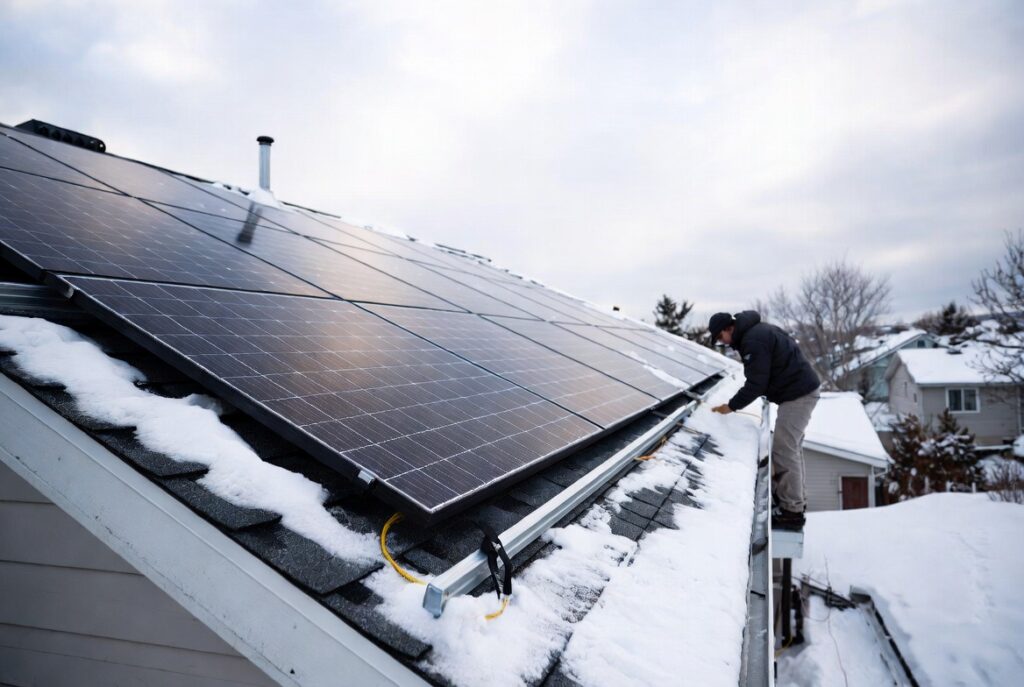
The most common Ontario solar wire gauge mistake is sizing the array wiring to the summer STC specification, because a property owner in Orangeville, Dufferin County sized his string run with standard 10 AWG solar cable based on his panel’s 22.5V STC Voc rating and discovered in January that the same panels were pushing 24.3V Voc at -10 degrees C ambient, an 8 percent cold boost that pushed his 10 AWG array run to its thermal limit on every clear January morning while his Victron MPPT 100/30 struggled to harvest the full array output.
He had sized the system correctly by every summer metric. His 400W array used two 200W panels in series, producing 45V at STC at full sun. The 10 AWG cable he ran from the array to the MPPT had adequate margin for the summer string voltage. The problem appeared on the first clear January morning at -8 degrees C.
The MPPT 100/30 showed lower input voltage than the panels should have been producing at that temperature. His Victron SmartShunt confirmed lower-than-expected charging current for the clear-sky conditions. The 10 AWG cable between the array and the controller was warm to the touch on a morning when all the energy should have been flowing into the battery bank. The cold Voc boost had pushed the string current through a resistance the wire was not sized to handle efficiently, and the difference between what the panels were producing and what the batteries were receiving was being converted to heat in the wire.
I recalculated his cold Voc correctly: 22.5V STC Voc multiplied by 1.08 for -10 degrees C equals 24.3V per panel, making the two-panel series string 48.6V Voc in January rather than the 45V STC value he had used for sizing. I recommended replacing the 10 AWG array run with 8 AWG, sized to the cold Voc calculation rather than the STC rating. After the rewire, the MPPT input voltage matched the cold Voc prediction and the SmartShunt confirmed a measurable recovery in winter daily energy harvest on the first clear January day after installation. See our Ontario solar sizing guide before making any solar wire gauge decision for an Ontario system.
The solar wire gauge cold Voc rule: why January produces more voltage than July and why that changes your AWG decision
| System power | System voltage | Continuous amps | Minimum AWG | Cable cost (10-ft run) |
|---|---|---|---|---|
| 2,000W | 12V | 167A | 4/0 AWG | $80-$120 |
| 2,000W | 24V | 83.5A | 1/0 AWG | $50-$70 |
| 2,000W | 48V | 42A | 2 AWG | $20-$30 |
| 400W array run (STC) | 45V string | ~8.9A | 10 AWG | Marginal for Ontario cold Voc |
| 400W array run (cold Voc -10°C) | 48.6V string | ~8.9A | 8 AWG | Correct Ontario standard |
Solar panels are semiconductors, and the open-circuit voltage of a semiconductor junction increases as temperature decreases. A panel with a 22.5V STC Voc does not produce 22.5V on a clear Ontario January morning. It produces approximately 24.3V at -10 degrees C (22.5 times 1.08) and approximately 25.2V at -20 degrees C (22.5 times 1.12). For a two-panel series string, those individual voltages produce 48.6V and 50.4V respectively in January conditions. If you sized your solar wire gauge for the 45V STC string voltage, your wire is undersized for the coldest and brightest days of the Ontario year, which are also the days when the most current is flowing through it.
The 10 AWG cable is the most common array wiring choice for Ontario Tier 1 and Tier 2 systems, rated at approximately 30 to 35A for chassis wiring.
Under Ontario cold Voc conditions, the increased voltage at the same current produces more power than the summer STC calculation accounts for, and the wire must handle that additional stress on every clear January morning. The correct solar wire gauge for an Ontario 400W array run is 8 AWG, sized to the cold Voc calculation at -10 degrees C with no more than 2 percent voltage drop over the full run length. For arrays larger than 400W or runs longer than 20 feet, recalculate for 6 AWG. See our solar panel wiring guide for the complete array wiring standard.
The cold Voc calculation: multiplying STC Voc by 1.08 at -10 degrees C and 1.12 at -20 degrees C
The cold Voc calculation for Ontario has three steps. First, find the STC Voc on your panel specification sheet , this is the open-circuit voltage listed at 25 degrees C, 1,000 W per square metre, and air mass 1.5.
Second, multiply by 1.08 for the design voltage at -10 degrees C, which is the Ontario January cold standard for Wellington County, Dufferin County, and most of southern Ontario. Multiply by 1.12 for -20 degrees C, which applies to gray-sky conditions in the coldest weeks or to northern Ontario builds. Third, size your solar wire gauge to achieve no more than 2 percent voltage drop across the full run length at the cold Voc design voltage. Never size solar wire gauge to the STC number for a permanent Ontario installation.
The 2 percent voltage drop target for Ontario DC solar runs means that a 48V cold Voc array producing 48.6V through a 20-foot run should lose no more than approximately 0.97V in the wire. At a typical 400W array cold Voc current of approximately 8 to 9A, a 20-foot run of 8 AWG produces approximately 0.48V of drop, which is well within the 2 percent target.
The same run in 10 AWG produces approximately 0.77V of drop, which is still within 2 percent but with less margin for additional resistance at the terminal connections. The Victron MPPT 100/30 displays input voltage in real time and is sensitive enough to reveal the difference between a correctly and incorrectly sized array run on the first clear cold morning after commissioning. See our solar fuse sizing guide for fuse sizing that must also account for the cold Voc current.
The solar wire gauge 48V advantage: how system voltage drops amperage by 75 percent and lets you run 2 AWG instead of 4/0
At 12V, a 2,000W load draws approximately 167A continuously from the battery bank to the inverter. This current requires 4/0 AWG cable rated at approximately 230A continuous, at a cost of $8 to $12 per foot. On a typical 10-foot battery-to-inverter run, that is $80 to $120 in cable alone, plus the weight and handling difficulty of 4/0 AWG, which is approximately the diameter of a thumb. At 48V, the same 2,000W load draws only approximately 42A, requiring 2 AWG cable rated at approximately 95A, at $2 to $3 per foot.
On the same 10-foot run, that is $20 to $30 in cable. The resistive loss in the wire (I squared times R) drops by 75 percent because the amperage dropped by 75 percent while the wire resistance stayed the same.
A property owner in Guelph, Wellington County specified the Battle Born heated LFP and sized every solar wire gauge decision from the January cold Voc calculation for his fall 2023 Tier 2 build.
His 48V battery-to-inverter run used 2 AWG cable at $2.50 per foot. The 12V equivalent requires 4/0 AWG at $10 per foot, making the 10-foot run $25 versus $100.
On the first clear January morning at -12 degrees C, the MPPT 100/30 input voltage matched the cold Voc prediction exactly. The Victron SmartShunt confirmed zero measurable voltage drop at commissioning. His system has operated through three Ontario winters without a single wire fault, overheated terminal, or measurable voltage drop event. His comment: “I spent $75 less on cable and got a more efficient system. The cold Voc calculation took 10 minutes.” See our solar inverter ontario guide for the MultiPlus-II specification that pairs with the 48V wiring standard.
The voltage drop diagnostic: what warm cables and low MPPT input voltage are telling you
Two field diagnostics confirm solar wire gauge problems after installation. The first is the MPPT input voltage check on a clear cold morning. Compare the MPPT’s displayed input voltage against the calculated cold Voc for the ambient temperature. If the MPPT shows significantly less than the calculated cold Voc, resistive losses in the array run are absorbing the difference. A correctly sized solar wire gauge produces an MPPT input voltage within approximately 1 to 2 percent of the calculated cold Voc. The SmartShunt confirms the downstream effect: lower-than-expected charging current on a clear cold day, when current should be at its seasonal peak, is the definitive signature of array wiring losses converting solar energy to heat.
The second diagnostic is the warm wire test. On a high-production clear day, carefully touch the main battery cables at the battery terminals and at the inverter input. A cable at or near ambient temperature is correctly sized and carrying its rated current within acceptable resistive loss parameters. A cable that feels warm to the touch is dissipating solar energy as heat. Heat in the cable is power that never reached the battery bank.
The warm wire test is a commissioning check, not a substitute for calculating voltage drop before installation. Correct the problem at the lug as well as the wire: a WBHome Crimper producing gas-tight compression lugs eliminates the terminal resistance that generates as much heat as undersized wire and corrodes in Wellington County humidity over the first winter. See our off-grid wiring guide for the complete Ontario DC wiring standard.
NEC and CEC: Ontario permit requirements for permanent solar wiring installations
NEC 690 governs photovoltaic system wiring in Ontario, including array wiring, all DC runs from the array to the charge controller, and battery bank interconnections. Solar wire gauge must be rated for the maximum system voltage including the cold Voc boost calculated at the minimum design temperature, must be sized for 125 percent of the maximum continuous current, and must be installed with appropriate weatherproofing and conduit protection for any outdoor or exposed run. The NEC 310.15 ampacity tables are the reference for conductor sizing. Use the 75 degrees C column for most off-grid solar wire gauge decisions, and apply the derating factor for conduit fill when multiple conductors share a conduit run.
Contact the NFPA at nfpa.org for current NEC 690 and NEC 310 requirements for solar wiring installations in Ontario.
CEC Section 64 governs electrical installations in Ontario. Any permanent solar wiring installation, including the array run, the charge controller connections, the battery bank wiring, and the inverter input, requires an ESA permit at $300 to $400 before installation begins. The ESA inspector will verify that all solar wire gauge choices meet the calculated cold Voc maximum voltage, the 125 percent continuous current rule, and the 2 percent voltage drop target on all DC runs. A licensed electrician must complete the installation and schedule the ESA inspection.
Operating a permanent solar installation without an ESA permit invalidates the property insurance coverage for the electrical system. Contact the Electrical Safety Authority Ontario at esasafe.com before beginning any permanent solar wiring installation in Ontario.
Pro Tip: On the first clear morning after commissioning , especially in cold weather , check the MPPT input voltage reading and compare it to your cold Voc calculation (STC Voc times 1.08 at -10 degrees C). If the MPPT shows the predicted cold Voc, your solar wire gauge is correct. If it shows significantly less, your array run has more resistance than the calculation allowed for, and the difference is being converted to heat in the wire. The Orangeville property owner spent two Ontario winters losing measurable winter harvest before the warm cable and low MPPT input voltage told him where the energy was going. The cold Voc calculation and an 8 AWG upgrade resolved it in one afternoon.
The solar wire gauge verdict: size for the January cold Voc, not the summer STC, and never accept more than 2 percent drop
- Ontario property owner who sized array wiring to the STC Voc and suspects cold-weather losses: check the MPPT input voltage on the first clear cold morning versus the cold Voc calculation. Multiply your panel STC Voc by 1.08 for -10 degrees C to get the January design voltage. If the MPPT shows significantly less than that number, upgrade the array run to the next gauge size. For most Ontario Tier 2 systems with 400W arrays, upgrading from 10 AWG solar cable to 8 AWG resolves the cold Voc mismatch. Confirm the fix with the Victron SmartShunt , charging current on the first clear cold day after the rewire should measurably improve against the same ambient conditions before the upgrade.
- Ontario property owner specifying a new Tier 2 system from scratch: size every solar wire gauge decision from the January cold Voc calculation, not the summer STC number. Multiply STC Voc by 1.08 for the design voltage. Size all runs for no more than 2 percent voltage drop at the cold Voc design voltage over the full run length. Specify the 48V system architecture to reduce battery-to-inverter cable from 4/0 AWG to 2 AWG and capture the 75 percent reduction in resistive losses. Use a WBHome Crimper on all lug connections to eliminate terminal resistance. Confirm the complete system with the Victron MPPT 100/30 input voltage reading on the first clear cold day after commissioning. The Guelph result: $75 saved on cable, zero measurable voltage drop at commissioning, three winters without a wire fault.
- Ontario property owner evaluating whether to upgrade from 12V to 48V for a new system or expansion: calculate the battery-to-inverter cable cost for both voltages on your specific run length before deciding. At 12V, a 2,000W load requires 4/0 AWG at $8 to $12 per foot. At 48V, the same load requires 2 AWG at $2 to $3 per foot. On a 10-foot run that is $80 to $120 versus $20 to $30, a $60 to $90 saving on that run alone. The 48V system also reduces inverter input current from 167A to 42A. This reduces heat in every component in the DC distribution path, extends service life across the system, and makes every future solar wire gauge decision simpler and less expensive.
Frequently Asked Questions
Q: What solar wire gauge do I need for an Ontario off-grid system?
A: For most Ontario Tier 2 systems with a 400W array, 8 AWG is the correct solar wire gauge for the array run, sized to the January cold Voc (STC Voc times 1.08 at -10 degrees C) with no more than 2 percent voltage drop over the full run length.
For the battery-to-inverter run on a 48V system carrying a 2,000W load, 2 AWG is the correct gauge. For the equivalent run on a 12V system, 4/0 AWG is required. The 48V system reduces the battery-to-inverter cable requirement by 75 percent in ampacity and approximately 60 to 75 percent in cost compared to 12V. Always calculate the specific run length and cold Voc design voltage before committing to a gauge , the correct answer depends on both.
Q: Why do solar panels produce higher voltage in winter than in summer?
A: Solar panels are semiconductor devices, and the open-circuit voltage of a semiconductor junction increases as temperature decreases.
As the panel cools below the 25 degrees C STC laboratory temperature, the internal junction resistance decreases and more voltage develops across the terminals. A panel rated at 22.5V Voc at STC (25 degrees C) produces approximately 24.3V Voc at -10 degrees C, an 8 percent increase. This cold Voc boost is why Ontario solar wire gauge sizing must use the January cold temperature as the design condition, not the summer STC temperature. The total daily energy output is still higher in summer due to longer days and more peak sun hours, but the peak voltage that your wiring must safely carry occurs on clear January mornings.
Q: What is an acceptable voltage drop for a DC solar system in Ontario?
A: The target voltage drop for DC runs in an Ontario off-grid solar system is 2 percent maximum, which is also the Victron recommended maximum and the NEC standard for DC solar circuits. Never accept more than 3 percent. On a 48V system with a 48.6V cold Voc array, 2 percent drop equals approximately 0.97V lost in the run. On a 12V system with a 24.3V cold Voc array run, 2 percent equals approximately 0.49V. Exceeding the 2 percent target causes measurable charging losses on every clear day, generates heat in the wire that shortens insulation life.
It is often the hidden cause of underperforming Ontario systems that otherwise check out correctly on a basic visual inspection.
This build is engineered within the 48V DC Safety Ceiling. Diagnostic logic is based on 20+ years of technical service experience. All structural and electrical installations must be verified by a Licensed Professional and comply with your Local AHJ. See our legal and safety disclosure for full scope.
About the Author
Robert Bertrand spent 20 years as a service advisor in the automotive industry (Lexus and Nissan), where precision diagnostics, wiring integrity, and documentation standards were non-negotiable. He brings that same technical discipline to GridFree Guide, where he researches, tests, and documents off-grid solar systems for Ontario conditions. Based in Rockwood, Ontario, every article is built on verified specifications, manufacturer data, and the real-world climate constraints of Canadian off-grid living.
As an Amazon Associate I earn from qualifying purchases. This site also contains affiliate links to other products and services. GridFree Guide earns a small commission at no extra cost to you.