
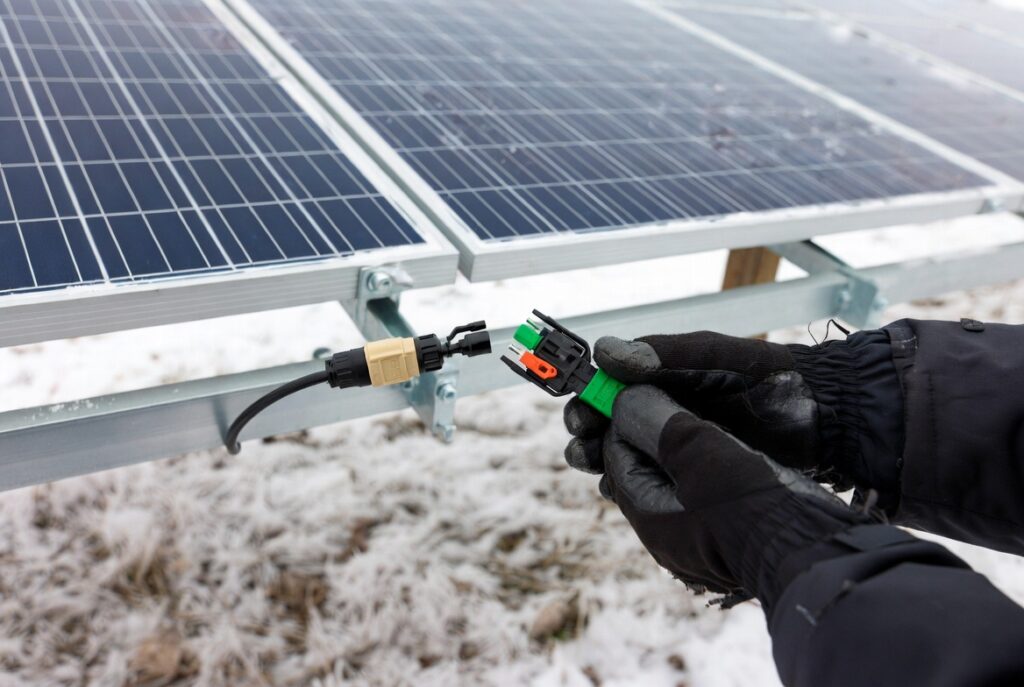
The mc4 connector Ontario mistake that causes the most silent output loss in Ontario off-grid arrays is treating MC4 connectors as universal plugs, because a property owner in Simcoe County extended their Renogy 100W panel factory cables with generic extension cables and their Victron SmartShunt showed one full string at zero output after the first October frost. The result was confirmed when they disassembled the mixed-brand joint and found standing water and green copper corrosion inside a connection that had appeared to click correctly during the summer installation. The MC4 connector was developed by Multi-Contact (now Stäubli) and multiple manufacturers now produce MC4-compatible connectors, but “compatible” means the pin fits , it does not mean the sealing geometry matches.
The IP67 rating defines an MC4 connector as suitable for Ontario outdoor installation: sealed against temporary immersion in up to 1 meter of water. An mc4 connector Ontario joint that does not achieve IP67 admits moisture during the first rain event, heavy frost, or snowmelt, and every subsequent Ontario freeze-thaw cycle expands that moisture and opens the seal further. The Simcoe County connector showed standing water inside after a single October frost-and-thaw cycle that followed a dry summer of apparently normal operation. The internal rubber gland that creates the IP67 seal is unique to each manufacturer’s housing , a Stäubli male paired with a generic female leaves the rubber glands misaligned at the seal radius.
The mc4 connector Ontario standard has four rules that together ensure every field-assembled joint achieves and maintains IP67 for 25 years of Ontario outdoor service: match brands on both sides of every connection, torque the locking collar to 2.5 to 4 Nm with a calibrated torque screwdriver, open the connector only with a dedicated MC4 disconnect tool, and size the branch connector for 125 percent of the combined string current. Every deviation from these four rules is a moisture entry point. See our Ontario solar sizing guide before any mc4 connector ontario specification.
The mc4 connector ontario brand match rule: why IP67 requires same-manufacturer pairs
| Connection type | IP67 achieved? | Ontario freeze-thaw result | ESA inspection |
|---|---|---|---|
| Same brand, ratchet crimped, torqued to 3 Nm | Yes | No degradation | Pass |
| Mixed brands (e.g. Renogy + generic) | No , seal geometry mismatch | Moisture ingress by first winter | Fail |
| Same brand, hand-tightened collar | No , gland not compressed | Capillary moisture ingress | Fail |
| Same brand, forced open with pliers | Void , locking tab damaged | Housing cannot re-seat | Fail |
The brand-mixing risk in a crimp solar Ontario array applies only to field-assembled connections , the factory-installed MC4 connectors on Renogy panels are correctly assembled to specification. The risk occurs when generic extension cables, branch connectors, or replacement connectors are mated with the factory connectors. Pre-assembled Renogy panel cables use Amphenol-based MC4 connectors. A generic cable from an unspecified supplier may use a different manufacturer’s housing geometry , the pins mate but the rubber glands do not align at the seal radius, leaving a gap that admits moisture at the first freeze-thaw event.
The brand-match rule applies to every mc4 connector Ontario connection in the array: panel-to-extension, extension-to-branch, and branch-to-combiner. A single mixed-brand connection in a 400W Ontario array voids IP67 at that joint and will produce a SmartShunt anomaly within 1 to 2 winters. The SmartShunt diagnostic: a gradual output decline on one string while the other is normal indicates a seal failure on the degraded string. Locate the specific joint by tracing the degraded string from the panel to the combiner. See our crimp solar Ontario guide for the complete MC4 pin ratchet-crimp protocol that must be completed before any connector is assembled.
After the Simcoe County discovery, the property owner replaced all generic extension cable connectors with Renogy-certified matched connectors, re-crimped all pins with the WBHome ratchet crimper, and re-torqued all locking collars to 3 Nm. The SmartShunt confirmed full string output was restored on the same day. The dry summer had obscured the seal failure because no condensation or frost had reached the joint , the first October frost-and-thaw was enough to force moisture past the misaligned rubber glands and flood the pin barrel.
The mc4 connector ontario torque specification: 2.5 to 4 Nm is not optional
A property owner in Huron County on the Bruce Peninsula built a new Tier 2 system in fall 2022 with all MC4 connections correctly ratchet-crimped. He hand-tightened every locking collar during commissioning because he had no torque screwdriver available on installation day. Hand-tight typically reaches approximately 0.5 to 1 Nm , well below the IEC 62852 minimum of 2.5 Nm. Without the correct torque, the rubber gland inside the housing does not compress fully against the wire insulation and the IP67 seal does not engage.
His SmartShunt showed an 8 percent output decline from the commissioning baseline by month 12 and 15 percent by month 18 , the same gradual pattern as the Grey Bruce crimp article result. The ratchet crimps were confirmed correct on pull-test. The locking collars were then tested: each collar rotated with finger pressure, confirming the gland had never been compressed. A $20 torque screwdriver set to 3 Nm was applied to every locking collar in the array. The SmartShunt confirmed full output was restored within 24 hours. His comment: “The seal never engaged on commissioning day. I’ve been running an unsealed array for 18 months.”
The mc4 connector Ontario torque specification applies at every assembly event: initial installation, after any repair, and after any re-connection following a service event. A collar that has been re-torqued after a disconnect should be confirmed with a gentle pull on the connector housing to verify the locking tab re-engaged. If the housing pulls open without applying the disconnect tool, the tab did not re-seat , back off the collar, re-seat the pin with the audible click, and re-torque. See our solar wire gauge Ontario guide for the PV cable gauge that determines the correct jaw profile for the ratchet crimp that precedes every connector assembly.
The disconnect tool rule: why pliers damage the locking tab permanently
The MC4 disconnect tool is not optional , it is the only correct way to open an MC4 connector without damaging the locking tab. Forcing a connector open with pliers or a flat-blade screwdriver collapses the locking tab, the small plastic ridge that retains the connector pin in the housing slot. A collapsed tab cannot re-engage the housing groove on the next connection. The connector appears to seat, held by friction rather than the locking mechanism, and will pull apart under cable weight or Ontario wind loading. The cost of a dedicated MC4 disconnect tool is approximately $8 to $15 and it lasts 25 years. The cost of a damaged connector pair is approximately $2 to $5 per failure event.
The disconnect tool works by inserting into the connector locking groove from the outside and lifting the tab clear of the retention ridge, allowing the connector to slide apart without deforming the tab geometry. If the tab is already damaged from a previous forced opening, the entire connector housing must be replaced , the pin can be re-used if the crimp and pin metal are undamaged, but the housing cannot be restored. The disconnect tool stores beside the WBHome ratchet crimper in the array maintenance kit and is used every time any mc4 connector Ontario connection is opened for inspection or repair. See our off-grid setup guide for the full Ontario array maintenance schedule.
The branch connector current rule: size for 125 percent of combined string current
The MC4 branch connector combines two panel strings into a single array output. Each Renogy 100W panel delivers an Isc of approximately 5.99A. Two panels per string produce approximately 11.98A per string. A branch connector combining two strings carries approximately 23.96A at full Ontario summer output. NEC 690 requires branch connectors to be rated for 125 percent of maximum continuous current: 23.96A times 1.25 equals approximately 30A minimum rating. The MC4 Branch at 30A is the correct component for any standard Tier 1 or Tier 2 Ontario 2-string array.
The most common mc4 connector Ontario branch failure is an unrated or underrated branch connector from an unknown supplier. These connectors look identical to rated components but carry no IEC 62852 certification and may be rated at 20A or less. At 24A full-output current on a hot July afternoon with the connector housing at 60 degrees C, an underrated branch connector overheats, the insulation softens, and the two live conductors can arc. Ontario summer conditions are the worst-case scenario for any underrated mc4 connector Ontario component. Specify only rated, branded branch connectors from a verifiable manufacturer.
NEC and CEC: Ontario permit requirements for MC4 connector installations
NEC 690 and NEC 690.33 govern MC4 connector use in Ontario solar installations. All MC4 connectors must be listed for the application, rated for the operating voltage and current, and used with matching listed connectors from the same manufacturer to maintain their listed rating. NEC 690.33 requires that connectors used in PV systems be polarized and non-interchangeable by design , mixing brands violates the listing because the seal geometry is no longer as tested and approved. All field-assembled MC4 connections must be ratchet-crimped using listed crimp methods before connector assembly. Contact the NFPA at nfpa.org for current NEC 690 and NEC 690.33 requirements.
CEC Section 64 governs Ontario electrical installations. Any permanently wired Ontario solar array with field-assembled MC4 connections requires an ESA permit. The ESA inspector will verify that all MC4 connectors are brand-matched, correctly rated for the circuit current, and installed with listed ratchet-crimp connections. Mixed-brand connections and under torqued locking collars will be flagged at inspection. The inspector may request the torque specification from the connector manufacturer and the calibration certificate for the torque screwdriver used. Contact the Electrical Safety Authority Ontario at esasafe.com before beginning any Ontario solar array with field-assembled mc4 connector Ontario connections.
Pro Tip: After assembling every mc4 connector Ontario connection, apply the Ontario weather test before commissioning: fill a bucket with water, submerge each assembled connector for 30 seconds, and visually inspect for air bubbles escaping from the seal radius. Air bubbles indicate the IP67 seal has not engaged , the rubber gland is not compressed, the collar may be under torqued, or the brands are mismatched. This test costs 5 minutes per array and identifies every seal failure before the first Ontario frost does. The Simcoe County property owner now does this on every connection before the extension cables are routed to the roof. No air bubbles, no moisture ingress, no SmartShunt anomalies after 2 Ontario winters.
The mc4 connector ontario verdict: brand match, torque spec, correct tools, rated branch
- Ontario property owner who has used mixed-brand MC4 connectors anywhere in their array: use the SmartShunt to identify which string is showing output anomalies, then locate and disassemble every mixed-brand joint on that string. Inspect for moisture and green corrosion inside the pin barrel. Replace the non-matching connector half with a brand-matched connector of the same manufacturer as the other half, re-crimp with the WBHome ratchet crimper, re-torque the locking collar to 3 Nm, and apply the water bucket test before returning the connection to service. The Simcoe County result: full string output restored on the same day after replacement with matched Renogy-certified connectors.
- Ontario property owner who hand-tightened MC4 locking collars during installation: obtain a $20 torque screwdriver and set it to 3 Nm, then apply it to every locking collar in the array on the next dry day. If a collar was already at hand-tight, it will reach 3 Nm with approximately a half-turn of additional torque. If any collar turns freely past 3 Nm, the rubber gland may be damaged and that connector should be replaced. Do not wait for SmartShunt degradation to identify under torqued collars , re-torque proactively before the first Ontario winter. The Huron County result: 18 months of output loss reversed by re-torquing to 3 Nm on a single afternoon.
- Ontario property owner building a new array: apply all four mc4 connector ontario rules at every connection before routing cables to the roof. Match brands throughout , if the panel factory connectors are Amphenol-based, use Renogy-certified or confirmed Amphenol-compatible extension cables. Use a torque screwdriver at 3 Nm on every locking collar. Open any connector only with the MC4 disconnect tool. Use only 30A-rated MC4 branch connectors. Apply the water bucket test to every field-assembled connection before commissioning. In Ontario, the weather will find any gap you leave in the seal , the four-rule protocol ensures there are none.
Frequently Asked Questions
Q: Can I mix MC4 connector brands in an Ontario solar array?
A: No. Mixing brands voids the IP67 waterproof rating at that joint because the internal rubber gland geometry differs by manufacturer. A Stäubli or Renogy-certified male connector mated with a generic female may click physically, but the seal radius is misaligned and the IP67 rating does not hold. The Simcoe County result confirms what happens: standing water and green copper corrosion inside a mixed-brand joint after the first October frost-and-thaw cycle, with one full string at zero output on the SmartShunt. The correct mc4 connector Ontario approach is to match brands throughout the array , panel factory connectors, extension cables, and branch connectors must all use the same underlying connector manufacturer on both sides of every joint.
Q: How tight should MC4 connector locking collars be?
A: Torque the locking collar to 2.5 to 4 Nm using a calibrated torque screwdriver set to 3 Nm. Hand-tight reaches only approximately 0.5 to 1 Nm , less than half the minimum required to compress the rubber gland and engage the IP67 seal. The Huron County result confirms the consequence of hand-tightening: 8 percent output loss by month 12 and 15 percent by month 18 from an array whose crimps were correctly executed but whose locking collars had never compressed the seal. A $20 torque screwdriver is the correct tool. Apply it to every mc4 connector Ontario locking collar at installation, after any repair, and after any re-connection following a service event.
Q: What happens if I open an MC4 connector with pliers instead of a disconnect tool?
A: The locking tab collapses. Pliers deform the small plastic ridge that retains the connector pin in the housing slot. A collapsed tab cannot re-engage the housing groove , the connector appears to seat on the next connection but is held only by friction, not the locking mechanism. Under cable weight or Ontario wind loading, a friction-only connection can pull apart. The entire connector housing must be replaced. The crimped pin can be re-used if undamaged, but the housing cannot be restored.
The correct mc4 connector Ontario tool is a dedicated MC4 disconnect tool at approximately $8 to $15. It inserts into the locking groove from the outside, lifts the tab without deforming it, and allows the connector to slide apart cleanly every time.
This build is engineered within the 48V DC Safety Ceiling. Diagnostic logic is based on 20+ years of technical service experience. All structural and electrical installations must be verified by a Licensed Professional and comply with your Local AHJ. See our legal and safety disclosure for full scope.
About the Author
Robert Bertrand spent 20 years as a service advisor in the automotive industry (Lexus and Nissan), where precision diagnostics, wiring integrity, and documentation standards were non-negotiable. He brings that same technical discipline to GridFree Guide, where he researches, tests, and documents off-grid solar systems for Ontario conditions. Based in Rockwood, Ontario, every article is built on verified specifications, manufacturer data, and the real-world climate constraints of Canadian off-grid living.
As an Amazon Associate I earn from qualifying purchases. This site also contains affiliate links to other products and services. GridFree Guide earns a small commission at no extra cost to you.