
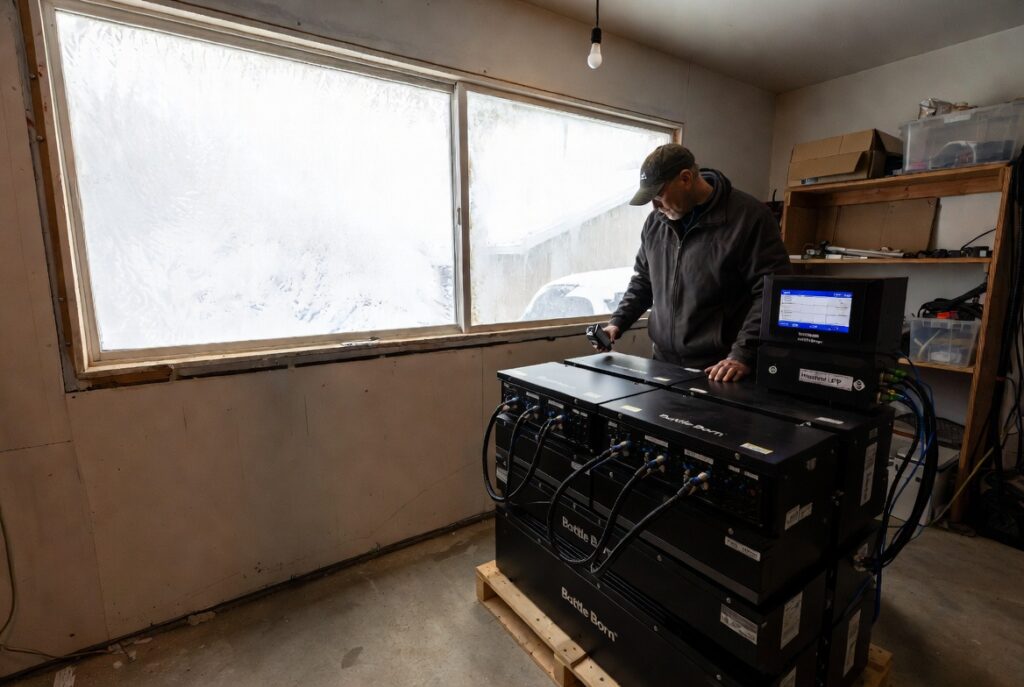
The most common Ontario solar battery heater failure is not a failed heater at all but the complete absence of one, because a property owner near Elora in Centre Wellington installed a standard 200Ah LFP bank in his unheated detached garage in October 2023 and watched his Victron SmartShunt display 0.0A of charging current for 11 consecutive clear January days while his MPPT 100/30 produced the correct 28.4V at the array and his 400W panels were clean and fully operational.
The solar system was working perfectly. The fault was in the battery bank, where the cell temperature had dropped to -8 degrees C and the BMS had blocked all incoming charging current to prevent lithium plating damage. His SmartShunt showed 71 percent SoC from the last full charge in late October, approximately 1,365Wh still available for loads.
He ran the system on stored capacity for 11 days, watching the SoC fall from 71 percent to 38 percent while the sun shone on his panels and the MPPT sat in bulk mode with nowhere to send the power. The bank could still power his loads because discharging is permitted at low temperature. But every watt out was a watt he could not replace until spring. This is the standard LFP winter failure mode in Ontario: not a sudden shutdown but a slow, one-way drain through the coldest months.
The fix was replacing the standard bank with two Battle Born heated LFP units wired in series for a 24V, 200Ah configuration. On the first clear morning after installation, at -12 degrees C ambient in the garage, the internal heater activated, raised the cell temperature to 6 degrees C, and the SmartShunt confirmed 18.3A of charging current flowing into the bank. The solar battery heater problem had a direct hardware solution that cost $200 more than the standard battery pair and paid for itself before February ended. See our Ontario solar sizing guide before specifying any solar battery heater for an Ontario system.
The solar battery heater problem: why standard LFP blocks all charging at 0°C
| Battery type | Charge threshold | Ontario unheated garage | Winter solar charging | Ontario verdict |
|---|---|---|---|---|
| Standard LFP (B06XX197GJ) | 0°C cell temp | -15 to -25°C Nov-Mar | Blocked 4-5 months/year | Summer system only in unheated space. |
| Battle Born heated LFP (B092RKVC1D) | Self-heats at 2°C | -15 to -25°C (irrelevant) | Charges at -20°C ambient | Year-round Ontario standard. |
| Standard LFP + external pad | 0°C cell temp | Pad draws 20-30W from bank | 4,200Wh drained in 7 days | Worse than no heater at all. |
| Standard LFP in conditioned space | 0°C cell temp | Above 10°C year-round | Never blocked | Correct. Heated LFP premium not needed. |
Charging LFP cells below freezing causes lithium plating on the anode, permanently reducing capacity and risking internal short circuits over repeated cycles. The BMS is doing exactly its job by blocking all incoming charging current when cell temperature drops to approximately 0 degrees C. This protects the cells from permanent damage. However, in a Wellington County unheated garage that drops to -15 to -25 degrees C from November through March, the BMS activates on the first cold night of the season and stays active until spring. The result is zero solar charging for 4 to 5 months per year, during the period when Ontario ice storms and power grid failures are most likely to occur.
The critical distinction is that the BMS blocks charging only, not discharging. A standard LFP bank in an Ontario unheated garage in January can still power loads down to approximately -20 degrees C at reduced capacity. The Elora owner still had 71 percent SoC and functional power. He simply could not replenish any of it from solar until temperatures rose. A system that can run loads but cannot recharge is not a reliable off-grid system for an Ontario winter. It is a slow countdown to a dead bank. See our LFP winter charging guide for the complete physics of lithium cold-charging behaviour.
The SmartShunt diagnostic: zero charging amps is the BMS block signature, not a panel fault
When a property owner sees 0.0A on the SmartShunt despite full sun on the panels and correct MPPT voltage, the first suspect is not the panels, not the charge controller, and not the wiring. It is the BMS charge block. The Victron SmartShunt measures current, voltage, and state of charge in real time. It does not measure cell temperature. Zero amps of charging current with a functioning solar system is the definitive BMS charge block signature. A disconnected battery and a BMS-blocked battery look identical from the charge controller side. The SmartShunt current reading is the first and fastest diagnostic available before any other troubleshooting begins.
The diagnostic procedure is straightforward. Check the SmartShunt current column first on any clear January day when the system is underperforming. If charging current reads 0.0A while the MPPT shows correct voltage, check the battery bank location and ambient temperature before touching any other component. The Elora result confirmed this process: 11 consecutive clear days, 28.4V at the MPPT array, and 0.0A into the bank. Every other component was functioning correctly. The SmartShunt eliminated every false diagnosis immediately and pointed directly to the BMS charge block as the sole cause. Had the property owner replaced his MPPT or inspected his panels based on that output, he would have spent hundreds of dollars solving the wrong problem.
The solar battery heater solution: how the Battle Born heated LFP self-heats and charges at -20°C ambient
The Battle Born heated LFP 100Ah contains an internal self-heating element that activates automatically at approximately 2 degrees C cell temperature. The element draws from the battery itself and raises cell temperature to 5 to 7 degrees C. At that point, the BMS opens to charging current and the solar array begins filling the bank. The ambient temperature of the room is irrelevant to the charging decision. At -20 degrees C ambient in an unheated Wellington County garage, the heated LFP self-heats, charges, and performs as a complete year-round solar battery heater solution. The cell never reaches the 0 degrees C charge inhibit threshold because the internal heater runs before it gets there.
A property owner near Kortright Road in Guelph, Wellington County, specified the Battle Born heated LFP from day one in his fall 2024 Tier 2 build. Two units wired in series (24V, 200Ah) through a Victron MPPT 100/30. His equipment room was an uninsulated utility space attached to an unheated garage, not the heated house interior. During the December 2024 cold snap at -18 degrees C ambient, the SmartShunt captured a small internal draw as the heating cycle activated, followed immediately by 15.8A of charging current on the first clear morning. Zero blocked days. Zero 0.0A charging events all winter. The bank never dropped below 55 percent SoC through any gray streak.
His comment after the first full Ontario winter: “I just watched the shunt numbers and everything worked. I didn’t do anything.” The Battle Born heated LFP is a drop-in replacement for the standard 100Ah unit, with an identical footprint and wiring configuration. The premium over the standard Battle Born 100Ah LFP is approximately $100 to $120 per unit, or $200 to $240 for a 200Ah 24V system. For any Ontario system where the bank will be in an unheated space, this premium is recovered on the first winter where a standard bank would have blocked charging for 4 to 5 months. See our solar battery ontario guide for the full Ontario heated LFP specification sequence.
The external heating pad trap: why 25W of draw accelerates the discharge it was meant to fix
An external 12V heating pad wrapped around a standard LFP battery draws approximately 20 to 30W when active and sources that power from the battery bank it is trying to warm. In an Ontario unheated space in January, where the BMS is blocking all solar charging input, this creates a one-way drain. At 25W continuous draw over 7 days: 25W times 24 hours times 7 days equals 4,200Wh consumed from the bank. A 200Ah 24V system has approximately 3,840Wh of usable capacity at 80 percent DoD. The external heating pad will drain the bank completely in under 7 days while receiving zero solar input. This is not a minor inefficiency. It is a system-ending failure mode in Ontario winter conditions.
External pads are appropriate only in marginally cold environments where the ambient temperature drops to 0 to -5 degrees C and the pad runs at low duty cycle to maintain temperature near the charge threshold.
In a Wellington County or Halton Hills unheated garage that drops to -20 degrees C, the pad runs continuously, drains the bank faster than any Ontario gray streak would, and leaves the property owner with a completely dead battery bank and no path to recovery until the garage warms in spring. The correct solar battery heater for Ontario unheated spaces is the Battle Born heated LFP, whose internal BMS-controlled heating circuit activates with precision and draws only what is needed to bring the cells above the 0 degrees C charge threshold. See our cold weather solar charging guide for the complete Ontario winter battery protocol.
Battery bank location: three Ontario installation rankings for solar battery heater performance
Battery bank location determines how much work the solar battery heater has to do. An unheated detached garage is the worst Ontario installation location. Wellington County and Halton Hills unheated garages drop to -15 to -25 degrees C from November through March. A standard LFP bank here blocks charging for the entire winter period. A Battle Born heated LFP bank here works correctly, but runs its internal heating element frequently and consumes approximately 2 to 5 percent of the bank’s total winter energy throughput in heating cycles. The system runs, but the heating overhead is real. This is manageable, but it confirms that even the heated LFP is not a zero-cost solution in the worst installation location.
A heated utility room attached to the living space is the correct Ontario installation location for most Tier 2 builds.
Temperatures in a properly insulated attached utility room stay above 5 degrees C year-round, which means the heated LFP heater rarely activates and the charging block never occurs.
A conditioned space inside the living envelope is the best location: a heated basement, interior utility closet, or insulated mechanical room that stays above 10 degrees C year-round eliminates the cold charging problem entirely. A standard LFP bank in a conditioned space that never drops below 5 degrees C does not require the heated LFP premium. If there is any doubt about whether the installation space stays above 0 degrees C through an Ontario winter, specify the Battle Born heated LFP. See our off grid setup guide for the complete Ontario battery bank installation sequence.
NEC and CEC: Ontario permit requirements for permanent battery bank installations
NEC 690 and NEC 70 (NFPA 70, the National Electrical Code) govern the installation of any permanent battery bank in Ontario off-grid systems. Battery bank wiring must be sized for 125 percent of the maximum continuous discharge current, protected with a Class T fuse at the battery positive terminal, and installed with an accessible DC disconnect switch between the battery bank and the rest of the system. The battery bank enclosure must provide adequate ventilation to prevent any gas accumulation. LFP batteries do not produce hydrogen gas during normal operation.
Contact the NFPA at nfpa.org for current NEC 690 requirements for battery bank installations in off-grid systems.
CEC Section 64 governs electrical installations in Ontario. Any permanently wired battery bank installation, including the DC disconnect switch, battery cables, fusing, and all system interconnections, requires an ESA permit at $300 to $400 before installation begins. The permit covers the battery bank, the DC wiring, the charge controller connections, and the inverter input wiring. A licensed electrician must complete the installation and schedule the ESA inspection. Operating a permanent off-grid system without an ESA permit invalidates the property insurance coverage for the electrical installation. Contact the Electrical Safety Authority Ontario at esasafe.com before beginning any permanent battery bank installation in Ontario.
Pro Tip: Before replacing any component because of apparent winter charging failure, check the SmartShunt current column on the first clear morning. If the MPPT is showing correct voltage and 0.0A is flowing into the bank, the problem is not the solar system. The problem is the battery bank location and temperature. The Elora fix cost $200 in heated LFP premium and 30 minutes of wiring. The alternative, replacing MPPT controllers and panels that were functioning correctly, would have cost $600 and solved nothing. Zero amps on a clear day in January is the BMS charge block signature. The solar battery heater is the answer.
The solar battery heater verdict: heated LFP for unheated spaces, standard LFP only inside the conditioned envelope
- Ontario property owner with a standard LFP bank already installed in an unheated garage who has experienced winter charging blocks: replace the bank with Battle Born heated LFP units. Do not install an external heating pad on the existing bank. At 25W continuous draw with the BMS blocking all solar input, the pad drains a 200Ah 24V bank completely in under 7 days. Confirm the fix with the Victron SmartShunt on the first clear morning after installation. The SmartShunt should show charging current flowing within minutes of sunrise once the internal heater brings the cells above 5 degrees C. The Elora result: 18.3A confirmed at -12 degrees C ambient on the first morning after installation.
- Ontario property owner specifying a new Tier 2 system with the battery bank in an unheated or marginally heated space: specify the Battle Born heated LFP from day one. Two units wired in series (24V, 200Ah) through a Victron MPPT 100/30 is the correct Ontario Tier 2 solar battery heater standard. The Guelph Kortright Road result confirms it: zero blocked days through a full Ontario winter at -18 degrees C ambient in an uninsulated utility space attached to an unheated garage. Bank never below 55 percent SoC. No generator required. The heated LFP premium of $200 to $240 for a 200Ah system is recovered on the first winter of blocked charging avoided.
- Ontario property owner with a battery bank inside the conditioned living space that stays above 10 degrees C year-round: the standard Battle Born 100Ah LFP is the correct specification. The solar battery heater premium is not justified when the installation space maintains temperature above the 0 degrees C charge inhibit threshold year-round. Confirm the space temperature with a $15 digital thermometer over the coldest week of the year before specifying either battery version. If the thermometer reads above 5 degrees C on every morning from December through February, the standard LFP is the correct and more economical choice.
Frequently Asked Questions
Q: Why is my solar battery not charging in winter even though the sun is out?
A: The BMS in your LFP battery bank is blocking all incoming charging current because the cell temperature has dropped to approximately 0 degrees C or below. Charging LFP cells below freezing causes permanent lithium plating damage, so the BMS cuts all charging input to protect the cells. Check your Victron SmartShunt current column. If it reads 0.0A despite correct MPPT voltage and full sun on your panels, the BMS charge block is confirmed.
The cells can still discharge and power your loads, but they cannot accept a charge until the cell temperature rises above 0 degrees C. The correct solar battery heater solution for Ontario unheated spaces is the Battle Born heated LFP, which self-heats to 5 to 7 degrees C before opening the BMS to charging current.
Q: What is the difference between the Battle Born heated LFP and the standard Battle Born for Ontario use?
A: The Battle Born heated LFP contains an internal self-heating element that activates at approximately 2 degrees C cell temperature and raises cells to 5 to 7 degrees C before the BMS opens to charging current. This allows the bank to charge at -20 degrees C ambient in an unheated Ontario space. The standard Battle Born 100Ah LFP blocks all charging below approximately 0 degrees C, the same as any standard LFP chemistry. Both have identical 100Ah capacity and footprint. The heated version costs approximately $100 to $120 more per unit. For any Ontario battery bank in an unheated or marginally heated space, the heated LFP is the only correct solar battery heater specification.
Q: Do I need a solar battery heater if my batteries are inside my cabin?
A: If the space where your batteries are installed stays above 10 degrees C year-round, including on the coldest January nights, the standard Battle Born 100Ah LFP is sufficient and the heated LFP premium is not justified. A heated basement, interior utility closet, or insulated mechanical room inside the living envelope typically meets this threshold. Confirm the space temperature with a $15 digital thermometer placed at battery height over the coldest week of the winter. If the reading stays above 5 degrees C through that period, standard LFP is the correct specification. If there is any doubt, specify the Battle Born heated LFP.
This build is engineered within the 48V DC Safety Ceiling. Diagnostic logic is based on 20+ years of technical service experience. All structural and electrical installations must be verified by a Licensed Professional and comply with your Local AHJ. See our legal and safety disclosure for full scope.
About the Author
Robert Bertrand spent 20 years as a service advisor in the automotive industry (Lexus and Nissan), where precision diagnostics, wiring integrity, and documentation standards were non-negotiable. He brings that same technical discipline to GridFree Guide, where he researches, tests, and documents off-grid solar systems for Ontario conditions. Based in Rockwood, Ontario, every article is built on verified specifications, manufacturer data, and the real-world climate constraints of Canadian off-grid living.
As an Amazon Associate I earn from qualifying purchases. This site also contains affiliate links to other products and services. GridFree Guide earns a small commission at no extra cost to you.