
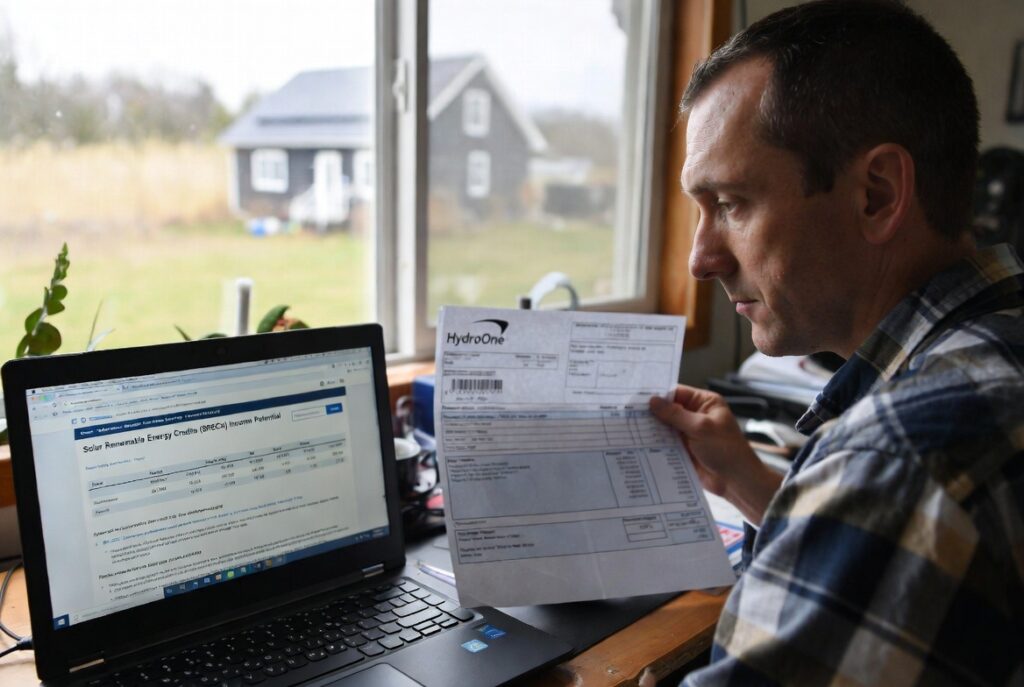
The solar renewable energy credit Ontario question I get asked most often at the counter is how to sell solar certificates to Hydro One, and the answer is the same every time: Ontario has no SREC market, no Renewable Portfolio Standard, and no program paying ongoing income for solar generation since microFIT closed in 2017.
The question comes from US forums where New Jersey and Massachusetts homeowners describe earning $200 to $400 per year in SREC sales. That income model exists because those states passed Renewable Portfolio Standards requiring utilities to buy solar certificates. Ontario’s IESO and OEB regulate under a different framework with no equivalent purchase requirement.
The Lanark County owner who included $300 per year in SREC income in their ROI spreadsheet recalculated after discovering microFIT had been closed for 7 years. The system still paid back in 3.4 years on avoided Hydro One costs alone after the Canada Greener Homes Grant reduced net cost to $9,000. The Prince Edward County owner found the grant and HST rebate produced $6,200 in day-one cost reduction on a $14,000 installation. Neither result required a solar renewable energy credit Ontario certificate market to produce a better outcome than most SREC programs would have delivered.
The practical answer to the solar renewable energy credit Ontario question is a redirect: stop looking for the certificate program and start with the Hydro One bill. Avoided monthly costs of $150 to $250 per month compound over 15 to 20 years of system life into a return that exceeds what even active US SREC markets deliver on a comparable system size. The grants and HST rebate reduce the upfront cost. The avoided costs do the rest. See our Ontario solar sizing guide before any solar renewable energy credit Ontario system planning.
What an SREC actually is: the US certificate market Ontario homeowners keep reading about
| Program / mechanism | Jurisdiction | How it pays | Annual value (5kW system) | Available to Ontario owners? |
|---|---|---|---|---|
| SREC market | New Jersey, Massachusetts, other RPS states | Certificate sale to utility | $200 to $400/year | No |
| microFIT program | Ontario (2009 to 2017) | Guaranteed rate per kWh exported | $500 to $1,200/year | No (closed 2017) |
| Canada Greener Homes Grant | Federal (Canada) | One-time grant | Up to $5,000 total | Yes (verify current status) |
| HST rebate on solar equipment | Ontario / Federal | One-time rebate | 13% of eligible hardware | Yes |
| Capital Cost Allowance | Federal (Canada) | Annual tax deduction | Varies by income | Yes (income-producing property) |
| Avoided Hydro One costs | Ontario (off-grid) | Monthly bill elimination | $1,800 to $3,000/year | Yes |
A Solar Renewable Energy Credit (SREC) represents 1MWh of electricity generated by a solar system. In US states with Renewable Portfolio Standards, utilities must purchase these certificates from solar owners to meet legislated renewable energy targets. A 5kW residential system in New Jersey producing approximately 6MWh per year generates approximately 6 SRECs annually. At $200 to $400 per SREC the annual income is $1,200 to $2,400 per year on top of energy savings. The SREC market functions because the RPS creates mandatory demand , utilities face financial penalties for falling short of their targets and buy certificates to comply.
Ontario has no RPS-equivalent legislation. The IESO and OEB regulate the province’s electricity system under a framework that does not require utilities to purchase certificates from residential solar owners. No Ontario utility is under any legal obligation to buy solar certificates from a homeowner, and no certificate market exists to trade them. The solar renewable energy credit Ontario search that lands Ontario homeowners on US forum threads is looking for a program that has never existed in this province. See our Ontario solar energy bill guide for how the Ontario electricity regulatory framework actually works.
What Ontario had instead: the microFIT program that closed to new applicants in 2017
Ontario’s microFIT (micro Feed-In Tariff) program was the closest equivalent to an SREC income model the province has had. It allowed small generators under 10kW to sell electricity back to the grid at a guaranteed rate , typically $0.20 to $0.38 per kWh depending on the installation year, significantly above the commodity rate. A 5kW system exporting 4,000kWh per year at $0.28 per kWh would earn approximately $1,120 per year. The program ran from 2009 and represented a genuine ongoing income stream for early adopters who enrolled before the window closed.
The microFIT program closed to new applicants in 2017. Existing contract holders continue to receive payments for the 20-year term of their contracts. No replacement program has been introduced for new residential solar installations since then. The FIT (Feed-In Tariff) program for larger generators also closed to new applicants. Ontario’s policy direction moved away from small generator income programs after 2017, and the solar renewable energy credit Ontario landscape for new installations has had no equivalent income mechanism since. Anyone who installed after 2017 does not have access to microFIT regardless of system size or configuration.
The solar renewable energy credit Ontario reality: no SREC market, no Renewable Portfolio Standard
Ontario has no Renewable Portfolio Standard. The province’s electricity mix targets are managed through the IESO’s Integrated Resource Plan and procurement contracts with large generators , not through a certificate market that individual homeowners can participate in. The OEB regulates electricity rates but has no mechanism for purchasing residential solar certificates. A homeowner who generates solar electricity in Ontario and wants to sell certificates has no buyer, no market, and no registry to issue the certificates in the first place.
The confusion between net metering credits and SREC income is the most common misunderstanding in Ontario solar planning. Net metering is a billing mechanism that credits excess solar production against future electricity consumption on a grid-tied system. Those credits reduce the commodity portion of the Hydro One bill. They are not tradeable certificates, they do not generate cash payments, and they do not accumulate as the kind of financial instrument an SREC represents. Net metering offsets commodity charges. SRECs generate cash. Ontario has the first; it has never had the second for residential owners.
The Lanark County recalculation: $300 per year SREC assumption removed, ROI improved
A Lanark County owner was planning a 5kW off-grid array and had been researching solar for approximately 3 weeks on US forums. The owner had built an ROI spreadsheet that included $300 per year in SREC income based on a New Jersey forum post describing certificate sales. The total system cost was approximately $14,000. With $300 per year in assumed SREC income added to the avoided Hydro One costs of $2,640 per year, the ROI spreadsheet showed a payback of approximately 4.6 years.
After confirming with Hydro One that the microFIT program had been closed since 2017 and no SREC market existed in Ontario, the owner removed the $300 SREC assumption from the spreadsheet entirely. The avoided Hydro One cost of $220 per month , commodity, delivery, regulatory, and HST , remained as the sole return. The Canada Greener Homes Grant of $5,000 was applied against the $14,000 system cost, reducing the net investment to $9,000. Annual return: $2,640 in avoided costs. Revised payback: approximately 3.4 years.
The solar renewable energy credit Ontario assumption that looked like a benefit was actually distorting the calculation. The $300 per year SREC income had inflated the apparent return and extended the apparent payback because the owner had sized the system larger to generate more certificates. Without the SREC assumption, the correctly-sized off-grid system with the grant applied produced a faster payback than the SREC-inclusive calculation. The MPPT 100/50 and Battle Born 100Ah LFP bank sized for the actual load produced the 3.4-year payback without any certificate income.
The solar renewable energy credit Ontario alternative: Canada Greener Homes Grant and HST rebate
The Canada Greener Homes Grant provides up to $5,000 toward eligible equipment for residential energy efficiency improvements including solar installations. The application requires a SIN number, a pre-installation energy audit by a registered energy advisor, selection of equipment from the eligible product list, and a post-installation energy audit submitted to Natural Resources Canada. The pre-installation audit must occur before the equipment is purchased , auditing after installation disqualifies the application. Verify current program funding status at canada.ca before including the grant in any ROI calculation, as the program has been paused and restarted at various points.
The HST rebate on solar equipment stacks with the Greener Homes Grant. Most solar panels, charge controllers, battery banks, and monitoring equipment qualify for the HST rebate on energy-efficient equipment purchases. At 13 percent of eligible hardware cost, a $9,200 hardware purchase produces approximately $1,200 in HST savings. Combined with the $5,000 grant, the day-one cost reduction is approximately $6,200 on a $14,000 installation. Capital Cost Allowance under Class 43.1 and 43.2 is also available for solar installations on income-producing properties , farms and rental properties can depreciate the equipment cost against income at an accelerated rate. See our Ontario solar payback guide for the complete ROI calculation framework.
The Prince Edward County grant result: $6,200 off a $14,000 installation on day one
A Prince Edward County owner on a hobby farm planned a 6kW off-grid system with a total installed cost of approximately $14,000. The owner began the Canada Greener Homes Grant application in spring 2023. The pre-installation energy audit was scheduled first, before any equipment was purchased, as required by the grant application process. The energy advisor documented the existing energy consumption baseline, assessed the property for solar suitability, and issued a pre-audit report recommending the solar installation. The audit took approximately 2 hours and cost approximately $300.
After the pre-audit, the owner purchased the system components from the eligible product list. The SmartShunt was included as the monitoring device confirming the installation as professional-grade rather than a simple panel-and-battery arrangement. After commissioning, the post-installation energy audit was completed and submitted to Natural Resources Canada along with the equipment receipts. The grant approval arrived approximately 10 weeks after submission. The $5,000 grant transferred directly to the owner’s registered account.
The HST rebate on the $9,200 in eligible solar hardware added approximately $1,200 to the day-one savings. Combined, the grant and HST rebate reduced the effective system cost from $14,000 to approximately $7,800. At $2,640 per year in avoided Hydro One costs, the payback on the $7,800 net cost is approximately 3.0 years. The solar renewable energy credit Ontario search that originally led the Prince Edward County owner toward certificate programs produced a better financial outcome through the grant process than any SREC market would have delivered on a comparable Ontario off-grid installation.
NEC and CEC: Ontario permit requirements for off-grid solar installations
Off-grid solar installations in Ontario require an ESA permit under CEC Section 64 for any permanently wired components. A system that includes a permanent inverter, fixed battery bank, and hardwired AC distribution requires a full ESA permit regardless of the absence of a utility connection. The permit application includes the system wiring diagram, equipment specifications, and the proposed installation location. The ESA inspector confirms that the installation meets the Ontario Electrical Safety Code requirements for standalone solar power systems before issuing the permit to operate. Contact the NFPA at nfpa.org for current NEC 690 requirements applicable to Ontario standalone solar installations.
A property that disconnects from Hydro One as part of an off-grid transition must also formally notify Hydro One and have the grid meter removed or sealed by a licensed electrician. The Canada Greener Homes Grant does not require an ESA permit as a condition of the grant application, but the post-installation energy audit will note whether the installation appears to comply with applicable codes. An installation that fails an ESA inspection after receiving grant funding does not automatically require grant repayment, but the ESA may require remediation before the system can legally operate. Contact the Electrical Safety Authority Ontario at esasafe.com before beginning any off-grid transition.
Pro Tip: Before spending time researching US solar programs, open your most recent Hydro One bill and calculate the avoided cost ROI first. Take the total monthly bill, multiply by 12, and divide that into the estimated net system cost after the Greener Homes Grant. The Lanark County result: $9,000 net cost divided by $2,640 per year avoided equals 3.4 years. The Prince Edward County result: $7,800 net cost divided by $2,640 per year equals 3.0 years. Both paybacks are faster than New Jersey SREC income would produce on the same system at the same cost. The solar renewable energy credit Ontario search is usually solved by the Hydro One bill calculation.
The solar renewable energy credit Ontario verdict: avoided costs and grants outperform any SREC market
- Ontario owner who found this article while searching for SRECs: Ontario has no SREC market and no equivalent program for new installations. Remove any SREC income assumption from ROI calculations. Recalculate using avoided Hydro One costs only. Apply the Canada Greener Homes Grant before purchase to reduce the net system cost. The Lanark County result: removing the $300 per year SREC assumption and applying the $5,000 grant produced a 3.4-year payback , faster than the SREC-inclusive calculation showed. The Battle Born 100Ah LFP bank and MPPT 100/50 sized for the actual load produced the return without any certificate income.
- Ontario owner who wants to maximise one-time financial benefits before installation: apply for the Canada Greener Homes Grant before purchasing any equipment. The pre-installation audit must happen before equipment purchase to qualify. Verify current program funding status at canada.ca before relying on it in ROI calculations. Stack the HST rebate on top of the grant. The Prince Edward County result: $5,000 grant plus $1,200 HST rebate reduced a $14,000 installation to $7,800 effective cost on day one , a 44 percent reduction before the system produced a single watt.
- Ontario farmer or rental property owner looking for ongoing annual tax benefit: Capital Cost Allowance under Class 43.1 and 43.2 provides accelerated depreciation of solar equipment against farm or rental income. This is the closest equivalent to the annual financial benefit an SREC market delivers for commercial and agricultural solar installations in Ontario. The accelerated depreciation reduces taxable income in the first years of operation. A Renogy 100W panel array sized for the agricultural load combined with CCA produces competitive after-tax ROI without any certificate income.
Frequently Asked Questions
Q: Does Ontario have a solar renewable energy credit program like the US SREC market?
A: Ontario has no SREC market and no Renewable Portfolio Standard requiring utilities to purchase residential solar certificates. The IESO and OEB regulate Ontario’s electricity system under a framework that does not create mandatory demand for residential solar certificates. The closest equivalent Ontario had was the microFIT program, which allowed small generators to sell electricity at a guaranteed rate, but microFIT closed to new applicants in 2017. No replacement program has been introduced for new residential solar installations since then. The solar renewable energy credit Ontario search leads to a program that does not exist in this province.
The practical Ontario alternative is the Canada Greener Homes Grant for one-time cost reduction and avoided Hydro One costs for ongoing ROI. The practical Ontario alternative is the Canada Greener Homes Grant for one-time cost reduction and avoided Hydro One costs for ongoing ROI , both of which produced faster paybacks than US SREC income in the Lanark County and Prince Edward County examples.
Q: What happened to the microFIT program in Ontario?
A: The microFIT (micro Feed-In Tariff) program allowed small residential solar generators under 10kW to sell electricity back to the Ontario grid at a guaranteed rate, typically $0.20 to $0.38 per kWh depending on the enrollment year. The program closed to new applicants in 2017 after the Ontario government changed its energy procurement policy. Homeowners who enrolled before 2017 continue to receive payments for the 20-year term of their individual contracts , those contracts are still active and those payments continue. No new microFIT contracts have been issued since 2017 and the program is not accepting new applications.
The FIT (Feed-In Tariff) program for larger generators also closed in the same period. The FIT (Feed-In Tariff) program for larger generators also closed to new applicants in the same period. Ontario has not introduced a replacement ongoing-income program for new residential solar installations in the years since microFIT closed.
Q: What grants or rebates can Ontario off-grid solar owners claim instead of SRECs?
A: Ontario off-grid solar owners have three main financial benefits available. The Canada Greener Homes Grant provides up to $5,000 for eligible equipment with a pre and post installation energy audit completed by a registered energy advisor , verify current funding availability at canada.ca before applying as the program has been paused and restarted at various points. The HST rebate on eligible solar equipment saves 13 percent of hardware costs , approximately $1,200 on a $9,200 hardware purchase.
Capital Cost Allowance under Class 43.1 and 43.2 is available for income-producing properties. Capital Cost Allowance under Class 43.1 and 43.2 is available for solar installations on income-producing properties such as farms and rental units, providing accelerated depreciation against income. None of these are ongoing annual cash income equivalent to an SREC sale, but combined they reduce effective system cost significantly. The Prince Edward County result confirmed the practical impact: $5,000 grant plus $1,200 HST rebate reduced a $14,000 installation to $7,800 effective cost and produced a 3.0-year payback on avoided Hydro One costs alone.
This build is engineered within the 48V DC Safety Ceiling. Diagnostic logic is based on 20+ years of technical service experience. All structural and electrical installations must be verified by a Licensed Professional and comply with your Local AHJ. See our legal and safety disclosure for full scope.
About the Author
Robert Bertrand spent 20 years as a service advisor in the automotive industry (Lexus and Nissan), where precision diagnostics, wiring integrity, and documentation standards were non-negotiable. He brings that same technical discipline to GridFree Guide, where he researches, tests, and documents off-grid solar systems for Ontario conditions. Based in Rockwood, Ontario, every article is built on verified specifications, manufacturer data, and the real-world climate constraints of Canadian off-grid living.
As an Amazon Associate I earn from qualifying purchases. This site also contains affiliate links to other products and services. GridFree Guide earns a small commission at no extra cost to you.