
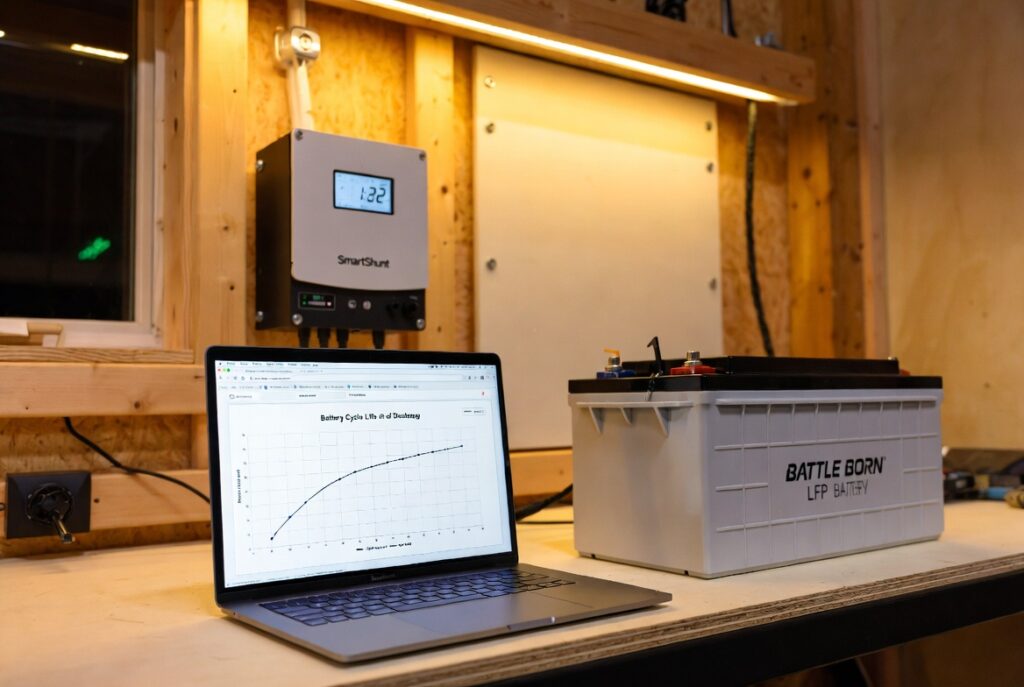
I still have the cold in my bones from that January morning when the battery spec sheet Ontario gap hit me: the SmartShunt blinked 15 percent SoC and the well pump would not kick on. Not because the battery was dead but because I had been reading the spec sheet wrong. I looked at the bold number on the box, 200Ah, and assumed that meant 2,400Wh of usable power. That is what you get when you multiply 12V by 200Ah. That is what the ad said. But the battery only gives you about 80 percent of that before it starts hurting itself, so instead of 2,400Wh I had 1,920Wh to work with.
My load was exactly 1,800Wh a day. No margin. Not enough to get through the first gray streak in January. Three straight days at 1.2 PSH pulled approximately 1,407Wh net from the bank each day. By day four the bank was at 15 percent SoC and the generator was running. The battery had not failed. The spec sheet reading had. A battery spec sheet Ontario reading failure is not a hardware problem and cannot be fixed by adding more panels.
There are four numbers on every battery spec sheet that determine whether a system works or fails in Ontario winter: rated versus usable capacity at 80 percent DoD, cycle life with the DoD percentage stated, minimum charge temperature, and maximum continuous discharge current. Manufacturers publish all four in their technical datasheets. The rated capacity on the front of the box is the least useful of the four for Ontario system design. Skipping the other three is the fastest way to guarantee a system that underperforms or fails years earlier than expected. See our Ontario solar sizing guide before any battery spec sheet Ontario system specification.
The battery spec sheet Ontario capacity numbers: rated versus usable at 80 percent DoD
| Spec sheet number | What it means | Ontario design rule | Lanark County error |
|---|---|---|---|
| Rated capacity (2,400Wh) | Total electrochemical capacity at 25 degrees C | Never use for load sizing | Sized 1,800Wh load against 2,400Wh rated, thought there was a 600Wh buffer |
| Usable at 80% DoD (1,920Wh) | Energy safely accessible without chemistry damage | Primary sizing input | Actual usable was 1,920Wh, leaving only 120Wh margin |
| Usable at 50% DoD (1,200Wh) | Shallow cycling for maximum cycle life | Used when targeting 6,000+ cycles | Not calculated by the Lanark County owner |
| Nominal voltage (12V) | Reference voltage for Wh calculation | Actual resting voltage 12.8V to 13.3V | 12V x 200Ah = 2,400Wh rated, not 1,920Wh usable |
The number on the box is rated capacity, measured under ideal lab conditions at 25 degrees C with a slow discharge rate. In Ontario you are not in a lab. You are pulling power in sub-zero temperatures through four months of limited production. Usable capacity is what you actually get when you respect the chemistry. For LFP batteries that is 80 percent depth of discharge. A Battle Born 100Ah LFP rated at 1,200Wh delivers 960Wh usable at 80 percent DoD. A 200Ah bank delivers 1,920Wh usable, not 2,400Wh rated.
The battery spec sheet Ontario sizing rule is to divide the daily load by 0.80 to find the minimum rated bank size. A 1,800Wh daily load divided by 0.80 requires 2,250Wh rated capacity minimum, approximately 188Ah at 12V. A 200Ah bank delivers 1,920Wh usable against an 1,800Wh load, leaving 120Wh margin. After the January incident I added a third 100Ah battery and brought the bank to 300Ah. At 80 percent DoD that is 2,880Wh usable, leaving a 1,080Wh margin for cloudy days. See our Ontario LiFePO4 battery guide for the complete bank sizing calculation.
The cycle life DoD specification: what the 5,000-cycle claim actually requires
I bought a budget 100Ah battery because the label said 3,000 cycles. I calculated one cycle per day at 365 days per year and expected roughly 8 years of service. That is what the headline number is designed to make you believe. But the number was measured at 100 percent DoD, which means cycling the battery from full to empty every single day, which is brutal on the chemistry. At 80 percent DoD, the same battery delivered 1,800 cycles before capacity dropped below 80 percent. At one cycle per day, that is five years of service, not eight.
A cycle life rating without an attached DoD percentage is not a usable battery spec sheet Ontario specification.
The correct reading is to open the manufacturer’s technical datasheet, find the cycle life column, and locate the number at the DoD the system will actually operate at. A transparent spec sheet publishes cycle life at multiple DoD points with the test temperature and end-of-life capacity threshold stated. A spec sheet that shows only a single cycle life number with no DoD annotation is withholding the information needed to evaluate the claim. The Battle Born 100Ah LFP publishes the full cycle life curve in its technical datasheet. See our Ontario solar battery life guide for how DoD and cycle life interact in real Ontario operating conditions.
The battery spec sheet Ontario charge temperature range: the 0 degrees C charging cutoff
I thought my unheated shed was fine until the first frost hit. LFP batteries cannot accept a charge below 0 degrees C. It is not a suggestion, it is physics. Below freezing, lithium ions do not intercalate correctly into the anode graphite structure. They plate onto the surface instead, causing permanent capacity loss. The BMS shuts down charging to prevent it. In Ontario, an unheated shed can sit below 0 degrees C from sundown to noon for approximately 60 to 90 days per year. One January morning the solar controller displayed a low-temperature charge disable. No power. No water. Just silence.
The fix is either insulating the enclosure with a small heater drawing 10 to 15W to keep cells above freezing, or buying batteries with integrated heating. The Battle Born 100Ah heated LFP has an internal heating pad that activates below approximately 5 degrees C and maintains cell temperature down to minus 20 degrees C. After installing one, the charging window opened at 8:30 AM instead of noon. The heater drew less power than a single LED light bulb and the generator did not run once that winter. The battery spec sheet Ontario minimum charge temperature specification is the number that determines whether you need heated batteries or a heated enclosure for Ontario winter operation.
The maximum continuous discharge rating: inverter load versus battery current limit
The biggest surprise was not battery size or cycle life, it was continuous current draw. A 2,000W inverter running off a single 100Ah LFP battery appeared to have 1,920Wh of usable energy available. That is enough energy. But a 2,000W load on a 12V system draws approximately 167A continuous, and a single 100Ah battery typically specifies a 100A maximum continuous discharge. The BMS trips the circuit when current exceeds the limit. The battery still has energy. The pipe is too small for the flow.
The battery spec sheet Ontario continuous discharge rule: verify that total parallel bank current capacity at full inverter load matches or exceeds the draw.
Two 100Ah batteries in parallel share 167A at approximately 83.5A each, within the 100A individual limit. Three batteries share it at approximately 56A each, leaving a healthy BMS margin. I upgraded to three 100Ah batteries in parallel and the tripping stopped immediately. The continuous discharge current specification is the design input for sustained loads like kettles, space heaters, and well pumps. The peak pulse rating handles motor starts. Always verify the battery spec sheet Ontario continuous discharge number against the inverter maximum, not just the Wh total. See our Ontario battery balancing guide for parallel bank configuration.
The Lanark County January result: 200Ah bank at 15 percent SoC by week one
The Lanark County incident was straightforward in retrospect. A 200Ah Battle Born LFP bank looked like 2,400Wh against an 1,800Wh daily load, a 600Wh margin. Through September and October the system produced correctly. The first week of January brought three consecutive days at 1.2 PSH. A 400W array at 82 percent efficiency on a 1.2 PSH day produces approximately 393Wh. Against the 1,800Wh daily load, each day drew approximately 1,407Wh net from the bank. Over three days that totalled approximately 4,221Wh against 1,920Wh usable capacity.
By the morning of day four the SmartShunt read 15 percent SoC. The well pump would not run. The generator started. The battery had performed exactly as specified. The 80 percent DoD number was in the technical datasheet the entire time. The battery spec sheet Ontario usable capacity calculation, 200Ah multiplied by 0.80 multiplied by 12V, produces 1,920Wh. Against an 1,800Wh daily load that leaves 120Wh, not 600Wh. No Ontario gray streak buffer. No three-day margin. Just a number that looked safe on paper and was not.
The correction was adding a third 100Ah battery the following spring. The bank reached 300Ah and 2,880Wh usable at 80 percent DoD. Against the 1,800Wh daily load, the margin became 1,080Wh, enough to sustain six consecutive days at 1.2 PSH before touching the generator. That is the correct Ontario winter buffer calculation, not the box number versus the daily load. The battery had not failed. The spec sheet reading had. Every subsequent January since has ended without a generator start during gray streaks.
The Frontenac County cycle life result: 3,000 cycles at an undisclosed DoD
The Frontenac County owner purchased a 100Ah LFP battery from a budget manufacturer based on a 3,000-cycle claim. At one cycle per day, the calculation produced approximately 8 years of service. The purchase price was approximately 40 percent below a name-brand equivalent. The product listing showed only the headline cycle count with no DoD annotation. The technical manual, available on the manufacturer’s website, showed that the 3,000-cycle rating was measured at 100 percent DoD with an 80 percent capacity retention threshold at end of life.
At 80 percent DoD, the same technical manual showed 1,800 cycles before the 80 percent capacity retention threshold. At the system’s actual operating DoD of approximately 75 to 80 percent, the projected service life was approximately five years rather than eight. The budget battery at 40 percent below name-brand cost delivered approximately 62 percent of the expected service life, producing a higher cost per operating year than a name-brand alternative with a transparent cycle life curve at multiple DoD points. The battery spec sheet Ontario cycle life reading requires the DoD column in the technical datasheet, not the product listing number.
The Frontenac County battery spec sheet Ontario lesson is not that budget batteries are always inferior but that a cycle life number without a DoD annotation cannot be evaluated or compared. A 3,000-cycle battery at 80 percent DoD with the test conditions stated is a well-specified product. A 3,000-cycle battery at an undisclosed DoD is an incomplete specification. If a manufacturer does not publish a full cycle life versus DoD curve in a technical datasheet, the headline number is not a purchasing input. A manufacturer who publishes cycle life at multiple DoD points is providing what is needed to calculate real-world service life under Ontario operating conditions.
NEC and CEC: Ontario permit requirements for battery bank installations
Any permanently wired battery bank installation in Ontario requires an ESA permit under CEC Section 64 before installation begins. The permit requirement applies regardless of battery chemistry, capacity, or brand. The ESA inspector confirms that wiring, overcurrent protection, BMS disconnect provisions, and enclosure ventilation meet the Ontario Electrical Safety Code. The maximum continuous discharge current on the battery spec sheet determines the minimum fuse rating on the battery positive terminal, making the spec sheet reading relevant to the permit application itself. Contact the NFPA at nfpa.org for current NEC requirements applicable to Ontario LFP battery installations.
CEC Section 64 requires the ESA permit before any permanent wiring connections are made. Replacing batteries within an existing permitted installation using the same chemistry and equivalent capacity is a like-for-like replacement that does not require a new permit. Adding capacity by connecting additional batteries to an existing installation is a modification requiring a permit update before the new batteries are wired in. Verifying the battery spec sheet Ontario continuous discharge current, charge temperature range, and cycle life DoD before purchase does not affect the permit requirement, but it determines whether the installation performs as designed after the permit is closed. Contact the Electrical Safety Authority Ontario at esasafe.com before beginning any battery bank installation or expansion in Ontario.
Pro Tip: Before purchasing any Ontario off-grid battery, locate the manufacturer’s full technical datasheet rather than relying on the product listing. The datasheet should contain rated capacity, usable capacity at 80 percent DoD, cycle life at 80 percent DoD with test temperature stated, minimum charge temperature, and maximum continuous discharge current. If the manufacturer does not publish a technical datasheet with all five numbers, the product listing is the only available specification and the headline numbers cannot be verified. The Lanark County and Frontenac County results both started with a product listing read and a technical datasheet skipped. The datasheet is not additional reading, it is the primary document.
The battery spec sheet Ontario verdict: four numbers that decide Ontario winter performance
- Ontario owner sizing a new battery bank: use the usable capacity at 80 percent DoD for all load calculations, never the rated capacity. A 100Ah 12V battery delivers 960Wh usable at 80 percent DoD, not 1,200Wh rated. Divide your daily load by 0.80 to find the minimum rated bank size. The Lanark County result confirmed what 120Wh actual margin looks like against a 1,800Wh daily load in Ontario January: 15 percent SoC by day four of a gray streak. The correct Ontario winter bank has enough usable capacity to sustain three to four consecutive low-production days at 1.2 PSH without reaching the generator. The Battle Born 100Ah LFP publishes the usable capacity number in its technical datasheet. That is the number that goes into the calculation, not the box.
- Ontario owner comparing battery brands: require cycle life at 80 percent DoD with test conditions before evaluating the claim. A headline cycle life number without a DoD annotation is an incomplete specification. The Frontenac County result: a 3,000-cycle budget battery measured at 100 percent DoD delivered 1,800 cycles at 80 percent DoD, projecting five years of service not eight. Cost per cycle at the operating DoD is the correct comparison metric, not headline cycle life against headline price. A manufacturer who will not publish the cycle life curve at multiple DoD points is withholding the information needed to evaluate whether the headline number applies to Ontario operating conditions.
- Ontario owner with an unheated battery enclosure: verify the minimum charge temperature specification before the first winter, not after. Standard LFP minimum charge temperature is 0 degrees C. An unheated Ontario enclosure that falls below 0 degrees C loses the charging window from sundown to mid-morning for approximately 60 to 90 days per year. The Battle Born 100Ah heated LFP extends the minimum charge temperature to minus 20 degrees C. The SmartShunt daily SoC and throughput records confirm whether the charging window loss is measurable in any given Ontario installation. The heater draw is less than a single LED bulb. The charging days recovered are not.
Frequently Asked Questions
Q: What is the difference between rated capacity and usable capacity on a battery spec sheet in Ontario?
A: Rated capacity is the theoretical maximum energy stored under laboratory conditions, the number on the box. Usable capacity is what you can pull without damaging the battery, calculated at a specific depth of discharge.
The Lanark County battery spec sheet Ontario error: sizing a 1,800Wh daily load against 2,400Wh rated capacity. Usable at 80 percent DoD was 1,920Wh, leaving 120Wh margin against the daily load with no gray streak buffer. The Lanark County battery spec sheet Ontario error was sizing a 1,800Wh daily load against the 2,400Wh rated capacity of a 200Ah bank. The actual usable capacity at 80 percent DoD was 1,920Wh, leaving 120Wh margin against the daily load. That margin was not enough for a three-day Ontario gray streak at 1.2 PSH. The correct design input is always usable capacity at the operating DoD, never the box number.
Q: How do I read the cycle life specification on a battery spec sheet in Ontario?
A: Open the manufacturer’s technical datasheet, not the product listing. Find the cycle life number and the DoD column beside it.
A complete battery spec sheet Ontario cycle life specification states the cycles, the DoD percentage, the test temperature, and the end-of-life capacity threshold, typically 80 percent. If there is no DoD percentage attached to the cycle life claim, the number cannot be evaluated or used for service life projection. The Frontenac County result confirmed the consequence: a 3,000-cycle budget battery measured at 100 percent DoD delivered 1,800 cycles at the 80 percent DoD the system actually operated at, cutting projected service life from eight years to approximately five. A manufacturer who publishes cycle life at multiple DoD points is providing the data needed to calculate real-world Ontario service life.
Q: Does the maximum continuous discharge rating on a battery spec sheet affect Ontario inverter selection?
A: Yes. The battery spec sheet Ontario maximum continuous discharge current determines whether the inverter load stays within the safe operating range.
A 100Ah 12V LFP battery rated at 100A continuous cannot sustain the approximately 167A draw of a 2,000W inverter at full load.
The BMS trips the circuit when current exceeds the limit, cutting power even though the battery still has energy. Two 100Ah batteries in parallel share the 167A at approximately 83.5A each, within the 100A individual limit. Three batteries at approximately 56A each provide a comfortable margin. The continuous discharge current rating, not the peak pulse rating, is the design input for sustained Ontario loads like kettles, space heaters, and well pumps. Always verify that the total parallel bank continuous discharge capacity meets or exceeds the inverter maximum draw before finalising the bank size.
This build is engineered within the 48V DC Safety Ceiling. Diagnostic logic is based on 20+ years of technical service experience. All structural and electrical installations must be verified by a Licensed Professional and comply with your Local AHJ. See our legal and safety disclosure for full scope.
About the Author
Robert Bertrand spent 20 years as a service advisor in the automotive industry (Lexus and Nissan), where precision diagnostics, wiring integrity, and documentation standards were non-negotiable. He brings that same technical discipline to GridFree Guide, where he researches, tests, and documents off-grid solar systems for Ontario conditions. Based in Rockwood, Ontario, every article is built on verified specifications, manufacturer data, and the real-world climate constraints of Canadian off-grid living.
As an Amazon Associate I earn from qualifying purchases. This site also contains affiliate links to other products and services. GridFree Guide earns a small commission at no extra cost to you.