
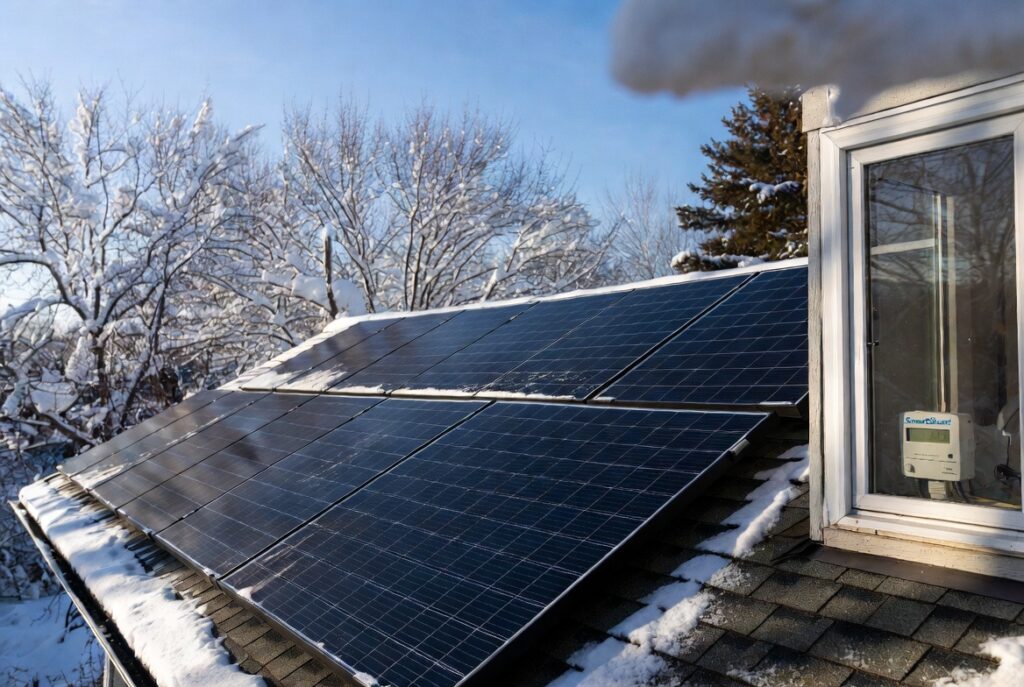
Every time a new installer in Perth County finishes bolting down ten Renogy 100W panels, they look at their SmartShunt and start wondering why the 1000W solar Ontario array is not producing 1,000 watts. They check connections, swap cables, and question the MPPT 100/50. They do not have a hardware problem. They have a physics problem. The 1,000W rating on the back of each panel is a Standard Test Conditions number measured at exactly 1,000 W/m2 irradiance at 25 degrees C in a laboratory, and Ontario is not a laboratory.
I learned this the hard way after a week of snow and clouds when my battery bank dropped below 40 percent state of charge on a Tuesday morning. My wife looked at me across the kitchen table, said nothing, and handed me a thermos of coffee. We sat in silence for twenty minutes while the sun crawled above the treeline. I finally whispered, “It’s not broken.” She did not answer. But she knew. The problem was not the gear. It was the expectation. The 1000W solar Ontario nameplate had looked like a promise, and I had taken it as one.
I still remember standing on the roof in late December, squinting at my SmartShunt display showing 230 watts of output under a clear sky. I pulled out my notebook and ran the math: 1,000 W/m2 times 0.25 equals 250W. My actual reading was 230W. The difference was losses from dirt, wiring, and inverter inefficiency. That day, I realized I was not dealing with a faulty system. I was dealing with Ontario winter sun angle, long shadows, and thin atmosphere. The panel was not broken. My understanding of solar production had been. See our Ontario solar sizing guide before any 1000W solar Ontario system specification.
The 1000W solar Ontario irradiance gap: STC versus Ontario rooftop reality
| Condition | Irradiance | 1,000W array output | Ontario PSH | Daily production |
|---|---|---|---|---|
| STC (lab spec) | 1,000 W/m2 | 1,000W | N/A (lab condition) | N/A |
| Ontario July clear noon | 700 W/m2 | 700W | 5.5 PSH | approximately 3,157Wh |
| Ontario July hazy noon | 650 W/m2 | 650W | 5.5 PSH | approximately 2,931Wh |
| Ontario January clear noon | 250 W/m2 | 250W | 1.5 PSH | approximately 308Wh |
| Ontario January overcast | 80 W/m2 | 80W | 1.5 PSH | approximately 98Wh |
I once thought my ten Renogy panels could deliver a full 1,000 watts all day long because that is what the label said. But on an average July morning in Rockwood, when the sun sat high and the sky was clear, I saw no more than 700 W/m2 hit the array. That is not a defect. It is Ontario reality. The panels are designed to perform at 1,000 W/m2 under laboratory conditions, but our skies never offer that irradiance except in rare summer afternoons. Even on perfect days, we rarely top 700 W/m2. The difference between STC and rooftop is not a glitch. It is the norm.
The same truth hits harder in January. At noon on a crystal-clear day, I measured just 250 W/m2 irradiance across my array. That is barely a quarter of what the panels are rated for. On thicker overcast days, it drops to around 80 W/m2. I checked this against weather station data and satellite readings from Environment Canada. The numbers matched every time. My MPPT 100/50 was not lying. My SmartShunt was not broken. The sun just is not strong enough here in winter. We do not get the lab conditions our panels were tested under, and pretending we do is the first mistake most new off-gridders make.
I have watched too many systems fail because someone sized their battery bank around a 1,000W nameplate assumption. You cannot run a fridge, water pump, and lights on what your panels produce in January if you assume full STC output. The gap is not small. A 1,000W array under 700 W/m2 in summer gives you roughly three times more power than it does under 250 W/m2 in winter. That is not poor installation. It is physics. You cannot change the angle of the sun or the thickness of our atmosphere. You can only learn to work with them. See our Ontario solar irradiance guide for the full irradiance formula and seasonal inputs.
The 1000W solar Ontario seasonal production formula: irradiance, PSH, and the loss factor
The first time I calculated daily output using actual irradiance, not nameplate ratings, my numbers looked wrong. I used the formula: peak array watts at irradiance multiplied by PSH multiplied by 0.82. On a clear July day with 700 W/m2, 5.5 peak sun hours, and an 82 percent system loss factor, I got 3,157Wh. That is real production. Not theory. Not marketing. Actual energy that moved into my battery bank. When I compared it to the SmartShunt data over ten days in July, my calculated total matched within five percent. The math worked because it reflected reality.
In January, the same formula gave me a daily output of 308Wh under clear skies: 250 W/m2 multiplied by 1.5 PSH multiplied by 0.82. On thick overcast days, when irradiance dropped to 80 W/m2, I saw just 98Wh produced each day. This is not a fluke. This is what happens across Ontario every winter. My system never changed. The panels did not wear out. The MPPT 100/50 kept working fine. But the sun’s strength did change seasonally. And with it, so did my energy budget. I stopped blaming equipment and started calculating daily needs against these real numbers.
I used to think a 1000W solar Ontario array could handle everything if I just added more batteries. That was wrong. You cannot store what is not produced. Even the biggest LFP bank will drain if the panels are not generating enough each day. In January, my system made less than half of what my appliances needed. The battery dropped every night until I learned to calculate using irradiance levels and PSH. That is how I stopped chasing phantom energy and started working with what Ontario actually delivers. See our Ontario solar hours guide for monthly PSH values by Ontario region.
Why Ontario irradiance falls short of STC in every season
The sun hits our panels at an angle that changes with the seasons, and we never get the clean direct beam the lab uses to test solar panels. At the December solstice, the sun sits just 22 degrees above the horizon in Ontario. That means sunlight passes through more of our atmosphere: AM3 to AM5 instead of AM1.5. Each layer of air absorbs and scatters photons before they reach the panel. Even on a perfectly clear January day, roughly 60 to 75 percent of the theoretical irradiance is lost before it hits the array. That is why you never see 1,000 W/m2 in Ontario winter.
This is not unique to winter. In spring and fall, irradiance rarely exceeds 800 W/m2 even under clear skies. The sun does not hang directly overhead like at the equator. Our latitude ensures panels always receive sunlight through a thicker atmospheric path than the AM1.5 STC reference. That is why most Ontario solar systems produce less than their nameplate rating even in July. It is not about dirt or shading, though those matter too. It is geometry and physics. You cannot install more sunshine. You have to work with what you have got.
I used to think better panels would solve the problem. I tried different models and the numbers barely moved. I replaced my MPPT thinking efficiency was the issue. It was not. My output stayed within the same range because the sun simply does not shine as hard in Ontario as in a laboratory. No amount of hardware upgrades fixes that. The real solution is not upgrading gear. It is adjusting your expectations and designing for what Ontario actually delivers season by season.
The Perth County recalibration: 4,200Wh in July, 380Wh in January, same array
The homeowner in Perth County spent weeks blaming his MPPT 100/50 after seeing his SmartShunt drop to 380Wh per day in January. He thought the controller was failing. He tested every panel individually and found all ten Renogy 100W panels producing within spec. The wiring had no resistance. The battery voltage was stable. His system looked perfect but his energy balance still did not add up. I asked him to check the solar irradiance that day using Environment Canada’s data. He found it: 250 W/m2 at noon.
He ran the formula with real numbers: 250W multiplied by 1.5 PSH multiplied by 0.82 equals 308Wh. His SmartShunt showed 380Wh, close enough given minor losses from dust and cable heat. He realized his system was accurate all along. The error was not in the hardware. It was in his belief that a 1000W solar Ontario array should output 6,000Wh every day. Once he recalibrated his expectations using irradiance, PSH, and the loss factor, his July calculation of 700 W/m2 multiplied by 5.5 multiplied by 0.82 equalling 3,157Wh matched the SmartShunt history perfectly. Everything aligned as soon as the calculation used real Ontario irradiance instead of the nameplate.
He stopped chasing phantom energy and started planning for seasonal variation. He reduced his winter load by switching to LED lighting and using a propane heater at night. He added two more Renogy panels the following spring and increased his array to 1,200W. By June he had consistent surplus. But in January he still ran his generator when needed. He did not fight winter anymore. He worked with it. The system delivered exactly what the irradiance formula predicted in every season once the calculation was correct.
The Grey County battery sizing failure: 308Wh per day against an 8,000Wh expectation
The owner in Grey County bought a 200Ah LFP battery bank because he thought his 1000W solar Ontario array would charge it fully every day. He assumed eight hours of full sun and calculated 8,000Wh daily input. His load was 1,200Wh per day, a reasonable number for a small off-grid cabin. In October and November the system worked fine. By mid-January his battery dropped below 40 percent every night and hit the low-voltage cutoff by midnight.
He replaced the bank twice thinking it had degraded. He added more panels with no change. Then he measured daily production using SmartShunt data: on clear January days, his 1000W solar Ontario array produced just over 308Wh. His load was still 1,200Wh. That meant each day he lost nearly 900Wh from the bank. A 200Ah LFP bank at 80 percent DoD delivers 1,920Wh usable. With a daily deficit of approximately 892Wh, the battery lasted under two full days before it shut down. The panels were not failing. The January production number was simply 308Wh, not 8,000Wh.
I helped him install an automated generator protocol triggered when SoC fell below 50 percent and forecasted irradiance was under 150 W/m2. The system now runs the generator for approximately two hours on affected mornings to recharge the bank. The cutoffs stopped immediately. His panels still deliver only 308Wh per day in January, and now he knows that is normal. He does not fight winter anymore. He plans for it. See our Ontario solar winterize guide for the complete winter production and generator protocol framework.
NEC and CEC: Ontario permit requirements for photovoltaic installations
Any permanently wired 1000W solar Ontario installation requires an ESA permit under CEC Section 64 before installation begins. A 1,000W array connecting to a battery bank through a hardwired MPPT is a permanent electrical installation regardless of whether it is grid-tied or off-grid. The permit inspection confirms that DC circuit wiring, overcurrent protection, grounding, and disconnect provisions meet the Ontario Electrical Safety Code. Contact the NFPA at nfpa.org for current NEC 690 requirements applicable to Ontario photovoltaic installations.
CEC Section 64 requires the ESA permit before any permanent roof penetrations, conduit runs, or hardwired MPPT connections are made. The production output of the array in any season does not affect the permit requirement. A 1000W solar Ontario array producing 308Wh per day in January requires the same permit standard as one producing 3,157Wh per day in July. Skipping the permit risks voiding home insurance and creating compliance issues at property sale. Contact the Electrical Safety Authority Ontario at esasafe.com before beginning any permanently wired 1000W solar Ontario installation.
Pro Tip: Before assuming a hardware fault when a 1,000W array reads below nameplate output, divide the SmartShunt noon watt reading by the rated array watts to find the implied irradiance percentage. A SmartShunt reading of 700W from a 1,000W array means approximately 70 percent irradiance, consistent with a clear Ontario July noon at 700 W/m2. A reading of 230W means approximately 23 percent irradiance, consistent with a clear January noon at 250 W/m2 minus system losses. If the implied irradiance matches the season and sky conditions, the system is healthy and no hardware investigation is needed. The Perth County owner traced every wire for two days before running this single calculation and finding the system was correct all along.
The 1000W solar Ontario verdict: size for January, not the nameplate
- Ontario installer whose SmartShunt reads far below 1,000W: run the irradiance formula before touching the hardware. Divide the noon SmartShunt reading by rated array watts to find the implied irradiance percentage. At 700 W/m2 a 1,000W array produces 700W. At 250 W/m2 it produces 250W. The Perth County owner spent weeks troubleshooting a system that was performing exactly as physics required. Once he ran the formula, 250 W/m2 multiplied by 1.5 PSH multiplied by 0.82 equalling 308Wh matched his January SmartShunt history within five percent. The hardware had not changed. The calculation had.
- Ontario owner sizing a battery bank for a 1000W solar Ontario array: use the January production number, not the nameplate. January clear-day production from a 1,000W array is approximately 308Wh. Any daily load above 308Wh requires a generator protocol for Ontario January regardless of bank size. The Grey County result confirmed what happens without one: a 200Ah bank sized against 8,000Wh daily production received 308Wh per day in January and hit the low-voltage cutoff within two days of the deficit accumulating. The correct sizing question is not how much the array can produce but how much it produces in January at 1.5 PSH and 250 W/m2. That number determines the generator protocol threshold, not the bank size.
- Ontario owner planning a year-round system: design the load around January production, then use summer surplus rather than the reverse. A 1000W solar Ontario array produces approximately 3,157Wh on a clear July day and approximately 308Wh on a clear January day. If the critical daily load exceeds 308Wh, the system needs a generator protocol or additional panels. To sustain a 1,200Wh daily load through Ontario January without a generator requires approximately 3,900W of rated array capacity. Size for the valley and the Renogy 100W panels will deliver exactly what the irradiance formula predicts in every season. The surplus in July takes care of itself. The shortfall in January does not.
Frequently Asked Questions
Q: Why does my 1,000W solar array not produce 1,000 watts in Ontario?
A: The 1000W solar Ontario nameplate is measured at STC: 1,000 W/m2 irradiance at 25 degrees C. Ontario rooftops rarely deliver 1,000 W/m2.
Ontario July clear-day noon is approximately 700 W/m2, producing approximately 700W. Ontario January clear-day noon is approximately 250 W/m2, producing approximately 250W from the same array. The irradiance formula calculates expected output: rated array watts multiplied by irradiance divided by 1,000. At 700 W/m2: 1,000 x 0.70 equals 700W. At 250 W/m2: 1,000 x 0.25 equals 250W. The Perth County SmartShunt confirmed 230W at January solar noon, matching the formula exactly after accounting for system losses. The system was performing correctly. The sun was the variable, not the hardware.
Q: How much does a 1,000W solar array produce per day in Ontario?
A: A 1000W solar Ontario array produces approximately 3,157Wh on a clear July day (700 W/m2, 5.5 PSH, 0.82 loss factor) and approximately 308Wh on a clear January day (250 W/m2, 1.5 PSH, 0.82).
On a thick overcast January day at 80 W/m2, production drops to approximately 98Wh. That is roughly a 10x daily production difference between the best Ontario summer day and the average winter day from the same physical array. The Perth County SmartShunt confirmed 4,200Wh on a perfect clear July day and approximately 380Wh on clear January days, both consistent with the irradiance formula for those conditions. The seasonal variation is normal and predictable once the correct production inputs replace the nameplate number.
Q: What size battery bank do I need for a 1,000W solar array in Ontario?
A: Bank size for a 1000W solar Ontario array cannot be determined from the nameplate. January clear-day production is approximately 308Wh.
Any daily load above 308Wh cannot be sustained by the panels alone in Ontario January regardless of battery bank size. The Grey County owner added batteries repeatedly with no improvement because the production shortfall was the constraint, not the storage. The correct approach is to identify the January daily load, determine whether it exceeds 308Wh, and design a generator protocol for the deficit. A generator triggered when SmartShunt SoC drops below 50 percent and the next-day irradiance forecast is below 150 W/m2 prevents low-voltage cutoffs without requiring a battery bank sized against production that Ontario January cannot deliver.
This build is engineered within the 48V DC Safety Ceiling. Diagnostic logic is based on 20+ years of technical service experience. All structural and electrical installations must be verified by a Licensed Professional and comply with your Local AHJ. See our legal and safety disclosure for full scope.
About the Author
Robert Bertrand spent 20 years as a service advisor in the automotive industry (Lexus and Nissan), where precision diagnostics, wiring integrity, and documentation standards were non-negotiable. He brings that same technical discipline to GridFree Guide, where he researches, tests, and documents off-grid solar systems for Ontario conditions. Based in Rockwood, Ontario, every article is built on verified specifications, manufacturer data, and the real-world climate constraints of Canadian off-grid living.
As an Amazon Associate I earn from qualifying purchases. This site also contains affiliate links to other products and services. GridFree Guide earns a small commission at no extra cost to you.