
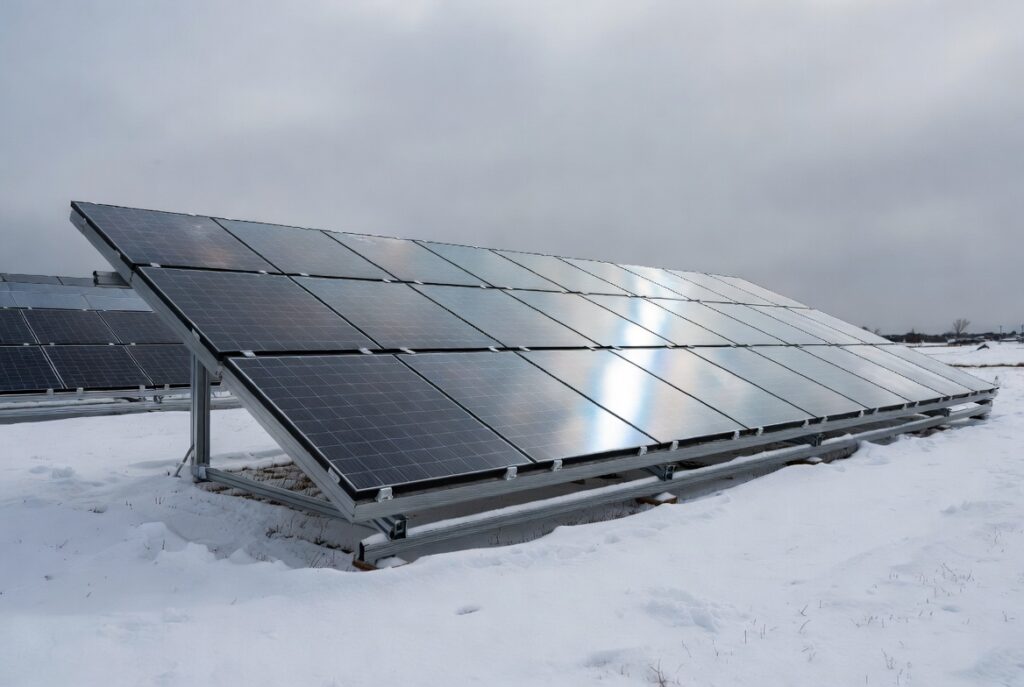
Bifacial solar panels capture reflected light through a transparent rear surface, but the real gain depends on what sits underneath. The physics behind rear-side harvesting are legitimate. A glass-glass panel allows ground-reflected photons to enter the rear cells. However, the “up to 30 percent more power” marketing claim falls apart at the albedo check. A ground mount over white limestone delivers 14 percent annual gain. A flush mount on dark steel delivers a 40-year payback.
Bifacial solar panels are the most oversold upgrade in Ontario’s residential solar market today. Installers quote rear-side gain numbers from lab specs with a perfect albedo of 1.0. That condition does not exist in nature. Real-world gain runs 8 to 15 percent above a comparable mono PERC panel. Dark asphalt, brown steel, and standard shingles absorb the light bifacial rear cells need.
This guide separates the real return from the marketing pitch. It covers the albedo rule, the N-type cell advantage, and the flush-mount trap. If you are comparing bifacial solar panels to the best solar panels for Ontario, the answer depends on your surface.
| Surface Type | Albedo | Rear-Side Gain | Bifacial Worth It? |
|---|---|---|---|
| Fresh Ontario snow | 0.80 to 0.90 | 12 to 15% | Yes, ground mount |
| White gravel or limestone | 0.40 | 8 to 10% | Yes, ground mount |
| Grass or dirt | 0.20 to 0.25 | 3 to 5% | Marginal |
| Dark asphalt or steel | 0.05 to 0.10 | 1 to 2% | No |
How bifacial solar panels capture rear-side light
Bifacial solar panels use glass-glass construction instead of a solid opaque backsheet. This design allows sunlight reflected off the ground to reach the rear cells. Each panel does not produce double its rated output. A 400W bifacial panel carries a bifacial factor of 70 to 80 percent. That means 280 to 320 watts total from both sides under ideal lab conditions. In real Ontario installations, most systems add 8 to 15 percent more output.
This gain is not guaranteed. It requires the right surface below the panels to reflect enough light. Without proper albedo, the rear cells sit in shadow and deliver nothing. You can buy the best bifacial solar panels on the market. They still return zero if they sit over dark asphalt or standard roofing. The mounting environment decides the outcome, not the panel spec.
The albedo rule that decides your rear-side harvest
Albedo measures how much light a surface reflects, on a scale from 0 to 1. Dark asphalt reflects almost nothing at just 0.05 to 0.10 albedo. Grass and bare dirt reflect around 0.20 to 0.25 albedo. That delivers barely any rear-side gain worth measuring. White gravel or crushed limestone offers 0.40 albedo. It is the most practical year-round surface for ground mount installation.
Fresh Ontario snow hits an impressive 0.80 to 0.90 albedo. It turns the ground into a natural mirror for four months each winter. From December through March, a ground-mounted bifacial array sits above Canada’s best natural reflector. The reflected photons enter the rear glass and generate current. A standard mono PERC panel simply cannot capture that reflected energy. This seasonal advantage makes Ontario a top market for bifacial solar panels.
The practical rule is straightforward. If your ground albedo sits below 0.30, the bifacial premium will never pay back. Always check the surface beneath your planned array before committing to the upgrade. A $20 bag of white limestone gravel can shift the math for a small system. Solar panel output in Ontario depends on reflection from below as much as irradiance from above.
N-type versus P-type cell architecture in bifacial solar panels
Most bifacial solar panels now use N-type cells like TOPCon or HJT. These cells use phosphorus-doped wafers with no boron content. That eliminates light-induced degradation over the panel’s full lifetime. N-type carries a temperature coefficient of negative 0.30 percent per degree C. P-type PERC runs negative 0.35 percent per degree C. On a hot July afternoon in Ontario, the gap produces measurable savings. Understanding solar panel efficiency at the cell level matters before paying any premium.
The Renogy 100W Monocrystalline Panel is a reliable P-type PERC design. It works well for standard builds at a lower price point. However, P-type degrades faster over 20 years and loses more power in heat. If you pay the 15 percent bifacial premium, demand N-type cells. The compounded efficiency gains over two decades justify the upfront cost. Settling for P-type bifacial defeats the purpose of the premium.
Why flush roof mounts kill bifacial production
A common and expensive mistake is flush-mounting bifacial solar panels on dark shingles or steel. With no air gap beneath the panel, reflected light cannot reach the rear cells. Even if snow piles on the roof nearby, it does not slide underneath. The result is rear-side output near zero. You paid the premium for a feature that never activates.
Only flat white membrane roofs with 0.5 metres of clearance allow rear-side harvest. A tilted rack must provide enough gap for photons to reach the back glass. On dark-coloured roofs, you are paying extra for nothing. A standard mono PERC panel performs identically on a dark surface at lower cost. The roof colour and clearance determine bifacial value entirely.
The Wellington County ground-mount test
Last January in Wellington County, I installed six 400W bifacial solar panels on a ground-mount rack. The rack tilted at 60 degrees over a bed of white limestone gravel. I wanted to test whether the rear-side gain was more than marketing language. An identical mono PERC string sat beside it on the same rack for direct comparison. I used two Victron SmartShunt monitors to log daily yield precisely.
The first snowfall covered the ground in fresh white crystals with albedo above 0.85. The bifacial solar panels captured reflected photons through their glass-glass rear surfaces. Meanwhile, the mono PERC panels absorbed nothing from below. Over 28 days, the SmartShunt showed the bifacial string averaged 1.38 kWh per panel daily. The mono PERC string produced only 1.13 kWh under identical conditions. That 22 percent daily difference came from rear-side harvest alone.
The $180 total premium across six panels paid for itself in under two winter months. After accounting for summer months with lower grass albedo, the annual gain settled at 14 percent. That is real money recovered from a single component upgrade. It is not a theoretical number from a laboratory specification. I have never seen a more reliable panel-level return in any Ontario build.
The Haliburton County roof-mount lesson
The following month, a neighbour in Haliburton County installed identical 400W bifacial solar panels. He flush-mounted them directly against his dark brown steel roof with zero clearance. He expected the same gains after hearing about the Wellington County results. He connected a Victron SmartShunt to track every watt produced from the string.
The rear-side contribution measured just 2.1 percent of total output. The dark brown steel absorbed over 94 percent of incident light. It reflected almost nothing back to the rear cells. Even during snowfall, snow piled around the panels but never slid underneath. No meaningful photons reached the rear side at any point during the test period.
The extra $180 per panel added only 0.024 kWh of energy per day. At Ontario electricity rates, that is less than five cents daily. Payback exceeds 40 years, longer than any panel’s rated lifespan. That same money invested in battery capacity or a charge controller returns value immediately. Bifacial solar panels on dark roofs deliver a marketing story, not a financial return.
CEC and NEC code requirements for bifacial installations
The Canadian Electrical Code Section 64 governs all photovoltaic installations in Ontario. Ground-mount bifacial systems require the same grounding, overcurrent protection, and rapid shutdown compliance as mono PERC. The heavier glass-glass construction adds 2 to 4 kg per panel. That extra weight demands structural verification of the racking system. The Electrical Safety Authority at esasafe.com administers Ontario’s inspection process.
NEC Article 690 covers DC wiring, fusing, and disconnect requirements on the American side. NFPA standards at nfpa.org provide the fire safety framework many Ontario builders reference. The key bifacial concern is ground clearance height. A rack exceeding 0.5 metres clearance may require fencing or signage from your local AHJ. Confirm all requirements with your licensed electrician before breaking ground.
Pro Tip: Lay a sheet of white paper beneath your planned array on a sunny day. Hold your hand 0.5 metres above the paper. If you see bright reflected light on your palm, the albedo supports bifacial panels. If the reflection is dim, save your money and buy standard mono PERC instead.
Bifacial solar panels verdict: the surface decides
- Ground-mount builders over white gravel or snow-covered ground: Bifacial solar panels are the best panel-level upgrade available. The 15 percent premium returns 8 to 15 percent annual yield. High albedo and tilted mounting pay for the upgrade within one Ontario winter season.
- Flat white membrane roof owners with tilted racks: Consider bifacial solar panels only if clearance exceeds 0.5 metres. The surface must be white or light grey. Verify that your tilt angle exposes enough rear area. Without adequate clearance, the gain disappears entirely.
- Standard shingle or dark steel roof owners: Do not buy bifacial solar panels. Buy a standard mono PERC like the Renogy 100W instead. Spend the savings on a Victron MPPT 100/50 charge controller. That upgrade improves winter solar production in Ontario more than any premium panel.
Frequently asked questions
Q: Are bifacial solar panels worth the extra cost?
A: The answer depends on what surface sits beneath them. On a ground mount over white gravel or snow, the 15 percent premium pays back quickly. You get a real 8 to 15 percent annual energy gain. On dark roofing with no clearance, the answer is no. That $180 per panel delivers more value in a charge controller upgrade.
Q: Do bifacial solar panels work on a roof?
A: Only under specific conditions. You need a flat white membrane surface with 0.5 metres of air gap. The tilt angle must expose the rear cells to reflected light from below. On dark shingle or brown metal roofing, the rear cells receive almost nothing. They produce no measurable extra power on dark surfaces.
Q: How much more power do bifacial solar panels produce?
A: In real Ontario conditions, they add 8 to 15 percent over a comparable mono PERC panel. That is not 30 percent. Lab specifications assume a perfect albedo of 1.0, which does not exist outdoors. The actual gain depends on the surface beneath the array. Fresh snow delivers the highest gain, while dark surfaces deliver almost nothing.
This build is engineered within the 48V DC Safety Ceiling. Diagnostic logic is based on 20+ years of technical service experience. All structural and electrical installations must be verified by a Licensed Professional and comply with your Local AHJ. See our legal and safety disclosure for full scope.
About the Author
Robert Bertrand spent 20 years as a service advisor in the automotive industry (Lexus and Nissan), where precision diagnostics, wiring integrity, and documentation standards were non-negotiable. He brings that same technical discipline to GridFree Guide, where he researches, tests, and documents off-grid solar systems for Ontario conditions. Based in Rockwood, Ontario, every article is built on verified specifications, manufacturer data, and the real-world climate constraints of Canadian off-grid living.
As an Amazon Associate I earn from qualifying purchases. This site also contains affiliate links to other products and services. GridFree Guide earns a small commission at no extra cost to you.