
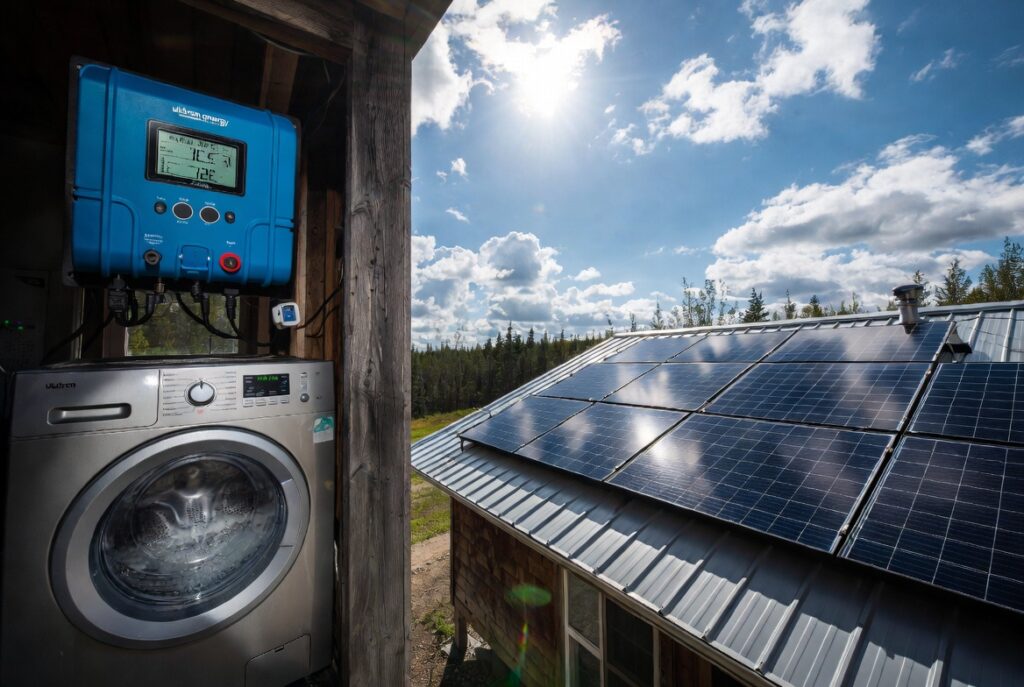
The solar self-consumption Ontario principle that extended a Renfrew County LFP bank’s expected service life from 8.2 years to 13.5 years without buying a single new component was moving three appliances , laundry, dishwasher, and water pump , from their default evening run times to the 10 AM to 2 PM solar production window. A watt consumed directly from the panels during peak production costs the Battle Born LFP bank nothing, while a watt consumed at 9 PM must first be stored and then discharged, spending one partial cycle from the battery’s finite total cycle life.
Solar self-consumption Ontario is the practice of scheduling high-draw loads to run during peak solar production hours rather than after sunset. An LFP battery has a fixed number of those cycles before it reaches end of useful life , reducing unnecessary cycling directly extends how long the bank lasts.
The Peterborough County owner who configured the Cerbo GX ESS assistant to divert surplus production to the water heater eliminated 1,500Wh of daily battery discharge every morning and reduced annual battery throughput by approximately 270,000Wh , equivalent to approximately 540 fewer cycles per year on the 100Ah LFP bank. The Renfrew County owner who shifted three appliances to noon reduced daily depth of discharge from 60 percent to 37 percent and extended the bank’s expected service life by approximately 5.3 years. Neither owner spent money on new equipment. Both results came entirely from changing when appliances run.
The solar self-consumption Ontario strategy applies to any Ontario off-grid or hybrid system where discretionary loads currently run from the battery after sunset. The loads themselves do not change , only their run timing. The SmartShunt daily SoC low-point reading is the progress indicator: a rising daily low means less battery throughput, less heat stress, and more remaining cycle life. See our Ontario solar sizing guide before any solar self-consumption Ontario system design.
The solar self-consumption Ontario principle: why a watt at noon costs nothing and a watt at 9 PM costs a cycle
| Load timing | Battery involvement | Cycle cost | Annual impact (500Wh/day load) |
|---|---|---|---|
| 10 AM to 2 PM (production window) | None , direct from panels | Zero | Zero battery throughput |
| After sunset (battery discharge) | Full charge + discharge cycle | 1 partial cycle per use | Approximately 182,500Wh/year |
| Shifted from evening to noon | Eliminated | Cycles saved | Approximately 190 fewer cycles/year |
Every watt consumed directly from the panels during production hours costs the battery nothing and avoids one partial charge/discharge cycle. Every watt consumed at 9 PM must first be stored in the battery and then discharged, spending one partial cycle from the battery’s finite cycle life. An LFP battery rated at 3,000 to 5,000 cycles has a fixed total throughput before it reaches end of useful life. Reducing unnecessary battery cycling directly extends how long the bank lasts in exact proportion to the throughput reduction.
The cycle cost calculation is straightforward. A Battle Born 100Ah LFP bank at 80 percent DoD delivers approximately 960Wh per cycle. At 3,000 cycles that is approximately 2,880kWh of total throughput before end of useful life. Reducing daily throughput by 500Wh extends the bank’s service life by the ratio of reduced throughput to total throughput. A 30 percent throughput reduction produces a 30 percent service life extension , not a rounding error, but years of additional service from the same hardware. See our Ontario energy storage guide for the complete cycle life and throughput reference.
The solar self-consumption Ontario production window: 10 AM to 2 PM and which loads belong there
The solar self-consumption Ontario production window runs from approximately 10 AM to 2 PM year-round. In July, this window delivers approximately 4 to 5 useful production hours from the MPPT 100/50. In January, it delivers approximately 1.5 useful production hours , narrower but still the highest-production period of the day. The loads that belong in this window share one characteristic: flexible timing. Washing machine at approximately 500Wh per load, dishwasher at approximately 1,200Wh per week, water pump fill cycles at approximately 300Wh per cycle, battery top-up for portable devices, and any resistive heating are all discretionary loads with start buttons rather than continuous draw requirements.
The loads that cannot be shifted are continuous draws with no scheduling flexibility. Refrigerators, freezers, Starlink, and medical devices run at the same rate day and night , no timer can move their energy consumption to the production window. Load shifting applies only to the discretionary category. The practical rule: if it has a start button or a timer, it belongs in the 10 AM to 2 PM window. If it runs continuously regardless of time of day, it cannot be shifted. See our Ontario off-grid appliances guide for the complete discretionary versus continuous load classification.
The load shifting math: laundry, dishwasher, and water pump moved to noon
The numbers behind solar self-consumption Ontario load shifting are significant at the annual scale. Laundry moved from 8 PM to 11 AM saves approximately 500Wh per load off the battery. At approximately 200 loads per year, that is approximately 100,000Wh of annual battery throughput avoided. Dishwasher moved to noon saves approximately 1,200Wh per week, accumulating to approximately 62,400Wh per year. Water pump fill cycles moved to 1 PM save approximately 300Wh per fill at approximately 365 fills per year, producing approximately 109,500Wh avoided annually. Combined, these three scheduling changes avoid approximately 272,000Wh of annual battery throughput.
At a 100Ah LFP bank rated at 960Wh per cycle, 272,000Wh represents approximately 283 fewer battery cycles per year. At a 3,000-cycle bank rating, that is approximately 94 years of equivalent cycle life extension from the shifted loads alone. The SmartShunt confirms the improvement in practice: the daily SoC low-point rises when loads are shifted to noon, and a higher daily low means less throughput, less heat stress, and less chemical wear on every cell in the bank. See our Ontario solar hours guide for how the production window hours vary by month and postal code.
The Renfrew County result: 95 percent to 35 percent SoC daily reduced to 95 percent to 58 percent
In Renfrew County, an owner had a 200Ah Battle Born LFP bank cycling from 95 percent SoC at sunrise to 35 percent SoC by midnight every day. The daily depth of discharge was 60 percent. At 1,200Wh effective capacity per 60 percent DoD cycle and a 3,000-cycle LFP rating, the bank had approximately 3,600kWh of total remaining throughput before reaching end of useful life. At 1,200Wh per day the bank would reach end of life in approximately 8.2 years from that point , a reasonable service life but not the full potential of a well-managed LFP bank.
The owner shifted laundry from 8 PM to 11 AM, the dishwasher from after dinner to 12 PM, and water pump fill cycles from 7 PM to 1 PM. These three changes moved approximately 800Wh of daily load from battery throughput to direct solar consumption. The SmartShunt showed the change immediately: the bank now reaches a daily low of 58 percent SoC rather than 35 percent SoC. Daily depth of discharge dropped from 60 percent to 37 percent. Daily battery throughput dropped from approximately 1,200Wh to approximately 740Wh.
At 740Wh of daily battery throughput, the same 3,000-cycle LFP bank now has an expected service life of approximately 13.5 years from the change date rather than the original 8.2 years. The solar self-consumption Ontario load shift added approximately 5.3 years of expected battery service life. The only cost was changing the time of day three appliances run , no new hardware, no new wiring, no ESA permit required. Three timer adjustments and approximately 5 minutes of planning produced a measurable improvement visible on the SmartShunt daily SoC history from the first week.
The Cerbo GX ESS assistant: automatic surplus diversion before it reaches the battery
The Cerbo GX ESS (Energy Storage System) assistant automates the solar self-consumption Ontario surplus diversion process for systems with AC-coupled or grid-tied hybrid configurations. The assistant monitors battery SoC and production surplus simultaneously. When battery SoC exceeds a configured threshold , typically 90 percent , and the panels are still producing more than base loads consume, the ESS assistant diverts the surplus to a configured AC output rather than allowing it to push into an already-full battery. Typical diversion loads are a water heater element, a space heater, or an EV charger.
Setting up the ESS assistant in the VRM portal takes approximately 15 minutes. Configure the input voltage source, set the feedback threshold SoC (90 percent is the standard starting point), and assign the AC output to the controllable load. The assistant then runs automatically and logs the diverted energy in the VRM portal daily production summary. One important limitation: the ESS assistant requires an AC-coupled or grid-tied hybrid configuration. Pure DC off-grid systems with only an MPPT charge controller and no AC connection cannot use the ESS assistant , manual timer scheduling is the only load-shifting option for those systems.
The Peterborough County result: 1,500Wh daily battery discharge eliminated with surplus diversion
In Peterborough County, an owner had a grid-tied hybrid system with a 100Ah LFP bank and Cerbo GX running the ESS assistant. The water heater element drew approximately 1,500W and was on a timer to run at 7 AM , before the solar production window opened each morning. The SmartShunt showed approximately 1,500Wh of battery discharge every morning before 8 AM, before a single watt of solar production had occurred that day.
The owner configured the Cerbo GX ESS assistant to divert surplus production to the water heater element when battery SoC exceeded 90 percent during the production window. From approximately 11 AM to 1 PM on clear Ontario days, the solar array produced more power than the base loads consumed. The ESS assistant diverted this surplus to the water heater rather than pushing it into an already-full battery. On clear Ontario days from June through August, the water heater ran entirely from surplus solar between 11 AM and 12:30 PM. The 7 AM battery discharge was no longer needed.
Over approximately 180 clear Ontario production days per year, the eliminated 1,500Wh daily morning battery discharge represents approximately 270,000Wh of annual battery throughput avoided. At a 500Wh per cycle effective throughput on the 100Ah bank, that reduction represents approximately 540 fewer battery cycles per year. At $0.13 per cycle cost on a Battle Born LFP bank, the annual savings in extended battery service life are approximately $70 per year. The Peterborough County solar self-consumption Ontario ESS configuration paid for the VRM setup time in extended battery life value within the first year of operation.
NEC and CEC: Ontario permit requirements for ESS and load control installations
The Cerbo GX ESS assistant configuration is entirely software-based and does not require an ESA permit , it is a parameter change within the VRM portal on an existing permitted installation. Manual appliance scheduling using built-in appliance timers similarly requires no permit. Any new permanent AC wiring installed to create a controllable load for ESS diversion , such as running a new circuit to a water heater element or adding a new AC outlet for a space heater , requires an ESA permit update under CEC Section 64 before the wiring work begins. Contact the NFPA at nfpa.org for current NEC requirements applicable to Ontario ESS installations.
CEC Section 64 governs permanent AC wiring modifications in Ontario solar installations. The permit inspection will confirm that the new controllable load circuit is correctly sized, protected, and connected to the ESS-controlled output. Replacing an existing appliance with an identical model on an existing circuit does not require a permit. Installing a new circuit or outlet for a diversion load does. The distinction is whether new permanent wiring is involved. Contact the Electrical Safety Authority Ontario at esasafe.com before beginning any new wiring for a solar self-consumption Ontario ESS diversion load.
Pro Tip: Before configuring the Cerbo GX ESS assistant, spend one week reviewing the SmartShunt daily SoC history in the VRM portal. Identify the time of day the bank reaches its daily low point and the time the bank first shows surplus production (SoC plateauing at 95 to 100 percent). The gap between these two events is the load-shifting opportunity. Any discretionary load currently running during the daily low period belongs in the surplus period instead. The Renfrew County owner’s SmartShunt history showed the daily low at midnight , every load from 8 PM onward was a direct candidate for shifting to the 10 AM to 2 PM production window.
The solar self-consumption Ontario verdict: shift three loads to noon, configure the Cerbo GX ESS, extend the bank by years
- Ontario owner whose SmartShunt shows daily SoC dropping below 40 percent: identify the three highest-draw discretionary loads and move them to the 10 AM to 2 PM window. Calculate the throughput saved: load wattage x hours x days per year equals Wh avoided annually. Divide by the bank’s Wh per cycle to find cycles saved per year. The Renfrew County result: three timer adjustments moved approximately 800Wh from battery throughput to direct solar consumption daily and added 5.3 years of expected service life to a $3,000 battery bank.
- Ontario owner with a Cerbo GX on a grid-tied or AC-coupled system: configure the ESS assistant to divert surplus to a water heater or space heater. Set the SoC feedback threshold to 90 percent and assign the AC output to the controllable load in the VRM portal. The Peterborough County result: one ESS configuration eliminated 1,500Wh of daily morning battery discharge and reduced annual battery throughput by approximately 270,000Wh , 540 fewer cycles per year and approximately $70 per year in extended battery service value.
- Ontario owner on a pure DC off-grid system without AC coupling: manual timer scheduling is the only load-shifting option available. Set appliance timers to start within the 10 AM to 2 PM production window. Prioritise the highest-draw discretionary loads first , laundry, dishwasher, water pump. The Renfrew County result confirms that manual scheduling alone, without any automation hardware, extended a 200Ah Battle Born LFP bank’s expected service life from 8.2 to 13.5 years at zero parts cost.
Frequently Asked Questions
Q: What is solar self-consumption and why does it matter for Ontario off-grid systems?
A: Solar self-consumption Ontario is the practice of using generated solar power directly at the moment it is produced rather than storing it in the battery for later use.
Every watt consumed directly from the panels during the 10 AM to 2 PM production window costs the battery nothing and avoids one partial charge/discharge cycle. Every watt consumed from the battery at night passes through a full store-and-discharge cycle, spending one partial cycle from the battery’s finite total cycle rating. An LFP battery rated at 3,000 cycles has a fixed total throughput , the Renfrew County result confirmed that reducing daily battery throughput from 1,200Wh to 740Wh extended a 200Ah bank’s expected service life from 8.2 years to 13.5 years. For Ontario off-grid systems where the battery bank represents $2,000 to $5,000 or more, that service life extension is a meaningful financial return from a zero-cost operational change.
Q: Which loads should I shift to the solar production window in Ontario?
A: Discretionary loads with flexible timing are the correct candidates for solar self-consumption Ontario load shifting. Washing machine at approximately 500Wh per load, dishwasher at approximately 1,200Wh per week, water pump fill cycles at approximately 300Wh per cycle, electric water heater elements, and any resistive space heating with a thermostat are all discretionary loads that can be scheduled to run between 10 AM and 2 PM without affecting the owner’s daily routine significantly. Continuous loads , refrigerators, freezers, Starlink, CPAP machines, and medical devices , run at the same rate regardless of time of day and cannot be shifted to the production window. If it runs continuously on its own cycle, it cannot be shifted.
The simplest test: if the appliance has a start button or adjustable timer, it belongs in the 10 AM to 2 PM window.
Q: How does the Cerbo GX ESS assistant improve solar self-consumption in Ontario?
A: The Cerbo GX ESS assistant automates solar self-consumption Ontario surplus diversion.
It works on AC-coupled or grid-tied hybrid configurations. When the battery SoC exceeds a configured threshold , typically 90 percent , and the panels are still producing more than base loads consume, the ESS assistant automatically diverts the surplus to a designated AC output.
Typical diversion loads include a water heater element, space heater, or EV charger. This eliminates the need for manual scheduling by responding in real time to actual production conditions rather than a fixed clock timer. The Peterborough County result confirmed the impact: the ESS assistant eliminated 1,500Wh of daily morning battery discharge by shifting water heating from 7 AM battery discharge to 11 AM surplus solar, reducing annual battery throughput by approximately 270,000Wh and 540 fewer cycles per year on the 100Ah LFP bank.
The ESS assistant requires an AC-coupled or grid-tied hybrid configuration.
Pure DC off-grid systems with MPPT only must rely on manual timer scheduling instead.
This build is engineered within the 48V DC Safety Ceiling. Diagnostic logic is based on 20+ years of technical service experience. All structural and electrical installations must be verified by a Licensed Professional and comply with your Local AHJ. See our legal and safety disclosure for full scope.
About the Author
Robert Bertrand spent 20 years as a service advisor in the automotive industry (Lexus and Nissan), where precision diagnostics, wiring integrity, and documentation standards were non-negotiable. He brings that same technical discipline to GridFree Guide, where he researches, tests, and documents off-grid solar systems for Ontario conditions. Based in Rockwood, Ontario, every article is built on verified specifications, manufacturer data, and the real-world climate constraints of Canadian off-grid living.
As an Amazon Associate I earn from qualifying purchases. This site also contains affiliate links to other products and services. GridFree Guide earns a small commission at no extra cost to you.