
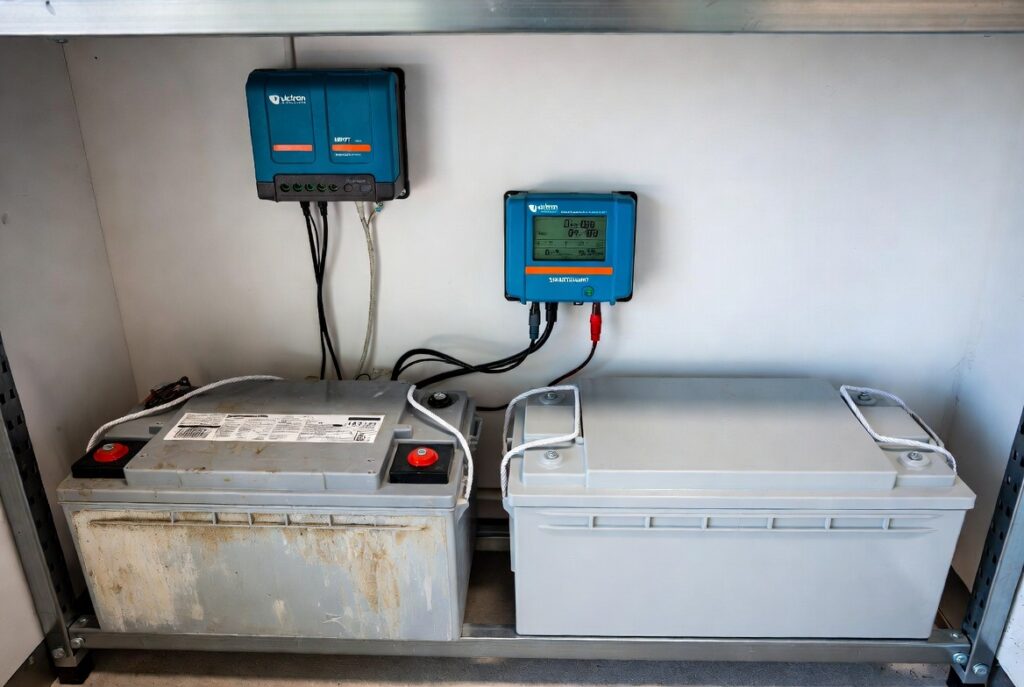
The mixing battery brands Ontario mistake that destroyed a Simcoe County AGM battery in 6 months was not a wiring fault or a BMS failure but a charge voltage mismatch: the MPPT 100/50 was correctly set to the LFP absorb voltage of 14.2V, the AGM battery sharing the same bus requires 14.4 to 14.8V absorb to prevent sulphation, and 6 months of charging at 14.2V delivered the AGM only 80 percent SoC on every cycle until the sulphation accumulated enough to reduce the battery to 61Ah of its rated 100Ah. Mixing battery brands Ontario safely requires understanding three compatibility rules before wiring any second battery to an existing bus.
The first rule is chemistry: AGM and LFP cannot share a charge bus because their absorb voltages are incompatible. The second and third rules , internal resistance and capacity , determine whether two same-chemistry batteries can safely share a bus.
The Lanark County owner who paralleled a new Battle Born 100Ah LFP with a 5-year-old Battle Born 100Ah watched the new battery degrade 5Ah per year rather than the expected 0.5Ah per year. The older battery’s higher internal resistance forced the new one to handle approximately 70 percent of every charge and discharge cycle, producing 1.3 years of cycle wear per year of calendar time. After 18 months, the new battery that should have had 17 or more years of cycle life remaining had already lost 5Ah of capacity. The Simcoe County owner who added a 100Ah AGM to an existing 100Ah LFP bus spent $280 replacing a destroyed AGM battery 6 months later.
Both results came from the same root cause: the mixing battery brands Ontario compatibility check was skipped before wiring a second battery to the existing bus. The mixing battery brands Ontario compatibility check takes approximately 10 minutes before installation and prevents both the immediate chemistry destruction and the slower internal resistance degradation. See our Ontario solar sizing guide before any mixing battery brands Ontario bank expansion.
The mixing battery brands Ontario chemistry rule: AGM and LFP cannot share a charge bus
| Battery combination | Chemistry compatible? | Safe on same bus? | Risk |
|---|---|---|---|
| LFP + LFP, same brand, same age | Yes | Yes | Minimal |
| LFP + LFP, different brand, matched capacity and age | Yes | Yes , with monitoring | Low , minor internal resistance variance |
| LFP + LFP, same brand, 5+ year age gap | Yes | Caution | High , new battery cycles 10x harder |
| LFP + AGM, same bus | No | Never | Certain , AGM sulphates or LFP overcharges |
| LFP + AGM, DC-DC isolator | Yes , isolated | Yes | Minimal , each charges at correct voltage |
In Ontario, LFP batteries require 14.2V absorb voltage. AGM batteries require 14.4 to 14.8V absorb voltage to complete the charge cycle and prevent sulphation. When these two chemistries share a charge bus, the MPPT 100/50 sets one voltage for the entire system. At 14.2V the AGM never completes absorb and chronically undercharges. At 14.4V or higher the LFP is overcharged and degrades faster. Neither outcome is acceptable and there is no intermediate voltage that satisfies both chemistries simultaneously.
A Victron Orion-Tr Smart DC-to-DC charger isolates two chemically incompatible battery banks by charging the secondary bank at its correct voltage from the primary bank. The LFP charges at 14.2V on the primary bus. The Orion-Tr charges the AGM at 14.4 to 14.8V from the LFP bank. Both batteries receive the correct charge voltage and neither damages the other. This configuration allows AGM and LFP to coexist in the same system without ever sharing a common charge bus voltage. See our Ontario battery charging guide for the complete LFP and AGM charge profile specifications.
The Simcoe County AGM destruction: 6 months at 14.2V reduced a 100Ah AGM to 61Ah
A Simcoe County owner had run a 100Ah LFP bank correctly for 2 years with the MPPT set to the LFP charge profile: bulk 14.2V, absorb 14.2V, float 13.5V. In spring 2023, they purchased a 100Ah AGM battery to expand capacity to 200Ah combined, wiring the AGM directly in parallel with the LFP on the same bus. The AGM arrived fully charged. The first few charge cycles appeared normal on the SmartShunt combined current reading. The owner had no indication that the AGM was reaching only 80 percent SoC on every cycle at 14.2V absorb.
By month 3 the combined bank voltage during heavy loads was dropping more quickly than expected for a 200Ah bank. The Cerbo GX VRM history showed the daily SoC low point progressively lower each month. The AGM was beginning to show the reduced capacity of progressive sulphation , the lead plates were accumulating lead sulphate crystals that would not dissolve at 14.2V. A full absorb at 14.6V would have dissolved the sulphate crystals, but the MPPT never reached that voltage because 14.6V would have damaged the LFP sharing the same bus.
By month 6 a capacity test confirmed the AGM at 61Ah of its rated 100Ah. The combined bank effective capacity had dropped from the planned 200Ah to approximately 161Ah. The AGM required replacement at a cost of approximately $280. The LFP remained completely undamaged because 14.2V is its correct absorb voltage. The mixing battery brands Ontario chemistry mismatch destroyed a functional 100Ah AGM battery in 6 months through a mechanism that was entirely predictable and entirely preventable before the first wire was connected.
The mixing battery brands Ontario internal resistance problem: why age mismatch cycles the new battery harder
A new 100Ah LFP battery has an internal resistance of approximately 1 to 3 milliohms. A 5-year-old 100Ah LFP from the same brand has accumulated internal resistance from cycling of approximately 3 to 8 milliohms. When these two batteries share a parallel bus, the lower internal resistance battery , the new one , accepts a larger share of incoming charge current and delivers a larger share of discharge current on every cycle. The difference is invisible on the SmartShunt, which shows only the combined current from both batteries together.
The accelerated aging mechanism is straightforward. If the new battery is handling 70 percent of every charge and discharge cycle on a system designed for 100Ah daily throughput, the new battery is cycling at an effective 130Ah per day. Normal LFP cycle throughput degrades a 100Ah battery approximately 0.5Ah per year at 100Ah daily cycling. At 130Ah daily cycling that degradation accelerates to approximately 0.65Ah per year at minimum. The Lanark County result showed 5Ah of degradation in 18 months , approximately 10 times the expected rate , because the new battery was handling disproportionately more than its design throughput on every cycle. See our Ontario LiFePO4 battery guide for the complete LFP cycle life and degradation reference.
The Lanark County age mismatch: new Battle Born aged 10 times faster beside a 5-year-old bank
A Lanark County owner had a 5-year-old Battle Born 100Ah LFP that had commissioned at 99Ah in 2019 and was cycling at approximately 88Ah after 5 years of normal use , a normal degradation curve for a well-managed LFP bank. In spring 2024, they purchased a new Battle Born 100Ah LFP to expand capacity, expecting the combined bank to deliver approximately 187Ah effective capacity. Both batteries were the same brand. The owner assumed the matching brand meant a safe parallel configuration.
After 8 months of parallel operation the SmartShunt showed the combined bank cycling between approximately 85Ah usable rather than the expected 187Ah. The Cerbo GX VRM history showed the daily SoC low point reaching progressively lower each month from June through January. The older battery’s accumulated internal resistance from 5 years of cycling was approximately 2 to 3 times higher than the new battery. The new battery was accepting approximately 70 percent of the incoming charge and delivering approximately 70 percent of each discharge cycle , effectively running 130Ah of daily throughput on a 100Ah-rated cell.
After 18 months of parallel operation a capacity check confirmed the new Battle Born at 94Ah , already 5Ah below its 99Ah commissioning baseline. At that degradation rate the new battery would reach the same 83Ah as the old battery in approximately 2 more years rather than the 15 or more years expected from a new LFP bank. The 5-year-old battery showed 83Ah, unchanged from before the parallel connection. The mixing battery brands Ontario internal resistance mismatch had transferred the new battery’s remaining cycle life to the older bank and accelerated new battery degradation by approximately 10 times the expected rate.
The capacity mismatch problem: why a 100Ah bank paired with a 200Ah bank never fully charges
A 100Ah LFP bank in parallel with a 200Ah LFP bank of the same chemistry and age creates a capacity mismatch on the shared bus. The 100Ah BMS hits its high-voltage cutoff at full charge (typically when cell voltage reaches 3.65V per cell) before the 200Ah bank has completed its absorb stage. When the 100Ah BMS disconnects or signals full charge, the combined bus voltage rises to the 100Ah bank’s cutoff level. The MPPT reads the bus voltage as full and terminates the charge cycle. The 200Ah bank ends every charge cycle at approximately 80 percent SoC.
Detecting capacity mismatch degradation requires looking past the combined SmartShunt reading. The combined bank SoC percentage will look reasonable because the 100Ah bank is genuinely full. But the system will discharge faster than the total combined capacity would predict , because the 200Ah bank starts each discharge at 80 percent rather than 100 percent SoC. The early signal on the Cerbo GX VRM is a combined bank that runs out of charge earlier than expected on days with heavy loads, even though the spring charge cycle appears to complete normally.
The SmartShunt blind spot: combined current readings cannot detect unequal parallel contribution
The SmartShunt is the most accurate battery monitor available for Ontario off-grid systems, but it has one significant limitation for parallel battery banks: it measures the combined current from all batteries on the bus and cannot distinguish how much each individual battery is contributing. An owner with two parallel batteries where one is doing 70 percent of the work and one is doing 30 percent will see a perfectly normal combined current reading on the SmartShunt display.
The only way to measure individual battery contribution is to temporarily disconnect one battery at a time and monitor the other’s current independently during a full charge and discharge cycle. If the disconnected battery was carrying a disproportionate share, the remaining battery’s current reading will drop significantly from the combined reading. The Cerbo GX VRM daily SoC low-point trend provides a slower but non-intrusive early signal , a parallel bank where one battery is cycling harder shows progressively lower daily low-point SoC over 3 to 6 months even when the total system capacity appears unchanged. See our Ontario battery balancing guide for the parallel bank equalization protocol.
NEC and CEC: Ontario permit requirements for battery bank expansion
Adding a battery to an existing permitted Ontario solar installation requires an ESA permit update under CEC Section 64 before the work begins. The permit covers the new battery’s wiring, overcurrent protection, and connection to the existing DC bus. Adding a second LFP battery to an existing LFP installation and adding an AGM battery to an existing LFP installation both require the same permit update , the chemistry incompatibility does not exempt the installation from the permit requirement, it makes the permit inspection more important because the inspector will verify the charge voltage settings are correct for the chemistry installed. Contact the NFPA at nfpa.org for current NEC requirements applicable to Ontario battery storage installations.
CEC Section 64 requires the ESA permit before the permanent wiring connection is made. The permit inspection will confirm that the MPPT charge profile settings match the battery chemistry installed, that overcurrent protection is correctly sized for the expanded bank current, and that the battery enclosure meets the Ontario Electrical Safety Code ventilation requirements for the increased bank capacity. A DC-to-DC charger installation to isolate two different battery chemistries is a new component addition that also requires a permit update. Contact the Electrical Safety Authority Ontario at esasafe.com before beginning any mixing battery brands Ontario bank expansion.
Pro Tip: Before adding any second battery to an existing Ontario solar bank, run a three-question compatibility check. First: same chemistry? LFP plus AGM on the same bus is never safe. Second: capacity within 10 percent? A 100Ah and 200Ah bank in parallel leaves the 200Ah bank chronically undercharged. Third: age within 2 years? The Lanark County result confirmed that a 5-year age gap between same-brand LFP batteries accelerates new battery degradation by approximately 10 times. All three checks take less than 10 minutes before purchase. The Simcoe County $280 AGM replacement and the Lanark County 10x degradation both resulted from skipping this check entirely.
The mixing battery brands Ontario verdict: same chemistry, same capacity, within two years of age
- Ontario owner who wants to expand an existing LFP bank by adding a second LFP battery: use the same brand and model where possible. If adding a different brand, confirm capacity within 10 percent and age within approximately 2 years. The Lanark County result confirmed that even same-brand parallel batteries with a 5-year age gap produce 10x faster degradation on the new battery from internal resistance mismatch. A Battle Born 100Ah LFP added alongside a 5-year-old Battle Born 100Ah is not a safe configuration , the age gap matters regardless of brand match.
- Ontario owner who has an AGM bank and wants to add LFP capacity: use a DC-to-DC charger to isolate the two chemistries rather than paralleling them on the same bus. The Simcoe County result confirmed that direct parallel connection between AGM and LFP destroys the AGM in 6 months through chronic undercharging at LFP voltage. The Victron Orion-Tr Smart DC-to-DC charger charges each chemistry at its correct voltage and prevents the mixing battery brands Ontario chemistry mismatch from occurring.
- Ontario owner building a new bank who is considering mixing new and used batteries: buy all new matched batteries or all used batteries of the same age and brand. Never mix a new LFP bank with a battery more than 2 years older regardless of brand. For Ontario winter use, consider the Battle Born 100Ah heated LFP as the correct new bank specification , matched batteries of the same model eliminate both the internal resistance mismatch and the cold-charging protection issue simultaneously.
Frequently Asked Questions
Q: Can you mix AGM and LFP batteries in the same Ontario solar system?
A: Not on the same charge bus. AGM batteries require 14.4 to 14.8V absorb voltage to complete a full charge cycle and prevent sulphation. LFP batteries require 14.2V absorb voltage. When both chemistries share the same charge bus, the MPPT sets one voltage for the entire system. At LFP voltage (14.2V), the AGM chronically undercharges and sulphates within months. At AGM voltage (14.4V or higher), the LFP overcharges and degrades faster. The Simcoe County result confirmed the LFP-voltage scenario: a 100Ah AGM reduced to 61Ah in 6 months from chronic undercharging at 14.2V. The safe alternative is a Victron Orion-Tr Smart DC-to-DC charger.
The Orion-Tr isolates the two chemistries and charges each bank at its correct voltage from a shared energy source without sharing a common bus voltage.
Q: Is it safe to add a second battery brand to an existing LFP bank in Ontario?
A: It depends on three compatibility factors: chemistry, capacity, and age. Same chemistry (both LFP) is required. Capacity should match within approximately 10 percent to avoid the smaller bank hitting its BMS cutoff before the larger bank reaches full charge. Age should be within approximately 2 years to avoid significant internal resistance mismatch. The Lanark County result confirmed the age mismatch risk: two Battle Born LFP batteries from the same brand but 5 years apart in age produced 10x faster degradation on the new battery because the older battery’s higher internal resistance forced the new one to handle 70 percent of every charge and discharge cycle. Same brand does not guarantee safe parallel operation if the age gap is significant.
Q: How do I know if my parallel battery bank has unequal contribution between batteries?
A: The SmartShunt measures combined bank current only and cannot detect unequal contribution directly.
The most reliable diagnostic is The most reliable diagnostic is to temporarily disconnect one battery and measure the remaining battery’s current independently during one full charge and discharge cycle. If the reading drops significantly from the combined value, the disconnected battery was carrying a disproportionate share of the cycling. The Cerbo GX VRM daily SoC low-point history provides a non-intrusive early signal over 3 to 6 months , a parallel bank where one battery is overworked shows a progressively lower daily SoC low point even when total capacity appears unchanged. The Lanark County owner first noticed the problem through the VRM SoC low-point trend 4 months before running the capacity check.
That check confirmed 5Ah of degradation on the new battery after only 18 months of parallel operation.
This build is engineered within the 48V DC Safety Ceiling. Diagnostic logic is based on 20+ years of technical service experience. All structural and electrical installations must be verified by a Licensed Professional and comply with your Local AHJ. See our legal and safety disclosure for full scope.
About the Author
Robert Bertrand spent 20 years as a service advisor in the automotive industry (Lexus and Nissan), where precision diagnostics, wiring integrity, and documentation standards were non-negotiable. He brings that same technical discipline to GridFree Guide, where he researches, tests, and documents off-grid solar systems for Ontario conditions. Based in Rockwood, Ontario, every article is built on verified specifications, manufacturer data, and the real-world climate constraints of Canadian off-grid living.
As an Amazon Associate I earn from qualifying purchases. This site also contains affiliate links to other products and services. GridFree Guide earns a small commission at no extra cost to you.