
Using Your House as Collateral and the Home Equity Loan Solar Reality
A home equity loan solar strategy uses your house as collateral to fund your system, and if your monthly electricity savings do not exceed the monthly loan payment, you are paying the bank to own your own sunshine while risking your home. A home equity loan puts a lien on your property. If you default, the bank can foreclose. This is fundamentally different from a personal loan or credit card where default affects your credit score but not your house.
The positive cash flow mandate is the single rule that governs every home equity loan solar decision. Monthly electricity savings must exceed the monthly loan payment or the math does not work. Use annual average savings, not summer peak numbers. Ontario solar produces 5 PSH in July and 1.5 PSH in December. A system that saves $300 per month in July may only save $80 in January. For the complete overview of solar financing options, see our beginner solar guide.
The Rockwood HELOC Success
A homeowner in Rockwood used a HELOC (Home Equity Line of Credit) to fund a $25,000 Tier 3 whole-home solar system built around a Victron MultiPlus-II inverter/charger. Because a HELOC is flexible, he only borrowed exactly what he needed as each phase of the project progressed. His monthly Hydro One savings were $210 based on his pre-solar annual average bill. His interest-only HELOC payment was $145 per month at prime plus 0.5 percent.
The HELOC’s flexibility allowed him to fund a battery expansion one year later when his winter production exceeded expectations. He achieved positive cash flow of $65 per month from month one because his $210 savings exceeded his $145 payment. He used the $65 monthly surplus to pay down the principal, reducing the total interest cost by 22 percent over the life of the line. After 3 years, his remaining HELOC balance was $14,200 and dropping $780 per year from the surplus alone.
Financing solar with a home equity loan solar strategy is like taking out a second mortgage on your garage to buy a fleet of service trucks. If those trucks are out on the road making money, the loan pays for itself and grows your business. But if those trucks sit idle in the bay because the math was wrong, you lose the trucks and the garage. His HELOC-funded system is the truck making money. The $65 monthly surplus proves the math works.
Home Equity Loan vs HELOC and Knowing the Difference
A fixed-term home equity loan provides a lump sum with a fixed interest rate and a fixed monthly payment. This offers payment certainty but zero flexibility. Once the money is disbursed, you pay the same amount every month regardless of whether the system performs as expected. If your savings fall short of projections, the payment does not adjust.
A HELOC is a revolving line of credit with a variable rate (prime plus a margin) and interest-only payment options during the draw period. For staged solar builds, a HELOC wins because you borrow only what you need at each phase of construction. You pay interest only on the drawn amount, not the full approved line. Both options use your house as collateral, so the positive cash flow mandate applies equally to both. The home equity loan solar decision is not about which product is cheaper. It is about which product matches your build timeline and risk tolerance.
The Positive Cash Flow Mandate and Why Home Equity Loan Solar Math Must Be Flawless
The rule is binary. If monthly electricity savings are less than the monthly loan payment, do not proceed. Use annual average savings, not summer peak. Ontario solar produces 5 PSH in July and 1.5 PSH in December. Summer savings of $300 per month become annual average savings of $150 to $180 per month when December through February production is factored in. A $380 monthly payment against $180 average savings creates a $200 monthly deficit that comes directly from your household budget. A Victron SmartShunt provides real-time production and consumption data to verify your savings projections against actual performance. For the complete payback formula, see our solar payback guide and our off-grid solar cost guide.
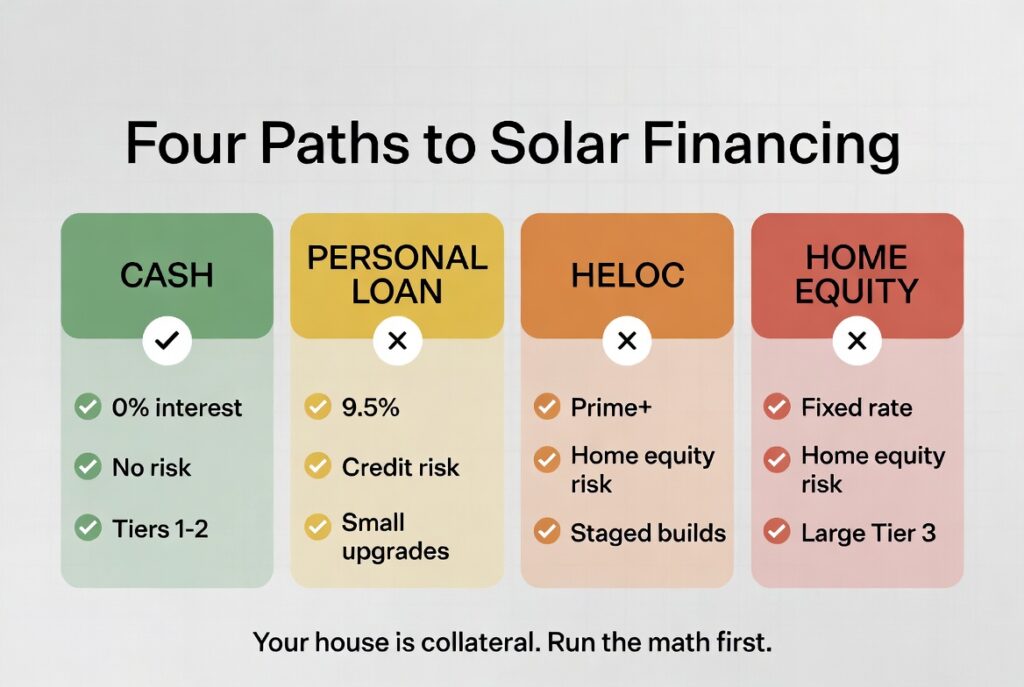
Comparing the Four Paths and Which One Fits Your System Tier
| Feature | Cash | Personal Loan | HELOC | Home Equity Loan |
|---|---|---|---|---|
| Interest Rate | 0% | High (9.5%+) | Variable (Prime +) | Fixed (Mid-range) |
| Collateral | None | None | Your Home | Your Home |
| Flexibility | High | Low | Very High | Low |
| Best For | Tiers 1 and 2 | Small Upgrades | Staged Builds | Large Tier 3 |
| Risk Level | None | Credit Score | Home Equity | Home Equity |
Cash wins for any system under $6,000 because there is no interest, no risk, and no monthly payment obligation. Personal loan works for small upgrades under $5,000 where the convenience of monthly payments outweighs the 9.5 percent interest cost. HELOC wins for staged Tier 3 builds where you borrow as you build and pay interest only on the drawn amount. Fixed home equity loan works only when the system is fully designed, the site is confirmed unshaded, and the annual average savings exceed the payment by at least a 20 percent margin. For the detailed cash vs loan breakdown, see our solar loan vs cash guide and our solar system cost guide.
Risk Assessment, the Milton Fixed-Term Trap, and When to Walk Away
Walk away from a home equity loan solar strategy if any of these conditions apply. A shaded lot reduces production by 40 to 60 percent and destroys the ROI calculation. Annual average savings below the monthly payment creates a permanent deficit. A variable rate HELOC with no rate cap exposes you to payment increases at renewal. An oversized system for your actual consumption means you borrowed more than the savings can repay.
A DIYer in Milton took a $35,000 fixed-term home equity loan solar package for an oversized system on a heavily shaded lot. His monthly fixed loan payment was $380 over 15 years at 6.5 percent interest. He estimated his electricity savings at $300 per month based on his summer Hydro One bills. He did not account for Ontario’s winter production drop when calculating his annual average.
His actual annual average electricity savings were $120 per month, not $300, because his shaded lot produced 60 percent less than an unshaded installation. The $260 monthly deficit between his $380 payment and his $120 savings came directly from his household budget. When interest rates rose at his 5-year renewal, his payment increased to $420 per month while his savings stayed at $120. The rigid payment structure forced him to take a second job to protect his home equity from default.
His $35,000 home equity loan solar decision will not break even for 22 years on a 15-year loan. He will pay $68,400 total ($35,000 principal plus $33,400 interest) for a system that saves $1,440 per year. A site assessment before borrowing would have shown the shading problem. The correct answer was a $5,000 Tier 2 system paid in cash on the unshaded portion of his roof, which would have broken even in 4 years. For the complete cash vs loan comparison, see our solar loan vs cash guide.
Frequently Asked Questions
Q: Is a HELOC or fixed home equity loan better for solar?
A: A HELOC is better for staged builds because you borrow only what you need at each phase and pay interest only on the drawn amount. A fixed home equity loan is better for a single large purchase with a locked interest rate. Both use your house as collateral, so the positive cash flow mandate applies equally.
Q: What happens if I default on a home equity loan for solar?
A: The lender can foreclose on your home because the loan is secured by your property. This is fundamentally different from a personal loan or credit card default which only affects your credit score. Never use home equity financing for a solar system unless the annual average electricity savings exceed the monthly payment with a 20 percent margin.
Q: How do I calculate if my solar savings will cover the payment?
A: Use your annual average Hydro One bill, not your summer peak, because Ontario solar production drops 60 to 70 percent from July to December. Divide your total annual electricity savings by 12 to get the monthly average, then compare that to the monthly loan payment. If the payment exceeds the average savings by any amount, the home equity loan solar math does not work for your property.
NEC Article 690 covers residential PV system installation requirements that protect both the hardware investment and the homeowner. Proper installation ensures the system delivers its rated performance over the expected lifespan. Current standards are published at nfpa.org.
CEC Section 64 governs residential solar installation requirements in Ontario including permits, inspection, and compliance standards. All permanent installations must meet ESA requirements to maintain warranty coverage and insurance eligibility. The Electrical Safety Authority (ESA) provides current compliance guidelines at esasafe.com.
This build is engineered within the 48V DC Safety Ceiling. Diagnostic logic is based on 20+ years of technical service experience. All structural and electrical installations must be verified by a Licensed Professional and comply with your Local AHJ. See our legal and safety disclosure for full scope.
About the Author
Robert Bertrand spent 20 years as a service advisor in the automotive industry (Lexus and Nissan), where precision diagnostics, wiring integrity, and documentation standards were non-negotiable. He brings that same technical discipline to GridFree Guide, where he researches, tests, and documents off-grid solar systems for Ontario conditions. Based in Rockwood, Ontario, every article is built on verified specifications, manufacturer data, and the real-world climate constraints of Canadian off-grid living.
As an Amazon Associate I earn from qualifying purchases. This site also contains affiliate links to other products and services. GridFree Guide earns a small commission at no extra cost to you.