
Why a Dual Fuel Generator Is the Ultimate Ontario Solar Partner
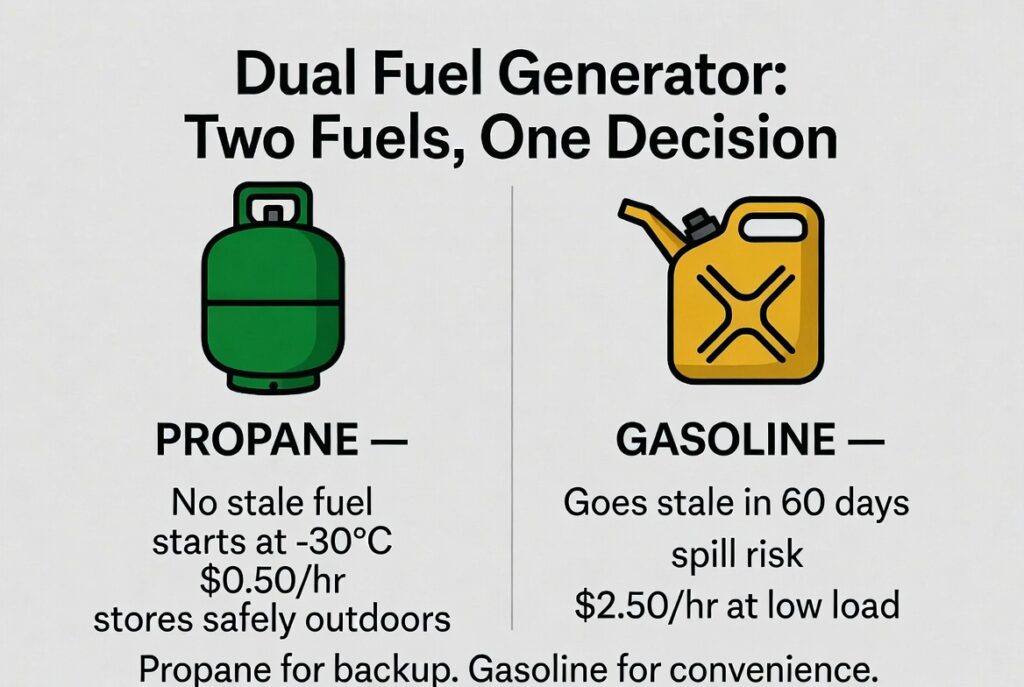
A dual fuel generator gives Ontario solar owners the best of both worlds because propane never goes stale in storage and gasoline provides maximum output when you need every watt. The number one backup power failure in Ontario is stale gasoline. Gas goes stale in 60 days without stabilizer. Propane never goes stale regardless of how long it sits in the tank. A dual fuel generator solves this by offering both fuel options in one unit.
When gas stations lose power during an outage, propane from your BBQ tank keeps the generator running. A 20 lb propane tank costs $25 to fill and provides 12 to 34 hours of runtime depending on load. Most Ontario households already have propane tanks for their BBQ. That means backup fuel is already sitting on your deck. For the complete backup strategy, see our backup power guide.
The Rockwood Propane Pivot
A homeowner in Rockwood used a Champion 2500W dual fuel generator to charge his LFP battery bank during a January ice storm. He started the generator on gasoline because his propane regulator was frozen from sitting in the snow. After 6 hours, the gas station lost power and closed. He switched the fuel selector to propane and connected a 20 lb tank from his BBQ.
The propane burned cleaner than gasoline with no visible exhaust odour. The engine ran slightly quieter on propane, which mattered during the silent nights of a grid-wide blackout. He ran his critical loads for 48 hours on a single 20 lb propane tank at 68 percent load. The clean propane combustion meant zero carburetor cleaning was needed after the storm.
A dual fuel generator is like a vehicle with a bi-fuel conversion kit. Propane is the premium synthetic oil. It is cleaner, lasts forever in the tank, and leaves no sludge in the engine. Gasoline is the regular 87. It is easy to find and packs a punch, but if you let it sit in the lines for six months, it rots the fuel system from the inside out. For a backup tool that sits 300 days a year, you want the option to run the clean stuff.
Top Rated Units from Portable Inverters to Whole-Home Power
| Tier | Wattage | Best For | Top Pick | Price | Propane Runtime |
|---|---|---|---|---|---|
| The Charger | 2,000W to 3,000W | LFP Bank Charging | Champion 2500 DF | $550 | 34 hrs on 20 lb tank |
| The Workshop | 4,000W to 5,000W | Sump Pump + Charging | Westinghouse iGen4500DFc | $900 | 14 hrs on 20 lb tank |
| The Fortress | 9,000W to 12,000W | Whole Home (AC/Well) | Duromax XP13000EH | $1,500+ | 8 hrs on 40 lb tank |
Tier 1 “The Charger” is the Champion 2500W dual fuel generator. It is the sweet spot for PowerAssist-equipped systems. At 1,850W running on gas and 1,665W on propane, it charges an LFP bank at 68 percent load. The 53 dBA noise level at 23 feet is quieter than a dishwasher. At 39 lbs, one person can carry it from the garage to the driveway.
Tier 2 “The Workshop” is the Westinghouse iGen4500DFc. It handles sump pump startup surges plus battery charging simultaneously at 3,700W running on gas. Remote start via key fob and a built-in CO sensor are standard. At 52 dBA, it is one of the quietest generators in the 4,500W class.
Tier 3 “The Fortress” covers whole-home units above 9,000W. These are for properties without PowerAssist where the dual fuel generator must handle all loads directly. The Duromax XP13000EH at 13,000W peak is the benchmark in this tier. For a detailed comparison of generator types, see our solar generator vs gas generator guide.
Fuel Consumption Math and Why Propane Wins When You Choose a Dual Fuel Generator
Propane at 50 percent load on a 2,500W unit costs approximately $0.50 per hour. Gasoline at 50 percent load on the same unit costs approximately $1.50 per hour. Over a 72-hour Ontario ice storm, propane costs $36 total versus gasoline at $108 total. The propane advantage triples at low load because gasoline efficiency drops sharply below 30 percent capacity while propane maintains consistent efficiency across the load range.
Propane stores safely outdoors in TSSA-approved tanks with no spill risk and no fire hazard from fumes. Gasoline requires indoor storage away from ignition sources, goes stale in 60 days without stabilizer, and creates a fire hazard during refuelling a hot generator. A Victron SmartShunt monitors exactly how many amps the dual fuel generator pushes into the battery bank, confirming the charge rate matches the load sweet spot. For the complete propane analysis, see our propane generator guide.
Maintenance Protocol and the Milton Stale Gas Misfire
Running a dual fuel generator on propane reduces maintenance requirements significantly. Change oil every 50 to 100 hours. Inspect spark plugs every 100 hours. Replace the air filter every season. Inspect the propane regulator and hose connections annually for cracks. Propane combustion produces less carbon buildup than gasoline, which extends spark plug life and reduces carburetor fouling.
A DIYer in Milton owned a gas-only 5,000W generator stored in his garage for emergencies. He filled the tank in September and did not add fuel stabilizer. During a February outage, the unit refused to start after three pulls. The gasoline had been sitting for 5 months, gumming up the needle valve in the carburetor.
He spent 4 hours in the cold trying to clean the fuel system while his house temperature dropped to 12 degrees C. The cost of the professional carburetor rebuild afterward was $280, more than the price difference between his gas-only unit and a dual fuel generator. His family spent the night at a hotel for $180. A dual fuel generator with propane would have started on the first pull because propane cannot go stale.
His total cost for the outage was $280 for the carburetor rebuild plus $180 for the hotel plus $40 in spoiled food. The $500 total loss exceeded the $150 price premium of buying a dual fuel generator instead of gas-only. A dual fuel generator eliminates the stale fuel problem entirely. Propane sits in the tank for years without degrading. For the complete sizing formula, see our size backup generator guide. For wiring integration, see our off-grid electrical wiring guide.
Frequently Asked Questions
Q: Can I run a dual fuel generator on propane all the time?
A: Yes, and propane is actually better for long-term engine health because it burns cleaner and produces less carbon buildup than gasoline. The only trade-off is approximately 10 to 15 percent less power output on propane compared to gasoline. For battery charging applications, this reduction is irrelevant because you size the generator for 50 to 80 percent load anyway.
Q: How long does a 20 lb propane tank last on a dual fuel generator?
A: At 25 percent load, a Champion 2500W runs for 34 hours on a single 20 lb tank. At 50 percent load, the runtime drops to approximately 17 hours. At 68 percent load, which is the battery charging sweet spot, a 20 lb tank lasts approximately 12 to 14 hours.
Q: Is a dual fuel generator worth the extra cost over gas-only?
A: Yes, because the $100 to $200 price premium eliminates the stale fuel problem that causes most gas-only generators to fail when you need them most. A single carburetor rebuild from stale gasoline costs $200 to $300, which exceeds the dual fuel premium. Propane storage is also safer than gasoline storage, especially in attached garages where gas fumes create a fire hazard.
NEC Article 702 covers standby power system requirements including generator installation, fuel storage, transfer switch integration, and maintenance protocols for residential backup systems. All standby systems must comply with applicable safety and installation standards. Current standards are published at nfpa.org.
CEC Section 64 governs generator installation requirements in Ontario including fuel storage, electrical connections, and exhaust ventilation standards. All permanently installed generators require ESA-compliant wiring and inspection. The Electrical Safety Authority (ESA) provides current compliance guidelines at esasafe.com.
This build is engineered within the 48V DC Safety Ceiling. Diagnostic logic is based on 20+ years of technical service experience. All structural and electrical installations must be verified by a Licensed Professional and comply with your Local AHJ. See our legal and safety disclosure for full scope.
About the Author
Robert Bertrand spent 20 years as a service advisor in the automotive industry (Lexus and Nissan), where precision diagnostics, wiring integrity, and documentation standards were non-negotiable. He brings that same technical discipline to GridFree Guide, where he researches, tests, and documents off-grid solar systems for Ontario conditions. Based in Rockwood, Ontario, every article is built on verified specifications, manufacturer data, and the real-world climate constraints of Canadian off-grid living.
As an Amazon Associate I earn from qualifying purchases. This site also contains affiliate links to other products and services. GridFree Guide earns a small commission at no extra cost to you.