
The Core Formula to Size Backup Generator Units and Why Efficiency Trumps Raw Watts
Learning to size backup generator units correctly saves fuel, extends engine life, and ensures your battery bank charges fast enough to survive a 72-hour Ontario ice storm. A generator in a solar system is a battery charger with an engine, not a primary power source. The inverter handles your loads directly. The generator charges the battery bank so the inverter has energy to draw from.
The sweet spot for generator efficiency is 50 to 80 percent of rated capacity. Below 30 percent causes wet stacking, where unburned fuel accumulates in the exhaust system. Above 90 percent causes overheating and accelerated wear. Start by listing your continuous loads, identify your surge requirements, add the battery charger input, and select a generator that puts your total at 50 to 80 percent of rated output. For the complete backup strategy, see our backup power guide.
The Rockwood Correctly Sized Propane Generator
A homeowner in Rockwood used a Victron MultiPlus-II with PowerAssist to manage his off-grid loads. Instead of a massive 10kW unit, he chose a 2,200W propane inverter generator. The MultiPlus-II handled the heavy surge loads from the well pump using battery power. The generator only needed to maintain a steady-state battery charge at 1,500W continuous.
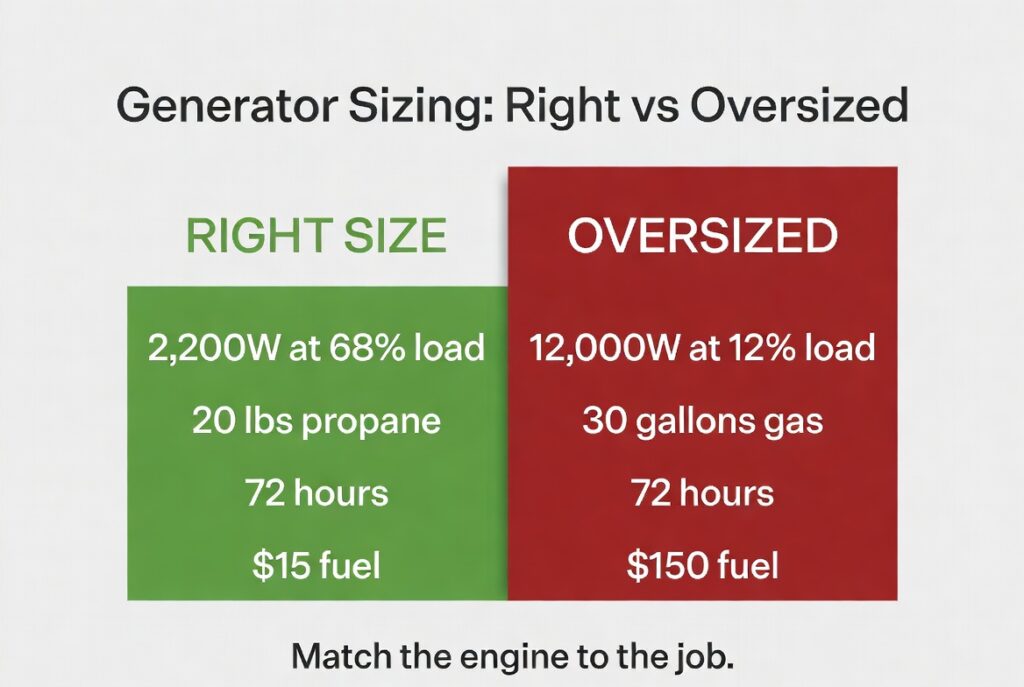
The correctly sized generator ran at 68 percent of its rated capacity, which is the fuel efficiency sweet spot. He ran his critical loads for 72 hours on just 20 lbs of propane during a January blackout. The smaller unit produced 58 dB at full load compared to 78 dB from his neighbor’s oversized contractor unit. The consistent moderate engine heat prevented the exhaust from freezing, which is a common failure on oversized units that cycle on and off in cold weather.
Sizing a generator is like selecting the right engine for the vehicle. A V8 in a compact car wastes fuel at every stoplight because it fights its own internal friction at low RPM. A 4-cylinder in a tow truck cannot pull the load and burns out its valves in a week. The 2,200W propane generator was the right engine for his 1,500W continuous load. It ran in the sweet spot and consumed one-fifth the fuel of an oversized unit running the same loads.
Calculating Your Continuous and Surge Loads and Sizing for Battery Charging
To size backup generator units for your system, list every load the generator must support while charging the battery bank. A fridge draws 80W, LED lights draw 50W, Starlink draws 75W, the furnace fan draws 400W, and the battery charger input draws 1,200W. Total continuous load is 1,805W. Select a generator rated at 2,200W to 3,000W to place this load in the 50 to 80 percent sweet spot.
Surge loads like a well pump at 1,500W startup are handled by the inverter from battery power, not the generator. This is why the generator only needs to cover the steady-state continuous load plus battery charging. The PowerAssist feature on the MultiPlus-II supplements generator output with battery power during momentary surge demands. This allows a smaller, more efficient generator to handle a system that would otherwise require a unit twice the size. For the complete comparison, see our solar generator vs gas generator guide and our battery vs generator guide.
A Victron SmartShunt monitors the charge input in real time so you can verify the generator is delivering its rated charge current to the battery bank. If the SmartShunt shows lower-than-expected charge amps, the generator may be undersized or the charging parameters need adjustment. Real-time monitoring eliminates guesswork and confirms that your sizing decision was correct.
Fuel Consumption Math and Why Propane Wins When You Size Backup Generator for Ontario
Propane has four advantages over gasoline for Ontario backup generators. It does not go stale in storage regardless of how long it sits in the tank. It starts reliably at minus 30 degrees C without a choke or primer. It stores safely outdoors in TSSA-approved tanks with no spill risk. It costs approximately $0.50 per hour at 50 percent load on a 2,200W inverter generator.
Gasoline goes stale in 60 days without stabilizer. It requires indoor storage away from ignition sources. Spills during refuelling are a fire hazard, especially when refilling a hot generator. A 2,200W propane inverter generator at 68 percent load burns 20 lbs of propane over 72 hours at approximately $15 total fuel cost. A 12,000W gas generator at 12 percent load burns 30 gallons of gasoline over the same 72 hours at approximately $150 total fuel cost. The correctly sized propane unit costs one-tenth the fuel of the oversized gas unit for the same runtime. For the complete propane analysis, see our propane generator guide.
The Milton Oversized Trap
A DIYer in Milton bought a 12,000W contractor-grade gas generator for $2,800 because he wanted to be prepared for anything. During a 3-day winter outage, he only ran a fridge and a few LED lights totalling 1,500W of continuous load. The 12,000W generator operated at 12 percent of its rated capacity. He did not understand that running a large engine at low load destroys fuel efficiency and damages the engine.
The massive engine spent 90 percent of its runtime wet stacking at 12 percent capacity. Wet stacking occurs when unburned fuel accumulates in the exhaust system because the engine never reaches proper operating temperature. He burned through 30 gallons of gasoline over 3 days to keep $40 worth of groceries cold. The low load caused carbon buildup on the spark plugs, and the generator failed to start on the final morning of the storm when temperatures hit minus 18 degrees C.
He spent $150 on fuel plus $180 on a service call to clean the spark plugs and clear the wet stacking residue. A correctly sized 2,200W inverter generator would have run the same 1,500W load at 68 percent capacity on 20 lbs of propane over the same 72 hours. Learning to size backup generator units for the actual load instead of the worst-case fantasy saves fuel, protects the engine, and ensures the unit starts when you need it most. The $2,800 contractor unit was the wrong engine for a 1,500W job. For the complete wiring integration, see our off-grid electrical wiring guide.
Frequently Asked Questions
Q: What size generator do I need for my off-grid solar system?
A: Add your continuous loads plus the battery charger input and select a generator that puts this total at 50 to 80 percent of rated output. A typical Tier 2 system needs a 2,000 to 3,000W inverter generator, not a 10,000W contractor unit. If you have a Victron MultiPlus-II with PowerAssist, the generator only needs to cover steady-state charging because the inverter handles surge loads from the battery.
Q: Is propane or gasoline better for a backup generator in Ontario?
A: Propane wins for backup applications because it does not go stale in storage and starts reliably at minus 30 degrees C. Gasoline goes stale in 60 days without stabilizer and is a fire hazard during refuelling. Propane costs approximately $0.50 per hour at 50 percent load compared to $2.50 per hour for gasoline on an oversized unit at low load.
Q: What happens if I run a generator at too low a load?
A: Running below 30 percent of rated capacity causes wet stacking where unburned fuel accumulates in the exhaust system. Wet stacking leads to carbon buildup on spark plugs and eventual hard-start or no-start conditions. A 12,000W generator running a 1,500W load operates at 12 percent capacity, which destroys fuel efficiency and damages the engine within one storm season.
NEC Article 702 covers optional standby power system requirements including generator sizing, fuel storage, and transfer switch integration for residential installations. All standby systems must comply with applicable installation and safety standards. Current standards are published at nfpa.org.
CEC Section 64 governs standby power system installation requirements in Ontario including generator sizing, fuel storage, and electrical integration. All permanently installed generators require ESA-compliant wiring and inspection. The Electrical Safety Authority (ESA) provides current compliance guidelines at esasafe.com.
This build is engineered within the 48V DC Safety Ceiling. Diagnostic logic is based on 20+ years of technical service experience. All structural and electrical installations must be verified by a Licensed Professional and comply with your Local AHJ. See our legal and safety disclosure for full scope.
About the Author
Robert Bertrand spent 20 years as a service advisor in the automotive industry (Lexus and Nissan), where precision diagnostics, wiring integrity, and documentation standards were non-negotiable. He brings that same technical discipline to GridFree Guide, where he researches, tests, and documents off-grid solar systems for Ontario conditions. Based in Rockwood, Ontario, every article is built on verified specifications, manufacturer data, and the real-world climate constraints of Canadian off-grid living.
As an Amazon Associate I earn from qualifying purchases. This site also contains affiliate links to other products and services. GridFree Guide earns a small commission at no extra cost to you.