
Choosing the wrong solar water heater for an Ontario off-grid property drains a battery bank before breakfast. A homeowner on Edinburgh Road South in Guelph installed a 9kW electric tankless in fall 2023. His battery bank was 200Ah LFP at 24V with 3,840Wh of usable capacity. Two 8-minute showers at 1,800W consumed 480Wh every morning.
In January his 600W panel array produced approximately 720Wh on a clear day at 1.5 peak sun hours. Two morning showers consumed 480Wh before 9 AM leaving 240Wh for everything else. On overcast days his panels produced 100 to 200Wh and showers consumed the entire budget.
I reviewed the corrected system at the commissioning check in March 2024. He replaced the electric tankless with a propane unit drawing approximately 1W for ignition and 15W for the control board. His January Victron SmartShunt logs showed the bank stable at 80 to 95 percent SoC through the full morning routine.
The solar water heater question was settled: propane for year-round Ontario domestic hot water. The 480Wh morning load disappeared from the SmartShunt graph the day after the switch. See our Ontario Solar Sizing Guide before designing any hot water system into a solar budget.
The Solar Water Heater Decision: Propane, Solar Thermal, or Electric
| System | Cost Installed | Battery Draw | Winter Performance | Ontario Verdict |
|---|---|---|---|---|
| Propane tankless | $800 to $1,500 | 15 to 25W control board | Excellent to minus 42C | Year-round standard |
| Solar thermal + glycol | $3,000 to $6,000 | 50W pump only | Needs propane Nov to Apr | Summer supplement |
| Electric on-demand | $200 to $600 | 240Wh per shower | 480Wh equals 50 percent of 100Ah | Tier 3 only |
Propane tankless delivers instant unlimited hot water with approximately 15 to 25W of battery draw. Ontario well water at 5 to 10C in January is handled instantly at any ambient temperature. Cost runs $800 to $1,500 installed including a TSSA-licensed gas fitter. This solar water heater path has zero meaningful impact on the battery bank.
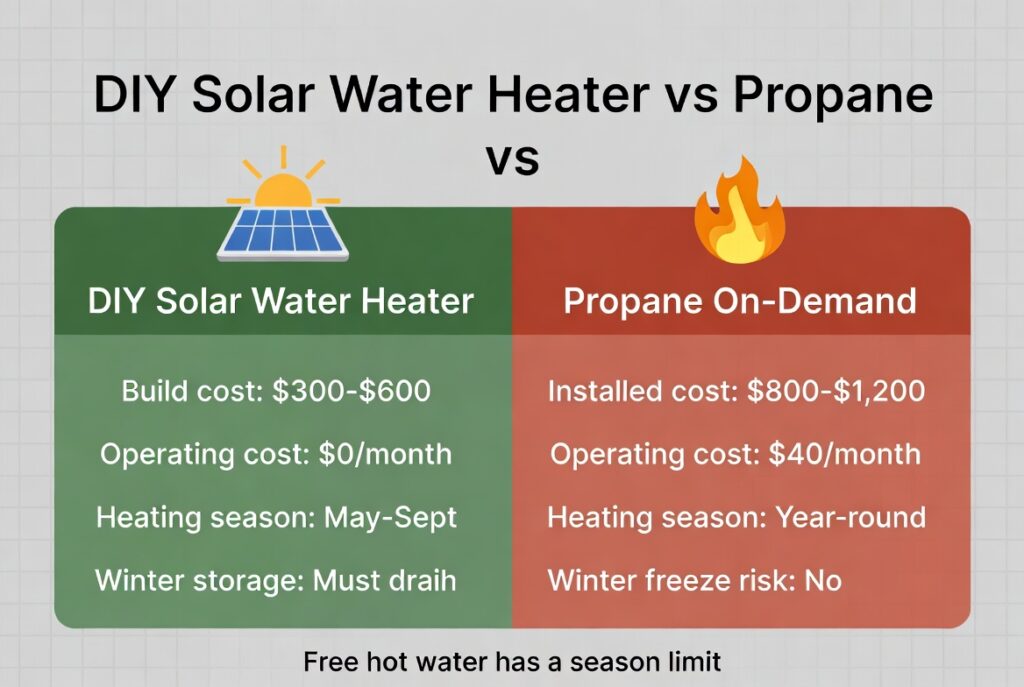
Solar thermal provides free domestic hot water from May through September at 80 to 100 percent coverage. A closed-loop glycol system prevents freeze damage on Ontario nights below minus 5C. A propane backup is required from November through April when output drops to minimal levels. Electric on-demand at 1,800W draws 240Wh per shower on a bank that cannot afford it in winter.
Propane Tankless: The Solar Water Heater Year-Round Standard
A propane tankless unit delivers unlimited hot water at $0.15 to $0.30 per shower in Ontario. It handles well water at 5 to 10C instantly and draws no meaningful battery capacity. A 6 L/min unit is adequate for 1 to 2 person properties with a single draw.
The battery ignition point is the detail most installations miss. A propane tankless requires reliable battery supply for ignition at 1W and the control board at 10 to 25W. In an unheated Ontario utility room at minus 20C, a standard LFP battery may refuse a charge.
A Battle Born heated LFP battery in the utility room maintains charge acceptance to minus 20C ambient. This ensures the ignition circuit is always powered regardless of temperature. For a 420 lb propane tank shared with the tankless and a generator, two annual deliveries cover a 2-person residence. See our Propane Generator Guide for shared supply sizing.
Solar Thermal: Free Hot Water May Through September
A solar thermal system provides free domestic hot water during Ontario productive solar season. A collector with a 200 to 300L storage tank covers 80 to 100 percent of hot water needs from May to September. A cottage owner on Guelph Line in Burlington added a flat plate system in spring 2023 at $3,800 installed.
From Victoria Day through Thanksgiving the system provided approximately 85 percent of domestic hot water requirements. That saved approximately $180 to $190 per season in propane costs. She correctly winterized the glycol loop in late October each year with no freeze damage across three seasons.
The glycol rule is mandatory for any solar water heater with outdoor collectors. A closed-loop propylene glycol mixture must circulate through collectors rather than plain water. Plain water freezes on the first Ontario night below minus 5C and shatters the tubes. A 50 percent glycol mix provides freeze protection to minus 35C.
Solar Water Heater Sizing for Ontario Households
Sizing the correct solar water heater for Ontario requires matching output to occupancy and season. For 1 to 2 person cottages a 6 L/min propane tankless or 150L solar thermal tank works. For 3 to 5 person permanent residences a 150,000 BTU propane unit handles simultaneous draws.
Ontario Building Code Section 7 requires permanent residences to meet minimum domestic hot water standards. A solar water heater system for a permanent Ontario residence must pass these OBC requirements before building inspection. Confirm compliance with the local building department before finalizing any specification. Seasonal cottages not occupied year-round are typically exempt from permanent habitation standards.
Pro Tip: Before selecting any solar water heater, run the January production test on your SmartShunt. Note total array production by 9 AM. Then calculate: at 1,800W electric, two 8-minute showers consume 480Wh. If hot water exceeds 50 percent of January morning production, electric on-demand creates a chronic deficit.
The Comparison Table
| Scenario | System Choice | Cost | Battery Impact | Ontario Winter Result |
|---|---|---|---|---|
| 1-2 person seasonal cottage | Propane tankless 6 L/min | $800 | 15W control board | Full hot water year-round |
| 1-2 person year-round | Propane tankless + solar thermal | $4,600 | 15W + 50W pump summer | Free hot water May to Sep |
| 3-5 person year-round | Propane whole-home 150k BTU | $1,500 | 25W control board | Simultaneous draws handled |
| Any property with electric | Replace with propane immediately | $800 to $1,500 | 480Wh eliminated | Bank stable at 80 to 95 percent |
NEC and CEC: Ontario Permit Requirements for Hot Water
The National Electrical Code governs solar PV installations including circulation pump circuits powered by off-grid systems. The pump circuit must be sized for rated current plus a 25 percent safety factor with appropriate fusing at the battery terminal. A 120V AC circuit feeding the propane control board must comply with NEC 240 appliance circuit requirements. Contact the National Fire Protection Association for current NEC requirements on residential solar hot water circuits.
CEC Section 64 governs solar PV installations in Ontario. A solar thermal circulation pump powered by the off-grid system requires an ESA permit. All propane connections require a TSSA-licensed gas fitter regardless of grid status. Contact the Electrical Safety Authority before wiring any solar water heater components.
Frequently Asked Questions
What is the best solar water heater for an off-grid property in Ontario?
Propane tankless is the correct year-round choice for any Ontario off-grid property below Tier 3 capacity. It provides unlimited hot water at $0.15 to $0.30 per shower with zero battery draw. Solar thermal supplements from May through September at zero operating cost.
Do I need glycol in my solar thermal system in Ontario?
Yes, unconditionally. Plain water in any outdoor collector will freeze on the first night below minus 5C. A 50 percent propylene glycol mix provides protection to minus 35C. Test concentration annually with a refractometer.
How much does propane vs electric cost for off-grid hot water?
Propane costs $0.15 to $0.30 per shower in fuel. Electric at 1,800W draws 240Wh per shower which depletes a 100Ah bank by 50 percent before 9 AM. Propane removes the capacity constraint entirely.
Does a portable solar thermal system need an ESA permit in Ontario?
Only if any component connects to the building electrical panel or permanent wiring. A standalone solar thermal loop with a DC-powered circulation pump on a portable battery does not require an ESA permit. All propane connections require a TSSA-licensed gas fitter regardless.
- Ontario seasonal cottage with propane on site: add solar thermal as a Phase 2 supplement at $3,800 installed and save $180 to $190 per season in propane costs from May through September.
- Ontario year-round residence needing full-time hot water: propane tankless at $800 to $1,500 installed delivers unlimited hot water at 15 to 25W battery draw and eliminates the 480Wh morning electric load.
- Ontario off-grid owner running electric on-demand with chronic morning battery depletion: replace with propane tankless immediately and watch the SmartShunt bank reading stabilize at 80 to 95 percent SoC.
Master Tech Advisory: When I diagnose a morning battery depletion pattern, the first thing I check is the hot water system. A sustained 1,800W load for 8 to 16 minutes every morning is the signature of electric on-demand. If the SmartShunt shows a sharp drop between 6 AM and 9 AM every day, that is the hot water draw. Switching to propane eliminates that block and recovers 480Wh of daily capacity for other loads.
About the Author
Robert Bertrand spent 20 years as a service advisor in the automotive industry (Lexus and Nissan), where precision diagnostics, wiring integrity, and documentation standards were non-negotiable. He brings that same technical discipline to GridFree Guide, where he researches, tests, and documents off-grid solar systems for Ontario conditions. Based in Rockwood, Ontario, every article is built on verified specifications, manufacturer data, and the real-world climate constraints of Canadian off-grid living.
As an Amazon Associate I earn from qualifying purchases. This site also contains affiliate links to other products and services. GridFree Guide earns a small commission at no extra cost to you.