
EG4 Battery Review and Why Server Rack Lithium Changed the Ontario Math
This eg4 battery review exists because a single product line broke the price floor on UL-listed lithium storage for Ontario off-grid builds. In under two years, EG4 went from an unknown brand to the most-discussed battery in every off-grid forum. The LifePower4 V2 server rack unit costs under $300 per kWh. That price undercuts Battle Born at $312 per kWh and comes within reach of DIY raw-cell builds at $250 per kWh.
For Tier 2 and Tier 3 Ontario builds needing 15kWh or more, the price difference at scale is $5,000 to $10,000. A 30kWh EG4 rack costs approximately $9,000. The same capacity in Battle Born 12V drop-ins exceeds $20,000 before wiring and shelf hardware. The server rack format does not just save money. It also simplifies installation and condenses 30kWh into a footprint smaller than a filing cabinet.
Still, EG4 is not a drop-in replacement for standard 12V lithium batteries. It requires DIP switch configuration, firmware updates, and CAN bus or RS485 communication setup. It ships exclusively from US dealers, primarily Signature Solar. For Ontario builders who want simplicity, this is not the right product. For builders ready to configure a networked battery system, this eg4 battery review covers exactly what you get and what it demands. For a broader look at lithium chemistry options, see our Ontario LiFePO4 battery guide.
LifePower4 V2 Versus LL-S and Which Model Fits Your Ontario Build
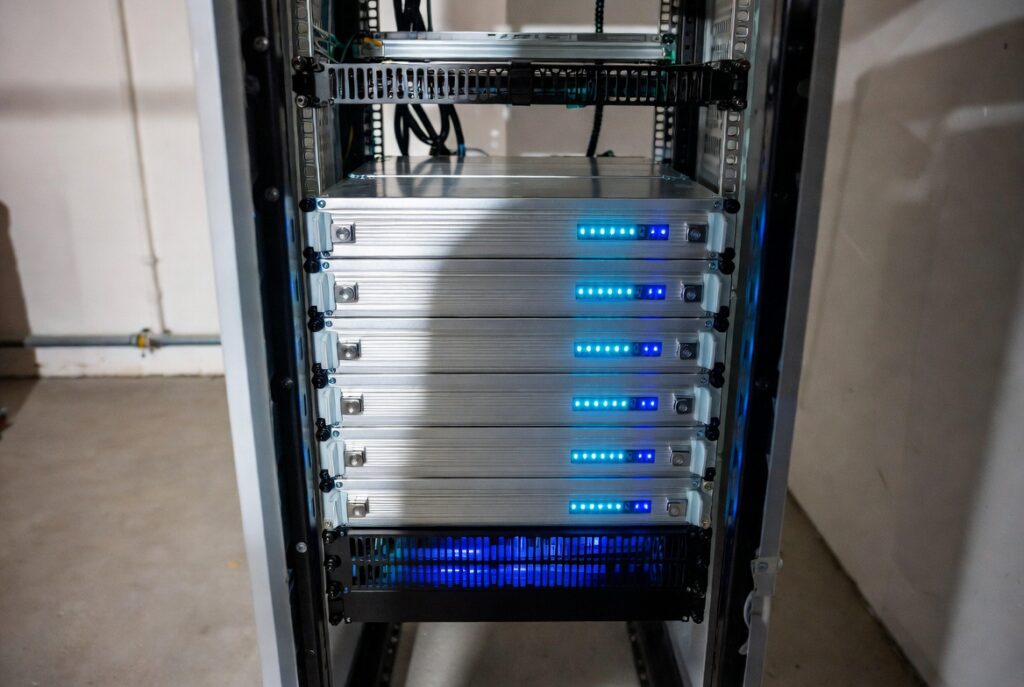
The EG4 LifePower4 V2 costs approximately $1,500 USD per unit. It delivers 5.12kWh at 51.2V nominal with 100A continuous charge and discharge. The unit weighs 99.6 lbs and fits a standard 19-inch server rack at 6.1 x 19 x 17.4 inches. It communicates via CAN bus and RS485 through a 6-position DIP switch. It holds UL1973 and UL9540A certifications and carries a 10-year limited warranty.
The LL-S model adds a 3.5-inch color touchscreen that displays cell voltages, SOC, and temperature directly on the battery. It uses different firmware and crossed ethernet pinouts compared to the LifePower4 V2. Do not mix the two models in the same bank. The LL-S costs approximately $1,600 per unit. For unheated Ontario installations where cold weather BMS management matters, the LL-S is worth the $100 premium. For basement or conditioned-space installations, the LifePower4 V2 saves $600 across a standard 6-battery rack. This distinction is the first decision any eg4 battery review should help you make.
EG4 Battery Review Comparison Table and the Cost Per kWh Math
When comparing the EG4 LifePower4 V2 to Battle Born 100Ah LFP and Chins 100Ah, the numbers tell a clear story. EG4 wins on density and price per kWh at scale. Battle Born wins on simplicity with zero configuration required. Chins offers the lowest entry price but loses on cycle life and warranty coverage.
| Model | Capacity (kWh) | System Voltage | Cycle Life | Cold Charging Cutoff | BMS Communication | Form Factor | Warranty | Price per Unit (USD) | Price per kWh (USD) |
|---|---|---|---|---|---|---|---|---|---|
| EG4 LifePower4 V2 | 5.12 | 48V | 6,000+ at 80% DoD | 0 degrees C | CAN bus and RS485 | 19-inch server rack | 10-year | $1,500 | $293 |
| Battle Born 100Ah | 1.28 | 12V | 3,000 to 5,000 | 0 degrees C | None | Group 31 case | 10-year | $400 | $312 |
| Chins 100Ah | 1.28 | 12V | 2,000 to 4,000 | 0 degrees C | None | Group 31 case | 3-year | $160 | $125 |
At 30kWh, six EG4 units cost approximately $9,000. Twenty-four Battle Born units to reach equivalent capacity cost $9,600 plus wiring, shelf hardware, and parallel connection complexity. Twenty-four Chins units cost $3,840 but deliver only 2,000 cycle life with no BMS communication. The eg4 battery review math favours EG4 at scale because the server rack format eliminates the wiring sprawl that 12V banks create. For a full breakdown of how depth of discharge affects these numbers, see our depth of discharge guide.
The Ontario Cold Weather Problem and the 0 Degrees C Charging Lockout
All LFP batteries refuse charge below 0 degrees C. EG4 is no exception. The BMS cuts charging current entirely when cell temperature drops below freezing. In an unheated Simcoe County garage or Muskoka District shed, this lockout means zero solar charging from November through March unless the battery space is heated. A thermostat-controlled cabinet heater set to maintain 5 degrees C minimum solves the problem. For full details, see our heated battery standard for Ontario.
The LL-S model offers improved cold weather BMS features compared to the LifePower4 V2. For Ontario builders installing batteries in semi-conditioned spaces that drop below 5 degrees C during January cold snaps, the LL-S is the safer choice. The $100 per unit premium is cheaper than building a heated battery enclosure from scratch. Every serious eg4 battery review must address this Ontario cold weather reality because ignoring it bricks the investment. For the full winter charging protocol, see our LFP winter charging standard.
The Simcoe County Server Rack Build
A homeowner in Simcoe County decided to replace a failing lead-acid bank with a full EG4 server rack system last October. He purchased six EG4 LifePower4 V2 units and a dedicated 6-slot 19-inch rack from Signature Solar. The total battery cost came in under $9,000 for 30.72kWh of usable storage. To get equivalent capacity from Battle Born 12V drop-ins, the quote exceeded $20,000 before wiring and shelf hardware.
The six batteries were installed in a semi-conditioned basement space that stays above 5 degrees C through winter. During the first minus 20 degrees C snap in January, the system held voltage without a single low-temperature fault. The Victron SmartShunt showed less than 0.2 percent SOC drift between all six units over the first 90 days. The CAN bus communication fed accurate cell-level data to the Victron Cerbo GX without a single dropped reading.
At 30.72kWh, the system runs the full house including well pump, refrigerator, and Starlink through 4-day gray streaks without generator backup. The cost per kWh came in at $293 versus $312 for Battle Born and $250 for a raw-cell DIY build that would have taken 3 weekends to assemble. For a full-house Ontario off-grid build at Tier 2 or above, the server rack format is the only configuration that makes financial and organizational sense at this scale. The owner has not opened the battery cabinet since commissioning day. For help calculating your own bank size, see our battery sizing calculator.
The Grey County DIP Switch Fix
A DIYer in Grey County purchased three EG4 LifePower4 V2 batteries for a cabin build and installed them over a weekend. He connected all three to his inverter using the included communication cables. When he powered up the system, the inverter displayed only one battery instead of three. He assumed the other two units were defective and contacted Signature Solar for warranty replacement.
The batteries were not defective. The 6-position DIP switches on the front panel were all set to the same default address. The inverter could only see one battery because all three were reporting as the same device on the communication bus. This is the most common EG4 installation mistake. It appears in every off-grid forum thread about the product. No eg4 battery review is complete without this warning because it accounts for more false warranty claims than any actual hardware failure.
After setting the master and slave IDs on each unit and updating the firmware via the EG4 Windows diagnostic tool, the system communicated perfectly within 15 minutes. The inverter immediately displayed all three batteries with individual cell voltages, SOC, and temperature readings. Unlike 12V drop-in batteries that just provide power, EG4 is a networked computer that requires correct addressing to function. If you are not comfortable with a data cable and a firmware update, stay with a standard 12V drop-in like Battle Born 100Ah.
EG4 Battery Review Verdict and Who Should Buy and Who Should Not
This eg4 battery review comes down to three buyer profiles. The right choice depends on your build scale, your comfort with configuration, and whether your battery space is heated.
- Tier 2 and Tier 3 Ontario builders needing 15kWh or more should buy the EG4 LifePower4 V2 in a server rack configuration. The $293 per kWh price point and 6,000 cycle life make it the best value at scale in 2026. Pair it with a Victron SmartShunt for independent SOC verification and a Victron Cerbo GX for remote monitoring through the VRM portal. For system monitoring details, see our Victron products review.
- Ontario builders with unheated battery spaces should buy the EG4 LL-S for the improved cold weather BMS features. The $100 per unit premium is cheaper than building a heated battery enclosure from scratch. For complete cold weather protocols, see our heated battery standard for Ontario. The LL-S touchscreen also eliminates the need for a separate monitoring device during initial commissioning.
- Tier 1 shed and cottage builders needing under 5kWh should skip EG4 entirely. Buy a Battle Born 100Ah 12V drop-in instead. No DIP switches, no firmware, no configuration required. The $107 premium per kWh over EG4 buys simplicity that is worth the cost at small scale. For the lead-acid alternative, see our LFP versus AGM comparison. If you are considering building your own bank from raw cells, see our DIY LiFePO4 battery guide.
Frequently Asked Questions
Q: Are EG4 batteries available in Canada?
A: EG4 is sold through Signature Solar and authorized US dealers, not Amazon. Canadian buyers must ship cross-border and factor in shipping costs and import duties. Verify warranty coverage with the dealer before purchasing because the 10-year warranty may require returning units to the US for service.
Q: Can I mix EG4 batteries with other brands?
A: No. The BMS communication protocols require matched brand and model throughout the bank. Do not mix LifePower4 V2 with LL-S units due to different firmware and crossed ethernet pinouts. Each battery must be addressable on the same communication bus for the inverter to read accurate SOC and cell data.
Q: How long do EG4 batteries last in Ontario?
A: The LifePower4 V2 is rated for 6,000+ cycles at 80 percent DoD. At one cycle per day, that translates to over 16 years of daily use. Cold weather does not reduce cycle life if you prevent charging below 0 degrees C. The 10-year warranty covers manufacturing defects but not damage from improper DIP switch configuration or charging below the BMS lockout temperature. For autonomy planning, see our gray streak battery sizing standard.
NEC Article 706 covers energy storage systems including overcurrent protection, disconnecting means, and rack-mounted battery installations. Server rack batteries like the EG4 LifePower4 V2 must comply with NEC 706.7 for disconnecting means and NEC 706.30 for overcurrent protection. All installations must follow the requirements published at nfpa.org for the current edition.
CEC Section 64 governs battery storage installations in Ontario. All structural and electrical installations must be verified by a Licensed Professional and comply with your Local AHJ. The Electrical Safety Authority (ESA) provides current standards and inspection requirements at esasafe.com.
This build is engineered within the 48V DC Safety Ceiling. Diagnostic logic is based on 20+ years of technical service experience. All structural and electrical installations must be verified by a Licensed Professional and comply with your Local AHJ. See our legal and safety disclosure for full scope.
About the Author
Robert Bertrand spent 20 years as a service advisor in the automotive industry (Lexus and Nissan), where precision diagnostics, wiring integrity, and documentation standards were non-negotiable. He brings that same technical discipline to GridFree Guide, where he researches, tests, and documents off-grid solar systems for Ontario conditions. Based in Rockwood, Ontario, every article is built on verified specifications, manufacturer data, and the real-world climate constraints of Canadian off-grid living.
As an Amazon Associate I earn from qualifying purchases. This site also contains affiliate links to other products and services. GridFree Guide earns a small commission at no extra cost to you.