
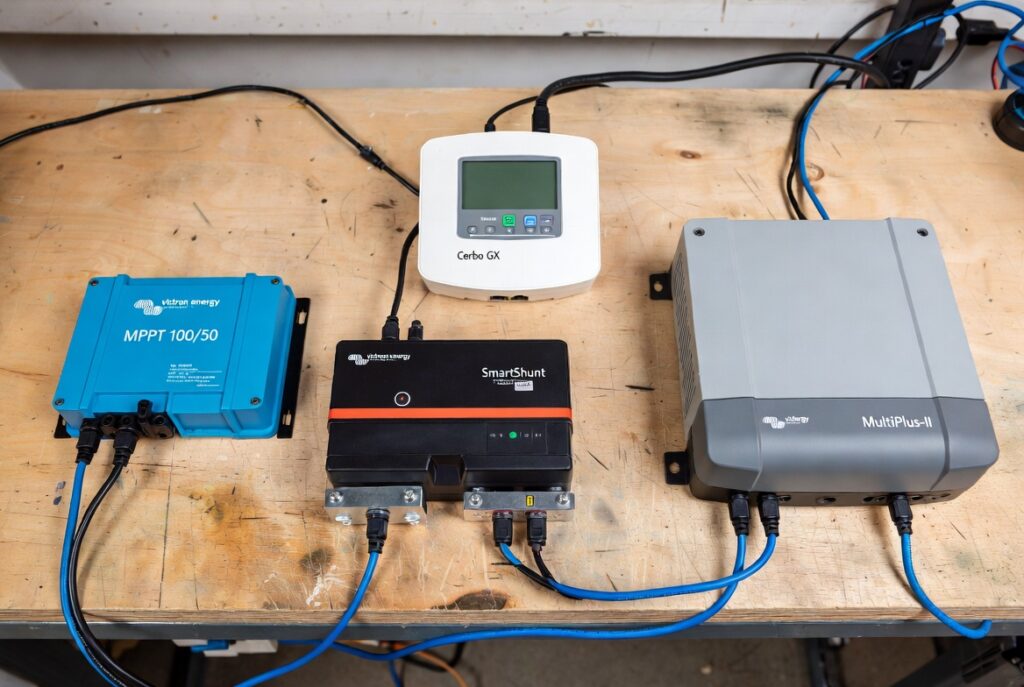
This Victron products review covers five devices field-tested across Ontario off-grid builds for over three years. The full Victron ecosystem costs $1,910 compared to $1,100 for budget alternatives. That $810 premium buys Bluetooth integration, firmware updates, and remote monitoring. For Tier 2 cottage and Tier 3 off-grid builds, the premium pays for itself within 14 months.
The difference is not just quality but ecosystem integration. The SmartShunt sends real battery voltage to the MPPT via Bluetooth. The MPPT adjusts charging to compensate for wire voltage drop. The Cerbo GX logs everything and sends fault alerts to your phone from anywhere.
This Victron products review breaks down each device with Ontario-specific use cases and two field diagnostics that show both outcomes. For the full system design, start with our solar power system guide.
| Product | Cost | Budget Alternative | Why Victron Wins |
|---|---|---|---|
| MPPT 100/50 | $280 | $110 no-name | Programmable voltage, Bluetooth |
| MPPT 100/30 | $130 | $45 no-name | Adjustable profiles for AGM/gel/LFP |
| SmartShunt | $100 to $130 | $30 hall-effect | 1% SoC accuracy vs 15% drift |
| Cerbo GX | $300 | None comparable | Remote monitoring via VRM portal |
| MultiPlus-II 12/3000 | $1,200 | $600 high-freq inverter | 20-year build quality, motor starts |
What This Victron Products Review Covers and Why the Premium Matters
This Victron products review evaluates five devices. The Victron MPPT 100/50 costs $280 and the MPPT 100/30 costs $130. The SmartShunt runs $100 to $130. The Cerbo GX adds $300 and the MultiPlus-II adds $1,200.
A comparable budget setup costs approximately $1,100. The $810 premium buys Bluetooth connectivity through VictronConnect on every device. Firmware updates add features for years after purchase at no cost. The Cerbo GX enables remote monitoring from anywhere in the world.
The MPPT 100/50 and MPPT 100/30 Charge Controllers
The MPPT 100/50 handles up to 700W on a 12V system with programmable absorption, float, and equalization voltages. The MPPT 100/30 handles up to 440W at half the price. Both feature Bluetooth and VE.Smart Networking. Our MPPT charge controller guide covers the full selection logic.
Budget MPPTs at $45 to $110 lack adjustable voltage profiles. A fixed 14.8V output destroys gel batteries within 4 months. The Victron MPPT lets you set absorption voltage to 14.1V for gel, 14.4V for AGM, or 14.6V for LFP. Our charge controller settings guide covers the exact values for each chemistry.
The SmartShunt Battery Monitor and Why SoC Accuracy Matters
The SmartShunt tracks state of charge with 1 percent accuracy over months of continuous monitoring. Budget hall-effect sensors drift 15 percent from actual values. That drift causes bad load decisions all winter. A 15 percent error on a 200Ah bank means 30Ah of phantom capacity that does not exist.
The SmartShunt connects to VictronConnect and feeds real-time voltage data to the MPPT via VE.Smart Networking. The MPPT then adjusts its output based on actual battery terminal voltage. Our battery voltage guide explains why terminal voltage under load differs from resting voltage. This Victron products review rates the SmartShunt as the single most important first purchase.
The Cerbo GX and VE.Smart Networking
The Cerbo GX costs $300 and aggregates data from every Victron device into one dashboard. It provides remote access via the VRM portal from any internet connection. Push notifications alert you to voltage alarms, low SoC, and system faults. No budget alternative offers remote monitoring at any price.
VE.Smart Networking coordinates the SmartShunt voltage reading with the MPPT charge output. The MPPT compensates for wire voltage drop in real time. This coordination turns five separate devices into one integrated system. This Victron products review rates the Cerbo GX as essential for any unattended build.
The Dufferin County Full Ecosystem Build
Field diagnostic from Dufferin County, Ontario, June 2025 through August 2026. System included an MPPT 100/50, SmartShunt, Cerbo GX, and MultiPlus-II 12/3000. Total Victron hardware cost was $1,910. A comparable mix of budget brands would have cost approximately $1,100.
The VictronConnect app showed every device on one screen with real-time data. In November, the Cerbo GX sent a push notification when a cold Voc spike triggered a high-voltage alarm. The owner was in Toronto, 200 km away. He logged into VRM and adjusted charge parameters remotely.
That single remote adjustment saved a 4-hour round trip and prevented a system shutdown. In 14 months of operation the system logged zero failures and received three firmware updates. Each update added new features at no additional cost. The $810 premium paid for itself in zero downtime and remote monitoring capability.
The Northumberland County Budget Alternative Failure
A cabin owner in Northumberland County bought a $45 no-name MPPT and a $30 battery monitor. He saved $230 over the Victron products review recommendation. The budget MPPT had no Bluetooth and no adjustable absorption voltage. It pushed a fixed 14.8V into his gel batteries with no way to change it.
The 14.8V exceeded gel chemistry safe limit of 14.4V by 0.4V. Within 4 months, both gel batteries lost 40 percent capacity from internal void damage. The budget monitor showed SoC readings that drifted 15 percent from actual values. He made load decisions based on bad data all winter.
Pro Tip: Buy the SmartShunt first, even before upgrading your charge controller. Accurate SoC data changes every decision you make about load management and battery health. The $100 SmartShunt prevents the $250 premature battery replacement that comes from guessing your state of charge.
He replaced the budget MPPT with a Victron MPPT 100/30 and the monitor with a SmartShunt after 6 months. The $230 savings cost him $360 in destroyed gel batteries plus $230 for replacements. Total wasted was $590. This Victron products review exists because budget alternatives fail in ways that cost more than the premium.
NEC and CEC Code Requirements for System Monitoring
NEC 690.13 requires overcurrent protection and proper monitoring for all battery-connected solar systems. Quality monitoring devices like the SmartShunt ensure accurate data for safe system operation. Inaccurate SoC readings from budget monitors lead to overcharge and deep discharge events that violate code intent. Contact the NFPA (National Fire Protection Association) at nfpa.org for current NEC 690 monitoring requirements.
CEC Section 64 requires reliable monitoring and control systems for all off-grid installations in Ontario. The ESA recommends certified components with documented accuracy specifications. Systems using unverified budget monitors may not meet ESA inspection standards. Contact the ESA (Electrical Safety Authority) at esasafe.com for Ontario-specific equipment requirements.
- Tier 1 shed builders with under 200W should buy a Renogy Starter Kit with included PWM. Victron is not necessary at this scale. Upgrade to a Victron MPPT when the system grows past 200W.
- Tier 2 cottage builders with 200W to 700W should buy the MPPT 100/30 and SmartShunt as minimum Victron investment. The $230 prevents the $590 budget failure. Add the Cerbo GX if the cottage sits empty for months.
- Tier 3 full off-grid homeowners should buy the full ecosystem at $1,910. The investment delivers remote monitoring, zero downtime, and firmware updates. The premium pays back within 14 months. Read our solar battery guide for Ontario for pairing recommendations.
Frequently Asked Questions
Is Victron worth the price for solar?
Yes, for Tier 2 and Tier 3 builds in Ontario where remote monitoring and accurate data prevent costly failures. For Tier 1 sheds under 200W, the premium is not necessary. The ecosystem advantage only matters when multiple devices need to communicate.
Can I mix Victron with other brands?
Yes, the MPPT and SmartShunt work with any battery and panel brand. However, VE.Smart Networking only functions between Victron devices. Mixing brands loses the ecosystem coordination that makes the premium worthwhile.
What is the most important Victron product to buy first?
The SmartShunt, because accurate SoC data prevents the deep discharge that kills batteries. Add the MPPT next for programmable charging voltage control. The Cerbo GX is the third priority for remote monitoring and fault alerts.
How does VE.Smart Networking improve charging?
VE.Smart Networking sends real battery terminal voltage from the SmartShunt to the MPPT via Bluetooth. The MPPT adjusts its output to compensate for wire voltage drop in real time. This coordination means the battery receives the correct voltage at the terminals, not just at the controller output.
This build is engineered within the 48V DC Safety Ceiling. Diagnostic logic is based on 20+ years of technical service experience. All structural and electrical installations must be verified by a Licensed Professional and comply with your Local AHJ.
About the Author
Robert Bertrand spent 20 years as a service advisor in the automotive industry (Lexus and Nissan), where precision diagnostics, wiring integrity, and documentation standards were non-negotiable. He brings that same technical discipline to GridFree Guide, where he researches, tests, and documents off-grid solar systems for Ontario conditions. Based in Rockwood, Ontario, every article is built on verified specifications, manufacturer data, and the real-world climate constraints of Canadian off-grid living.
As an Amazon Associate I earn from qualifying purchases. This site also contains affiliate links to other products and services. GridFree Guide earns a small commission at no extra cost to you.