
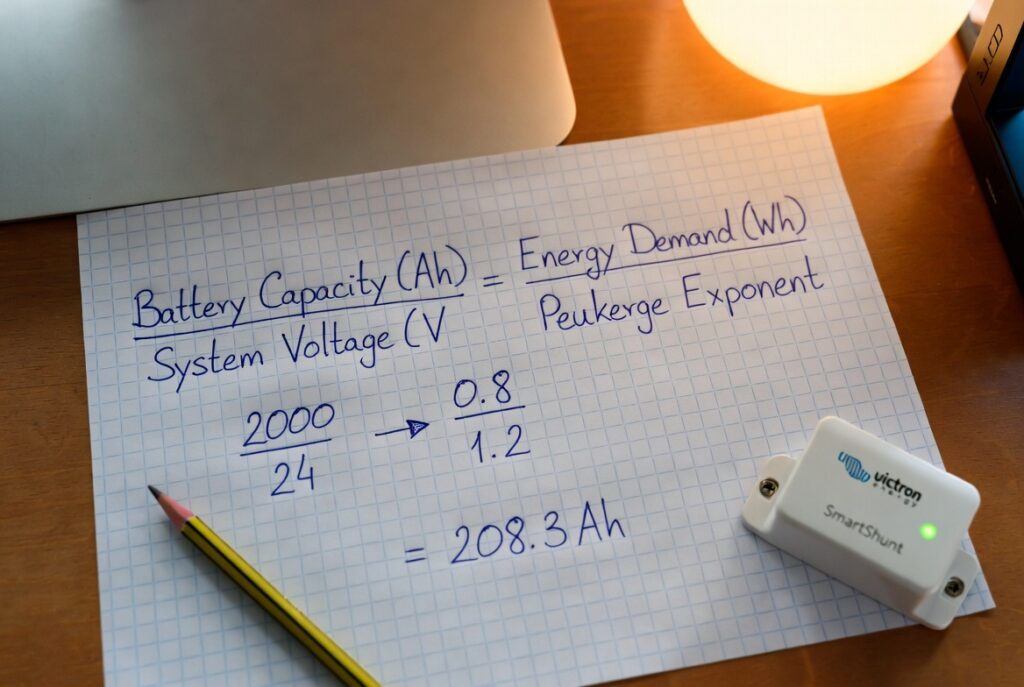
A battery sizing calculator starts with your daily load in watt-hours, not the number on the battery label. A 100Ah battery does not give you 100Ah of usable energy. AGM delivers only 50Ah usable at 50 percent DoD while LFP delivers the full 100Ah. The label tells you nothing about how many days your system will survive.
The battery sizing calculator is a 4-step formula. Calculate daily load in Wh, convert to Ah, apply the DoD limit for your chemistry, and multiply by autonomy days. In Ontario, you need at least 3 days of stored energy to survive a January grey streak. Without that buffer, the system dies on day two every time.
This guide walks through each step with real numbers and two Ontario I-moments. For the full system design sequence, start with our solar power system guide.
| Daily Load | Chemistry | DoD | Min Bank | 3-Day Autonomy | Cost |
|---|---|---|---|---|---|
| 500 Wh (shed) | AGM | 50% | 78Ah | 234Ah | ~$250 |
| 500 Wh (shed) | LFP | 100% | 39Ah | 117Ah | ~$400 |
| 2,000 Wh (cottage) | AGM | 50% | 312Ah | 936Ah | ~$1,250 |
| 2,000 Wh (cottage) | LFP | 100% | 156Ah | 468Ah | ~$2,010 |
| 3,200 Wh (home) | LFP | 100% | 250Ah | 1,000Ah | ~$3,600 |
How the battery sizing calculator works in four steps
The battery sizing calculator replaces guesswork with a repeatable formula. Step one: add up every device’s watts multiplied by hours of daily use. Step two: divide the total watt-hours by 12.8V to get daily Ah draw. Step three: divide by the DoD limit for your chemistry.
Step four: multiply the result by your target autonomy days. A 2,000 Wh cottage draws 156Ah daily and needs 312Ah minimum on AGM or 936Ah with 3 days autonomy. LFP at 100 percent DoD needs only 468Ah for the same 3 days. The battery sizing calculator shows LFP needs half the bank for the same coverage.
How to calculate your daily load in watt-hours
Start by listing every device and its daily run time. A fridge at 150W with 8 hours of compressor cycling draws 1,200 Wh. A CPAP at 60W for 8 hours draws 480 Wh. LED bulbs at 30W for 5 hours and a router at 12W for 24 hours add another 438 Wh.
Phone charging at 15W for 3 hours adds 45 Wh. A laptop at 60W for 4 hours adds 240 Wh. A typical Ontario cottage runs 2,000 to 2,500 Wh daily while a shed runs 300 to 500 Wh. These totals feed directly into the battery sizing calculator as step one.
The DoD limit step in the battery sizing calculator
The depth of discharge guide explains why DoD is the most important variable in battery sizing. AGM at 50 percent DoD means a 200Ah bank delivers only 100Ah usable. LFP at 100 percent DoD means 200Ah delivers 200Ah usable. The chemistry determines how much of the label number you actually get.
This single step doubles the AGM bank requirement compared to LFP. A cottage drawing 156Ah daily needs 312Ah of AGM but only 156Ah of LFP. The LFP versus AGM comparison shows why LFP wins on bank size and cost per cycle.
The Ontario grey streak multiplier and why autonomy saves your system
Ontario January grey streaks last 3 to 7 consecutive cloudy days with only 0.8 to 1.2 PSH of recharge. Without at least 3 days of stored energy, the system dies on day two. The battery sizing calculator’s final step multiplies the minimum bank by your autonomy target. Three days is the minimum for sheds while 4 to 5 days is recommended for homes.
This multiplier is what separates a system that survives winter from one that fails every grey streak. The solar battery lifespan guide shows how undersized banks also suffer accelerated degradation from repeated deep discharge. Oversizing by the autonomy multiplier protects both uptime and battery life.
The Lanark County undersized AGM bank
A cottage owner in Lanark County bought two 100Ah AGM batteries for a system drawing 1,500 Wh daily. At 12.8V, that is 117Ah of daily draw. At 50 percent max DoD, his usable capacity was only 100Ah from the 200Ah bank. He did not run the battery sizing calculator before purchasing.
The bank emptied every night by 10:00 PM because daily draw exceeded usable capacity. He had zero autonomy for cloudy days. During a 3-day grey streak in November, the system was dead by noon on day two. The fridge warmed, the phones died, and the router went offline.
He added two more 100Ah AGMs at $250 to reach 400Ah total with 200Ah usable. That gave him 1.7 days of autonomy. The battery sizing calculator formula would have shown 400Ah minimum from the start. He spent $500 total instead of $250 because he guessed instead of calculating.
The Peterborough County correctly sized LFP bank
A homeowner in Peterborough County ran the battery sizing calculator before spending a dollar. His daily load was 3,200 Wh at 12.8V, which equals 250Ah daily draw. At LFP’s 100 percent DoD, minimum bank was 250Ah. With 4 days autonomy for January grey streaks, the target was 1,000Ah.
He compromised on budget and built two 280Ah DIY LFP banks for 560Ah total. That gave him 2.2 days of autonomy instead of the ideal 4 days. During a 5-day grey streak in January, the Victron SmartShunt showed SOC dropping to 15 percent on day five. He knew from the calculator that day five was his limit.
He reduced non-essential loads on day three to stretch remaining capacity. On day six, partial sun restored 400 Wh and the system recovered. The bank survived because he calculated his limits before buying. He plans to add a third 280Ah bank next fall to reach 840Ah and 3.4 days of true autonomy.
NEC and CEC code requirements for battery bank sizing
NEC 690.71 addresses overcurrent protection for battery banks and requires sizing that prevents overheating under maximum load. An undersized bank operating at continuous deep discharge violates NEC 690.71 by exceeding safe thermal limits. Proper battery sizing calculator results must inform the overcurrent protection design. Contact the NFPA at nfpa.org for current requirements.
CEC Section 64 requires all battery bank installations in Ontario to meet ESA safety standards for capacity and protection. An undersized bank that regularly drops below safe DoD limits creates fire and equipment damage risk. The ESA at esasafe.com publishes sizing guidelines for residential off-grid systems. Verify your battery sizing calculator output against these standards before installation.
Pro Tip: After installing your bank, run the battery sizing calculator in reverse for one week. Log your SmartShunt SOC readings at the same time each morning. If SOC drops below 50 percent on any day with normal use, your bank is undersized. Add capacity before the first grey streak hits.
Battery sizing calculator verdict: calculate before you buy
- Shed builders with 500 Wh daily load: Two 100Ah AGMs at $250 deliver 200Ah usable with 2.6 days autonomy. Acceptable for non-critical loads. Run the battery sizing calculator to verify before purchasing.
- Cottage builders at 1,500 to 2,500 Wh daily: LFP is correct because AGM needs twice the battery count. Two 280Ah DIY LFP banks at $2,010 deliver 560Ah usable. Pair with a Victron MPPT 100/50 and Renogy 100W panels for recharge.
- Full off-grid homeowners at 3,000+ Wh daily: Size for 4 to 5 days autonomy at 1,000Ah or more of LFP. Use a SmartShunt to validate your calculator assumptions. A Battle Born 100Ah LFP is the prebuilt option if DIY is not feasible. Our solar battery guide for Ontario covers chemistry selection.
Frequently asked questions
Q: How many batteries do I need for off-grid solar?
A: It depends on your daily load. A 2,000 Wh/day cottage needs 936Ah of AGM or 468Ah of LFP for 3 days autonomy. Use the battery sizing calculator with your specific load numbers to get the correct answer.
Q: What is battery autonomy and why does it matter?
A: Autonomy is the number of days your bank can power loads without solar recharge. Ontario grey streaks require 3 to 5 days minimum. Without that buffer, the system fails on day two of every cloudy stretch.
Q: Is it better to oversize or undersize a battery bank?
A: Always oversize. An undersized bank forces deep discharge that destroys AGM within months. Oversizing by 20 to 30 percent extends lifespan and provides the grey streak buffer that Ontario demands.
This build is engineered within the 48V DC Safety Ceiling. Diagnostic logic is based on 20+ years of technical service experience. All structural and electrical installations must be verified by a Licensed Professional and comply with your Local AHJ. See our legal and safety disclosure for full scope.
About the Author
Robert Bertrand spent 20 years as a service advisor in the automotive industry (Lexus and Nissan), where precision diagnostics, wiring integrity, and documentation standards were non-negotiable. He brings that same technical discipline to GridFree Guide, where he researches, tests, and documents off-grid solar systems for Ontario conditions. Based in Rockwood, Ontario, every article is built on verified specifications, manufacturer data, and the real-world climate constraints of Canadian off-grid living.
As an Amazon Associate I earn from qualifying purchases. This site also contains affiliate links to other products and services. GridFree Guide earns a small commission at no extra cost to you.