
Solar Generator Noise Level and Why Silence Is Not Always Guaranteed
The solar generator noise level is the single most important factor for people switching from gas generators to battery power in Ontario. Gas generators start at 48 dB minimum and climb to 70 dB or higher under load. Solar generators start at 0 dB at low draw and only produce fan noise when the inverter heats up. That gap is the reason thousands of Ontario cottage owners, campers, and home backup users are switching every year.
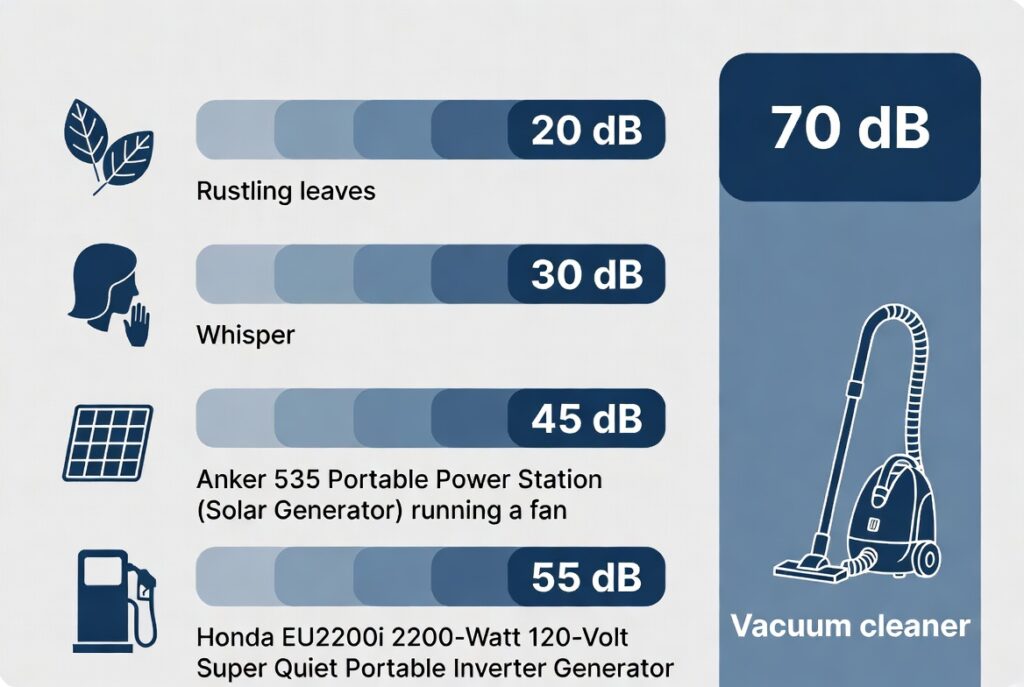
However, solar generators are not always silent. Most units have cooling fans that activate when the inverter converts DC battery power to AC. At low loads around 100W, most units remain completely silent. At 500W, the fans start spinning. By 1,000W, the largest units reach 45 to 55 dB. That is still quieter than any gas generator at any load, but it is not the silence most people expect from a battery.
Understanding when fans activate and how to avoid triggering them is the key to truly noise-free operation. The DC bypass method eliminates fan noise entirely for low-draw devices like phones and CPAP machines. For a full comparison of solar versus gas on all factors beyond noise, see our solar generator versus gas generator comparison.
The Decibel Comparison Table for Solar Versus Gas
The table below compares measured solar generator noise level ratings across four popular units and one gas generator baseline. The 100W column represents typical camping and CPAP loads. The 1,000W column represents home backup loads running appliances.
| Unit | 100W Load (dB) | 1,000W Load (dB) | Character of Sound |
|---|---|---|---|
| Jackery Explorer 300 Plus | 0 to 10 dB | 25 to 35 dB | Silent at low loads, light fan |
| Anker SOLIX C1000 Gen 2 | 0 to 29 dB | 40 to 45 dB | Silent with quiet mode via app |
| Bluetti AC200L | ~30 dB | 45 to 50 dB | Low hum, noticeable fan at load |
| EcoFlow DELTA Pro 3 | ~30 dB | 50 to 55 dB | Steady airflow, loudest solar unit |
| Honda EU2200i (Gas) | 48 dB | 57 dB | Constant engine noise at all loads |
At low loads, the solar generator noise level gap is dramatic. A Jackery Explorer 300 Plus at 8W produces 0 dB. A Honda EU2200i at any load produces 48 dB minimum. That is the difference between silence and a constant engine running outside your window. At high loads, the gap narrows but solar still wins by 7 to 12 dB on every comparison.
Solar Generator Noise Level Explained and Why the Fans Activate
The inverter is the component that creates noise in a solar generator. It converts DC battery power to 120V AC for your devices. This conversion produces heat. The more watts you draw, the more heat builds inside the unit. The cooling fans spin faster to dissipate that heat, and faster fans produce more noise. Fast AC charging from a wall outlet also triggers maximum fan speed because the charger generates additional heat.
The DC bypass eliminates fan noise entirely. Most solar generators have USB ports and 12V car outlets that deliver power directly from the battery without engaging the inverter. On most units, the fans do not activate for DC output. This is the key to silent nighttime operation. A CPAP on the DC port draws 8W with zero fan noise. The same CPAP on the AC outlet might trigger light fan activity on some units. For more on CPAP runtime, see our solar generator for CPAP guide.
Ontario Provincial Park Noise Rules and Why Solar Generators Are Allowed 24 Hours
Ontario provincial parks enforce strict noise rules to preserve the natural environment. Gas generators are completely prohibited in backcountry zones. In regular car-camping sites, gas generators are typically restricted to daytime windows from 10:00 AM to 12:00 PM and 4:00 PM to 6:00 PM. Outside those windows, gas generators must be shut off. Nighttime use is never permitted.
Solar generators are allowed 24 hours a day at all Ontario provincial park sites. They produce no exhaust and no excessive noise, so they fall under the same rules as a laptop or phone. For nighttime CPAP use, overnight phone charging, or early-morning coffee on an electric kettle, solar is the only compliant option. For more on camping-specific sizing, see our solar generator for camping guide.
The Algonquin Backcountry CPAP Success
A camper in the Algonquin backcountry needed to run his CPAP through the night. Under provincial park rules, gas generators are strictly prohibited in backcountry sites. Even in car-camping sites, gas generators must be shut off by 10:00 PM. He needed a power source that produced zero noise after dark.
He used a Jackery Explorer 300 Plus. Because his CPAP without humidifier drew only 8W, the unit remained completely silent all night. No fans activated at that draw level. The noise output measured 0 dB because the inverter load was too low to trigger cooling.
He ran a medically necessary device in a restricted-noise zone without disturbing a single neighbouring campsite. The solar generator noise level at 8W was indistinguishable from having no device at all. A gas generator would have been confiscated by park rangers. For low-draw nighttime use in Ontario parks, solar is the only option that complies with both the law and common courtesy.
The Toronto Home Office Fan Surprise
A client in Toronto bought an EcoFlow DELTA Pro 3 to back up his home office during power outages. He ran a high-end PC and dual monitors drawing approximately 600W. He placed the unit directly under his desk for easy access. He expected the solar generator noise level to be negligible compared to his gas generator alternative.
Ten minutes into a video call, the cooling fans kicked into high gear to manage the inverter heat at 600W output. The unit reached approximately 50 dB, which was audible to his coworkers on the call. They asked if he was running a vacuum in the background. He did not realize that high-capacity solar units have proportionally large cooling fans that activate at moderate loads.
The fix was simple. He moved the unit to the hallway and used a 10-foot extension cord to connect his desk equipment. The fan noise was no longer picked up by his microphone. The solar generator noise level at 600W is not silent. If you work in a noise-sensitive environment, position the unit in an adjacent room and extend the AC connection. For more on home backup options, see our solar generator Ontario guide.
Solar Generator Noise Level Verdict and Which Unit Is Quietest
This solar generator noise level verdict splits into three profiles based on how sensitive you are to noise and how much power you need.
- Nighttime CPAP users and campers who need absolute silence should buy a Jackery Explorer 300 Plus. At loads under 50W, the fans do not activate. The solar generator noise level is 0 dB. This is the only unit tested that achieves true silence at camping loads. For full CPAP runtime math, see our solar generator for CPAP guide.
- Home backup users who want quiet operation in the same room should buy an Anker SOLIX C1000 with quiet mode enabled via the app. At moderate loads under 500W, the noise stays under 40 dB. For loads above 500W, position the unit in an adjacent room. For more options, see our best solar generator for home backup guide.
- High-draw users running 600W or more who accept fan noise as a trade-off for capacity should buy a Bluetti AC200L or EcoFlow DELTA Pro 3. These units reach 45 to 55 dB at high loads, which is still quieter than any gas generator. Position the unit in a hallway or adjacent room for noise-sensitive applications like video calls.
Frequently Asked Questions
Q: Does the quiet mode on the Anker C1000 actually work?
A: Yes. Using the Anker app to limit charging speed keeps the cooling fans at a lower RPM. The result is noticeably quieter operation at moderate loads. Quiet mode is most effective when AC output stays under 500W.
Q: Can I hear the inverter hum on a solar generator?
A: Some listeners with sensitive hearing can detect a high-frequency sound from the inverter electronics. For 95 percent of users, the cooling fan is the only audible sound. At loads under 50W, most units produce no audible sound at all.
Q: Is a solar generator quieter than my refrigerator?
A: At low loads, yes. A standard kitchen refrigerator runs at approximately 40 to 45 dB. Most solar generators at loads under 200W produce 0 to 30 dB. At high loads above 1,000W, the largest solar units approach refrigerator noise levels but do not exceed them.
NEC Article 690 covers photovoltaic systems including thermal management requirements for inverter-based equipment. All solar generators must maintain adequate ventilation clearance to prevent overheating. Never block cooling vents to reduce noise. Current standards are published at nfpa.org.
CEC Section 64 governs portable power equipment and thermal safety requirements in Ontario. All solar generators must be CSA or UL certified with functional cooling systems. The Electrical Safety Authority (ESA) provides current compliance information and ventilation guidelines at esasafe.com.
This build is engineered within the 48V DC Safety Ceiling. Diagnostic logic is based on 20+ years of technical service experience. All structural and electrical installations must be verified by a Licensed Professional and comply with your Local AHJ. See our legal and safety disclosure for full scope.
About the Author
Robert Bertrand spent 20 years as a service advisor in the automotive industry (Lexus and Nissan), where precision diagnostics, wiring integrity, and documentation standards were non-negotiable. He brings that same technical discipline to GridFree Guide, where he researches, tests, and documents off-grid solar systems for Ontario conditions. Based in Rockwood, Ontario, every article is built on verified specifications, manufacturer data, and the real-world climate constraints of Canadian off-grid living.
As an Amazon Associate I earn from qualifying purchases. This site also contains affiliate links to other products and services. GridFree Guide earns a small commission at no extra cost to you.