
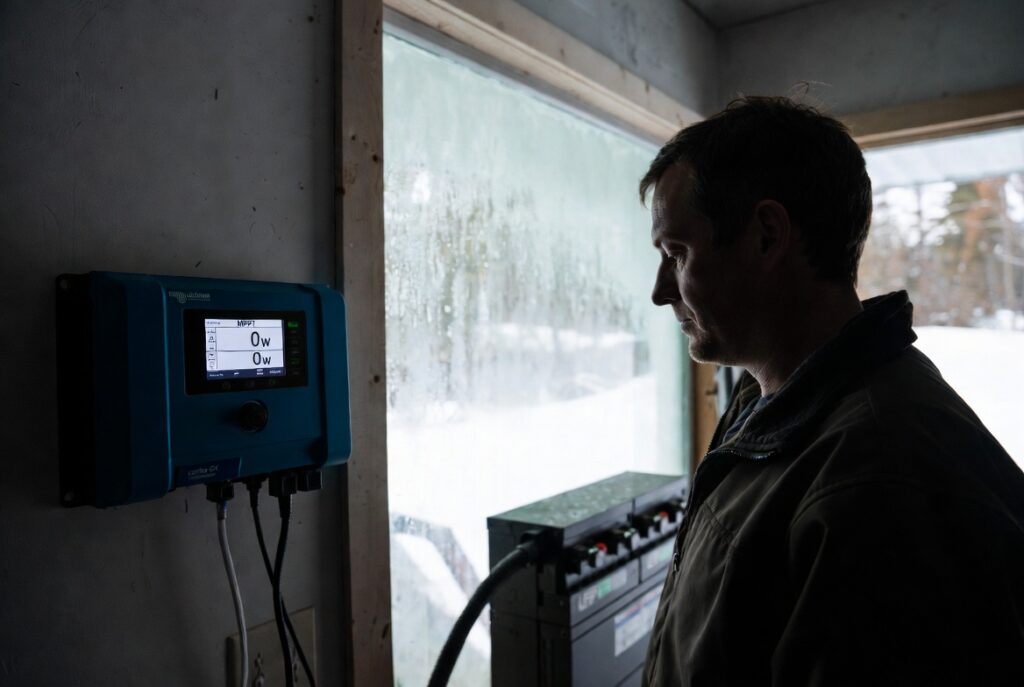
The solar fault Ontario call that arrives most often in October is from a property owner who is certain their MPPT controller has failed because the SmartShunt shows zero input current on a clear morning but the Cerbo GX is showing no faults. The Renfrew County investigation confirmed: the system was functioning correctly, the cells were below 0 degrees C, and the BMS was protecting them.
The SmartShunt is the correct first instrument to check when any solar fault Ontario is suspected. A reading of 0.0A input on a clear day means no current is entering the bank, but the cause could be any of seven distinct issues ranging from a cold BMS to a shaded panel.
Running through the seven causes in order of frequency takes less than 30 minutes and identifies the fault without replacing any components. Cause 1 (BMS cold block) takes 2 minutes to diagnose with a VictronConnect cell temperature reading. Cause 2 (partial shade) takes 5 minutes by walking the array and checking Cerbo GX current data. Causes 3 through 7 (MC4 connection, Voc, full SoC, fuse, VE.Direct cable) each take 2 to 5 minutes. See our Ontario solar sizing guide for the full system specification that prevents most solar fault Ontario issues before commissioning.
The solar fault Ontario diagnostic sequence: start with the SmartShunt, not the MPPT
| Cause | Symptom | Diagnostic tool | Time to diagnose |
|---|---|---|---|
| 1. BMS cold block | 0.0A input, clear day, Oct,Apr | VictronConnect cell temp | 2 min |
| 2. Partial shade | Full Voc, near-zero current | VRM current graph + visual | 5,10 min |
| 3. Loose MC4 | Below-expected production | Physical , warm to touch | 5 min |
| 4. Voc too low | MPPT never starts charging | Check panel Voc vs bank voltage | 5 min |
| 5. Full SoC (float) | MPPT in float, no current | SmartShunt at 100% | 1 min |
| 6. Blown Class T fuse | MPPT shows production, SmartShunt 0A | Visual fuse + terminal inspect | 5 min |
| 7. VE.Direct fault | Cerbo shows fault, MPPT LED active | Reseat VE.Direct cable | 2 min |
The first step in any solar fault Ontario diagnosis is to confirm what the SmartShunt is actually seeing. The SmartShunt on the battery negative terminal measures all current flowing in and out of the bank regardless of what the MPPT display or Cerbo GX reports. If the SmartShunt shows 0.0A input on a clear day, no current is reaching the bank , but the MPPT may still be producing current that is being blocked before it reaches the shunt. If the SmartShunt shows normal current but the Cerbo GX reports a fault, the fault is in the communications layer. These two readings together narrow the solar fault Ontario before any component is touched.
Ontario’s cause 1 (BMS cold block October through April) and cause 2 (partial shade) together account for the majority of solar fault Ontario calls from September through May. Both are diagnosed without any tools beyond the VictronConnect app and a walk of the array. Cause 1 resolves in 2 hours with no component replacement. Cause 2 resolves in 10 minutes with a panel adjustment. Causes 3 through 7 are less frequent but each has a clear diagnostic path. See our Ontario Victron solar guide for the full SmartShunt wiring specification that makes this diagnostic sequence possible.
The solar fault Ontario cause 1: BMS cold block and the Renfrew County October result
An owner in Renfrew County called in October 2023 certain that their MPPT controller had failed overnight. The SmartShunt showed 0.0A input from a clear 8 AM sky. The Cerbo GX displayed no error codes. All components had power. Every indicator suggested the system was online except the one that mattered: no current was entering the bank. The VictronConnect app connected to the battery via Bluetooth and showed an internal cell temperature of -2 degrees C. The LFP BMS charge block threshold is 0 degrees C. The system was functioning correctly and protecting the cells from lithium plating damage that would have occurred if charging had proceeded at that temperature.
The fix was moving the battery bank from the unheated outbuilding to the heated cabin. After 2 hours of thermal equalisation, the VictronConnect app confirmed cell temperature had risen to 5 degrees C. The SmartShunt immediately confirmed 14.2A of charging current from the array. Total repair cost: zero dollars. The solar fault Ontario was a BMS cold block, not a failed MPPT. The owner’s comment: “The system wasn’t broken. The battery was just cold.” He installed a Battle Born heated LFP the following spring to permanently eliminate the BMS cold block for year-round unheated outbuilding storage.
The Battle Born heated LFP self-heater activates at 2 degrees C cell temperature and allows charging at ambient temperatures down to -25 degrees C. For any Ontario property owner who stores the battery bank in an unheated space from October through April, the heated LFP eliminates cause 1 permanently. The standard LFP BMS cold block is not a defect , it is a protection mechanism , but it is also the most preventable solar fault Ontario cause on this list. See our Ontario LiFePO4 battery guide for the full cold storage comparison between standard and heated LFP.
Cause 2: partial shade on a series string and the Prince Edward County VRM diagnosis
A 400W array in Prince Edward County with 4 panels wired in series was stuck below 40 percent SoC for 3 consecutive days in mid-July 2024 despite clear skies. The VRM portal showed a consistent pattern: MPPT Voc reading normal (full panel voltage) every day, but MPPT current dropping to near zero every day at approximately 11 AM and staying low until approximately 2 PM. Full Voc with near-zero current is the diagnostic signature of partial shade on a series string. In a series configuration, all panels share the same current path , one shaded panel’s current limits the entire string regardless of what the other panels are producing.
Physical inspection at 11 AM on the third day found the cause: a newly installed roof vent cover that had been added during a recent renovation was casting a shadow approximately 4 inches wide across the lower corner of the westernmost panel. Moving that panel 6 inches left on its existing mount cleared the shadow completely. The SmartShunt confirmed full array production on the next clear morning. The Cerbo GX VRM current graph was the diagnostic tool that identified the problem without a single physical inspection , the consistent daily timing of the current drop pointed directly to a moving shadow source rather than a hardware fault. See our Ontario MC4 connector guide for the series vs parallel wiring decision.
Cause 3: loose or high-resistance MC4 connector
A loose or corroded MC4 connection produces a solar fault Ontario with a different signature than cause 1 or 2: production is below expected but not near zero, and the shortfall is consistent across all irradiance conditions rather than time-of-day dependent. The diagnostic test is physical , under load, a high-resistance MC4 connection generates heat from resistive current flow. A connection that is warm to the touch while the system is producing is a confirmed high-resistance joint. This is the same fault that the Muskoka property owner detected via the VRM portal: 15 percent below baseline production, confirmed by physical inspection as a loose MC4 collar that had developed high resistance from freeze-thaw thermal cycling.
Tightening the MC4 collar until the locking tab clicks into place resolves most loose connection solar fault Ontario cases. If the collar is damaged or if the connection shows discoloration from prolonged resistive heating, replace the MC4 housing rather than retightening. A replacement MC4 pair costs approximately $2 to $5 and takes less than 5 minutes to crimp. Inspecting all MC4 connections at the start of each Ontario season , particularly after the first hard freeze , prevents this solar fault Ontario cause from progressing to a melted housing or a complete panel disconnect. See our Ontario solar storage guide for the full seasonal inspection checklist.
Cause 4, 5, 6, and 7: Voc, full SoC, blown fuse, and VE.Direct cable fault
Cause 4 is an MPPT that never begins charging because the panel Voc is insufficient relative to the battery voltage. The Victron MPPT 100/50 requires array Voc to be at least 5V above battery voltage to initiate charging: a 12V bank needs at least 17V array Voc and a 24V bank needs at least 29V. A single 100W panel with 21 to 23V STC Voc is adequate for a 12V bank but will never charge a 24V bank alone.
Cause 5 is not a fault at all: a SmartShunt showing 100 percent SoC with the MPPT in float mode means the system is working exactly as designed. A property owner who topped up the bank from a generator overnight then sees zero charging current the next clear morning has a full bank, not a broken system.
Cause 6 is a blown or corroded Class T fuse on the battery positive line: the MPPT shows production but the SmartShunt shows zero input because the fuse is an open circuit between them. Inspect the fuse visually and check both terminal lugs for grey-white oxidation on the copper. Replace the fuse (approximately $20 to $40) and clean the terminals if oxidation is present.
Cause 7 is a VE.Direct cable fault producing a false solar fault Ontario indication on the Cerbo GX. The MPPT physical LED shows bulk or absorb charging active, but the Cerbo GX reports connection lost or MPPT fault. Reseat the VE.Direct cable at both ends; if the fault persists after reseating, replace the cable for approximately $15 to $25. The SmartShunt continues to report correct current data during a VE.Direct fault on the MPPT connection.
NEC and CEC: Ontario permit requirements and safety standards for solar charging systems
NEC 690 and NEC 690.9 govern permanently wired Ontario off-grid solar charging installations. All DC conductors from the battery bank must be sized for 125 percent of maximum continuous current, and the Class T fuse referenced in cause 6 above must be installed within 18 inches of the battery positive terminal. The correct fuse placement is the most common solar fault Ontario wiring error that causes a cause 6 diagnostic: a fuse installed far from the battery terminal introduces a long unprotected conductor that can arc if damaged before the overcurrent protection acts. Contact the NFPA at nfpa.org for current NEC 690 requirements.
CEC Section 64 governs all permanent Ontario electrical installations including solar charging systems. A permanently wired solar fault Ontario system requires an ESA permit before installation. The ESA inspector will verify conductor sizing, overcurrent device placement, and array grounding. For any Ontario property owner who has modified their system , added panels, replaced the MPPT, or changed the battery bank , and has not updated the permit, the ESA permit should be revisited before the next inspection cycle. Contact the Electrical Safety Authority Ontario at esasafe.com for Ontario solar installation permit requirements.
Pro Tip: Run the 7-cause diagnostic sequence in writing on a notepad before touching any component. Write down what the SmartShunt reads, what the Cerbo GX displays, and what the MPPT LED shows before unplugging anything. These three readings together point to the correct cause in most solar fault Ontario cases without any further investigation. Cause 1 (BMS cold block): SmartShunt 0A, Cerbo no fault, MPPT offline. Cause 2 (shade): SmartShunt 0A, Cerbo shows low current, MPPT Voc normal. Cause 6 (fuse): SmartShunt 0A, MPPT shows production. The three readings take 30 seconds to record and eliminate 6 of the 7 causes before a single wire is touched.
The solar fault Ontario verdict: three causes cover 80 percent of Ontario faults
- Ontario property owner with zero input in October through April: the solar fault Ontario diagnosis is BMS cold block until proven otherwise. Check cell temperature via VictronConnect before touching any other component. If below 0 degrees C, move the bank above 0 degrees C and wait 2 hours. The Renfrew County result: -2 degrees C confirmed, 2-hour warm-up, 14.2A full production restored at zero cost. Permanent fix: Battle Born heated LFP eliminates cause 1 for year-round unheated Ontario storage.
- Ontario property owner with reduced or intermittent production in summer: the solar fault Ontario diagnosis is partial shade until proven otherwise. Check the Cerbo GX VRM current graph for a daily drop at a consistent time. Full Voc with near-zero current confirms series string shade. Walk the array at the time of the drop and look for shadow sources. The Prince Edward County result: 4-inch vent cover shadow on one panel limiting 400W of array to near zero; 6-inch panel adjustment restored full production.
- Ontario property owner with SmartShunt showing zero input while the MPPT shows production: the solar fault Ontario diagnosis is cause 6 , blown or corroded Class T fuse. Inspect the fuse and both terminal lugs before replacing any other component. A corroded lug has grey-white oxidation on the copper surface. Replace the fuse (approximately $20 to $40) and clean the terminals. If the fuse is intact and terminals are clean, the fault is cause 7 , reseat or replace the VE.Direct cable between the MPPT and Cerbo GX.
Frequently Asked Questions
Q: Why does my solar battery show zero charging current on a clear Ontario day?
A: The most common solar fault Ontario cause for zero input on a clear day from October through April is a BMS cold block: the LFP battery cells have been cold-soaked below 0 degrees C and the BMS is blocking charging to prevent lithium plating. Check cell temperature via the VictronConnect app. If below 0 degrees C, move the bank to a heated space and recheck in 2 hours.
In summer, zero input on a clear day with full Voc on the Cerbo GX indicates partial shade on a series string. Walk the array at the time of zero current and look for shadow sources. The SmartShunt reading combined with the Cerbo GX Voc reading narrows the solar fault Ontario to one of these two causes in 90 percent of cases.
Q: Why is my solar array producing voltage but no current in Ontario?
A: Full Voc with near-zero current is the diagnostic signature of partial shade on a series string. In a series-wired array, one shaded panel limits the current for the entire string regardless of what the other panels are producing. The Cerbo GX VRM current graph identifies this solar fault Ontario by showing a consistent daily current drop at the time the shadow moves across the affected panel. Physical inspection at the time of the drop finds the shadow source , a chimney, vent pipe, tree branch, or new rooftop feature installed since commissioning. Moving the shaded panel out of the shadow path or rewiring the affected panel in parallel resolves the fault permanently.
Q: How do I know if my LFP battery BMS is blocking solar charging in Ontario?
A: The BMS cold block solar fault Ontario has three simultaneous indicators: the SmartShunt shows 0.0A input, the Cerbo GX shows no error codes, and the MPPT shows offline or zero production despite a clear sky. All three together confirm the fault is in the battery rather than the charging circuit. Confirm by checking cell temperature in the VictronConnect app , a reading below 0 degrees C confirms BMS cold block. The fix is warming the bank above 0 degrees C before rechecking. For year-round unheated Ontario storage, specify the Battle Born heated LFP. It self-heats at 2 degrees C and maintains charge acceptance regardless of ambient temperature.
This build is engineered within the 48V DC Safety Ceiling. Diagnostic logic is based on 20+ years of technical service experience. All structural and electrical installations must be verified by a Licensed Professional and comply with your Local AHJ. See our legal and safety disclosure for full scope.
About the Author
Robert Bertrand spent 20 years as a service advisor in the automotive industry (Lexus and Nissan), where precision diagnostics, wiring integrity, and documentation standards were non-negotiable. He brings that same technical discipline to GridFree Guide, where he researches, tests, and documents off-grid solar systems for Ontario conditions. Based in Rockwood, Ontario, every article is built on verified specifications, manufacturer data, and the real-world climate constraints of Canadian off-grid living.
As an Amazon Associate I earn from qualifying purchases. This site also contains affiliate links to other products and services. GridFree Guide earns a small commission at no extra cost to you.