
The drone solar ontario constraint that grounds commercial operators and wildlife photographers is not weather or airspace but battery management, because a DJI Mavic 3 intelligent flight battery delivers approximately 27 minutes of usable flight time per charge and a 6-hour Ontario survey day requires approximately 13 full charges totaling approximately 1,001Wh of charging energy. Any Ontario drone operator without a solar charging solution is either hauling 13 pre-charged batteries into the backcountry or ending their shoot at noon.
A 40Ah LFP bank at 80 percent depth of discharge provides approximately 410Wh of usable energy, covering approximately 5.3 full Mavic 3 charges from the bank alone before the panel adds a single watt. The SmartShunt on the battery negative terminal confirms bank state of charge in real time and shows exactly how many charges remain at any point in the shooting day.
A 100W Renogy flexible panel at Ontario summer 5.5 peak sun hours produces approximately 550Wh per clear day. Combined with the 40Ah LFP bank, the total daily drone solar ontario capacity is approximately 960Wh, or approximately 12 full Mavic 3 charges per clear Ontario summer day. The panel produces continuously during the midday production window while the operator flies morning batteries from the bank. By 2 PM the bank is fully recharged and ready for the afternoon session.
The drone solar ontario advantage over hauling pre-charged batteries is not just weight , it is operational flexibility. A wildlife photographer on a 3-day Algonquin backcountry canoe trip cannot carry 39 pre-charged Mavic 3 batteries. A Niagara vineyard operator running an 8-hour commercial survey cannot recharge 22 batteries from a single shore power outlet fast enough to maintain continuous operations. The portable drone solar ontario system converts any Ontario location with south-facing solar access into a fully self-sufficient charging station for the entire shoot. See our Ontario solar sizing guide before any drone solar ontario bank decision.
The drone solar ontario charging math: 77Wh per Mavic 3 charge, 960Wh daily capacity, 12 charges per clear day
| Spec | Backcountry (40Ah LFP + 100W panel) | Commercial (100Ah LFP + 200W panel) |
|---|---|---|
| Bank usable (80% DoD) | 410Wh (~5.3 charges) | 1,024Wh (~13.3 charges) |
| Panel , summer (5.5 PSH) | 550Wh (~7.1 charges) | 1,100Wh (~14.3 charges) |
| Combined daily , summer | 960Wh (~12.5 charges) | 2,124Wh (~27.6 charges, 22 practical) |
| Panel , fall (3.5 PSH) | 350Wh (~4.5 charges) | 700Wh (~9.1 charges) |
| Combined daily , fall | 760Wh (~10 charges) | 1,724Wh (~22 charges) |
The DJI Mavic 3 intelligent flight battery is 77Wh and delivers approximately 27 minutes of usable flight time per charge. A 6-hour Ontario survey day requires approximately 13 full charges, totaling approximately 1,001Wh of charging energy. A 40Ah LFP bank at 80 percent depth of discharge provides approximately 410Wh, covering the first approximately 5.3 charges from the bank before the panel contributes anything. The 100W Renogy flexible panel at Ontario summer 5.5 PSH adds approximately 550Wh, bringing the combined daily drone solar ontario capacity to approximately 960Wh.
The operating sequence on a clear Ontario shooting day works in two phases. Morning flights draw from the LFP bank while the panel charges continuously; by early afternoon the bank is at full capacity and the operator runs afternoon flights from fresh bank charge. The SmartShunt shows remaining capacity in real time throughout the day, eliminating any guesswork about how many charges are left before the system needs to rest. The practical limit for a 40Ah LFP plus 100W panel system is approximately 12 Mavic 3 charges per clear summer day, which covers a serious 6-hour shoot with a small reserve. See our Ontario solar storage guide for the full LFP capacity specification.
The Algonquin backcountry spec: 40Ah LFP, 100W flexible panel, and 3 days of self-sufficient flying
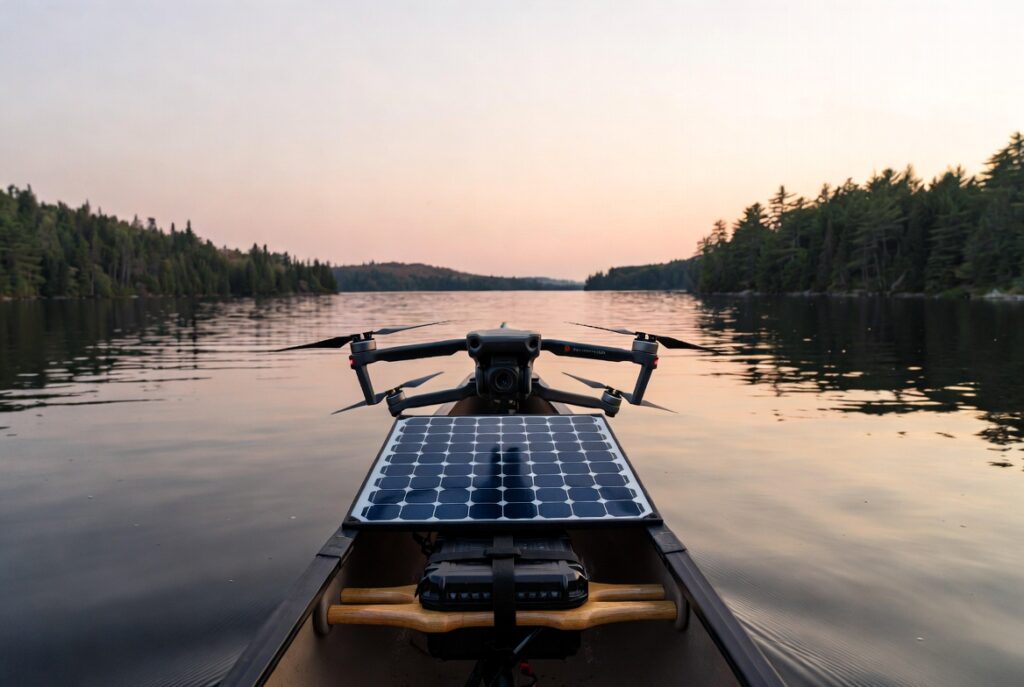
A wildlife photographer planning a 3-day backcountry canoe loop in Algonquin Park in August 2023 needed to document moose movement in remote lakes accessible only by paddle. He was running a DJI Mavic 3 and needed enough charging capacity for 3 to 4 full survey flights per day across 3 days without resupply. His drone solar ontario kit was a 40Ah LFP in a waterproof Pelican-style case secured to the centre thwart, a 100W Renogy flexible panel lashed to the canoe bow with four adjustable straps, a Victron MPPT 100/30 and a SmartShunt on the battery negative. The total kit weight was approximately 12 lbs , less than a second paddle.
Across three clear August days, the SmartShunt confirmed 8 full Mavic 3 charges per day: 8 x 77Wh = 616Wh of drone charging energy drawn against the approximately 960Wh combined daily capacity. He completed 3 to 4 full survey flights per day at approximately 27 minutes per flight, capturing footage across 6 remote lake sites. The LFP bank entered day 2 at approximately 80 percent SoC after the previous afternoon’s full panel recharge, and entered day 3 at approximately 85 percent SoC. The SmartShunt never showed the bank below 35 percent at any point during the 3-day loop.
He finished the Algonquin trip with the bank at 78 percent SoC and a full card of usable moose footage. The drone solar ontario backcountry result confirmed the 4 lbs Renogy flexible panel adds less than a lens to the canoe load and the 40Ah LFP adds less than a dry bag. For any Ontario backcountry drone operator, the weight penalty is negligible and the operational gain is complete independence from wall power for the entire duration of the trip. See our Ontario fish finder solar guide for the same canoe bow panel spec applied to sonar charging.
The Niagara commercial spec: 100Ah LFP, 200W array, and 22 Mavic 3 charges per summer day
A commercial drone operator in Niagara-on-the-Lake held a June to October aerial survey contract covering 50 acres of vineyard for a client needing monthly growth mapping and harvest condition reporting. He needed a drone solar ontario charging station that could sustain a full 8-hour commercial day with 2 to 3 DJI Mavic 3 drones rotating through the battery queue simultaneously, without requiring a shore power hookup at each vineyard location. His trailer-based spec was a 100Ah Battle Born heated LFP bank, a 200W panel array on the trailer roof, an MPPT 100/30, and a SmartShunt on the battery negative.
The SmartShunt confirmed 22 full Mavic 3 battery charges per summer day at Ontario summer 5.5 PSH: the 100Ah bank at 80 percent DoD provides approximately 1,024Wh and the 200W panel at 5.5 PSH produces approximately 1,100Wh, for a combined daily capacity of approximately 2,124Wh. Three simultaneous Mavic 3 chargers draw approximately 195W total, which the 200W panel sustains with the bank absorbing fluctuation. The practical charge count is 22 rather than the theoretical 27 maximum because the operator allows buffer for recharge overlap and battery cooling time between flights. The SmartShunt prevented over-discharge across the entire June to October season by showing bank SoC in real time at the trailer.
The commercial drone solar ontario result was a 40 percent increase in survey capacity over the previous season when battery availability was the daily constraint. The trailer-based setup required zero shore power hookups at any of the 12 vineyard sites across the contract season. The Battle Born heated LFP specification became relevant in October when overnight trailer temperatures dropped below 0 degrees C , the standard LFP BMS would have blocked morning charging until the bank warmed above 0 degrees C by ambient conduction. See our Ontario cabin solar guide for the full trailer-based portable solar specification.
The drone solar ontario seasonal reality: 5.5 PSH in summer, 3.5 PSH in fall, and the cold battery rule
Ontario peak drone solar production runs from June through August at approximately 5.5 PSH per day. A 100W panel produces approximately 550Wh per clear day and a 200W array produces approximately 1,100Wh. September and October drop to approximately 3.5 PSH, reducing the 100W panel yield to approximately 350Wh and the combined backcountry system daily capacity to approximately 760Wh , approximately 10 Mavic 3 charges. November through March averages approximately 1.5 PSH with frequent overcast, reducing the 100W panel yield to approximately 150Wh on clear days and near zero on overcast days. For most Ontario backcountry drone operators, November through March is functionally off-season.
Both DJI Mavic 3 LiPo batteries and the LFP charging bank have cold temperature limitations that Ontario operators need to manage separately. Keep Mavic 3 batteries in an inside jacket pocket between flights when ambient temperature is below 5 degrees C. Below this threshold the LiPo chemistry loses 15 to 20 percent of rated flight time and the battery management system may slow-charge or refuse charging.
The LFP charging bank operates to approximately -20 degrees C for discharge but the BMS blocks charging below 0 degrees C cell temperature. The LFP charging bank operates to approximately -20 degrees C for discharge but the BMS blocks charging below 0 degrees C cell temperature , the same rule that applies to every LFP battery stored in an unheated Ontario space. For year-round or cold-weather drone solar ontario operations, the Battle Born heated LFP self-heats at 2 degrees C to maintain charging regardless of ambient temperature.
NEC and CEC: Ontario permit requirements for drone operations and portable solar charging
Transport Canada regulates drone operations in Ontario under the Aeronautics Act , RPAS regulations govern where and how drones fly, not the ESA or NEC 690. A portable drone solar ontario charging system using an LFP bank, flexible panel, and MPPT controller with no permanent connection to any fixed structure does not require an ESA permit. The setup is equivalent to a portable power bank used in the field , no permanent wiring modification occurs and the Ontario Electrical Safety Code permanent installation requirements do not apply. Contact the NFPA at nfpa.org for current NEC requirements applicable to portable power systems.
Any permanently wired drone solar ontario charging installation connected to a building electrical system, a trailer shore power inlet, or a dock-side electrical supply requires compliance with CEC Section 64 and an ESA permit before installation begins. This includes any fixed panel wired into a trailer’s 12V bus or any shore power inlet wired into the trailer electrical system. Contact the Electrical Safety Authority Ontario at esasafe.com before beginning any permanently wired Ontario drone solar charging installation.
Pro Tip: Before any Ontario drone solar ontario shoot, confirm the SmartShunt shows full bank capacity and run the first Mavic 3 charge cycle while the panel is producing to verify the system is functioning correctly. A bank that shows 95 percent but will not accept the first charge cycle indicates either a loose MC4 connection on the panel output or a BMS cold block if the temperature is near 0 degrees C. Diagnosing this in the parking lot before a 3-day Algonquin backcountry trip takes 5 minutes. Diagnosing it on the water on day 2 costs the afternoon shoot. The SmartShunt live display confirms both the panel input current and the battery draw simultaneously.
The drone solar ontario verdict: 40Ah LFP for backcountry, 100Ah for commercial, and why the SmartShunt is essential
- Ontario backcountry photographer or recreational operator (Algonquin, Temagami, wilderness canoe trips): 40Ah LFP in a waterproof case, 100W Renogy flexible panel on the canoe bow, MPPT 100/30, SmartShunt. The Algonquin result: 8 full Mavic 3 charges per clear day, 3 to 4 complete survey flights, 3-day self-sufficient backcountry operation with bank never below 35 percent SoC. Total weight added to the canoe: approximately 12 lbs. The entire drone solar ontario kit packs into a single dry bag plus the rolled flexible panel.
- Ontario commercial operator (vineyard surveys, real estate, agricultural mapping, June to October): 100Ah Battle Born heated LFP, 200W array on a dedicated trailer, MPPT 100/30, SmartShunt. The Niagara result: 22 Mavic 3 charges per summer day, full 8-hour commercial shoot, zero shore power across the entire June to October season, survey capacity increased 40 percent. The heated LFP handles October overnight trailer temperatures without a morning charge block.
- Ontario drone operator running cold-weather operations (October through April): specify the Battle Born heated LFP for the charging bank. The standard LFP BMS charge block below 0 degrees C will cut morning charging in any unheated Ontario trailer or vehicle. The Battle Born self-heater activates at 2 degrees C and maintains full charge acceptance regardless of ambient temperature. Keep Mavic 3 LiPo batteries in a heated case or inside pocket below 5 degrees C until immediately before flight , the drone battery cold limitation and the LFP bank cold limitation are separate systems requiring separate management.
Frequently Asked Questions
Q: How many DJI Mavic 3 batteries can I charge from a solar system in Ontario?
A: A portable drone solar ontario system with a 40Ah LFP bank and 100W flexible panel provides approximately 12 full Mavic 3 charges per clear Ontario summer day at 5.5 PSH. The 40Ah bank alone provides approximately 5.3 charges before the panel adds its contribution. In September and October at 3.5 PSH, the same system provides approximately 10 charges per clear day. For a commercial operator requiring 22 charges per day, the correct specification is a 100Ah LFP bank and 200W panel array, as the Niagara-on-the-Lake result confirmed across the full June to October vineyard survey season. The SmartShunt is the tool that confirms the actual charge count at any point in the shooting day.
Q: What solar panel do I need for drone operations in Algonquin Park?
A: A 100W Renogy flexible panel is the correct backcountry drone solar ontario specification for canoe-based Algonquin operations. At approximately 4 lbs it adds less than a lens to the canoe load and can be lashed to the bow without drilling. At Ontario August 5.5 PSH it produces approximately 550Wh per clear day, which combined with a 40Ah LFP bank provides approximately 960Wh of total daily capacity , approximately 12 full Mavic 3 charges. The Algonquin wildlife photographer confirmed 8 charges per day across 3 days at summer production rates, completing 3 to 4 full survey flights daily with reserve remaining. A rigid 100W panel produces marginally more per hour but is not practical for canoe portaging.
Q: Can I run commercial drone operations in Ontario without shore power?
A: Yes. A 100Ah LFP bank and 200W array on a dedicated survey trailer provides approximately 22 full Mavic 3 battery charges per clear Ontario summer day , enough for a full 8-hour commercial shoot operating 2 to 3 drones simultaneously. The Niagara-on-the-Lake vineyard operator ran the entire June to October season across 12 survey sites without a single shore power hookup. The SmartShunt confirmed bank state of charge throughout the day and prevented over-discharge. For October and later operations when overnight trailer temperatures drop below 0 degrees C, specify the Battle Born heated LFP to prevent the standard LFP BMS charge block from cutting morning charging before the day begins.
This build is engineered within the 48V DC Safety Ceiling. Diagnostic logic is based on 20+ years of technical service experience. All structural and electrical installations must be verified by a Licensed Professional and comply with your Local AHJ. See our legal and safety disclosure for full scope.
About the Author
Robert Bertrand spent 20 years as a service advisor in the automotive industry (Lexus and Nissan), where precision diagnostics, wiring integrity, and documentation standards were non-negotiable. He brings that same technical discipline to GridFree Guide, where he researches, tests, and documents off-grid solar systems for Ontario conditions. Based in Rockwood, Ontario, every article is built on verified specifications, manufacturer data, and the real-world climate constraints of Canadian off-grid living.
As an Amazon Associate I earn from qualifying purchases. This site also contains affiliate links to other products and services. GridFree Guide earns a small commission at no extra cost to you.