
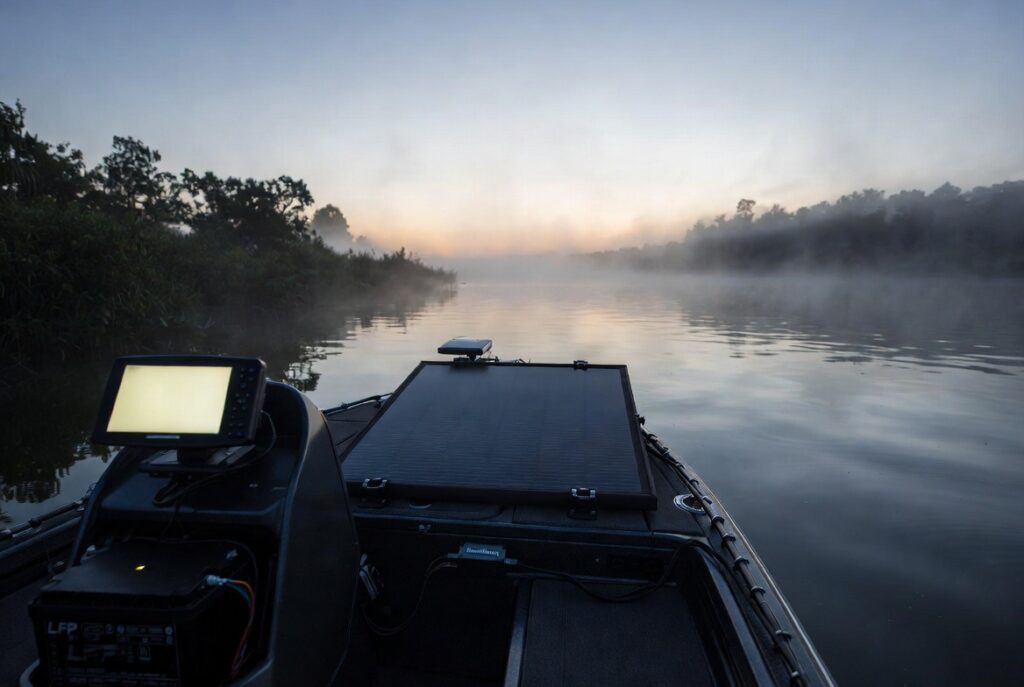
The fish finder solar ontario problem that ends bass tournaments and wilderness canoe trips is not a failed fish finder or a dead transducer but a voltage sag from the main cranking battery that causes the Humminbird Helix 7 to reboot and lose all saved waypoints at the worst possible moment. A tournament competitor in Kawartha Lakes was running his Helix 7 off the same lead-acid cranking battery as his main outboard.
Every time he started the engine the 12V voltage dropped from 12.6V to below 11V for approximately 200 milliseconds. That drop is exactly the threshold at which the Helix 7 resets and clears the active sonar screen. The fix was a dedicated 20Ah LFP bank for the fish finder electronics only, isolated completely from the cranking and trolling motor circuits.
A 20Ah LFP at 80 percent depth of discharge provides 16Ah of usable energy. At 1.2A average draw for a Humminbird Helix 7 in normal scanning mode, that is approximately 13 hours of continuous operation on a single charge. The cranking battery restarts the engine and the SmartShunt-monitored LFP bank runs the electronics without any voltage interaction between the two circuits. In the second season, the Kawartha Lakes angler added a 50W flexible Renogy panel to the setup. The SmartShunt confirmed the panel recharges the 20Ah LFP fully between morning and afternoon tournament sessions on any clear Ontario day at 5.5 peak sun hours, producing approximately 275Wh against the 192Wh nameplate capacity of the bank.
The fish finder solar ontario case for LFP over lead-acid goes beyond the voltage isolation. A 20Ah LFP weighs approximately 6 pounds versus approximately 14 pounds for an equivalent 20Ah AGM. The LFP holds 12.8V flat across 80 percent of its discharge curve, while the AGM begins dropping from 12.6V immediately and reaches 11.8V at 50 percent discharge. The Helix 7 display brightness, CHIRP sonar processing speed, and GPS update rate all respond to supply voltage , the performance difference between 12.8V and 11.8V input is visible on the water. See our Ontario solar sizing guide before any fish finder solar ontario bank decision.
The fish finder solar ontario power draw: Helix 7, 20Ah LFP, and the 13-hour runtime math
| Scenario | Draw | Daily Ah | 20Ah LFP runtime |
|---|---|---|---|
| Helix 7, low brightness | 1.0A | 7.0Ah (7hr day) | 16.0 hours |
| Helix 7, normal tournament | 1.2A | 8.4Ah (7hr day) | 13.3 hours |
| Helix 7, max brightness | 1.5A | 10.5Ah (7hr day) | 10.7 hours |
| 10-hour tournament day (1.2A) | 1.2A | 12.0Ah | 13.3 hours (reserve remains) |
The Humminbird Helix 7 draws approximately 1.0A to 1.5A at 12V depending on display brightness and CHIRP sonar intensity. At 1.2A average over a 7-hour Ontario fishing day, the draw is approximately 8.4Ah. A 20Ah LFP bank at 80 percent depth of discharge provides 16Ah of usable capacity, delivering approximately 13 hours of continuous Helix 7 operation. For a 10-hour tournament day drawing approximately 12Ah, the 20Ah LFP provides the full session with approximately 4Ah of reserve remaining at the end of the day.
The fish finder solar ontario LFP advantage over AGM is not only runtime , it is consistent voltage. An AGM battery starts dropping voltage from the first amp-hour of discharge and reaches approximately 11.8V at 50 percent discharge. The Helix 7 CHIRP sonar processing, GPS positioning update rate, and display brightness all degrade measurably between 12.8V and 11.8V input. The LFP flat discharge curve keeps the Helix performing at specification for the full 13 hours, not just the first half of the day. See our Ontario solar storage guide for the full LFP versus AGM specification comparison.
The Kawartha Lakes tournament fix: dedicated 20Ah LFP eliminates voltage sag and waypoint loss
The Kawartha Lakes tournament angler had built his waypoint library over two full seasons of pre-fishing. He had 47 confirmed bass holding spots across three tournament lakes, all loaded into the Helix 7 G3N MEGA and backed up on an SD card.
On the first morning of the tournament in June 2023, he started the outboard at the launch ramp and the Helix 7 screen went dark, rebooted, and came up with a blank waypoint chart. The lead-acid cranking battery under maximum starter load had dropped the 12V bus to approximately 10.8V for approximately 200 milliseconds , long enough to trigger the Helix 7 reset protection. The SD card backup saved the waypoint data, but reloading it took 4 minutes at the dock while other boats launched.
The fix installed after the tournament was a dedicated 20Ah LFP bank connected to the Helix 7 and chartplotter only, isolated from the cranking battery and the trolling motor deep-cycle bank using a Blue Sea Systems dual-circuit isolator. The SmartShunt on the LFP bank negative terminal confirmed approximately 1.2A average draw during normal tournament operation and approximately 1.5A during active MEGA Side Imaging. At 1.2A average, the 16Ah usable bank provided approximately 13 hours of operation , covering a full tournament day from pre-dawn launch to weigh-in with reserve remaining.
In the second season, he added a 50W flexible Renogy panel mounted to the port side deck using adhesive mounts. The SmartShunt confirmed the panel fully recharged the 20Ah LFP between the 6 AM launch and the 11 AM mid-tournament break on every clear morning. He never lost a waypoint again and finished the 2024 season with the LFP bank still reading full capacity after 14 months of tournament use. See our Ontario battery generator guide for the full dual-bank isolation specification.
The fish finder solar ontario wilderness spec: 50Ah bank, 100W flexible panel, and the Temagami result
Two paddlers completed a 3-day wilderness canoe loop in Temagami in August 2023 navigating deep structure on a route that required the Humminbird Helix 7 for both fish finding and safe water depth confirmation. Their fish finder solar ontario setup was a 50W flexible Renogy panel lashed to the canoe bow with four adjustable straps, a 20Ah LFP in a waterproof Pelican-style case secured in the centre hull, and a Victron MPPT 100/30 connecting the panel to the bank. The SmartShunt on the battery negative terminal tracked SoC throughout the trip.
The daily fish finder draw was approximately 8.4Ah at 7 hours of operation per day. The 50W panel at Ontario August 5.5 peak sun hours produced approximately 275Wh per clear day , approximately 21.5Ah of charge against the 8.4Ah daily draw, a net daily surplus of approximately 13Ah. The SmartShunt confirmed full SoC every afternoon between 11 AM and 3 PM on all three days of the trip. The bank never dropped below 40 percent SoC at any point across 3 full fishing and paddling days, including two mornings of overcast conditions where production was reduced to approximately 80Wh.
They finished the Temagami loop with the bank at 87 percent SoC , higher than the 75 percent SoC at launch on day one. The fish finder solar ontario system was completely self-sufficient for the full 3-day wilderness trip with no shore power and no generator backup. For multi-day trips beyond 3 days or for anglers who add a VHF radio and phone charging to the same bank, size up to a 50Ah LFP: 40Ah usable at 80 percent DoD provides approximately 33 hours of Helix 7 operation or approximately 4.7 full fishing days without any recharge. See our Ontario cabin solar guide for the full portable off-grid spec progression.
The Ontario cold storage rule for fishing batteries: unheated boathouse and BMS charge block
Every LFP fishing battery stored in an unheated Ontario boathouse, garage, or trailer from October through April is subject to the BMS charge block below 0 degrees C. The BMS blocks all charging current to prevent lithium plating on the anode.
A fish finder solar ontario bank that cold-soaks in an unheated boathouse all winter arrives at the first April launch with unknown SoC and a BMS that will block the solar panel input until the cells warm above 0 degrees C by ambient conduction , which in an unheated boathouse on a cold April morning can take 2 to 4 hours. The panel is producing; the bank is not accepting.
The correct layup procedure for any Ontario fish finder solar ontario LFP bank is to bring the battery indoors at the end of the season, confirm full charge, and store it above 0 degrees C until the spring launch. For anglers who cannot bring the battery indoors, including live-aboard boats and permanent dock installations, the Battle Born heated LFP is the correct specification. The self-heater element activates at 2 degrees C cell temperature and allows full charging at ambient temperatures down to -25 degrees C. See our Ontario LiFePO4 battery guide for the full cold storage comparison.
NEC and CEC: Ontario permit requirements for permanent marine solar installations
Portable fish finder solar ontario systems using a 12V LFP bank connected to a flexible panel via an MPPT controller, with no permanent connection to the boat’s electrical system, do not require an ESA permit. The setup is equivalent to a portable power bank used aboard a vessel , no permanent wiring modification occurs and the Ontario Electrical Safety Code permanent installation requirements do not apply. Contact the NFPA at nfpa.org for current NEC requirements applicable to marine electrical systems.
Any permanently wired marine solar installation, including a fixed panel wired into the boat’s 12V electrical bus, a shore power integration, or a dock-side charging connection, requires compliance with ABYC E-11 (marine electrical standard) and CEC Section 64 for any shore-side connection. The ESA permit covers the electrical safety inspection for any permanently wired Ontario marine installation. Contact the Electrical Safety Authority Ontario at esasafe.com for permit requirements before beginning any permanently wired fish finder solar ontario marine installation.
Pro Tip: Before the spring Ontario fishing season, bring the fish finder LFP bank indoors two weeks before launch and run a full discharge and recharge cycle. Record the SmartShunt displayed capacity after a full indoor charge and compare it to the nameplate. A 20Ah LFP showing 18Ah or better on a full charge is outage-ready. A unit that has cold-soaked in a boathouse all winter may show reduced capacity until the cells fully warm to room temperature. The two-week indoor warmup before the first spring launch ensures the bank is at full specification when the bass season opens , not 40 percent depleted before the first cast.
The fish finder solar ontario verdict: dedicated LFP bank, 50W panel, and why lead-acid loses tournaments
- Ontario tournament angler (Kawartha Lakes day fishing): dedicate a 20Ah LFP to the electronics circuit, isolated from all other banks. Add a 50W flexible Renogy panel for between-session recharge and a SmartShunt for SoC monitoring. Never share the electronics bank with the cranking or trolling motor battery , the voltage isolation eliminates Helix 7 reboots and waypoint loss permanently. The Kawartha result: 13 hours of continuous Helix 7 operation, full recharge between sessions on clear days, and 14 months of tournament use with zero capacity loss. All-in under approximately $350 for the bank, panel, and MPPT 100/30.
- Ontario wilderness angler (3-day Temagami or Algonquin canoe trip): 20Ah LFP in a waterproof case, 50W flexible Renogy panel on the bow, MPPT 100/30, SmartShunt. The Temagami result confirmed: bank never below 40 percent SoC across 3 full fishing days, finished at 87 percent SoC, completely self-sufficient with no shore power. For trips beyond 3 days or with added electronics (VHF radio, phone charging), size up to 50Ah LFP for approximately 33 hours of fish finder runtime and indefinite self-sufficiency with a 100W panel.
- Ontario angler storing the fishing battery in an unheated boathouse October through April: specify the Battle Born heated LFP. The standard LFP BMS charge block at 0 degrees C will prevent the first spring panel charge if the battery has cold-soaked all winter. If bringing the battery indoors is not practical, the Battle Born self-heater activates at 2 degrees C cell temperature and allows full charging at -25 degrees C ambient. The fish finder solar ontario heated spec adds approximately $400 over a standard LFP but eliminates the cold charging limitation for permanent dock installations.
Frequently Asked Questions
Q: What size LFP battery do I need to run a Humminbird Helix 7 all day in Ontario?
A: A dedicated 20Ah LFP bank is the correct fish finder solar ontario specification for a full Ontario fishing day. At 1.2A average draw, the 16Ah usable capacity from a 20Ah LFP at 80 percent depth of discharge provides approximately 13 hours of continuous Helix 7 operation , covering a 7-hour fishing day with approximately 6 hours of reserve. For a 10-hour tournament day at 1.2A average, the 12Ah draw still leaves approximately 4Ah of reserve. Pair the bank with a 50W flexible panel and the SmartShunt to confirm actual draw between sessions. The Kawartha Lakes result: 14 months of tournament use, approximately 13 hours per charge, zero waypoint loss.
Q: Can I charge a fish finder battery with a solar panel on a canoe?
A: Yes. A 50W flexible Renogy panel lashed to the canoe bow at the correct south-facing angle produces approximately 275Wh on any clear Ontario summer day at 5.5 peak sun hours. Against a daily Helix 7 draw of approximately 8.4Ah (approximately 107Wh), the panel produces a net daily surplus of approximately 168Wh , more than enough to fully recharge the 20Ah LFP bank during the midday paddling break. The MPPT 100/30 charge controller regulates the panel output to protect the LFP bank. The SmartShunt confirms the charge cycle in real time. The Temagami result confirmed full SoC every afternoon between 11 AM and 3 PM across a 3-day wilderness canoe loop with no shore power access.
Q: What happens to my fish finder battery stored in an Ontario boathouse in winter?
A: Any standard LFP battery stored in an unheated Ontario boathouse from October through April will have its BMS block all charging input when the cell temperature drops below 0 degrees C. This is a protection mechanism against lithium plating, not a defect , but it means the fish finder solar ontario bank arriving at the spring launch from a cold boathouse may show reduced SoC and will not accept panel charge until the cells warm above 0 degrees C by ambient conduction. On a cold April morning in an unheated boathouse, this warming can take 2 to 4 hours.
The correct layup procedure is to bring the battery indoors at the end of the season. If indoor storage is not practical, specify the Battle Born heated LFP, which self-heats at 2 degrees C cell temperature regardless of ambient temperature.
This build is engineered within the 48V DC Safety Ceiling. Diagnostic logic is based on 20+ years of technical service experience. All structural and electrical installations must be verified by a Licensed Professional and comply with your Local AHJ. See our legal and safety disclosure for full scope.
About the Author
Robert Bertrand spent 20 years as a service advisor in the automotive industry (Lexus and Nissan), where precision diagnostics, wiring integrity, and documentation standards were non-negotiable. He brings that same technical discipline to GridFree Guide, where he researches, tests, and documents off-grid solar systems for Ontario conditions. Based in Rockwood, Ontario, every article is built on verified specifications, manufacturer data, and the real-world climate constraints of Canadian off-grid living.
As an Amazon Associate I earn from qualifying purchases. This site also contains affiliate links to other products and services. GridFree Guide earns a small commission at no extra cost to you.