
Comparing Solar Loan vs Cash for Ontario Off-Grid Systems
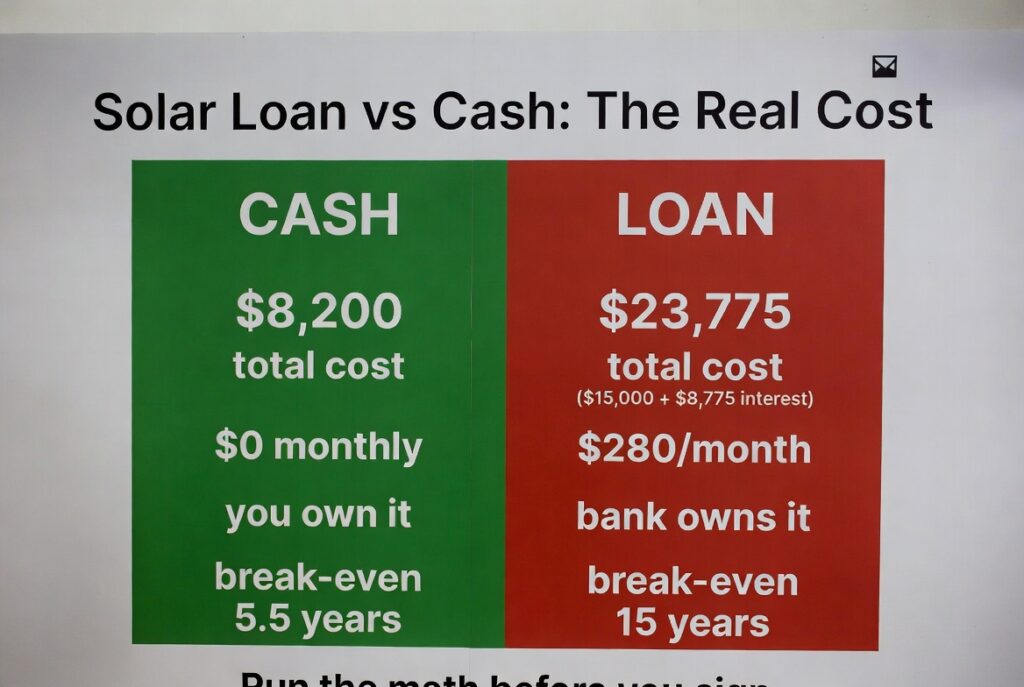
Deciding between a solar loan vs cash purchase is a math problem because interest on a $15,000 loan at 9.5 percent adds $8,775 to your total cost and pushes the break-even point past 10 years. Paying cash eliminates this interest drag and gives you immediate ownership of the hardware from day one. A loan preserves your savings account but extends the payback timeline by 3 to 10 years depending on the interest rate. The decision depends on your system size, the interest rate available to you, and your monthly electricity savings.
A $5,000 Tier 2 system paid in cash breaks even in 4.5 years. The same system financed at 9.5 percent over 5 years costs $6,325 total and breaks even in 7 years. A $15,000 Tier 3 system paid in cash breaks even in 7 to 9 years. The same system financed at 9.5 percent over 10 years costs $23,775 total and breaks even in 15 years. The interest drag on the larger system nearly doubles the effective price. For the complete system pricing, see our beginner solar guide and our off-grid solar cost guide.
The Rockwood Cash Buyer Success
A homeowner in Rockwood saved $8,500 over two years specifically for an off-grid solar build. He paid cash for a Tier 2 cabin system with 800W of panels, a 200Ah 48V LFP bank, and a Victron MultiPlus-II inverter/charger. His total system cost was $8,200 CAD. He had zero financing, zero monthly payments, and zero interest.
Having no monthly payment allowed him to redirect $280 per month toward a system upgrade. He added a second MultiPlus-II six months earlier than planned because his cash flow was unencumbered. His system payback through electricity savings reached break-even at 5.5 years instead of the 8 to 10 years a financed buyer would face. During winter months when production dropped to 1.5 PSH, he had zero financial stress because no bank expected a payment.
Choosing between a solar loan vs cash is like deciding whether to buy a car outright or lease it. Paying cash is like owning the vehicle with no monthly overhead. A loan is like a lease where the monthly fee remains the same even if the car sits in the garage. In Ontario, your solar system produces less in December, but the bank expects the same payment every 30 days regardless of the weather.
Why Cash Is King for Small Off-Grid Builds
Tier 1 systems at $800 to $1,500 and Tier 2 systems at $3,000 to $6,000 are small enough to save for in 6 to 24 months. The interest on a $5,000 loan at 9.5 percent over 5 years is $1,325. That $1,325 buys another 400W of panels or a heated LFP battery that extends your winter capacity. Financing a small system means paying a premium for convenience that could have purchased a meaningful upgrade instead.
A Renogy 100W Starter Kit at $200 CAD is the ultimate cash entry point. Add a 100Ah LFP battery at $400 and you have a functional Tier 1 shed system for $650 total. No lender will write a $650 loan, and no borrower should want one. Cash is the only sensible path for any solar loan vs cash decision under $3,000. For the complete starter system guide, see our off-grid setup guide.
When a Solar Loan vs Cash Decision Favours Financing
Tier 3 whole-home systems at $15,000 to $30,000 may justify financing under one specific condition. The monthly electricity savings must exceed the monthly loan payment. If Hydro One charges $250 per month and the loan payment is $200, the system generates positive cash flow from month one. In that scenario, the solar loan vs cash math favours the loan because you keep your $15,000 in savings while the system pays for itself through the utility offset.
Ontario’s seasonal production complicates this calculation. Summer savings are high when panels produce 5 PSH per day. Winter savings drop when panels produce 1.5 PSH per day. The loan payment stays constant at $280 every month regardless of production. The break-even math must use the annual average savings, not the summer peak. If the annual average monthly savings are below the monthly payment, the solar loan vs cash analysis says pay cash or buy a smaller system. For the complete payback formula, see our solar payback guide and our solar system cost guide.
The Milton Financed Overbuy
A DIYer in Milton took a $15,000 personal loan at 9.5 percent interest over 10 years to build a Tier 3 whole-home system. His monthly loan payment was $280. He calculated his electricity savings from going off-grid at $95 per month based on his Hydro One bill. He expected the system to pay for itself through the savings.
The interest alone consumed 60 percent of his monthly payment. Only $112 of each $280 payment went toward principal in the first year. His actual break-even point extended to nearly 15 years because the $95 monthly savings did not cover the $280 monthly payment. The $185 monthly gap between savings and payment came directly from his household budget. When his property taxes increased by $1,200 per year, the rigid solar loan payment created a debt trap.
He was forced to sell the hardware at a loss on the used market to eliminate the monthly payment. His $15,000 loan balance after 2 years of payments was still $13,200. He sold the equipment for $6,500. He still owed $6,700 on a system he no longer owned. A solar loan vs cash analysis before purchasing would have shown that a $5,000 Tier 2 system paid in cash breaks even in 4.5 years, while a $15,000 Tier 3 system financed at 9.5 percent breaks even in 15 years.
Frequently Asked Questions
Q: Should I pay cash or get a loan for solar in Ontario?
A: Pay cash for any system under $6,000 because the interest on small loans costs more than the convenience of monthly payments. Consider a loan only for Tier 3 systems above $15,000 where the monthly electricity savings exceed the monthly loan payment. Always calculate the total cost including interest before signing any financing agreement.
Q: What interest rate makes a solar loan not worth it?
A: Any rate above 7 percent on a system where monthly savings do not cover the monthly payment creates negative cash flow. At 9.5 percent on a $15,000 loan over 10 years, you pay $8,775 in interest alone, which nearly doubles the effective cost of the system. Compare the total loan cost including interest to the total electricity savings over the same period before deciding.
Q: How long does it take to break even on a cash purchase?
A: A Tier 1 shed system at $800 to $1,500 breaks even in 2 to 3 years through eliminated extension cord costs and convenience. A Tier 2 cabin system at $5,000 breaks even in 4 to 6 years through reduced or eliminated Hydro One charges. A Tier 3 whole-home system at $15,000 paid in cash breaks even in 7 to 9 years compared to 12 to 15 years when financed at 9.5 percent.
NEC Article 690 covers residential PV system installation requirements that protect both the hardware investment and the homeowner. Proper installation ensures the system delivers its rated performance over the full 25-year panel lifespan. Current standards are published at nfpa.org.
CEC Section 64 governs residential solar installation requirements in Ontario including permits and inspection standards. All permanent installations must comply with ESA guidelines to maintain warranty coverage and insurance eligibility. The Electrical Safety Authority (ESA) provides current compliance guidelines at esasafe.com.
This build is engineered within the 48V DC Safety Ceiling. Diagnostic logic is based on 20+ years of technical service experience. All structural and electrical installations must be verified by a Licensed Professional and comply with your Local AHJ. See our legal and safety disclosure for full scope.
About the Author
Robert Bertrand spent 20 years as a service advisor in the automotive industry (Lexus and Nissan), where precision diagnostics, wiring integrity, and documentation standards were non-negotiable. He brings that same technical discipline to GridFree Guide, where he researches, tests, and documents off-grid solar systems for Ontario conditions. Based in Rockwood, Ontario, every article is built on verified specifications, manufacturer data, and the real-world climate constraints of Canadian off-grid living.
As an Amazon Associate I earn from qualifying purchases. This site also contains affiliate links to other products and services. GridFree Guide earns a small commission at no extra cost to you.