
Understanding the Test Battery Capacity Process and Why Your SoC Is Lying
Learning to test battery capacity with a controlled discharge is the only way to know if your battery bank is delivering its rated amp hours because voltage readings and BMS percentages hide the truth. Lithium Iron Phosphate batteries have a flat voltage curve between 20 and 80 percent SoC. This plateau makes the voltage a poor indicator of actual capacity. A reading of 13.2V could mean 40 percent or 70 percent remaining, and the voltmeter cannot tell you which.
Surface charge compounds the problem. After a full charge cycle, a chemical layer builds on the cell plates that inflates the voltage reading by 10 to 15 percent. The BMS reads this inflated voltage and reports a higher SoC than the cells actually hold. BMS percentages also drift over time without recalibration, adding another layer of inaccuracy. The only method that cuts through all three sources of error is a controlled discharge under a known load. For the complete battery decision map, see our solar battery guide. For why voltage lies on LFP, see our battery voltage guide.
The Rockwood Surface Charge Discovery
A homeowner in Rockwood noticed his LED lights flickering earlier than usual during February evenings. His SmartShunt showed 85 percent SoC at 8 PM, but the lights dimmed by 9:30 PM. He suspected the battery was not holding its rated 100Ah capacity. He decided to test battery capacity using a controlled 20-hour discharge test with a known 5A resistive load.
The discharge test revealed the “fully charged” reading was actually a surface charge hiding a 15 percent capacity deficit. The bank delivered 85Ah instead of 100Ah. He inspected the connections and found a loose busbar bolt creating high resistance at one terminal. The high-resistance connection was generating heat under load and dropping voltage at that terminal, which triggered the early flickering.
Testing battery capacity is exactly like performing a fuel flow test on a vehicle. You can have a full tank of gas, but if the fuel pump cannot deliver volume under load, the engine stalls. Measuring voltage is the fuel gauge. A capacity test measures exactly how many litres the pump delivers per minute. Tightening the busbar bolt restored the full 100Ah capacity before the next blizzard hit. The 20-minute fix saved a $950 battery replacement.
Essential Tools and the Step-by-Step Discharge Testing Procedure
To test battery capacity accurately, you need four tools. A Victron SmartShunt logs every amp-hour entering and leaving the battery with 1 percent accuracy. A known resistive load provides a consistent drain. A 60W incandescent bulb draws exactly 5A at 12V, making it the simplest test load available. A timer and a temperature sensor complete the toolkit. For the SmartShunt wiring sequence, see our SmartShunt installation guide.
The procedure starts with a full charge to 100 percent SoC. Let the bank rest for 4 hours after charging to dissipate surface charge. This rest period is critical because testing immediately after charging inflates the result by 10 to 15 percent. Connect the known load and record the start time. Let the load run until the SmartShunt shows the low-voltage cutoff threshold at 10.5V for a 12V system or 42V for a 48V system.
Record the total amp-hours the SmartShunt shows at cutoff. That number is your actual usable capacity. A 100Ah bank that delivers 95Ah is healthy. A 100Ah bank that delivers 78Ah is degraded and needs investigation. A Victron Cerbo GX with VRM portal access logs the entire discharge curve remotely, providing a permanent diagnostic record you can reference on future tests.
Why Temperature Affects Your Test Battery Capacity Results in Ontario
LFP capacity drops 10 to 15 percent at 0 degrees C compared to 25 degrees C. The internal resistance of the cells increases as temperature drops, which reduces the voltage under load and triggers the low-voltage cutoff earlier. A 100Ah bank at 25 degrees C might deliver only 85Ah at 0 degrees C. That 15 percent loss is real and repeatable until the cells warm up above 10 degrees C.
Run the test at room temperature between 20 and 25 degrees C for a baseline result that matches manufacturer specifications. If your bank lives in an unheated garage or shed in Ontario, run a second test at that ambient temperature to know your real winter capacity. The difference between the two tests tells you exactly how much capacity you lose to cold. For the complete temperature analysis, see our battery temperature guide. This information is essential when you test battery capacity on any bank that spends October through April in an unheated space.
The Milton Used Battery Crash
A DIYer in Milton bought a used 400Ah LFP bank from a Facebook Marketplace seller for $1,200. The seller showed a BMS app screenshot displaying 92 percent State of Health. The buyer connected the bank to his off-grid system without performing a discharge test. He assumed the BMS percentage was accurate.
During a winter power outage, the system crashed while the BMS display still showed 40 percent remaining. The cells were severely out of balance with one cell at 2.8V while the others held 3.2V. The weak cell triggered a low-voltage disconnect that sent a voltage spike through the system. The sudden voltage drop fried a $200 networking switch connected to the inverter output. For more on cell drift and rebalancing, see our battery balancing guide.
A controlled discharge test before installation would have revealed the cell imbalance and the 40 percent actual capacity loss in under 24 hours. The $1,200 “deal” on used batteries cost him $1,200 for the bank plus $200 for the networking switch plus $950 for the replacement LFP bank he bought the following week. A $0 discharge test using his existing SmartShunt would have shown the problem before he connected a single wire. Never trust a BMS screenshot from a seller. Always test battery capacity yourself before committing a used bank to service.
Frequently Asked Questions
Q: How often should I test battery capacity?
A: Test once per year for LFP banks and twice per year for AGM banks. Test immediately after purchasing used batteries before connecting them to your system. Test any time the SmartShunt shows unexpected capacity drops or the system crashes before reaching the expected low-voltage threshold.
Q: What does my capacity score mean?
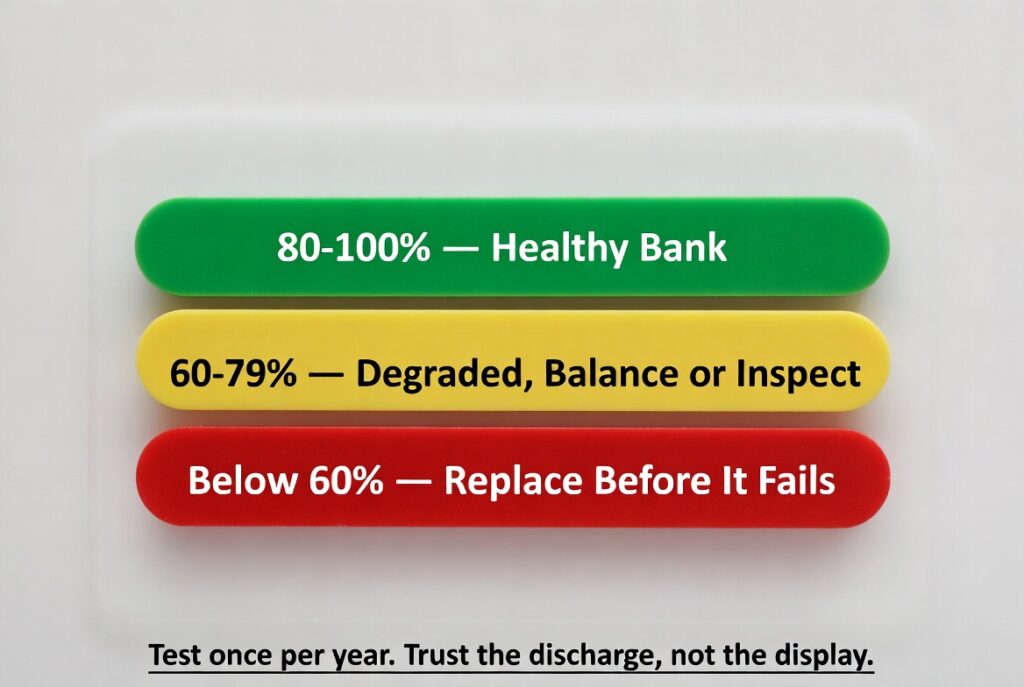
A: Above 80 percent of rated capacity means the bank is healthy and performing within manufacturer specifications. Between 60 and 80 percent means the bank is degraded and may need cell balancing or connection inspection. Below 60 percent means the bank has reached end of useful life and should be replaced before it fails during an outage.
Q: Can I test battery capacity without a SmartShunt?
A: Yes, but the results are less accurate because you must manually track time and calculate amp-hours from the known load. A SmartShunt automates the measurement and logs every amp-hour with 1 percent accuracy. The $180 cost of a SmartShunt pays for itself by preventing one misdiagnosed battery replacement.
NEC Article 480 covers battery storage system safety requirements including testing procedures, ventilation, and overcurrent protection for residential installations. All battery systems must comply with applicable testing and maintenance standards. Current standards are published at nfpa.org.
CEC Section 64 governs battery storage installation and maintenance requirements in Ontario. All permanently installed battery systems require ESA-compliant testing and inspection protocols. The Electrical Safety Authority (ESA) provides current compliance guidelines at esasafe.com.
This build is engineered within the 48V DC Safety Ceiling. Diagnostic logic is based on 20+ years of technical service experience. All structural and electrical installations must be verified by a Licensed Professional and comply with your Local AHJ. See our legal and safety disclosure for full scope.
About the Author
Robert Bertrand spent 20 years as a service advisor in the automotive industry (Lexus and Nissan), where precision diagnostics, wiring integrity, and documentation standards were non-negotiable. He brings that same technical discipline to GridFree Guide, where he researches, tests, and documents off-grid solar systems for Ontario conditions. Based in Rockwood, Ontario, every article is built on verified specifications, manufacturer data, and the real-world climate constraints of Canadian off-grid living.
As an Amazon Associate I earn from qualifying purchases. This site also contains affiliate links to other products and services. GridFree Guide earns a small commission at no extra cost to you.