
What a Battery Backup System Is and How It Protects Your Ontario Home
A battery backup system stores electricity in a battery bank and delivers it to your home during a power outage, and the right size depends on how many hours of runtime your critical loads require. The system has three parts: a battery, an inverter, and a charging source. The battery stores energy. The inverter converts stored DC power to AC for your appliances. The charging source refills the battery from the grid, solar panels, or a generator.
A battery backup system works in three modes depending on the charging source. UPS mode charges from the grid and switches to battery within 20 milliseconds when the power fails. Solar mode charges from panels during the day and powers loads overnight. Hybrid mode combines grid, solar, and generator charging for maximum redundancy. For a broader overview of system options, see our beginner solar guide.
The Rockwood Sump Pump Save
A homeowner in Rockwood installed a battery backup system after losing his basement to a spring flood in 2024. His sump pump drew 800W with a 1,500W startup surge. He chose an Anker SOLIX C1000 with 1,056Wh and 1,800W continuous output. He tested the system by turning off the main breaker and running the sump pump on battery power.
The battery backup system ran his sump pump through a 6-hour spring rainstorm while the grid was down. The pump cycled 23 times during the outage, drawing approximately 380Wh total. He still had 64 percent battery remaining when the grid returned. The $900 battery backup system protected $35,000 in basement renovation from the same flood that destroyed his neighbor’s unfinished basement.
A battery backup system is like a spare tire in the trunk. You hope you never need it. When you do need it, nothing else matters. The $900 he spent on the backup system was 2.6 percent of the $35,000 basement it protected. Insurance does not cover flood damage from sump pump failure during a power outage in most Ontario policies.
Three Types of Backup and How to Choose the Right One for Your Property
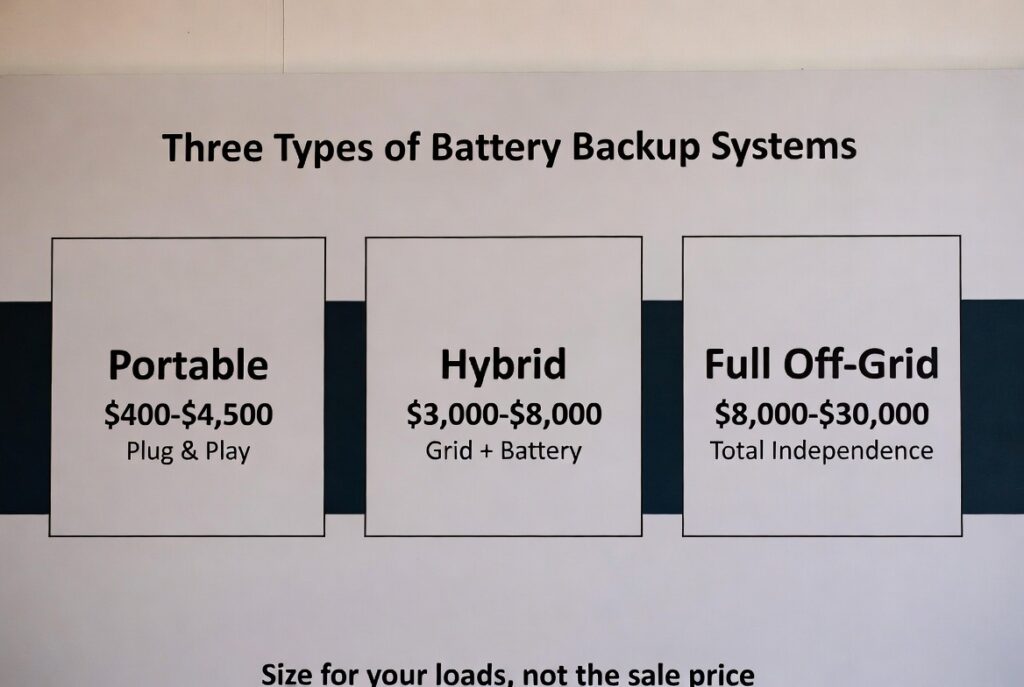
The first type is a portable power station. This is an all-in-one battery backup system in a single box. Prices range from $400 to $4,500 CAD depending on capacity. The Anker SOLIX C1000 at $900 is the strongest mid-range option with UPS mode and 1,800W continuous output. Portable units require zero installation and work out of the box. For more options across all wattage classes, see our solar generator Ontario guide.
The second type is a hybrid inverter with battery. This integrates into your existing electrical panel through a transfer switch and provides seamless power during outages. Costs range from $3,000 to $8,000 CAD and require a licensed electrician for installation. The third type is a full off-grid battery bank for complete independence from the grid. A Victron MultiPlus-II based system costs $8,000 to $30,000 CAD depending on capacity and includes an inverter/charger with built-in transfer switch. For the complete wiring sequence, see our off-grid electrical wiring guide. For battery chemistry selection, see our solar battery guide.
Choosing between the three types depends on your budget and your critical loads. A portable power station covers a sump pump and fridge for 6 to 24 hours. A hybrid system covers an entire critical load panel for 12 to 48 hours. A full off-grid battery backup system covers your entire home indefinitely with solar recharging. For a detailed comparison of backup strategies, see our backup power guide.
How to Size a Battery Backup System for Ontario Critical Loads
Sizing a battery backup system starts with listing every load you need to run during an outage. A sump pump draws 800W with a 1,500W startup surge. A fridge draws 80W average. A furnace fan draws 400W. A CPAP draws 30W. Starlink draws 75W. LED lights draw 50W total. Add the watts of all loads that must run simultaneously and that gives you the minimum continuous output your inverter needs.
Multiply the total watts by the number of hours you need coverage to get the required watt-hours. A sump pump plus fridge plus LED lights equals 930W continuous. At 12 hours of runtime, that requires 11,160Wh of battery capacity. Add 25 percent headroom for inverter efficiency losses and you need approximately 14,000Wh. For the complete load calculation method, see our solar sizing guide.
The Milton Undersized Mistake
A homeowner in Milton bought a 300Wh portable battery backup system for $350 because the reviews said it was great for emergencies. He planned to run his fridge and furnace fan during winter outages. His fridge drew 80W average. His furnace fan drew 400W.
The 300Wh battery ran the fridge for 3.75 hours before dying. He never connected the furnace fan because its 400W draw plus the fridge’s 80W exceeded the unit’s 300W continuous output. His house temperature dropped to 6 degrees C by morning during a January ice storm. A battery backup system that cannot run your two most critical loads provides zero backup.
Buying a 300Wh battery backup system for a house with a furnace fan and a fridge is like putting a motorcycle spare tire on a pickup truck. It fits the rim. It cannot carry the load. Sizing the battery backup system for his actual critical loads would have shown he needed a minimum of 2,000Wh with 500W+ continuous output. The correct answer was $900, not $350.
Frequently Asked Questions
Q: How long does a battery backup system last during an outage?
A: Runtime depends on battery capacity divided by load. A 1,056Wh unit running a fridge at 80W lasts 13 hours. A 4,096Wh unit running a fridge and sump pump at 930W combined lasts 4.4 hours. Always size for your actual critical loads, not marketing claims.
Q: Can a battery backup system run a furnace?
A: A battery backup system can run the furnace fan at 400W but cannot power an electric furnace at 10,000W to 20,000W. Gas and propane furnaces only need the fan and igniter powered, which draws 400W to 600W. Electric baseboard heaters and electric furnaces are not compatible with battery backup.
Q: How much does a battery backup system cost in Ontario?
A: A portable power station for basic backup costs $400 to $1,500 CAD. A mid-range unit with UPS mode for sump pump and fridge protection costs $900 to $2,500 CAD. A whole-home battery backup system with automatic transfer switch costs $8,000 to $30,000 CAD installed.
NEC Article 702 covers optional standby systems including battery backup installations for residential use. All battery backup systems must comply with transfer switch, grounding, and overcurrent protection requirements. Current standards are published at nfpa.org.
CEC Section 64 governs alternative energy source installation including battery backup systems in Ontario. All permanently installed systems require ESA approval and inspection. The Electrical Safety Authority (ESA) provides current compliance guidelines at esasafe.com.
This build is engineered within the 48V DC Safety Ceiling. Diagnostic logic is based on 20+ years of technical service experience. All structural and electrical installations must be verified by a Licensed Professional and comply with your Local AHJ. See our legal and safety disclosure for full scope.
About the Author
Robert Bertrand spent 20 years as a service advisor in the automotive industry (Lexus and Nissan), where precision diagnostics, wiring integrity, and documentation standards were non-negotiable. He brings that same technical discipline to GridFree Guide, where he researches, tests, and documents off-grid solar systems for Ontario conditions. Based in Rockwood, Ontario, every article is built on verified specifications, manufacturer data, and the real-world climate constraints of Canadian off-grid living.
As an Amazon Associate I earn from qualifying purchases. This site also contains affiliate links to other products and services. GridFree Guide earns a small commission at no extra cost to you.