
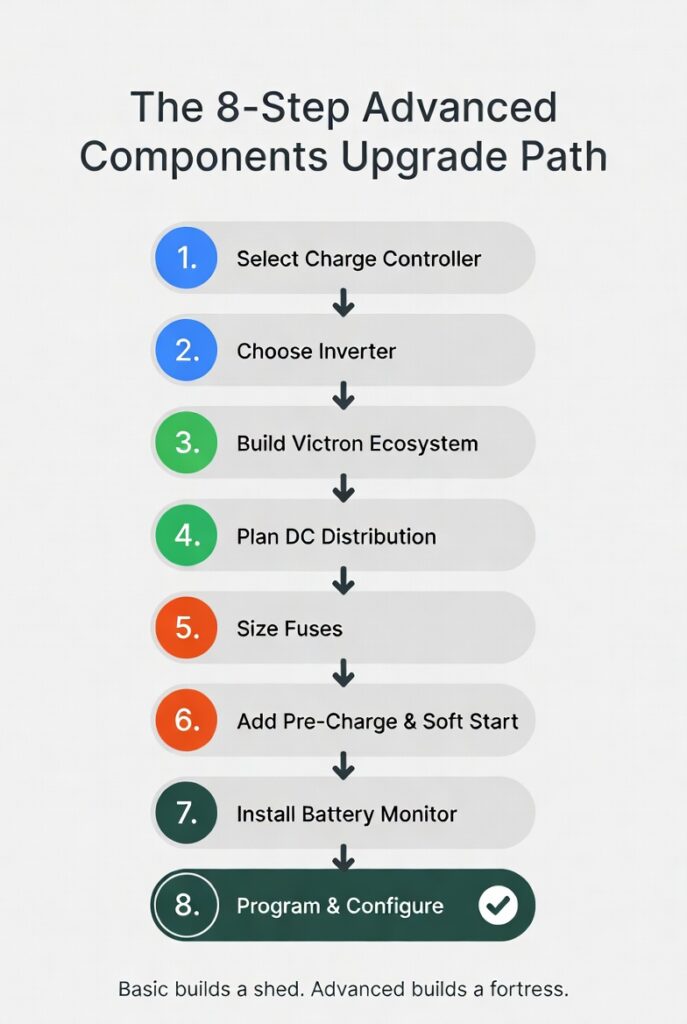
The Advanced Components Upgrade Path and Why the Controller and Inverter Determine System Lifespan
Upgrading to advanced components is what separates a basic off-grid shed from a professional-grade fortress because the charge controller, inverter, and monitoring system determine whether your build lasts 5 years or 25. Eight component categories define the upgrade path from basic to professional. A PWM controller and modified sine wave inverter can light a shed. An MPPT controller and pure sine wave inverter can power a home through an Ontario January.
A builder in Rockwood upgraded from $450 in basic components to $2,680 in Victron advanced components. His winter production increased by 30 percent without adding a single panel. A DIYer in Milton mixed three brands of advanced components and spent 3 months troubleshooting communication failures between devices that were never designed to work together. The difference was not the components. It was the ecosystem.
This article is the master reference map for the entire Advanced Components category. Each section covers one component decision and links to the full detailed guide. The Victron ecosystem is the professional standard because every component communicates with every other component automatically. For a broader system overview, see our solar generator Ontario guide.
Charge Controller and Inverter Selection as the Core of Every Advanced Build
Step 1 is charge controller selection. MPPT controllers are 30 percent more efficient than PWM controllers because they convert excess panel voltage into additional charging current. A Victron SmartSolar MPPT 100/50 handles up to 2,400W at 48V and provides Bluetooth monitoring plus VE.Direct data output. Over-paneling strategies push 120 to 150 percent of the controller’s rated capacity through the array, which boosts winter production when panel output drops to 70 percent of nameplate. For the complete comparison, see our MPPT vs PWM guide and our Victron vs Renogy guide.
Step 2 is inverter selection. Pure sine wave output is mandatory for any system running sensitive electronics, variable-speed motors, or medical equipment. The Victron MultiPlus-II 48V 3000VA combines an inverter, battery charger, and transfer switch in one unit. Its idle draw of 18W is among the lowest in its class. Cold start surge sizing for Ontario must account for motor loads at minus 25 degrees C where startup current increases by 20 to 30 percent. For the detailed comparison, see our pure sine wave guide and our MultiPlus vs Quattro guide.
The Advanced Components Victron Ecosystem and DC Distribution Standard
Step 3 is building the Victron ecosystem. The Victron Cerbo GX is the system brain that connects every component via VE.Direct or VE.Bus cables. The VRM portal provides remote monitoring from anywhere with internet access, logging every charge cycle, discharge event, and error code. VE.Smart networking allows the SmartShunt to share battery temperature and voltage data with the charge controller for automatic compensation without a Cerbo GX. For the complete ecosystem guides, see our Cerbo GX guide, our VRM portal guide, and our VE.Bus vs VE.Direct guide.
Step 4 is DC distribution. The Victron Lynx Distributor provides 4 individually fused DC connection slots with proper heat dissipation spacing. Never stack lugs on a single busbar stud because stacked connections create uneven contact pressure, which generates heat under load. The Lynx system organizes every DC connection in a clean, serviceable layout. For the complete DC distribution guide, see our Lynx distribution guide.
Fuse Selection, Pre-Charge, Soft Start, and Battery Monitoring
Step 5 is fuse selection. Class T fuses are the lithium standard because they interrupt a short circuit in under 5 milliseconds. MEGA fuses are slower and designed for lower-voltage lead-acid systems. For any LFP bank at 48V, Class T is the correct advanced components choice. For the complete comparison, see our Class T vs MEGA fuse guide. Step 6 is pre-charge and soft start. A pre-charge resistor prevents the $2,000 spark when you first connect a large inverter to a capacitor bank. An EasyStart reduces AC compressor startup surge by 70 percent, allowing a 15,000 BTU air conditioner to start on a 3,000W inverter. For the complete guide, see our soft start guide.
Step 7 is battery monitoring. The Victron SmartShunt is the current standard for advanced components builds. It measures every amp-hour using coulomb counting and provides true State of Charge via Bluetooth and VE.Direct. The older BMV-712 includes a physical display but the SmartShunt at $180 CAD provides the same data through the VictronConnect app and integrates with the Cerbo GX. For the complete comparison, see our SmartShunt vs BMV guide.
The Rockwood Victron Ecosystem Build
A builder in Rockwood upgraded from a basic PWM controller and modified sine wave inverter to a full Victron ecosystem. He installed a SmartSolar MPPT 100/50, a MultiPlus-II 48V 3000VA, a SmartShunt, and a Cerbo GX with VRM portal access. His total advanced components cost was $2,680 CAD. His previous basic components cost $450 CAD.
The MPPT controller extracted 30 percent more energy from his existing panels than the PWM controller did. His winter production increased from 2,100Wh per day to 2,730Wh per day without adding a single panel. The VRM portal alerted him to a failing MC4 connection via a sudden voltage drop three months before the connection would have overheated. The Cerbo GX logged every charge cycle, discharge event, and error code, giving him a complete diagnostic history of his system.
Upgrading from basic to advanced components is like upgrading from a carburetor to fuel injection. The engine is the same. The fuel is the same. But the fuel injection system extracts more power per drop, monitors performance in real time, and alerts you before a failure occurs. The $2,230 premium over basic components paid for itself in 14 months through increased production and avoided failures.
The Milton Mismatched Components Failure
A DIYer in Milton built his system with advanced components from three different brands. He used a Renogy charge controller, a Samlex inverter, and a generic Chinese BMS on his battery bank. None of the components could communicate with each other. He had no system-level monitoring.
The Renogy controller’s temperature compensation did not match the generic BMS charging parameters. The controller pushed 14.6V absorption voltage while the BMS was set to disconnect at 14.4V. Every absorption cycle triggered a BMS disconnect, which interrupted charging and confused the controller. The controller threw error codes that referenced Renogy-specific faults the Samlex inverter could not read. He spent 3 months troubleshooting communication failures between components that were never designed to work together.
Mixing component brands in an off-grid system is like installing a Ford ECU in a Toyota engine bay. Both are quality parts. They speak different languages. The Victron ecosystem uses VE.Direct and VE.Smart networking so every component shares data automatically. Advanced components from a single ecosystem eliminate integration failures. The $500 he saved by mixing brands cost him 3 months of troubleshooting and a $350 replacement controller.
The Advanced Components Verdict on Programming, Error Codes, and the Single-Ecosystem Advantage
Step 8 is programming and configuration. LFP batteries require specific charge controller settings: 14.2V absorption at 12V systems, 28.4V at 24V, and 56.8V at 48V. Setting AGM values on an LFP bank causes persistent overcharging that degrades cells. Error code diagnostics through the Cerbo GX identify issues before they become failures. Firmware updates keep every component compatible and add new features over time. For the complete programming guide, see our program controller for LFP guide.
The single-ecosystem advantage of advanced components is that every Victron device communicates with every other Victron device automatically. Temperature compensation, synchronized charging, load shedding, and error reporting all happen without manual configuration. For the complete wiring context, see our off-grid electrical wiring guide. For battery selection, see our solar battery guide. For installation safety, see our solar safety guide.
Frequently Asked Questions
Q: Is the Victron ecosystem worth the premium over budget brands?
A: Yes, for any system Tier 2 or above because the ecosystem integration eliminates communication failures between components. The VRM portal provides remote monitoring and diagnostic data that budget brands cannot match. The 30 percent MPPT efficiency gain over PWM pays back the controller premium in 12 to 18 months of increased production.
Q: Can I mix Victron components with other brands?
A: Yes for passive components like panels, fuses, and wire, but not recommended for active components like controllers, inverters, and monitors. Mixing active component brands breaks the VE.Smart and VE.Direct communication that enables automatic temperature compensation and synchronized charging. The $200 to $500 savings from mixing brands typically costs more in troubleshooting and replacement than buying the matched ecosystem.
Q: Do I need a Cerbo GX or can I use Bluetooth only?
A: Bluetooth works for local monitoring within 10 meters, but the Cerbo GX adds VRM remote access from anywhere plus data logging plus automatic firmware updates. For any system at a cottage or property you do not visit daily, the Cerbo GX is essential for remote monitoring and low-battery alerts. The $350 cost is justified by the first alert that saves you from a BMS lockout or frozen pipes.
NEC Article 690 covers charge controller and inverter installation requirements including grounding, overcurrent protection, and labeling for residential PV systems. All advanced components must carry UL or equivalent certification for residential use. Current standards are published at nfpa.org.
CEC Section 64 governs off-grid solar component installation requirements in Ontario including system design, inspection, and safety standards. All installations must pass ESA inspection before energizing. The Electrical Safety Authority (ESA) provides current compliance guidelines at esasafe.com.
This build is engineered within the 48V DC Safety Ceiling. Diagnostic logic is based on 20+ years of technical service experience. All structural and electrical installations must be verified by a Licensed Professional and comply with your Local AHJ. See our legal and safety disclosure for full scope.
About the Author
Robert Bertrand spent 20 years as a service advisor in the automotive industry (Lexus and Nissan), where precision diagnostics, wiring integrity, and documentation standards were non-negotiable. He brings that same technical discipline to GridFree Guide, where he researches, tests, and documents off-grid solar systems for Ontario conditions. Based in Rockwood, Ontario, every article is built on verified specifications, manufacturer data, and the real-world climate constraints of Canadian off-grid living.
As an Amazon Associate I earn from qualifying purchases. This site also contains affiliate links to other products and services. GridFree Guide earns a small commission at no extra cost to you.