
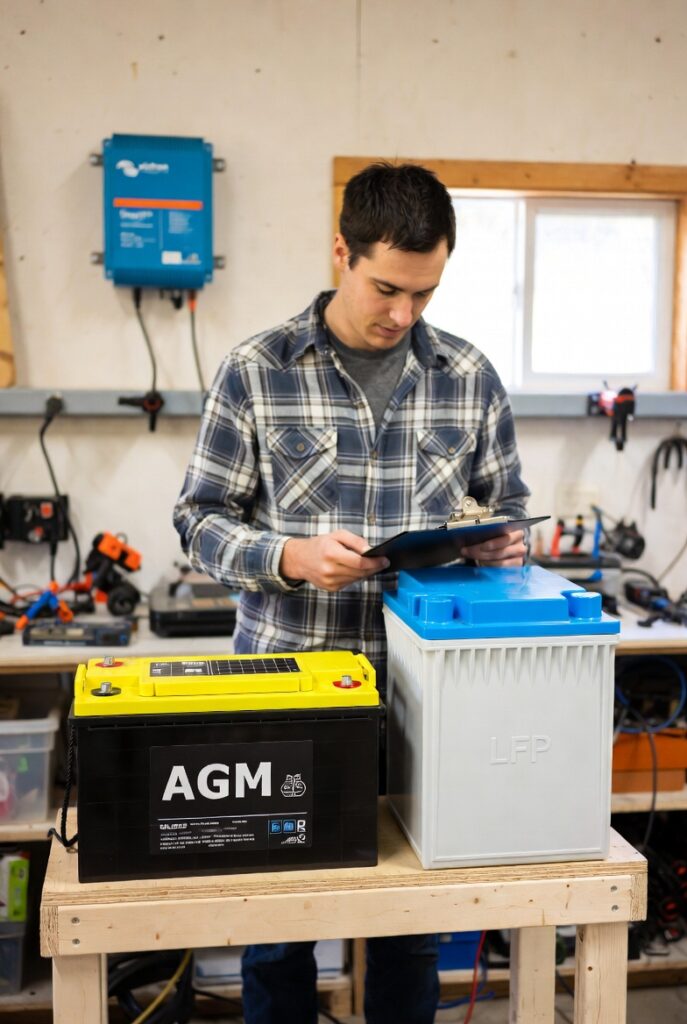
The most common solar battery storage mistake Ontario beginners make is buying the cheapest battery with the largest Ah number on the label, without understanding that not all of those amp-hours are usable, and that Ontario winters will expose the difference within the first gray streak. A homeowner on Stone Road West in Guelph, Wellington County purchased 200Ah of AGM sealed batteries for his off-grid cabin solar battery storage system in spring 2022. The AGM batteries cost approximately $400 less than a comparable LFP bank and he was satisfied with summer performance. His daily load was approximately 40Ah per day and he assumed that gave him 5 days of reserve.
In reality his 200Ah AGM bank provided approximately 100Ah of usable storage at the 50% depth of discharge limit required to avoid damaging AGM cells. That gave him 2.5 days of reserve, not 5. During a 4-day January gray streak in 2023 he pushed the batteries below 50% DoD on day 3 trying to avoid running the generator. He repeated this pattern approximately 8 to 10 times that winter.
I reviewed his system at the spring commissioning check in April 2024. The AGM batteries had lost approximately 35 to 40% of their original capacity to sulfation, the irreversible plate damage that occurs when lead acid chemistry is discharged below 50% DoD repeatedly in cold conditions. His 200Ah bank was performing as approximately 120Ah, providing only about 60Ah of usable storage. He replaced the AGM bank with a 100Ah Battle Born LFP battery that provided 80Ah usable at 80% DoD, outperforming the degraded AGM bank at half the physical size.
The Victron SmartShunt confirmed the new bank’s capacity was holding stable after 6 months of Ontario winter cycling. See our Ontario solar sizing guide before selecting any solar battery storage system.
The solar battery storage chemistry decision: LFP, AGM, and lead acid compared
| Chemistry | Usable DoD | Cycle life | Charges below 0C? | Ontario verdict |
|---|---|---|---|---|
| LFP (Lithium Iron Phosphate) | 80 to 100% | 3,000 to 5,000 | No (BMS cutoff at 0C) | Year-round standard ✓ |
| AGM (Sealed Lead Acid) | 50% | 500 to 800 | Yes | Seasonal only, low budget |
| Flooded Lead Acid | 50% | 300 to 500 | Yes (reduced rate) | Legacy, not recommended |
LFP is the correct solar battery storage chemistry for any Ontario off-grid system that will face winter gray streaks. At 80% depth of discharge, a 100Ah LFP battery delivers 80Ah of usable energy across 3,000 to 5,000 charge cycles, enough for 8 to 13 years of daily cycling. AGM provides only 50Ah usable from a 100Ah battery at 50% DoD, across 500 to 800 cycles before significant capacity degradation. Flooded lead acid at 300 to 500 cycles requires regular distilled water top-up, periodic equalization charging, and hydrogen venting, a maintenance burden not appropriate for unattended Ontario off-grid installations.
The lifecycle cost comparison explains why LFP dominates Ontario solar battery storage despite its higher upfront price. A 100Ah LFP battery at approximately $900 to $1,000 CAD delivers 80Ah usable across 3,000 cycles, for a total usable energy delivery of approximately 240,000Ah over its service life. A 100Ah AGM battery at approximately $200 to $300 delivers 50Ah usable across 500 cycles, for approximately 25,000Ah total, roughly 10 times less lifetime usable energy at roughly one-quarter the upfront cost. Per usable Ah delivered over the system lifetime, LFP is significantly cheaper than AGM. See our solar battery bank sizing guide for the full gray streak reserve calculation.
The usable capacity trap: why rated Ah and actual Ah are different numbers
The DoD trap is the most important concept in solar battery storage selection. A 200Ah AGM bank provides 100Ah of usable storage at the recommended 50% DoD limit. A 200Ah LFP bank provides 160Ah usable at 80% DoD. The buyer who chooses 200Ah AGM over 200Ah LFP to save money compares rated capacity while receiving only 62% of the usable energy. To match the 160Ah usable from the LFP bank, AGM requires a 320Ah rated bank, significantly more expensive and physically larger than it first appeared.
The Stone Road West Guelph result confirms the calculation failure. The homeowner assumed 200Ah rated AGM meant 5 days of reserve at 40Ah per day. It provided 2.5 days usable. That gap triggered the sulfation damage cycle: 8 to 10 deep discharges that winter reduced the bank to 60Ah usable. The correct pre-purchase calculation for any solar battery storage system: divide the required usable capacity by the DoD limit to find the minimum rated capacity. At 50% DoD for AGM: 100Ah usable needed requires 200Ah rated. At 80% DoD for LFP: 100Ah usable needed requires only 125Ah rated.
Pro Tip: Before purchasing any solar battery storage bank, run the usable capacity check in 60 seconds. Take your daily load in Ah, multiply by 3 for a standard Ontario gray streak reserve, and divide by the battery chemistry DoD limit. AGM at 50% DoD: a 50Ah/day load needs (50 x 3) / 0.50 = 300Ah rated AGM. LFP at 80% DoD: the same load needs (50 x 3) / 0.80 = 187.5Ah rated LFP, rounded to 200Ah. The SmartShunt makes the comparison concrete after installation: set the bank capacity in the SmartShunt settings to the rated Ah and watch the SoC percentage in real time. A correctly sized LFP bank should stay above 40% SoC through a 3-day Ontario gray streak with no solar input.
The 0C charge limit: why Ontario winters expose LFP’s hidden requirement
Standard LFP batteries disconnect charge input when cell temperature drops below 0C. The battery management system implements this protection to prevent lithium plating, the irreversible damage that occurs when lithium ions deposit as metallic lithium on the anode during charging below 0C. In a heated interior room or basement that stays above 5C in Ontario January, the 0C limit is not a concern. In an unheated shed, garage, or crawlspace where January ambient drops to -10C or -20C, the battery may be below 0C from midnight through mid-morning, blocking several hours of early solar production that the panels would otherwise deliver.
The Battle Born heated LFP battery solves this for unheated Ontario solar battery storage enclosures. Internal heating elements warm the cells above 0C before allowing charge input, typically drawing 10 to 20W for 30 to 60 minutes on cold mornings. The heated variant is the correct specification for any solar battery storage system in an unheated shed or outbuilding in Ontario. For systems in heated interior spaces, the standard LFP variant is correct.
Use the SmartShunt to confirm the battery accepts charge on cold January mornings: if the current shows zero despite panel production, the 0C BMS protection is active and the heated variant is required. See our solar inverter types guide for how the inverter-charger specification interacts with the battery bank on cold-start mornings.
The solar battery storage sizing rule: usable capacity and the 3-day Ontario standard
The 3-day gray streak sizing rule for Ontario solar battery storage: daily load in Ah multiplied by 3 days gives the minimum usable capacity required. Divide usable capacity by the DoD limit to find the required rated bank size. For LFP at 80% DoD: 50Ah/day x 3 days = 150Ah usable needed, 150 / 0.80 = 187.5Ah rated, rounded to 200Ah. For AGM at 50% DoD: 50Ah/day x 3 days = 150Ah usable needed, 150 / 0.50 = 300Ah rated. That comparison illustrates exactly why a 200Ah LFP bank and a 300Ah AGM bank serve the same load for 3 Ontario gray streak days.
A cottage owner on Bronte Road in Oakville, Halton County installed a correctly specified solar battery storage system in fall 2023. Her daily load was approximately 50Ah per day. Two Battle Born 100Ah LFP batteries (200Ah rated, 160Ah usable at 80% DoD) cost approximately $1,800 total. The equivalent AGM bank to match 150Ah usable would require 300Ah rated at approximately $1,200. Her SmartShunt logs for December 2023 and January 2024 confirmed she never dropped below 22% SoC during any gray streak period. Zero generator use through her first full Ontario winter. The $600 LFP premium over AGM eliminated the sulfation risk that destroyed the Stone Road Guelph bank within 18 months.
NEC and CEC: Ontario requirements for off-grid battery storage installations
NEC 690 governs solar PV installations. A solar battery storage system permanently installed in an off-grid system must comply with NEC 690 requirements for battery type, installation, DC wiring, overcurrent protection, and disconnecting means. NEC 690.71 specifies requirements for battery systems used with solar PV, including ventilation requirements for battery enclosures, overcurrent protection sizing, and disconnecting means. LFP batteries do not produce hydrogen gas and do not require the ventilation required for flooded lead acid batteries, but the enclosure must still comply with the manufacturer’s installation specifications.
The DC cable from the battery terminals to the charge controller and inverter must be sized for the battery’s maximum charge and discharge current with appropriate fusing at each terminal. Contact the NFPA at nfpa.org for current NEC 690 battery storage requirements.
CEC Section 64 governs solar PV installations in Ontario. A permanently installed solar battery storage system requires an ESA permit. The permit application must identify the battery chemistry, rated capacity, voltage, the charge controller, the overcurrent protection at the battery terminal, and the physical location and enclosure of the battery bank. LFP batteries require identification as lithium iron phosphate chemistry on the ESA permit application. The battery enclosure must comply with the manufacturer’s temperature and ventilation specifications for the Ontario installation environment. Contact the Electrical Safety Authority Ontario at esasafe.com before installing any permanently mounted solar battery storage system in Ontario.
The solar battery storage verdict: which chemistry fits your Ontario property
- Ontario year-round off-grid property owner with the battery enclosure in an unheated shed, garage, or outbuilding: specify the Battle Born heated LFP and size using the 3-day gray streak rule. The Bronte Road Oakville result: 200Ah LFP at 80% DoD = 160Ah usable, 50Ah/day x 3-day reserve confirmed, never below 22% SoC through a full Ontario winter, zero generator use. Use the Victron SmartShunt to confirm charge acceptance on cold January mornings, zero input current despite panel production means the 0C BMS is active and the heated variant is required.
- Ontario seasonal cottage owner occupied May through October who wants the lowest upfront cost: AGM is defensible only if the bank will never be pushed below 50% DoD. Size the AGM bank to double the required usable capacity so that normal gray streak use stays well within 50% DoD. Do not use AGM for any year-round system or any system where gray streaks may push discharge to 60%, 70%, or 80%. The Stone Road Guelph result is the cost of ignoring this: 40% capacity loss in 18 months from 8 to 10 deep discharge events.
- Ontario off-grid owner who already has AGM batteries and is noticing reduced capacity: diagnose with the SmartShunt before replacing. Fully charge to 100% SoC, then discharge to 50% DoD while the SmartShunt counts actual Ah delivered. If the bank delivers significantly less than 50% of the rated Ah, sulfation damage has occurred and LFP replacement is the correct step. See our solar generator vs battery guide for how backup generation integrates with a correctly sized replacement LFP bank.
Frequently Asked Questions
Q: What is the best battery for off-grid solar storage in Ontario?
A: LFP (Lithium Iron Phosphate) is the correct solar battery storage chemistry for Ontario off-grid systems that face winter gray streaks. At 80% depth of discharge and 3,000 to 5,000 cycle life, LFP delivers significantly more usable energy per dollar over the system lifetime than AGM. The Stone Road West Guelph result shows the AGM alternative: 40% capacity loss in 18 months from 8 to 10 deep discharge events during Ontario gray streaks. AGM is defensible only for seasonal cottage systems where the bank will never be pushed below 50% DoD and the total cycle count will remain well under 500 over the system lifetime.
Q: How long do AGM batteries last in an Ontario off-grid system?
A: AGM batteries are rated for 500 to 800 cycles at 50% depth of discharge under ideal conditions. In Ontario winter use where gray streaks may push the bank below 50% DoD, the cycle life degrades significantly faster. The Stone Road West Guelph result: approximately 8 to 10 deep discharge events in a single Ontario winter produced 35 to 40% capacity loss from sulfation. For Ontario solar battery storage systems that will face winter gray streaks, a properly managed AGM bank may last 2 to 4 years before replacement, compared to 8 to 13 years for a correctly managed LFP bank.
Q: Why won’t my lithium battery charge on cold Ontario mornings?
A: Standard LFP batteries include a battery management system that disconnects charge input when cell temperature drops below 0C. This protects against lithium plating damage. If the solar battery storage enclosure is in an unheated space that drops below 0C overnight, the panels will produce current but the battery BMS will block charging until the cells warm above 0C. The SmartShunt confirms this: zero charge current despite panel production is the diagnostic signal. The solution is the Battle Born heated LFP variant, which uses internal heating elements to warm the cells above 0C before allowing charge input, typically 10 to 20W for 30 to 60 minutes on cold January mornings.
This build is engineered within the 48V DC Safety Ceiling. Diagnostic logic is based on 20+ years of technical service experience. All structural and electrical installations must be verified by a Licensed Professional and comply with your Local AHJ.
About the Author
Robert Bertrand spent 20 years as a service advisor in the automotive industry (Lexus and Nissan), where precision diagnostics, wiring integrity, and documentation standards were non-negotiable. He brings that same technical discipline to GridFree Guide, where he researches, tests, and documents off-grid solar systems for Ontario conditions. Based in Rockwood, Ontario, every article is built on verified specifications, manufacturer data, and the real-world climate constraints of Canadian off-grid living.
As an Amazon Associate I earn from qualifying purchases. This site also contains affiliate links to other products and services. GridFree Guide earns a small commission at no extra cost to you.