
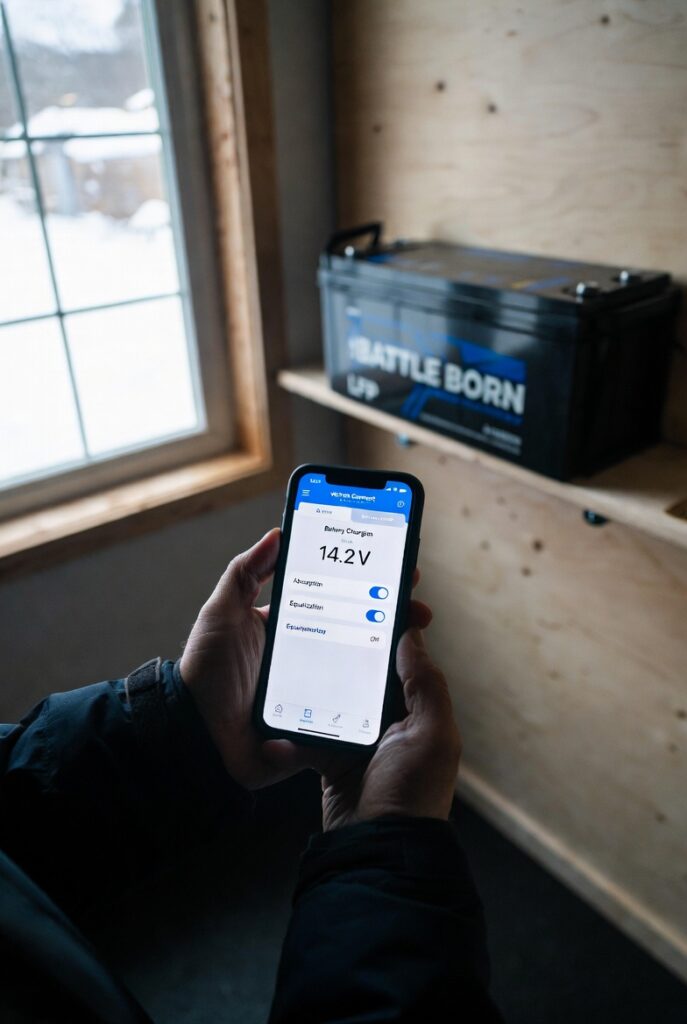
The wrong charge controller settings are the leading cause of premature battery failure in Ontario off-grid systems, and the most common mistake is using a Victron factory default profile without confirming it matches the installed battery chemistry. A homeowner on Clairfields Drive in Guelph, Wellington County installed a new Battle Born 100Ah LFP battery in the spring of 2023 and connected it to a Victron SmartSolar MPPT 100/30 without modifying the factory charge controller settings.
The Victron default profile is a sealed lead acid configuration with an absorption voltage of 14.4V. His Battle Born BMS had a cell overvoltage protection trigger at 14.4V to 14.6V. Every afternoon at approximately 2 PM the BMS registered an overvoltage condition and disconnected the load circuit.
He spent approximately three weeks testing the controller, the battery cables, and the inverter before calling the installer who had recommended the system. The installer reviewed the Victron Connect app configuration remotely and identified the charge controller settings error in approximately four minutes. The absorption voltage was set to 14.4V, the float was set to 13.8V, and equalization was enabled. Every one of those settings was wrong for LFP chemistry. The correct LFP charge controller settings for a Battle Born battery are: absorption 14.2V, float 13.5V, equalization disabled. The 0.2V difference between 14.4V and 14.2V was the entire cause of three weeks of daily power outages at 2 PM.
I walked through the corrected configuration with him during the commissioning check two weeks after the settings change. The Victron Connect app showed clean bulk-to-absorption transitions with the absorption phase completing in approximately 35 to 45 minutes on clear days. The Victron SmartShunt confirmed 98% SoC on the first full clear day after the settings correction, up from the 87% false ceiling the BMS protective disconnect had been imposing. The incorrect charge controller settings had been preventing a full charge cycle every single day since installation. See our Ontario solar sizing guide before building your system to ensure the battery bank and controller are correctly sized before configuration begins.
The four charge stages: bulk, absorption, float, and equalization
| Stage | What happens | LFP target | AGM target |
|---|---|---|---|
| Bulk | Maximum current, voltage rising | Up to 14.2V | Up to 14.4V |
| Absorption | Voltage held, current tapering to full | 14.2V, 1 hr max | 14.4V, 2 to 3 hrs |
| Float | Maintains charge, runs background loads | 13.5V | 13.8V |
| Equalization | High-voltage desulfation pulse | DISABLED, NEVER | DISABLED (sealed) / 15.0V (flooded only) |
The four charge stages determine how the controller moves current through the battery during each solar day. Bulk delivers maximum available current while voltage climbs to the absorption setpoint. Absorption holds voltage steady while current tapers, filling the battery to 90 to 100% SoC by the end of the phase. Float drops voltage to a maintenance level that prevents self-discharge while running background loads such as Starlink and refrigeration. Equalization is a high-voltage overcharge pulse used exclusively for flooded lead acid batteries to dissolve lead sulfate deposits on the plates. Equalization must be disabled for every LFP battery and every sealed AGM battery without exception.
The stages matter for Ontario off-grid operation because an incomplete absorption phase leaves the battery at approximately 80 to 85% SoC on every charge cycle. That 15 to 20% shortfall reduces the effective battery bank capacity and shortens the time before a gray streak triggers a low-voltage cutoff. The Victron SmartShunt logs show whether absorption is completing correctly by displaying phase duration and final current taper. If the current at the end of absorption is not below approximately 1 to 2% of the battery Ah rating, the absorption setpoint or duration in the charge controller settings may be insufficient. See our LFP battery maintenance guide for the full SmartShunt calibration procedure after the first corrected absorption cycle.
The charge controller settings table: LFP vs AGM voltage profiles
| Setting | LFP (Lithium) | Sealed AGM | Flooded lead acid |
|---|---|---|---|
| Absorption voltage | 14.2V | 14.4V | 14.4 to 14.8V |
| Float voltage | 13.5V | 13.8V | 13.8V |
| Absorption time | 1 hour max | 2 to 3 hours | 2 to 3 hours |
| Equalization | DISABLED, NEVER | DISABLED, NEVER | 15.0 to 15.5V monthly |
| Low-temp cutoff | 5C (Ontario rule) | Not required | Not required |
The most common field error is using the Victron factory default sealed lead acid profile on an LFP battery. The factory default absorption is 14.4V. The LFP BMS protection threshold is 14.4V to 14.6V. The 0.2V gap between the controller setpoint and the BMS trigger produces the Clairfields Drive scenario: 21 consecutive days of 2 PM load disconnect. Updating the charge controller settings in Victron Connect takes approximately 90 seconds: navigate to Settings, then Battery, then Charge Voltages, enter the correct absorption and float values, disable equalization, and confirm the low-temperature cutoff is set to 5C with a temperature sensor physically connected.
Some LFP manufacturers specify 14.4V absorption rather than 14.2V. Always check the battery manufacturer datasheet before entering any charge controller settings. Battle Born specifies 14.2V to 14.4V, use 14.2V as the safe default on their batteries. After updating the settings, review the charge profile graph in Victron Connect on the first full-sun day following the change. A correctly configured LFP profile shows a bulk phase climbing to 14.2V, a clean absorption phase tapering over approximately 30 to 60 minutes, and a float phase holding at 13.5V for the remainder of the day. See our solar battery bank sizing guide for how the charge profile interacts with the 3-day gray streak autonomy calculation.
Why wrong charge controller settings kill batteries in two different ways
LFP on a high-voltage AGM profile produces the visible failure: daily BMS disconnects at peak solar. The 14.4V absorption setpoint sits at or above the BMS overvoltage threshold. The BMS disconnects to protect the cells. The system loses power every afternoon at the exact moment solar production is highest. The battery is physically undamaged, the BMS did its job. The owner does not see battery damage; they see what appears to be a controller or inverter fault. Most owners replace functional hardware before discovering the charge controller settings are the cause.
AGM on a low-voltage LFP profile produces the invisible failure: gradual sulfation with no visible event. The 14.2V absorption voltage is below the 14.4V saturation point AGM cells require. The battery never reaches full charge. Each cycle leaves the plates at 85 to 90% SoC. Chronic partial-state-of-charge cycling causes lead sulfate to crystallise on the plates, permanently reducing Ah capacity. An AGM bank on LFP charge controller settings loses approximately 15 to 25% of rated capacity per season with no warning until a battery analyser reveals the damage.
A cottage owner on Main Street in Milton, Halton County installed a 100Ah LFP battery in an unheated shed in September 2024. Her installer set the LFP charge controller settings correctly: 14.2V absorption, 13.5V float, equalization disabled. However, neither owner nor installer set the low-temperature cutoff or installed the temperature sensor. On a clear January morning at -12C ambient, the battery enclosure was approximately -8C. The controller pushed full bulk current into cells below 0C internal temperature. No immediate symptom appeared. In March a battery analyser showed 18% permanent capacity loss from the September baseline. Lithium plating from January below-0C charging is irreversible. Her $800 Battle Born battery was operating at 82Ah effective capacity after one Ontario winter.
Ontario winter rule: low-temperature cutoff for LFP in unheated enclosures
LFP batteries in unheated Ontario sheds or outdoor enclosures require a confirmed low-temperature cutoff in the charge controller settings. The cutoff must be set to 5C rather than 0C because battery enclosure temperature lags ambient temperature. An enclosure reading +2C ambient may have internal cell temperature still at -2C when the sun rises and bulk charging begins. The 5C cutoff provides a safety buffer for this lag. Without it, every clear January morning begins with the controller pushing charging current into a battery below freezing.
The temperature sensor is the required companion to the cutoff setting. Victron SmartSolar MPPT controllers accept a compatible temperature sensor at the battery temperature sensor port. Without a physically connected and reading sensor, the charge controller settings low-temperature cutoff has no effect regardless of the value entered. Before leaving an LFP battery in an unheated Ontario winter enclosure: confirm the sensor port is connected, confirm the Victron Connect app is displaying a plausible battery temperature reading, and confirm the low-temperature cutoff is set to 5C. The Milton Main Street result confirms the cost of skipping this step: 18% permanent capacity loss and an $800 battery performing as an $640 battery for the rest of its service life.
Pro Tip: The fastest way to confirm the charge controller settings are working correctly for LFP is to watch the Victron Connect charge graph through one complete sunny day cycle after the settings update. A correctly configured LFP profile produces a characteristic shape: a rising bulk phase reaching 14.2V in the mid-morning, a flat absorption plateau lasting 30 to 60 minutes as current tapers, then a float line at 13.5V for the remainder of the afternoon. If the absorption plateau is absent and the voltage reaches 14.2V then immediately drops to float without tapering, the battery was already fully charged before the absorption phase could complete, which usually means the previous day’s charge was interrupted. If the voltage climbs past 14.2V during absorption and the BMS disconnects, the absorption setpoint is still too high. Both failure patterns are visible in the charge graph within 20 seconds of opening Victron Connect.
NEC and CEC: Ontario requirements for charge controller installations
NEC 690 governs solar PV installations. The charge controller must be listed for the application and installed per manufacturer specifications under NEC 690.35. The charge controller settings configured in the Victron Connect app constitute part of the system commissioning documentation. Absorption, float, and equalization values must be appropriate for the connected battery chemistry as specified in the battery manufacturer’s installation manual. Installing a controller with incorrect charge controller settings that cause repeated BMS protective disconnections constitutes a non-compliant installation because the system is not operating per the battery manufacturer’s specifications. Contact the NFPA at nfpa.org for current NEC 690 requirements for charge controller installation and commissioning in residential solar PV systems.
CEC Section 64 governs solar PV installations in Ontario. The ESA permit application for a solar installation must identify the charge controller model and configuration. The battery chemistry and corresponding charge controller settings profile are part of the commissioned system documentation that an ESA inspector may review. A charge controller configured with equalization enabled on an LFP battery, or with absorption voltage settings that repeatedly trigger BMS protective disconnection, may not satisfy the inspection requirement that the installation operates per manufacturer specifications. Contact the Electrical Safety Authority Ontario at esasafe.com before commissioning an Ontario solar installation to confirm current documentation requirements for charge controller configuration.
The charge controller settings verdict: three Ontario configuration rules
- Confirm battery chemistry and enter the correct charge controller settings manually before the first charge cycle. The Victron factory default is a sealed lead acid profile with 14.4V absorption. LFP requires 14.2V absorption, 13.5V float, equalization disabled. The Clairfields Drive result quantifies the cost of skipping this step: 21 consecutive days of 2 PM power outages from a 0.2V error. Check the battery manufacturer datasheet, open Victron Connect, navigate to Settings, then Battery, then Charge Voltages, and enter the correct values before commissioning. The change takes 90 seconds. The damage from skipping it took three weeks to diagnose. See our MPPT charge controller guide for cold Voc string sizing before confirming the controller model.
- Disable equalization on every LFP and every sealed AGM battery without exception. Equalization is a flooded lead acid procedure that desulfates plate deposits through a controlled overcharge. LFP chemistry has no sulfation mechanism and equalization causes cell damage through overvoltage. Sealed AGM cannot vent the gas equalization generates, and sealed AGM must never undergo equalization, maximum absorption voltage for sealed AGM is 14.8V. The Victron default equalization setting should be confirmed disabled in every installation before commissioning regardless of whether the default appears to be off. If it is enabled, disable it. This takes one toggle in Victron Connect.
- Confirm the low-temperature cutoff is set to 5C and the temperature sensor is physically connected for every LFP battery in an unheated Ontario winter enclosure. The Milton Main Street result is the cost of the omission: 18% permanent capacity loss and a $800 battery performing at $640 effective value after one winter. Set the cutoff. Wire the sensor. Verify the Victron Connect app is displaying a plausible battery temperature reading before the first Ontario winter. A system with correct charge controller settings, a confirmed temperature sensor, and equalization disabled will protect the battery investment through Ontario winters without daily intervention.
Frequently Asked Questions
Q: What are the correct Victron charge controller settings for an LFP battery?
A: Absorption voltage 14.2V, float voltage 13.5V, absorption time 1 hour maximum, equalization disabled, and low-temperature cutoff set to 5C with a temperature sensor physically connected and confirmed reading in the Victron Connect app. Some LFP manufacturers specify 14.4V absorption rather than 14.2V, always check the battery datasheet and use the manufacturer-specified value. The 14.2V default is the safe starting point for Battle Born and most quality LFP brands. After entering these charge controller settings, review the charge profile graph in Victron Connect on the first full clear day to confirm the absorption phase is completing cleanly with a proper current taper before transitioning to float.
Q: Can I use the default Victron settings for my battery or do I need to change them?
A: The Victron factory default charge controller settings are a sealed lead acid profile and must be changed for LFP batteries before the first charge cycle. Using the default AGM absorption voltage of 14.4V on an LFP battery sets the absorption setpoint at or above the BMS overvoltage protection threshold, producing daily load disconnects at peak solar production. The Clairfields Drive owner ran the factory default for three weeks before the installer identified the error remotely in four minutes. The correct LFP charge controller settings take approximately 90 seconds to enter in Victron Connect. The cost of skipping this step is measured in weeks of daily outages or years of premature battery degradation depending on which direction the error runs.
Q: What happens if I accidentally leave equalization enabled on an LFP battery?
A: Equalization generates a high-voltage overcharge pulse at 15.0V or above, designed to dissolve lead sulfate deposits on flooded lead acid plates. LFP chemistry has no sulfation mechanism and cannot benefit from equalization. The high voltage exceeds the BMS overvoltage protection threshold and triggers an emergency protective disconnect. Repeated equalization events can cause lithium plating on the anode and permanent capacity loss beyond what the BMS protection alone prevents. Disable equalization in the Victron Connect charge controller settings immediately if it is currently enabled on an LFP installation. Navigate to Settings, then Battery, then the equalization toggle, and confirm it is disabled before the next full charge cycle.
This build is engineered within the 48V DC Safety Ceiling. Diagnostic logic is based on 20+ years of technical service experience. All structural and electrical installations must be verified by a Licensed Professional and comply with your Local AHJ.
About the Author
Robert Bertrand spent 20 years as a service advisor in the automotive industry (Lexus and Nissan), where precision diagnostics, wiring integrity, and documentation standards were non-negotiable. He brings that same technical discipline to GridFree Guide, where he researches, tests, and documents off-grid solar systems for Ontario conditions. Based in Rockwood, Ontario, every article is built on verified specifications, manufacturer data, and the real-world climate constraints of Canadian off-grid living.
As an Amazon Associate I earn from qualifying purchases. This site also contains affiliate links to other products and services. GridFree Guide earns a small commission at no extra cost to you.