
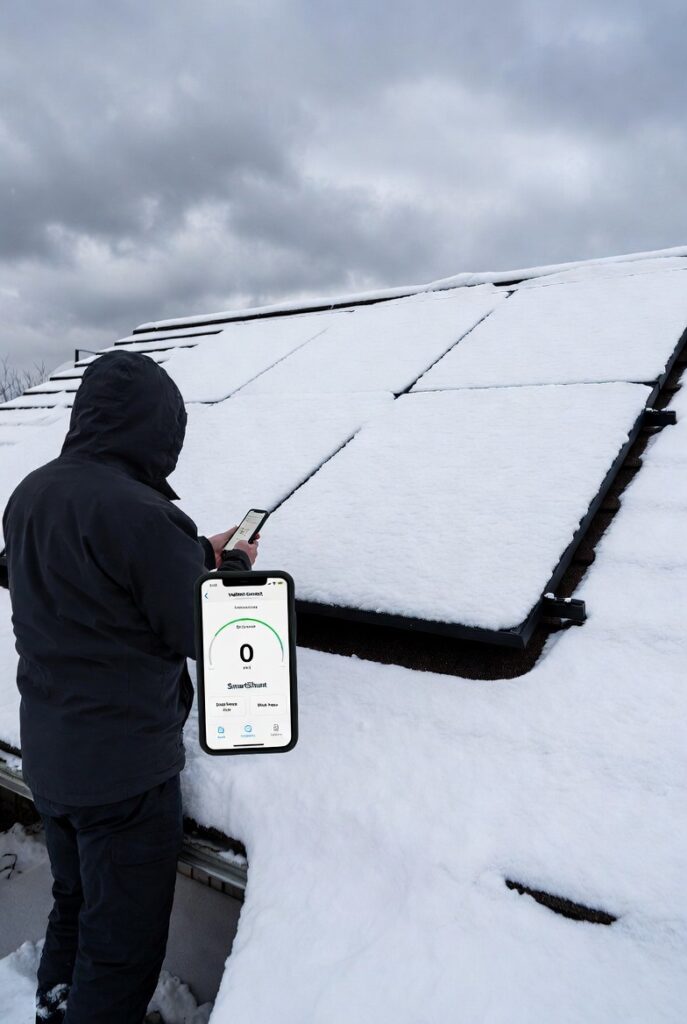
Solar panel output in Ontario drops to approximately 27% of the nameplate rating in January, not because the panels are defective, but because the sun delivers only 1.5 peak sun hours per day instead of the 4.5 hours that made your July system look like it was working fine. A homeowner on Clairfields Drive in Guelph, Wellington County built a 400W panel array in July 2023. He sized his battery bank based on a July production average of approximately 1,600Wh per day and calculated that his 150Wh daily workshop load was well covered with plenty of reserve. His first November confirmed the July math: clear days delivered approximately 1,100Wh with 4.0 peak sun hours.
His first January delivered a shock. On a clear January day with full sun and no snow cover, his Victron SmartShunt showed 280Wh of total daily solar panel output, not the 1,600Wh July figure, and not the 1,000Wh he expected from a sunny day. The 400W array at STC would produce 400Wh in exactly one peak sun hour. January in Wellington County delivers approximately 1.5 to 2.0 peak sun hours on a clear day. At 1.5 hours with a system efficiency of 0.80: 400W x 1.5 x 0.80 = 480Wh. His 280Wh result indicated partial shading from a low sun angle and diffuse irradiance on a technically clear but hazy January day, which is not unusual in Wellington County.
I walked through the revised winter sizing with him at the spring commissioning check. His July sizing had been based on a 4.0-hour average. His January reality was 1.5 hours at best. The ratio is 1.5 divided by 4.0 = 0.375, meaning January solar panel output is approximately 37.5% of July solar panel output from the same array. He had sized a summer system and installed it year-round.
The correct approach was to size to the worst-case Ontario month: December or January at 1.5 peak sun hours. He added two additional Renogy 100W panels in spring 2024, bringing his array to 600W. His revised January solar panel output on clear days: approximately 720Wh. See our Ontario solar sizing guide for the full load-to-array sizing method.
Solar panel output variable one: why Ontario January delivers only 1.5 peak sun hours
| Month | Peak sun hours | 400W array output (0.80 eff.) | vs January |
|---|---|---|---|
| July | 4.5 to 5.0 PSH | 1,440 to 1,600Wh | 3x January |
| June / August | 4.0 to 4.5 PSH | 1,280 to 1,440Wh | 2.7x January |
| October / March | 3.0 to 3.5 PSH | 960 to 1,120Wh | 2x January |
| November / February | 2.0 to 2.5 PSH | 640 to 800Wh | 1.4x January |
| December / January | 1.5 to 2.0 PSH | 480 to 640Wh | Baseline |
The primary driver of winter solar panel output in Ontario is peak sun hours. Panels are rated at STC assuming 1,000 W/m2 irradiance, meaning one peak sun hour delivers the full rated wattage. In July, Ontario sees 4.5 to 5.0 peak sun hours on clear days. By January, this drops to 1.5 to 2.0 peak sun hours. For a 400W array: 400W x 4.5 PSH x 0.80 = 1,440Wh in July versus 400W x 1.5 PSH x 0.80 = 480Wh in January. January produces approximately one-third of July output from the same array at the same location.
The low sun angle in winter compounds the peak sun hours reduction. In July the high sun arc keeps panels near peak irradiance from 9 AM to 5 PM, producing approximately 8 hours of useful output with the middle 4.5 hours near STC intensity. In January the low sun arc delivers useful irradiance from approximately 10 AM to 2 PM, only 4 hours total with the middle 1.5 hours near STC intensity.
A south-facing panel at 30 to 45 degrees tilt captures more of the low winter sun angle than a flat-mounted panel. Steeper tilt angles of 50 to 60 degrees are optimal for January in Wellington County and improve snow shedding simultaneously. See our best solar panels Ontario guide for tilt angle and IEC 61215 snow load specifications.
How to calculate realistic solar panel output for Ontario winter planning
The Ontario winter solar panel output formula uses three inputs: array wattage, January peak sun hours, and system efficiency. Step 1: Array Watts x 1.5 PSH x 0.80 = theoretical clear-day Wh. Step 2: multiply by 0.50 to account for Ontario January snow cover frequency of approximately 30 to 50% of days. Result: average daily solar panel output for Ontario January planning. For a 400W array: 400 x 1.5 x 0.80 = 480Wh clear day; 480 x 0.50 = 240Wh average daily January output. For a 600W array: 600 x 1.5 x 0.80 = 720Wh clear day; 720 x 0.50 = 360Wh average January output.
The July sizing trap works in reverse for array expansion decisions. If the daily load is 400Wh and the January average solar panel output formula must cover it, work backwards: 400Wh divided by (1.5 x 0.80 x 0.50) = 400 divided by 0.60 = 667W minimum array for Ontario January self-sufficiency. A 700 to 800W array handles this with a small buffer. Summer performance from a winter-sized array will be excellent: a 700W array produces approximately 2,520Wh on a clear July day at 4.5 PSH, roughly 3x the January output. The excess summer production bulk-charges the battery bank. See our solar battery bank sizing guide for how to pair the array size calculation with the 3-day gray streak battery formula.
Variable two: snow cover and what it does to your array
Fresh snow across the panel surface reduces solar panel output to near zero because photons cannot reach the cells through the snow layer. A 2cm dusting eliminates production as effectively as a full storm accumulation. Panels at 45 degrees or steeper shed dry snow within 2 to 4 hours after the sun warms the upper edge of the glass. Panels at 30 degrees may hold snow for 1 to 3 days. Panels at 15 degrees or flat require manual clearing because snow will not slide on its own. Wet heavy April snow sits at any tilt angle for 12 to 36 hours before natural melt releases it.
A cottage owner on James Street North in Milton, Halton County had a 600W array on a south-facing cottage roof at approximately 30-degree tilt. His January SmartShunt logs showed a consistent pattern: zero solar panel output from Saturday morning through Monday afternoon on roughly 40% of winter weekends, followed by normal clear-day production once the snow cleared. His theoretical clear-day solar panel output was 600W x 1.5 x 0.80 = 720Wh.
His actual January daily average was approximately 390Wh, approximately 54% of the clear-day theoretical figure. He adopted the 50% planning budget and learned a snow management technique: clear the bottom two-thirds of each panel with a soft roof rake from the ground, leaving the top strip exposed to the sun. The exposed strip warms the glass and the remaining snow slides within approximately 45 minutes.
Variable three: cold temperature coefficient and the Voc silver lining
The cold temperature coefficient is the smallest of the three winter variables and works partially in your favour. Cold increases open circuit voltage (Voc) slightly, which improves MPPT controller harvest efficiency. The temperature coefficient of Pmax for quality monocrystalline panels is typically -0.35 to -0.45%/°C, meaning a -15C day reduces rated output by approximately 14 to 16% from the 25C STC value. The net Ontario winter solar panel output at -15C is approximately 84 to 92% of STC wattage. Cold reduces output slightly but does not explain the large summer-to-winter production gap. Peak sun hours is always the dominant variable.
The Voc increase in cold creates one genuine risk for controller selection. Panel open-circuit voltage at -20C is approximately 13 to 15% higher than at STC. A string of three 22.5V Voc panels reaches 22.5V x 1.14 x 3 = 77V at -20C. A four-panel string reaches 102V, exceeding the 100V max input of the Victron MPPT 100/30. String voltage must always be calculated using cold morning Voc, not STC Voc. For the full cold Voc calculation and MPPT controller sizing method, see our MPPT charge controller guide.
Pro Tip: The fastest way to separate the three winter output problems is to read the SmartShunt production log looking for three distinct signatures. Problem 1 (cold Voc controller trip): zero output until approximately 10 AM on clear cold mornings, then normal output once panels warm above -5C. Problem 2 (peak sun hours shortfall): consistently low output across all daylight hours on clear days, proportionally lower than summer by approximately 3x. Problem 3 (snow cover): zero output for 24 to 72-hour stretches followed by a sharp recovery to normal once snow clears or is removed. These three patterns produce visually distinct signatures in the SmartShunt daily history graph. Confusing them leads to wrong solutions: adding more panels does not fix a cold Voc controller trip, and widening the MPPT input voltage range does not add January daylight hours.
NEC and CEC: Ontario requirements for solar panel installations
NEC 690 governs solar PV installations. Solar panel output capacity, array configuration, and all associated wiring must comply with NEC 690 requirements for listed equipment, conductor sizing, and overcurrent protection. Array wiring must be sized for the maximum short-circuit current of the panel string under full irradiance conditions, not the average winter production figure. NEC 690 also governs the disconnecting means for the array, which must be accessible and capable of interrupting the maximum available array fault current. Contact the NFPA at nfpa.org for current NEC 690 requirements applicable to residential solar panel installations in Ontario.
CEC Section 64 governs solar PV installations in Ontario. Any expansion of an existing solar panel array, such as adding panels to improve Ontario winter solar panel output, constitutes a modification to the original permitted installation. Adding panels changes the array wattage, string voltage, and short-circuit current values documented in the original ESA permit. This modification may require a permit amendment before the new panels are connected. Before adding panels to an existing Ontario solar installation, confirm with your installer whether the expansion falls within the original permit scope or requires an amendment. Contact the Electrical Safety Authority Ontario at esasafe.com before expanding any previously permitted Ontario solar panel installation.
The solar panel output verdict: sizing to January, not July
- Ontario owner experiencing winter production shortfall: run the formula before buying more panels. Array Watts x 1.5 PSH x 0.80 = clear-day January Wh. Multiply by 0.50 for the snow cover adjustment to get average daily January solar panel output. If this number does not cover the daily load, the array needs expansion or the battery bank needs to be larger to bridge the shortfall through gray streaks. The Clairfields Drive result confirms the formula: 600W x 1.5 x 0.80 = 720Wh clear day, approximately 360Wh average January, adequate for a 150Wh daily workshop load with reserve and several gray streak days before the generator is needed.
- Ontario owner planning a new system: size to January first, verify July second. Calculate the minimum winter array: daily load divided by (1.5 x 0.80 x 0.50) = minimum array Watts for Ontario January self-sufficiency. For a 400Wh daily load: 400 divided by 0.60 = 667W minimum array. A 700 to 800W array handles this load with buffer. Summer solar panel output from this array will be approximately 2,500 to 2,900Wh per clear day, roughly 3x the January figure, and the excess simply bulk-charges the battery bank. The cost of a winter-sized array is the correct baseline, not a premium.
- Ontario owner whose system shuts down in January on clear days: read the SmartShunt log before ordering hardware. Pattern 1 (zero until 10 AM then recovery): cold Voc controller trip, fix is controller input voltage, see the MPPT guide. Pattern 2 (low but proportional output all day): 1.5 PSH winter reality, fix is more panels or larger battery bank. Pattern 3 (zero for 24 to 72 hours then sharp recovery): snow cover, fix is steeper tilt or manual clearing technique. Each pattern has a different solution and a different cost. Confusing them wastes money. The SmartShunt log distinguishes all three in a 5-minute review.
Frequently Asked Questions
Q: Why is my solar panel output so low in Ontario winter compared to summer?
A: The primary cause is peak sun hours. July in Wellington and Halton County delivers 4.5 to 5.0 peak sun hours on clear days. January delivers 1.5 to 2.0 peak sun hours. A 400W array produces approximately 1,440Wh on a clear July day and approximately 480Wh on a clear January day, before accounting for snow cover. Snow cover on approximately 30 to 50% of January days reduces the monthly average further to approximately 240Wh per day. Cold temperature reduces solar panel output by approximately 8 to 16% from the STC value, but is the smallest of the three variables. The dominant cause is always the shortened January solar day, not panel failure or temperature damage.
Q: How do I calculate realistic solar panel output for an Ontario January system?
A: Use the Ontario winter formula: Array Watts x 1.5 PSH x 0.80 system efficiency = clear-day January Wh. Then multiply by 0.50 to account for the approximately 30 to 50% of January days with snow cover reducing or eliminating output. For a 600W array: 600 x 1.5 x 0.80 = 720Wh clear day; 720 x 0.50 = 360Wh average daily January output. For system design, use the 360Wh average figure, not the 720Wh clear-day figure. Size the battery bank using the 3-day gray streak formula from the battery bank guide to bridge the days when solar panel output falls below the daily load.
Q: Does snow on solar panels completely stop output or just reduce it?
A: Fresh snow covering the entire panel surface reduces solar panel output to near zero because photons cannot pass through the snow layer to reach the cells. Even a 2cm dusting fully blocks production. A partial covering, such as snow on the lower half of a panel at a shallow tilt, reduces output proportionally to the covered area. Panels at 45 degrees or steeper typically shed dry snow within 2 to 4 hours of sunrise once the sun warms the upper panel edge.
Panels at 30 degrees or shallower require manual clearing or accept the 24 to 72-hour production gap while the snow melts. The Milton James Street North result, 390Wh actual versus 720Wh theoretical in January, reflects the realistic impact of 30-degree tilt panels in Ontario winter conditions.
This build is engineered within the 48V DC Safety Ceiling. Diagnostic logic is based on 20+ years of technical service experience. All structural and electrical installations must be verified by a Licensed Professional and comply with your Local AHJ.
About the Author
Robert Bertrand spent 20 years as a service advisor in the automotive industry (Lexus and Nissan), where precision diagnostics, wiring integrity, and documentation standards were non-negotiable. He brings that same technical discipline to GridFree Guide, where he researches, tests, and documents off-grid solar systems for Ontario conditions. Based in Rockwood, Ontario, every article is built on verified specifications, manufacturer data, and the real-world climate constraints of Canadian off-grid living.
As an Amazon Associate I earn from qualifying purchases. This site also contains affiliate links to other products and services. GridFree Guide earns a small commission at no extra cost to you.