
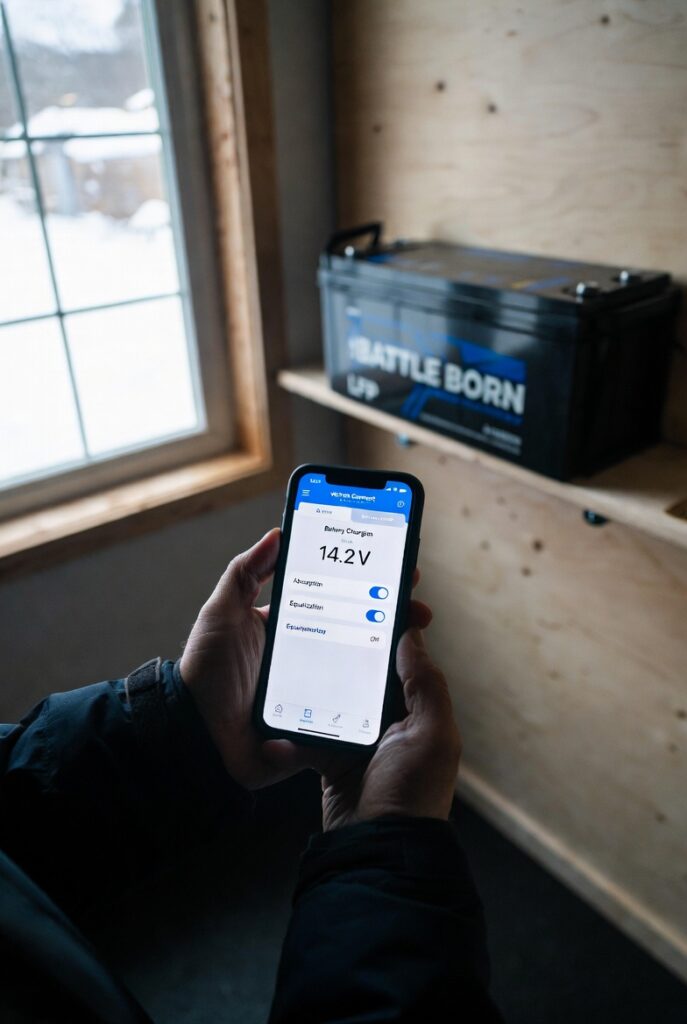
Off grid washing is one of the most demanding loads in a residential solar system because a washing machine delivers three distinct energy challenges in a single appliance: motor startup surge, extended running current, and an optional electric water heating element that consumes more energy than the motor ever does. A homeowner on Kortright Road West in Guelph, Wellington County purchased a 2,000W pure sine wave inverter and connected it to his existing 24V LFP battery bank specifically to run his top-load washing machine.
He calculated that his top-load washer listed a running power draw of approximately 500W and concluded a 2,000W inverter had four times the headroom required. His first full wash cycle confirmed the calculation was wrong. Every time the motor attempted to start the agitation cycle, the inverter hit its overload protection and shut down.
He replaced the inverter with a second 2,000W unit assuming the first was defective. The second unit behaved identically. He called the installer who explained the motor surge problem in approximately ten minutes: a top-load agitator motor has a startup inrush current of approximately 3 to 5 times its running current. His 500W running motor was drawing approximately 1,500 to 2,500W at every agitation start. A 2,000W inverter with a typical 4,000W surge rating was not sufficient for a 2,500W motor surge on a 24V battery bank with the additional voltage sag that accompanies high-current draw. He had spent approximately $400 on a replacement inverter before understanding the actual requirement.
I walked through the correct specification with him at the commissioning check after the system was rebuilt. Reliable off grid washing on a top-load machine requires a minimum 3,000W pure sine wave inverter with a 6,000W rated surge peak, a 48V battery bank to keep surge current within acceptable wire gauge, and a battery bank of at least 3,840Wh usable capacity. Four Battle Born 100Ah LFP batteries in two series pairs wired in parallel at 48V produce approximately 9,600Wh total and 7,680Wh usable at 80% DoD. His rebuilt system has run every laundry day without an inverter trip since spring 2024. See our Ontario solar sizing guide before designing a system around washing machine use.
The off grid washing motor surge problem: why 2,000W is never enough
| Machine type | Running watts | Startup surge | Surge multiplier | 24V bank current | 48V bank current |
|---|---|---|---|---|---|
| Top-load agitator | 400 to 500W | 1,200 to 2,500W | 3 to 5x | 52 to 104A | 25 to 52A |
| Front-load inverter drive | 300 to 400W | 600 to 1,000W | 1.5 to 2.5x | 25 to 42A | 12 to 21A |
| Minimum inverter required | , | Top-load: 3,000W/6,000W | , | Not recommended | Preferred ✓ |
The motor surge problem is why a correctly rated running wattage produces the wrong inverter specification for off grid washing. A top-load agitator motor with a 500W running draw has a startup inrush of approximately 1,500 to 2,500W for 0.5 to 2 seconds. At 24V, a 2,500W surge requires approximately 104A from the battery bank, which exceeds the safe continuous discharge rate of most 100Ah LFP cells and causes voltage sag that drops the effective inverter output. At 48V, the same surge requires approximately 52A, within the continuous discharge rating of a Battle Born 100Ah cell. System voltage and inverter surge rating must be specified together for any off grid washing application.
The front-load washing machine with an inverter drive motor is the lower-surge option for off grid washing. The inverter drive ramps motor speed gradually through variable frequency control rather than slamming the agitator to full torque. A front-loader at 350W running has a startup surge of approximately 525 to 875W, compared to 1,500 to 2,500W for a top-load machine at comparable running power. A 3,000W/6,000W inverter handles the front-load surge with substantial headroom even on a 24V system, though 48V remains the recommended specification for any off grid washing installation. See our battery inverter guide for the full pure sine wave inverter sizing method for motor loads.
Off grid washing and the hidden load: water heating element vs cold wash
The motor draws approximately 300 to 500W during wash and spin cycles and is not the dominant energy consumer per load. The electric water heating element draws approximately 2,000W to 2,500W during the warm-up phase of any hot or warm wash cycle. On a warm wash (40C) the element runs approximately 15 to 25 minutes, consuming 500 to 1,000Wh. On a hot wash (60C) the element runs approximately 25 to 35 minutes, consuming approximately 833 to 1,458Wh. A cold wash draws zero watts from the heating element. The total energy per load: hot wash approximately 1,100 to 1,750Wh, cold wash approximately 300 to 400Wh. The element is 3 to 4 times the motor energy draw per load.
A cottage owner on Regional Road 25 in Milton, Halton County added off grid washing to her system in spring 2025 after reviewing her Victron SmartShunt consumption logs and confirming she had sufficient clear-day surplus from her 1,200W panel array. She installed a compact front-load washer with an inverter drive motor rated at approximately 350W running. Her previous hot wash baseline was approximately 2,400Wh per load including the electric element.
She switched to cold wash for regular loads including towels, casual clothing, and linens. Her SmartShunt logs showed each off grid washing load drawing approximately 380Wh, a reduction of approximately 84% from the hot wash baseline. On clear summer days her array produced approximately 1,440Wh by 10 AM and she ran three loads before noon using approximately 1,140Wh while her battery bank rose from 60% to 85% SoC simultaneously.
Pro Tip: The fastest way to determine whether your existing system can support off grid washing before purchasing a machine is to check your SmartShunt clear-day surplus figure. Open the Victron Connect app on a sunny Ontario day, note the total daily production at sunset, subtract your total daily load consumption, and the remainder is available for laundry. A front-load cold wash requires approximately 380Wh per load. If your clear-day surplus is at least 760Wh (two loads’ worth), front-load cold washing is achievable on your existing system. If your surplus is below 380Wh, the system needs expansion before adding off grid washing. This single calculation, which takes approximately 60 seconds on a clear day, prevents the Kortright Road West scenario: a $400 inverter replacement followed by a complete 48V system rebuild.
Front loader vs top loader: which motor wins on solar
The inverter drive motor in a front-load washing machine ramps speed through a variable frequency drive, producing a startup surge of approximately 1.5 to 2.5x running power rather than the 3 to 5x inrush of a direct-drive top-load agitator. A front-loader at 350W running draws approximately 525 to 875W at startup. A 3,000W/6,000W inverter handles this comfortably even on a 24V system with a properly sized battery bank. Front-loaders also use approximately 50% less water per load than top-loaders, reducing greywater volume and pump run time. For any new off grid washing installation, a front-load machine with an inverter drive motor is the correct specification.
The spin cycle is a second surge event in every load. After the wash phase the motor accelerates from slow tumble to high-speed spin to extract water from the fabric. A front-loader spinning at 1,200 RPM draws approximately 300 to 400W at steady speed, but the acceleration to spin speed creates a secondary surge of approximately 600 to 800W lasting 2 to 4 seconds. Size the inverter to handle both the agitation startup and the spin acceleration simultaneously.
A 3,000W/6,000W inverter on a 48V bank manages both surge events for a front-load machine with comfortable margin and is the minimum recommended configuration for any off grid washing system planned for Ontario year-round use. See our solar battery bank sizing guide for how laundry load figures feed into the 3-day gray streak battery formula.
The minimum 48V system specification for laundry day
The minimum configuration for reliable off grid washing in Ontario is a 48V system with a 3,000W pure sine wave inverter rated for 6,000W surge. The battery bank: four Battle Born 100Ah LFP batteries wired as two series pairs in parallel, producing 48V at 200Ah, 9,600Wh total capacity, and 7,680Wh usable at 80% DoD. Three to four cold wash loads at 380Wh each draws approximately 1,140 to 1,520Wh, approximately 15 to 20% of usable capacity. A 1,000W or larger panel array recovers the laundry load fully on a clear Ontario day.
The electric clothes dryer is not practical on any off grid washing system. A standard electric dryer draws 4,500 to 5,500W continuously for 45 to 60 minutes per load, consuming approximately 3,375 to 5,500Wh, more than the entire laundry battery bank capacity in a single drying cycle. Outdoor line drying from May through September and a propane clothes dryer in the winter months are the correct Ontario off grid solutions for drying. The Victron SmartShunt confirms the actual per-load draw in real time on laundry day, verifying the cold wash strategy is delivering the projected 380Wh result rather than the 2,400Wh hot wash figure.
NEC and CEC: Ontario electrical requirements for washing machine circuits
NEC 690 and NEC Article 422 govern the electrical installation of appliances in solar-powered residential systems. A washing machine connected to an off-grid inverter output circuit must be connected to a properly protected 120V AC branch circuit with overcurrent protection rated for the appliance’s maximum running current plus motor startup inrush tolerance. NEC 240 governs branch circuit overcurrent protection sizing, the washing machine circuit must be protected by a breaker sized for the nameplate amperage plus the motor inrush, typically a 20A dedicated circuit. The inverter output distribution panel must include a dedicated washing machine breaker separate from lighting and general-purpose circuits. Contact the NFPA at nfpa.org for current NEC requirements for appliance circuits in residential solar PV systems.
CEC Section 64 governs solar PV installations in Ontario. The ESA permit application for an off-grid inverter system must identify the rated output of the inverter and the loads connected to it. A washing machine added to an existing permitted inverter output panel constitutes a load addition that may exceed the original permitted inverter output capacity and require a permit amendment. Before connecting a washing machine to an existing Ontario off-grid system, confirm with a Licensed Electrical Contractor that the inverter output panel has sufficient capacity and that the washing machine circuit is protected per the Ontario Electrical Safety Code. Contact the Electrical Safety Authority Ontario at esasafe.com before connecting any large appliance to a permitted Ontario off-grid solar installation.
The off grid washing verdict: minimum specification for Ontario laundry
- Ontario off-grid owner who wants to add laundry to an existing Tier 1 or Tier 2 system: check the SmartShunt clear-day surplus before purchasing a machine. A front-load cold wash requires approximately 380Wh per load. If your clear-day surplus after daily loads is at least 760 to 1,140Wh, front-load cold washing is achievable without rebuilding. If surplus is below 380Wh on clear days, expand the system first. The SmartShunt clear-day surplus figure is the gate check. See our Ontario off-grid roadmap for the full load audit sequence before adding major appliances.
- Ontario off-grid owner building a new system with laundry included from day one: the minimum specification is non-negotiable, 48V, 3,000W/6,000W pure sine inverter, four Battle Born 100Ah LFP in two series pairs. Front loader, cold wash for regular loads, propane tankless water heater for occasional hot wash items that require sanitation. This configuration handles three to four loads per clear summer day with full panel recovery. Winter laundry on shorter solar days: schedule for the clearest forecast days and plan one load per day in November through February. The Kortright Road West result confirms the cost of undersizing: $400 replacement inverter plus a complete 48V system rebuild before the off grid washing system ran reliably.
- Ontario full-time off-grid homeowner who needs hot wash capability for work clothing, cloth diapers, or medical requirements: avoid the electric heating element and use a propane tankless water heater instead. The electric element requires a minimum 10kWh usable battery bank and a 2,000W or larger panel array to recover the 1,500 to 2,400Wh hot wash load within the same day. A propane tankless water heater connected to the cold water inlet delivers the same hot wash temperature without the electric element draw at a fraction of the system upgrade cost. Cold wash handles approximately 90% of regular household laundry loads. Reserve hot wash with the propane tankless for the specific fabrics and sanitation requirements that cold water cannot address.
Frequently Asked Questions
Q: What size inverter do I need for an off-grid washing machine in Ontario?
A: A 3,000W pure sine wave inverter with a minimum 6,000W surge peak is the standard for off grid washing in Ontario. A top-load washing machine with a 500W running motor has a startup inrush of approximately 1,500 to 2,500W. A 2,000W inverter with a 4,000W surge rating is insufficient for a top-load machine on a 24V system, as the Kortright Road West result confirms after two inverter trips and a $400 replacement cost. The 3,000W/6,000W specification on a 48V battery bank handles both the agitation startup surge and the spin acceleration surge with comfortable headroom for any standard residential washing machine.
Q: Can I run a washing machine on a 24V solar system?
A: A front-load washing machine with an inverter drive motor can run on a carefully sized 24V system because its startup surge of approximately 600 to 1,000W is within range of a 3,000W/6,000W inverter on an adequate battery bank. A top-load washing machine is not recommended on a 24V system because the agitator motor startup surge of 1,500 to 2,500W requires approximately 104A from a 24V battery, which causes significant voltage sag and exceeds the safe continuous discharge rate of most 100Ah LFP cells. For reliable off grid washing with any machine type, 48V is the recommended system voltage because it halves the surge current requirement and keeps wire gauge and battery discharge within safe operating limits.
Q: How much energy does a washing machine use on an off-grid cold wash cycle?
A: A front-load washing machine on a cold wash cycle draws approximately 300 to 400Wh per load from the battery bank, with the Milton Regional Road 25 result confirming approximately 380Wh per load on a compact front-loader with a 350W inverter drive motor. A hot wash cycle using the machine’s internal electric element draws approximately 1,100 to 2,400Wh per load depending on the target temperature and element wattage, with the element consuming approximately 3 to 4 times the motor energy per load. Switching from hot to cold wash on a front-loader reduces the per-load energy draw by approximately 80 to 84%, the most significant single efficiency measure available for off grid washing without changing the appliance.
This build is engineered within the 48V DC Safety Ceiling. Diagnostic logic is based on 20+ years of technical service experience. All structural and electrical installations must be verified by a Licensed Professional and comply with your Local AHJ.
About the Author
Robert Bertrand spent 20 years as a service advisor in the automotive industry (Lexus and Nissan), where precision diagnostics, wiring integrity, and documentation standards were non-negotiable. He brings that same technical discipline to GridFree Guide, where he researches, tests, and documents off-grid solar systems for Ontario conditions. Based in Rockwood, Ontario, every article is built on verified specifications, manufacturer data, and the real-world climate constraints of Canadian off-grid living.
As an Amazon Associate I earn from qualifying purchases. This site also contains affiliate links to other products and services. GridFree Guide earns a small commission at no extra cost to you.