
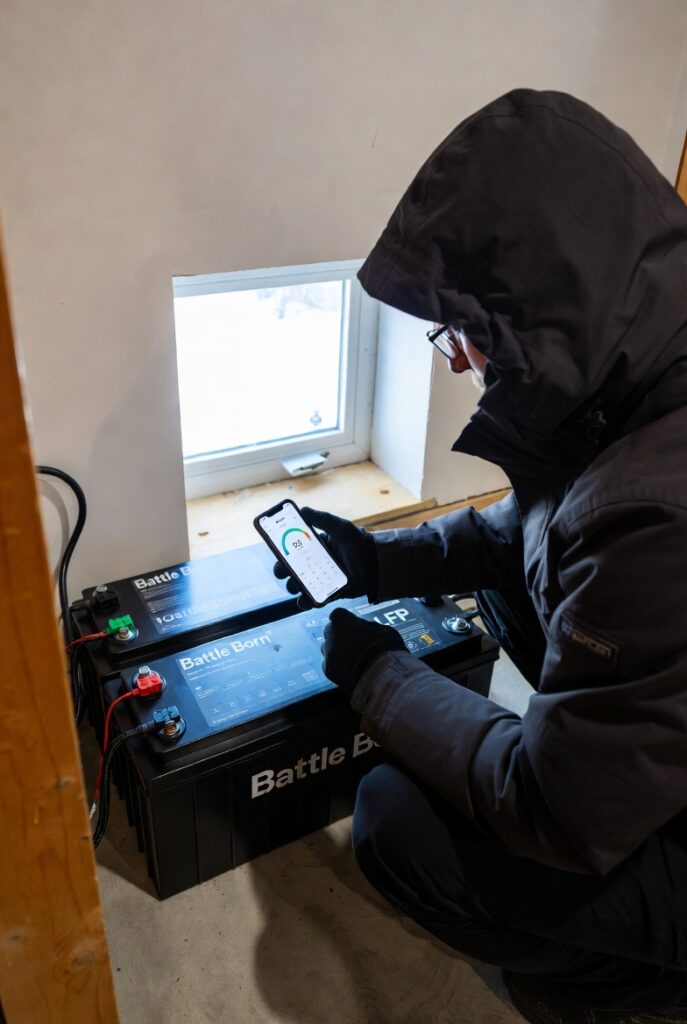
The most common solar battery bank sizing mistake in Ontario is calculating for one night of storage instead of three consecutive days of cloud cover. A homeowner on Elmira Road North in Guelph, Wellington County built his first off-grid system in the spring of 2022. He calculated his nightly load at approximately 400Wh and purchased a 100Ah LFP battery at 12V, approximately 960Wh of total capacity and 768Wh of usable capacity at 80% DoD. His summer performance was excellent. The system ran his LED lighting, laptop, and router through every clear July and August night with the battery at 55% by morning.
In November the first gray streak arrived: four overcast days with approximately 1.5 peak sun hours per day. His 200W panel array produced approximately 300Wh per day. His daily load of approximately 400Wh exceeded daily production by approximately 100Wh. By day 3 the solar battery bank was at 12% SoC and the system shut down at 6 PM before he had finished his work. The math exposed the problem clearly: 768Wh usable divided by 400Wh daily load = 1.9 nights of autonomy. A Wellington County November gray streak runs 4 to 7 days. The three-day autonomy standard requires a solar battery bank of 400Wh x 3 divided by 0.80 DoD = 1,500Wh minimum, approximately 125Ah at 12V.
He upgraded to a 200Ah LFP bank at 24V in December 2022, adding a second Battle Born 100Ah LFP in series with the first. His solar battery bank now holds 4,800Wh total capacity with 3,840Wh usable at 80% DoD, approximately 9.6 nights of his 400Wh daily load. The upgrade also doubled the system voltage from 12V to 24V, halving the current in his existing wiring and reducing resistive heating in the charge controller and inverter circuits.
His first full December after the upgrade: four-day gray streak in mid-month, solar battery bank held at 28% SoC at lowest, no shutdown, no generator required. I reviewed his Victron SmartShunt data from that stretch at the spring commissioning check. See our Ontario solar sizing guide before running your own load calculation.
Why one night of storage fails every Ontario November
Ontario November through February produces approximately 1.5 to 2.0 peak sun hours per day. A 200W array in those conditions delivers approximately 300 to 400Wh per day. If daily load equals or exceeds daily production, each overcast day depletes the solar battery bank by the load-production deficit. At 300Wh production and 400Wh load: -100Wh per day net depletion. A 768Wh usable solar battery bank lasts approximately 7.7 days of deficit at that rate, but a multi-day gray streak with minimal production accelerates the depletion far beyond a simple per-night calculation.
The three-day standard is the Ontario minimum because Wellington and Halton County experience gray streaks of 3 to 7 consecutive days from November through February. A solar battery bank sized for 3 days of autonomy survives the median gray streak comfortably with a small generator supplement at worst. A 5-day bank covers the 90th percentile event without any generator. The cost difference between 3-day and 5-day sizing is approximately 40% more bank capacity. For year-round full-time systems, the additional battery investment pays for itself in generator fuel and operational interruptions avoided in the first two Ontario winters. See our Ontario off-grid roadmap for how battery sizing fits into the full six-step system design sequence.
The solar battery bank sizing formula: three steps for Ontario gray streaks
| Step | Operation | 800Wh example | 900Wh example |
|---|---|---|---|
| 1. Daily load | Sum all loads (Wh) | 800Wh | 900Wh |
| 2. Autonomy | Daily Wh x 3 days | 2,400Wh | 2,700Wh |
| 3. DoD, LFP | ÷ 0.80 | 3,000Wh rated | 3,375Wh rated |
| 3. DoD, AGM | ÷ 0.50 | 4,800Wh rated | 5,400Wh rated |
| Convert to Ah at 12V | Wh ÷ 12 | 250Ah | 281Ah |
| Convert to Ah at 24V | Wh ÷ 24 | 125Ah | 140.6Ah |
The three steps produce the minimum rated solar battery bank capacity the Ontario gray streak standard requires. Step 1: total daily load in Wh, including inverter idle draw at 8 to 35W continuous depending on inverter size. Step 2: multiply by days of autonomy, 3 for Ontario cottage use, 5 for year-round full-time. Step 3: divide by DoD percentage, 0.80 for LFP, 0.50 for AGM. The result is rated solar battery bank capacity in Wh. Divide by system voltage for Ah. Higher voltage reduces the Ah requirement for the same storage: 3,000Wh at 12V requires 250Ah; at 24V, 125Ah; at 48V, 62.5Ah.
A cottage owner on Britannia Road West in Milton, Halton County applied the formula to a full seasonal cottage system in spring 2025. Her daily load was approximately 900Wh: DC fridge at 50% duty cycle (480Wh), Starlink (200Wh), LED lighting (90Wh), and miscellaneous loads (130Wh).
Applying the 3-day standard: 900Wh x 3 = 2,700Wh divided by 0.80 = 3,375Wh rated solar battery bank. At 24V: 3,375 divided by 24 = 140.6Ah, rounded to 200Ah using two Battle Born 100Ah LFP batteries in series. Her 4,800Wh rated bank with 3,840Wh usable delivered 4.3 days of autonomy. A 4-day January 2026 gray streak hit 31% SoC at its lowest then recharged to 95% on two clear days without any generator supplement. See our LFP battery maintenance guide for SmartShunt calibration after the first full charge cycle.
Solar battery bank chemistry: why LFP delivers 60% more usable capacity than AGM
| Specification | AGM 100Ah | LFP 100Ah |
|---|---|---|
| Working DoD | 50% | 80% |
| Usable Ah per 100Ah rated | 50Ah | 80Ah |
| Usable Wh at 12V | 600Wh | 960Wh |
| Rated Ah for 3,000Wh usable | ~500Ah | ~312Ah |
| Cycle life at working DoD | 300 to 500 | 3,000 to 5,000 |
| Years at 1 cycle/day | ~1 to 1.5 years | ~8 to 14 years |
| Cold charge limit | Down to -20C (slow) | BMS cutoff below 0C |
LFP delivers 60% more usable energy per rated Ah than AGM because the working DoD is 80% versus 50%. To achieve the same 3,000Wh of usable solar battery bank capacity: LFP requires approximately 312Ah rated; AGM requires approximately 500Ah rated. The LFP bank is physically smaller, lighter, and delivers more usable capacity from fewer batteries. For the 3-day Ontario gray streak standard at an 800Wh daily load, LFP achieves compliance with approximately 4 x 100Ah batteries; AGM requires approximately 5 x 100Ah batteries and still delivers less reserve margin at the end of a 3-day stretch.
Cycle life makes the total cost comparison decisive for Ontario owners cycling their solar battery bank daily. LFP at 3,000 to 5,000 cycles at 80% DoD lasts approximately 8 to 14 years at one cycle per day. AGM at 300 to 500 cycles at 50% DoD lasts approximately 1 to 1.5 years at that cycling rate. A Battle Born 100Ah LFP solar battery bank lasting 10 or more years compares against four to five AGM replacements over the same period. The AGM upfront cost advantage disappears within the first two replacement cycles. One Ontario winter note: LFP BMS protection cuts off charging below 0C to prevent lithium plating, so battery enclosures must remain above freezing for reliable winter charging performance.
Parallel wiring and the diagonal method: building a multi-battery bank
Parallel wiring connects positive to positive and negative to negative, doubling the Ah capacity while keeping voltage the same. Series wiring connects the positive terminal of battery 1 to the negative terminal of battery 2, doubling the voltage while keeping Ah the same. For a 24V solar battery bank using 12V batteries: two batteries in series, matched to the array using the MPPT charge controller sizing guide. For a 200Ah bank at 24V using four 12V batteries: two series pairs wired in parallel. Confirm the voltage matches at both ends of each series string before connecting the parallel junction to avoid cross-current between strings of mismatched voltage.
The diagonal wiring method ensures balanced current distribution across all batteries in a parallel bank. Connect the positive output lead to the positive terminal of the first battery in the bank. Connect the negative output lead to the negative terminal of the last battery in the bank, not the same battery as the positive lead. This diagonal path equalises the cable length and resistance between the output terminals and each battery in the bank.
Equal resistance produces equal current draw from each battery, equal charge and discharge cycles, and equal wear across all cells. The alternative, connecting both output leads to the same battery, creates an unequal resistance path that causes the directly-connected battery to work harder and fail years earlier than the rest of the bank.
Pro Tip: After building or expanding a solar battery bank, the first task before trusting the Victron SmartShunt SoC reading is a full synchronisation charge. Run the bank to 100% absorbed charge, hold at absorption voltage for the full absorption time, then watch for the SmartShunt to reset its coulomb counter to 100%. Until that first full sync charge completes, the SoC percentage is an estimate, not a calibrated measurement. A bank that reads 78% SoC before the first sync may actually be at 65% or 85% depending on initial battery state at installation. The Elmira Road North homeowner learned this when his December post-upgrade SmartShunt read 62% on day one, well below the 95% he expected after a full day of clear sky. A manual absorption charge reset the counter and every subsequent reading was accurate.
NEC and CEC: code requirements for battery bank installations in Ontario
NEC 690 governs solar PV installations. A solar battery bank installed as part of a PV system must comply with NEC 690.71 listing requirements and NEC 690 overcurrent protection requirements for battery circuits. Each battery in the bank must have appropriate fusing or circuit breaker protection at the battery terminals to prevent short-circuit current from exceeding the battery’s internal discharge capability. In parallel battery banks, each parallel string requires individual overcurrent protection before the strings are connected at the bus bar. NEC 690 also requires a battery disconnect switch that can safely interrupt the maximum available fault current from the solar battery bank. Contact the NFPA at nfpa.org for current NEC 690 battery bank wiring and overcurrent protection requirements.
CEC Section 64 governs battery installations in Ontario. The solar battery bank configuration, including number of batteries, series versus parallel connections, voltage, and Ah capacity, must be documented in the ESA permit application. Changes to the battery bank after the original permit inspection, such as adding a second battery in parallel to increase Ah or adding a second series pair to increase voltage, may constitute a configuration change requiring a permit amendment. Before expanding an existing solar battery bank, confirm with your installer whether the expansion falls within the original permit scope or requires an amendment. Contact the Electrical Safety Authority Ontario at esasafe.com before modifying a previously permitted Ontario solar battery bank installation.
The solar battery bank verdict: three Ontario sizing profiles
- Ontario shed or Tier 1 seasonal cottage owner with daily load under 400Wh: round up to at least 200Ah at 12V or 100Ah at 24V as the minimum Ontario winter solar battery bank. The 3-day formula: 400Wh x 3 divided by 0.80 = 1,500Wh = 125Ah at 12V. A single 100Ah LFP at 12V gives only 1.9 nights of autonomy, which is adequate for summer and fails in November. The Guelph Elmira Road result is the cost of undersizing: a first-November shutdown followed by an $800 corrective bank expansion. Size correctly from day one and the upgrade cost never materialises.
- Ontario full seasonal cottage owner with daily load of 800 to 1,200Wh: the two-battery 24V bank is the Ontario cottage standard. The 3-day formula produces 3,000 to 4,500Wh rated solar battery bank at this load range. At 24V that is 125 to 187Ah, rounded to 200Ah using two Battle Born 100Ah LFP batteries in series. The Milton Britannia Road West result confirms the sizing: 900Wh daily load, 200Ah at 24V, January 2026 four-day gray streak survived at 31% SoC minimum, no generator. The diagonal wiring method applies when a third or fourth battery is added in parallel to expand the bank without rebuilding.
- Ontario full-time year-round off-grid homeowner with daily load above 1,500Wh: apply the 5-day formula and move to a 48V architecture. At 1,500Wh daily: 1,500Wh x 5 divided by 0.80 = 9,375Wh minimum solar battery bank. At 48V that is approximately 195Ah, achieved with four Battle Born 100Ah batteries in two series pairs wired in parallel using the diagonal method. Configure the Victron SmartShunt to the correct total bank capacity before first use, and allow the first full absorption charge to complete the SoC synchronisation before relying on the coulomb counter for system management decisions.
Frequently Asked Questions
Q: How do I calculate the right solar battery bank size for Ontario winters?
A: Use the Ontario 3-day gray streak formula: total daily load in Wh, multiplied by 3 days of autonomy, divided by the battery DoD percentage. For LFP at 80% DoD: daily Wh x 3 divided by 0.80 = rated solar battery bank capacity in Wh. Divide by system voltage for Ah. Example: 800Wh x 3 = 2,400Wh divided by 0.80 = 3,000Wh rated = 125Ah at 24V. This sizing ensures the solar battery bank survives the median Wellington County and Halton County November gray streak of 3 to 5 days without a full discharge. For year-round full-time systems, use 5 days of autonomy in the formula to cover the longer January gray streaks.
Q: How many Battle Born batteries do I need for a 24V solar battery bank?
A: Two Battle Born 100Ah LFP batteries wired in series produce a 24V, 100Ah bank with 2,400Wh total capacity and 1,920Wh usable at 80% DoD. For the 3-day Ontario standard at an 800Wh daily load, 3,000Wh rated capacity is the minimum, which requires rounding up to a 200Ah bank at 24V: two series pairs of two batteries each, wired in parallel using the diagonal method for balanced current distribution. For a 900Wh daily cottage load, the same 200Ah at 24V bank provides 4,800Wh rated and 3,840Wh usable, confirmed adequate by the Milton Britannia Road West January 2026 gray streak result.
Q: What is the diagonal wiring method for parallel battery banks?
A: The diagonal method connects the positive output lead to the positive terminal of the first battery in the parallel bank and the negative output lead to the negative terminal of the last battery in the bank, not the same battery as the positive connection. This configuration ensures that the cable path length and resistance between the output terminals and each battery in the bank is equal, which produces equal current draw from each battery during both charge and discharge cycles.
Equal current distribution means equal wear across all cells, maximising the lifespan of the entire solar battery bank. Connecting both output leads to the same battery creates unequal resistance paths and causes that battery to work harder and fail significantly earlier than the others.
This build is engineered within the 48V DC Safety Ceiling. Diagnostic logic is based on 20+ years of technical service experience. All structural and electrical installations must be verified by a Licensed Professional and comply with your Local AHJ.
About the Author
Robert Bertrand spent 20 years as a service advisor in the automotive industry (Lexus and Nissan), where precision diagnostics, wiring integrity, and documentation standards were non-negotiable. He brings that same technical discipline to GridFree Guide, where he researches, tests, and documents off-grid solar systems for Ontario conditions. Based in Rockwood, Ontario, every article is built on verified specifications, manufacturer data, and the real-world climate constraints of Canadian off-grid living.
As an Amazon Associate I earn from qualifying purchases. This site also contains affiliate links to other products and services. GridFree Guide earns a small commission at no extra cost to you.