
How Fast Solar Panels Charge a Generator Unit and Why Ontario Is Slower Than the Spec Sheet
Understanding how fast solar panels charge a generator unit is the moment where marketing specs meet the reality of the Ontario sky. A 100W solar panel is rated at standard test conditions that assume perfect sunlight, zero shade, and a cell temperature of 25 degrees C. Those conditions exist in a lab in Arizona. They do not exist at a campsite in Algonquin or on a shed roof in Grey County in January.
Ontario peak sun hours vary from approximately 5.0 PSH in July to 1.5 PSH in January. That seasonal range changes recharge time by a factor of 3.3x on the same panel and battery combination. A setup that refills a 1,000Wh battery in one summer day takes 4 days to do the same job in January. The charge time formula is straightforward: Battery Wh divided by (Panel watts x PSH x 0.80). The 0.80 factor accounts for cable loss, heat derating, MPPT conversion, and real-world efficiency.
The recharge table below shows exact times for every common panel and battery combination in both Ontario summer and January conditions. The sizing rule that follows explains why most buyers undersize their panel array and how to fix it. For a broader look at Ontario generator options, see our solar generator Ontario guide.
The Ontario Recharge Table for Summer Versus Winter
Every charge time below uses the formula: Battery Wh / (Panel W x PSH x 0.80). Summer assumes 5.0 PSH. Winter assumes 1.5 PSH. The difference between the two columns is the Ontario reality that every solar generator owner must plan for.
| Unit Capacity | Solar Panel Array | Summer Charge (5 PSH) | Winter Charge (1.5 PSH) |
|---|---|---|---|
| 300Wh | 100W panel | 3.7 hours | 12.5 hours (2 days) |
| 1,000Wh | 200W panel | 6.2 hours | 21 hours (4 days) |
| 1,000Wh | 400W panel | 3.1 hours | 10.5 hours (2 days) |
| 2,000Wh | 400W panel | 6.2 hours | 21 hours (4 days) |
| 2,000Wh | 800W panel | 3.1 hours | 10.5 hours (2 days) |
The table makes the seasonal gap visible. A 2,000Wh battery with 400W of panels recharges in 6.2 hours on a clear July day. The same setup takes 4 days in January. Doubling the panel array to 800W cuts January charge time to 2 days. But if the sky is grey for 6 consecutive days, no amount of panels solves the problem. For more on cloudy conditions, see our cloudy weather solar output guide.
The Panel-to-Battery Sizing Rule and Why Most People Undersize
The sizing rule is simple. Your panel array should have enough wattage to refill the battery from 0 to 100 percent in one average summer day of 5 PSH. For a 2,000Wh battery, the math is: 2,000 / (5 x 0.80) = 500W minimum panel array. Pairing a 2,000Wh unit with a single 100W panel is the most common sizing mistake in portable solar. That combination takes over 5 days to recharge from empty in Ontario summer.
Modern generators accept far more solar input than most owners use. The Bluetti AC200L accepts up to 1,200W of solar input. The EcoFlow DELTA Pro 3 accepts up to 1,600W. Using the available input capacity is the difference between a system that recovers in hours and one that takes days. For more on what these units can run, see our 2000W solar generator load guide.
How Fast Solar Panels Charge Generator in January and the Grey Streak Reality
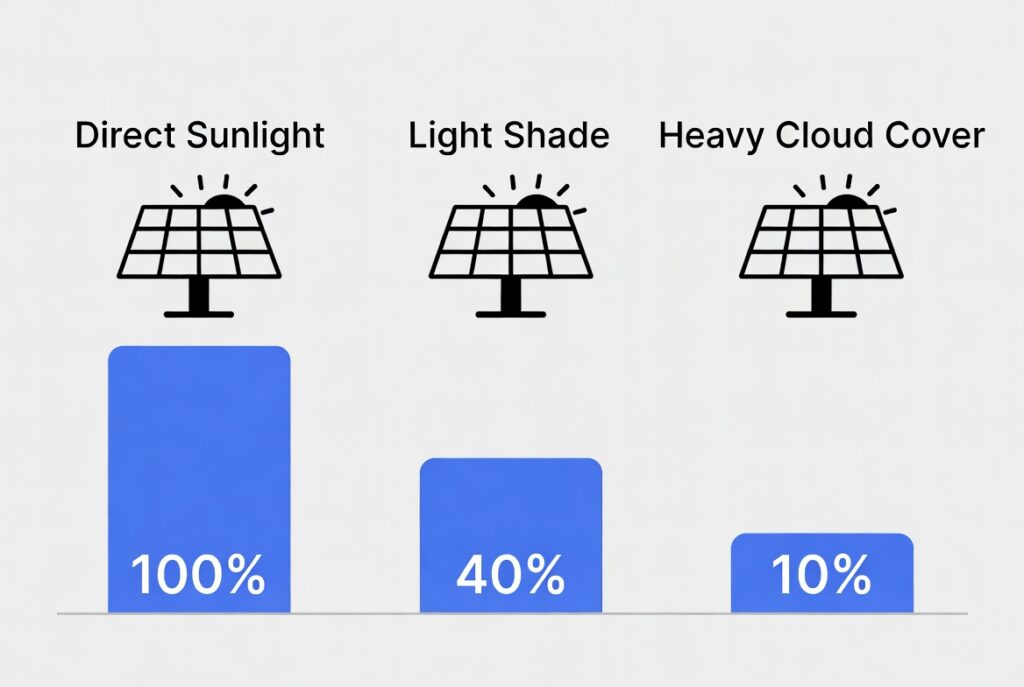
January at 1.5 PSH multiplies all summer charge times by approximately 3.3x. A 1,000Wh unit with 200W of panels takes 4 days to recharge in January. A 2,000Wh unit with 400W of panels takes the same 4 days. Adding more panels helps on clear days, but the real threat in Ontario winter is consecutive grey days where solar output drops to 10 to 15 percent of rated capacity regardless of panel count.
For January reliability, the answer is not more panels. It is a larger battery that bridges multi-day gaps without needing solar input at all. A 4,096Wh unit like the EcoFlow DELTA Pro 3 runs essential loads for 2 to 3 days on a single charge without any solar recharge. The panels become the recovery tool on the first clear day, not the primary fuel source. This is the fundamental shift in thinking that separates how fast solar panels charge generator in summer versus winter planning.
The Guelph Panel Oversizing Success
A homeowner in Guelph paired his Anker SOLIX C1000 with 400W of rigid Renogy panels mounted on his shed roof. The C1000 has a 500W max solar input, so 400W kept the system within limits with headroom. He positioned the panels at a 35-degree tilt facing due south. On a clear July day with 5 PSH, his theoretical input was 400W x 5 x 0.80 = 1,600Wh.
The battery reached 100 percent by 1:30 PM. Because he had oversized the panel array relative to the battery, he had excess solar capacity in the afternoon. He used that surplus to run an air fryer for lunch at 1,500W for 20 minutes without touching his overnight battery reserve. The excess panels turned the midday sun into free high-draw appliance time that would have been impossible with a correctly sized 200W array.
Oversizing your solar array is like installing a high-flow fuel pump in a performance engine. It ensures the battery never starves for energy, even when you push it hard with unexpected loads. The 400W array cost approximately $600 CAD. The peace of mind of a full battery by early afternoon with surplus power for cooking was worth twice that during a multi-day outage.
The Algonquin Tree Canopy Failure
A camper in Algonquin Park brought a 1,000Wh generator and a single 100W folding panel. He positioned the panel in a clearing near his campsite and expected a full recharge every day based on the 5 PSH summer rating. His campsite was under a heavy maple canopy. He did not account for the shade penalty.
The 100W panel peaked at only 25W for most of the day due to canopy shade. After 8 hours of charging, he had gained only 15 percent of the battery back. He did not realize that a single leaf shadow falling across one cell in the panel can drop the entire panel output by 50 percent on panels without bypass diodes. The marketing-rated 100W became a real-world 25W under the maples.
Trying to charge under a tree canopy is like driving with a clogged air filter. The system is starved for its primary input, and no amount of waiting compensates for the restricted flow. The fix for canopy sites is either a longer extension cable to reach a sunny clearing or a larger panel array that produces usable wattage even at 25 percent efficiency. For Algonquin camping, a 200W to 400W folding array is the minimum to overcome the canopy penalty on a 1,000Wh unit. For more on camping setups, see our solar generator for camping guide.
How Fast Solar Panels Charge Generator Verdict and Which Setup to Buy
This solar panels charge generator verdict splits into three profiles based on battery size, use case, and how fast you need the recharge.
- Weekend campers with a 300Wh unit need one 100W folding panel. It recharges the battery in under 4 hours of clear sun. That is enough for phones, lights, and small accessories over a weekend without carrying excessive weight. For more on camping sizing, see our solar generator for camping guide.
- Home backup users with a 1,000Wh to 2,000Wh unit should buy 400W to 800W of rigid panels. Mount them on a shed roof or ground frame facing due south at 35 degrees tilt. This ensures a full recharge in one summer day and a usable partial recharge in 2 days during winter. For outage-specific protocols, see our solar generator outage protocol.
- Off-grid users who need to stay ahead of the load year-round should max out their generator’s solar input capacity. If the EcoFlow DELTA Pro 3 accepts 1,600W, install 1,200W or more of panels. Oversizing the array means afternoon surplus that powers high-draw appliances without touching the overnight reserve. The upfront panel cost pays back in operational flexibility within the first extended outage.
Frequently Asked Questions
Q: Does heat affect charging speed?
A: Yes. Solar panels are less efficient in extreme heat. A cold, clear October day often produces more output per hour than a humid 35 degrees C August day. Optimal panel temperature is approximately 25 degrees C, which is the STC test condition that manufacturers use for their ratings.
Q: Can I mix different brands of solar panels?
A: Yes, as long as the total open-circuit voltage (Voc) stays within your generator’s supported input range. Check the Voc rating on each panel spec sheet before connecting in series. Mismatched panels in parallel may result in current imbalance but will not damage the generator.
Q: What is MPPT and why does it matter?
A: MPPT stands for Maximum Power Point Tracking. It is the charge controller technology inside your solar generator that constantly adjusts to extract maximum available power from the panels. MPPT is 15 to 25 percent more efficient than older PWM technology. All major brands including Anker, Bluetti, and EcoFlow use MPPT in their current models.
NEC Article 690 covers photovoltaic system connections including series string voltage limits, overcurrent protection, and overvoltage protection requirements. Always verify that your total panel array Voc does not exceed the generator’s maximum input voltage before connecting in series. Current standards are published at nfpa.org.
CEC Section 64 outlines Ontario-specific requirements for solar panel installations and portable photovoltaic connections. All installations must use CSA or UL certified equipment. The Electrical Safety Authority (ESA) provides current compliance guidelines and safe connection resources at esasafe.com.
This build is engineered within the 48V DC Safety Ceiling. Diagnostic logic is based on 20+ years of technical service experience. All structural and electrical installations must be verified by a Licensed Professional and comply with your Local AHJ. See our legal and safety disclosure for full scope.
About the Author
Robert Bertrand spent 20 years as a service advisor in the automotive industry (Lexus and Nissan), where precision diagnostics, wiring integrity, and documentation standards were non-negotiable. He brings that same technical discipline to GridFree Guide, where he researches, tests, and documents off-grid solar systems for Ontario conditions. Based in Rockwood, Ontario, every article is built on verified specifications, manufacturer data, and the real-world climate constraints of Canadian off-grid living.
As an Amazon Associate I earn from qualifying purchases. This site also contains affiliate links to other products and services. GridFree Guide earns a small commission at no extra cost to you.