
The Relay Logic and How Auto Generator Start Manages Your System
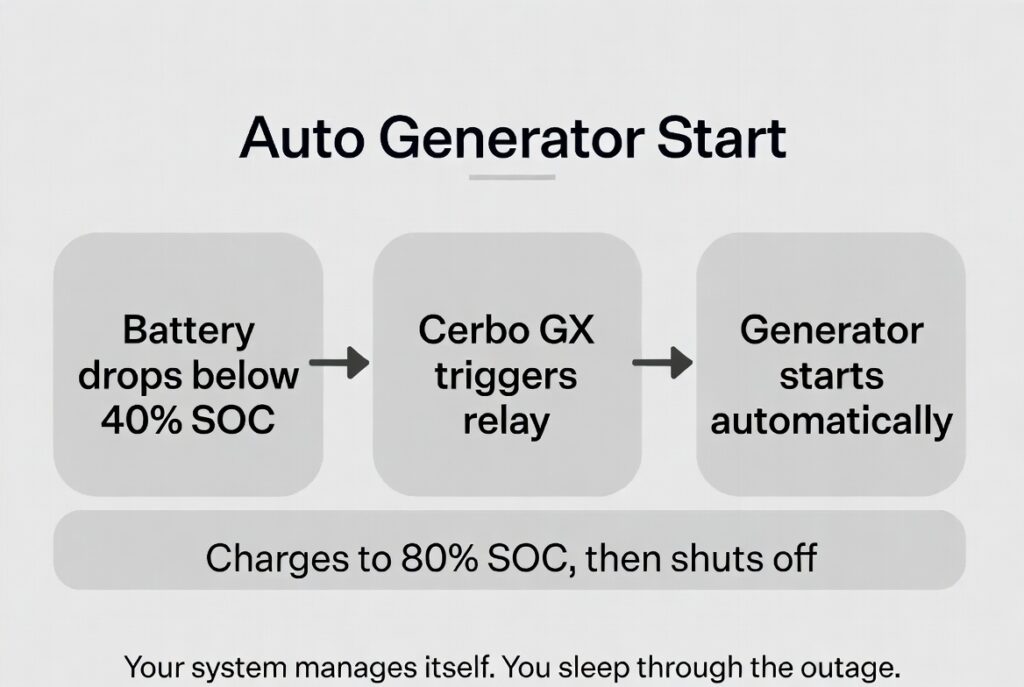
An auto generator start system uses a relay triggered by your battery monitor to start and stop your backup generator automatically so you never have to leave your bed during a winter outage. AGS works with three components: a battery monitor, a controller, and a relay. The Victron SmartShunt provides SOC data to the Cerbo GX, which evaluates it against set thresholds.
When the batteries drop to 40 percent SOC, the Victron Cerbo GX triggers the relay, sending a start signal to the generator. Once the batteries reach 80 percent SOC, the Cerbo sends the stop signal and the generator shuts off. This cycle repeats as needed without any human input. The system manages itself 24 hours a day, 365 days a year. For the complete backup strategy, see our backup power guide.
The Rockwood Automated Sleep
A homeowner in Rockwood configured his Victron Cerbo GX to trigger his generator’s auto generator start whenever the battery bank dropped below 40 percent SOC. He set the stop threshold at 80 percent SOC. He wired the Cerbo’s relay output to his dual fuel generator’s electric start input using a 2-wire connection. The SmartShunt provided real-time SOC data to the Cerbo for trigger accuracy.
During a January storm, the house went into a power deficit at midnight when solar production was zero and the furnace fan ran continuously. The Cerbo triggered the relay at 40 percent SOC. The generator ran for 3 hours at 68 percent load until the batteries reached 80 percent SOC, then shut off automatically. Because the system charged during the low-load nighttime hours, the generator ran more efficiently than it would have during the day when the well pump and kitchen appliances added surge loads.
Auto generator start is like the automatic engine start/stop in a modern hybrid vehicle. The car’s computer monitors the battery state. When it needs a charge, it fires up the engine seamlessly. You do not have to think about it. Relying on a manual start generator is like having to get out and hand-crank your car every time you come to a red light. The family woke up to a warm house and full batteries without ever leaving their beds.
Setting the Threshold and SOC vs Battery Voltage Triggers
SOC-based triggers via the SmartShunt are more accurate than voltage-based triggers because voltage fluctuates under load. A battery at 48V under a 2,000W load might actually be at 60 percent SOC. A voltage trigger set at 48V would start the generator unnecessarily. SOC accounts for the load and gives the true remaining capacity. Recommended defaults are start at 40 percent SOC and stop at 80 percent SOC. For the complete voltage analysis, see our battery voltage guide.
Never set the auto generator start threshold below 30 percent SOC. Deep discharge below 30 percent damages lead-acid batteries and triggers BMS protection on LFP banks. The 40 to 80 percent cycling range keeps your batteries in their healthiest zone while providing 4 to 8 hours of runtime between generator cycles depending on your load. For the complete generator sizing formula, see our size backup generator guide.
Quiet Hours, Safety Programming, and the Auto Generator Start Configuration
Quiet hours prevent the generator from starting between set times in residential areas. The default window is 10 PM to 7 AM. The Cerbo GX allows you to override quiet hours if SOC drops below a critical threshold, which defaults to 25 percent. This means the generator stays silent during normal nighttime discharge but activates automatically in an emergency when the batteries reach a dangerously low level.
The Cerbo logs every auto generator start event with a timestamp, SOC at start, SOC at stop, and total runtime duration through the VRM portal. This data is accessible remotely from any device with internet access. Over time, the log reveals your system’s charging patterns and helps you optimize the start and stop thresholds for your specific load profile. For the complete generator selection, see our dual fuel generator guide. For relay wiring details, see our off-grid electrical wiring guide.
Manual vs AGS Comparison and the Milton Pull-Start Crisis
| Feature | Manual Start | Auto Generator Start (AGS) |
|---|---|---|
| Effort | Physical (Pull-start/Electric) | 100% Automated |
| Reliability | Depends on you waking up | Logic-based (SOC/Voltage) |
| Efficiency | Often over-charges or under-charges | Shuts off exactly at target SOC |
| Neighbours | No quiet hours control | Automatic silence window |
| Safety | High risk of deep discharge | Protects battery lifespan |
Manual start requires you to be awake, present, and physically able to start the generator. Auto generator start requires nothing from you. The table shows why AGS is the standard for any serious off-grid system in Ontario where winter outages can last 3 to 5 days.
A DIYer in Milton relied on a manual pull-start generator for his off-grid backup. He fell asleep watching TV during a winter outage. By 3 AM, his inverter hit the low-voltage cutoff and the house went dark. He had to walk to the shed in minus 15 degrees C wearing boots and a jacket over his pajamas.
The pull-start cord was frozen solid from condensation inside the recoil housing. He spent 20 minutes trying to free the cord before the engine finally turned over. By the time the generator was running and the batteries were charging, his indoor temperature had dropped to 8 degrees C. The deep discharge to 10 percent SOC reduced his lead-acid battery bank’s lifespan by an estimated 15 percent in a single night.
A $350 Cerbo GX with auto generator start would have triggered the generator at 40 percent SOC, four hours before the crisis point. The generator would have run for 3 hours, charged the bank to 80 percent, and shut off. The house would have stayed at 20 degrees C all night. The batteries would have never dropped below 40 percent, preserving their full cycle life. The cost of not having auto generator start was 15 percent of his battery bank’s total lifespan in one night.
Frequently Asked Questions
Q: What equipment do I need for auto generator start?
A: A Victron Cerbo GX with relay output provides the control logic, a SmartShunt provides the SOC data the Cerbo needs for accurate trigger decisions, and your generator must have electric start capability because pull-start generators cannot be automated. The total cost for the Cerbo GX and SmartShunt is approximately $530 CAD.
Q: Can I use auto generator start with a pull-start generator?
A: No, AGS requires a 2-wire electric start signal that a pull-start generator cannot accept. If your current generator is pull-start only, you can add an aftermarket electric start kit for $150 to $300 depending on the model. The alternative is upgrading to a dual fuel generator with factory electric start which provides both AGS compatibility and propane fuel flexibility.
Q: What SOC thresholds should I set for auto generator start?
A: Set the start threshold at 40 percent SOC and the stop threshold at 80 percent SOC as your baseline. Never set the start threshold below 30 percent because deep discharge below 30 percent damages lead-acid batteries and triggers BMS protection on LFP banks. The 40 to 80 percent range keeps your batteries in their healthiest cycling zone while providing 4 to 8 hours of runtime between generator cycles depending on load.
NEC Article 702 covers standby power system requirements including automatic transfer controls, generator start circuits, and relay protection for residential backup installations. All auto generator start wiring must comply with applicable overcurrent and grounding standards. Current standards are published at nfpa.org.
CEC Section 64 governs standby power system installation requirements in Ontario including generator start circuits, relay wiring, and transfer switch integration. All permanently installed AGS systems require ESA-compliant wiring and inspection. The Electrical Safety Authority (ESA) provides current compliance guidelines at esasafe.com.
This build is engineered within the 48V DC Safety Ceiling. Diagnostic logic is based on 20+ years of technical service experience. All structural and electrical installations must be verified by a Licensed Professional and comply with your Local AHJ. See our legal and safety disclosure for full scope.
About the Author
Robert Bertrand spent 20 years as a service advisor in the automotive industry (Lexus and Nissan), where precision diagnostics, wiring integrity, and documentation standards were non-negotiable. He brings that same technical discipline to GridFree Guide, where he researches, tests, and documents off-grid solar systems for Ontario conditions. Based in Rockwood, Ontario, every article is built on verified specifications, manufacturer data, and the real-world climate constraints of Canadian off-grid living.
As an Amazon Associate I earn from qualifying purchases. This site also contains affiliate links to other products and services. GridFree Guide earns a small commission at no extra cost to you.