
The First Number Is a Bid and the Negotiate Solar Quote Reality
Learning to negotiate solar quote line items saves Ontario homeowners $3,000 to $6,000 because the first number an installer presents is never their best number and every line item has markup built in. Solar installers mark up panels 30 to 45 percent over wholesale prices. Labour rates vary from $1.25 to $3.00 per watt depending on your knowledge level. Administrative and permit fees often appear as extras that should be included in the base price.
The key is getting at least 3 quotes and requesting itemized breakdowns from all 3. The price difference between the highest and lowest quote on the same 6kW system typically ranges from $5,000 to $12,000 in Ontario. That gap is not quality. That gap is markup. For the complete beginner overview, see our beginner solar guide.
The Rockwood Informed Negotiator
A homeowner in Rockwood received a $25,000 quote for a 6kW grid-connected solar system from a local installer. Instead of signing, he requested an itemized breakdown showing panels, inverter, labour, permits, and administrative fees separately. He checked the panel price against Amazon retail and found the installer was marking up Canadian Solar panels by 45 percent over wholesale. He also found a $1,200 “administrative fee” that was not explained in the contract.
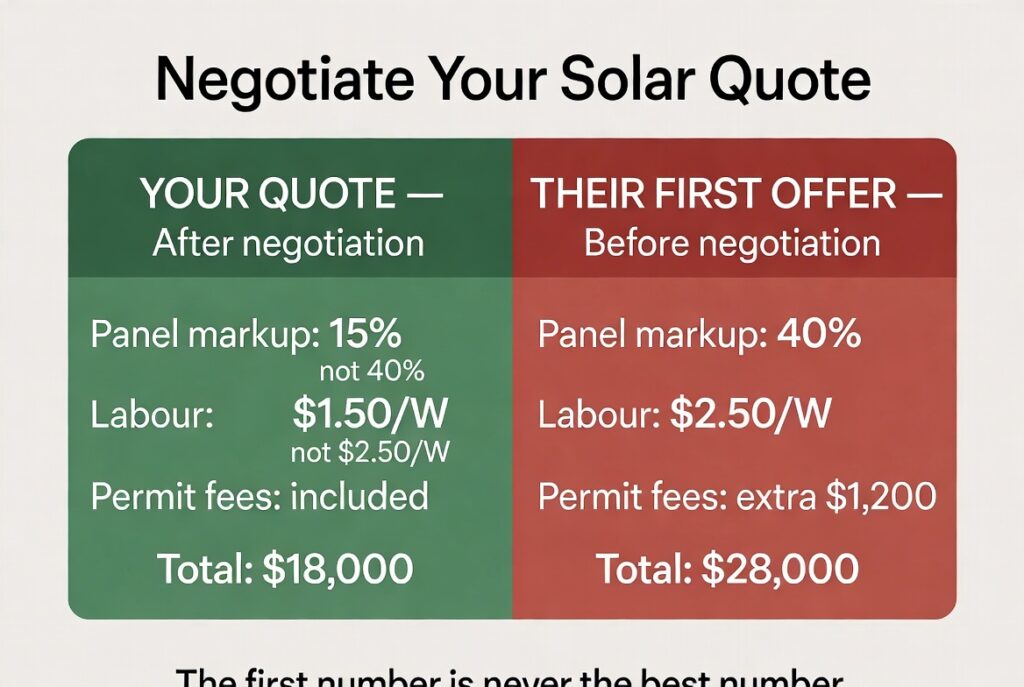
He challenged the panel markup with printed Amazon screenshots showing retail pricing. He offered to pay a flat $1.50 per watt labour fee instead of the quoted $2.50 per watt. He negotiated to have all ESA permit fees included in the total instead of billed separately. Because he showed he understood the math, the installer assigned their most experienced lead technician to the job, knowing the homeowner would be checking the torque specs on every connection.
To negotiate solar quote pricing effectively, treat it like a dealership Repair Order. If a shop quotes you $400 for a $40 sensor and 4 hours of labour for a 20-minute job, you challenge the book time and the parts margin. A solar installer is a contractor. Their first quote includes a safety margin for them. Your job is to negotiate that margin down while keeping the quality of the mechanical work high. His final price was $20,500. Total savings: $4,500.
Challenging the Hardware Markup on Panels and Inverters
Check the quoted panel price against Amazon retail before accepting any hardware line item. A Renogy 100W mono panel retails for $120 CAD on Amazon. If the installer quotes $200 for the same panel, the markup is 65 percent. Fair markup is 15 to 20 percent to cover handling, warranty support, and inventory cost.
The same principle applies to inverters. A Victron MultiPlus-II retails for $1,800 CAD on Amazon. If the quote shows $3,000, that is a 67 percent markup. Challenge it with the retail number. Most installers will negotiate down to 20 to 25 percent markup when they know you have done the research. The goal is not to eliminate their margin entirely. The goal is to ensure you are paying for expertise, not ignorance.
The Labour Rate and How to Negotiate Solar Quote Line Items in Ontario
| Line Item | Inflated Quote | Fair Quote | Savings Strategy |
|---|---|---|---|
| Panel Markup | 40% to 50% | 15% to 20% | Check wholesale prices on Amazon |
| Labour Rate | $2.50 to $3.00/W | $1.25 to $1.75/W | Negotiate flat rate per watt |
| Permit/Admin | $1,200+ (Extra) | Included in labour | Demand all-in pricing |
| Inverter Brand | Budget off-brand | Premium (Victron/Fronius) | Never accept uncertified hardware |
| Performance Guarantee | Not included | 85% year-one production | Written into the contract |
The labour rate is the biggest negotiation lever on any solar quote. Moving from $2.50 per watt to $1.50 per watt on a 6kW system saves $6,000 on labour alone. Get 3 quotes and use the lowest labour rate as leverage against the others. Most installers will match a competing labour rate rather than lose the job entirely.
The performance guarantee is the most overlooked negotiation point when you negotiate solar quote terms. If the installer will not guarantee 85 percent of projected year-one production in writing, their confidence in their own system design is questionable. A written performance guarantee protects you if the system underperforms due to design errors or installation quality issues. For the complete system pricing breakdown, see our off-grid solar cost guide.
The Milton First-Offer Trap and the Line Item Comparison
A homeowner in Milton received one quote for $28,000 for a 6kW system. He did not request a second or third quote. He signed within 48 hours because the salesman said the pricing was “only valid this week.” That urgency tactic is the oldest trick in sales. No legitimate installer rescinds a quote because you took a week to compare options.
The system that cost him $28,000 should have cost approximately $18,000 based on fair market pricing for the same components. The installer charged a 40 percent hardware markup plus $1,200 in administrative fees buried on page 3 of the contract. He did not negotiate solar quote terms, performance guarantees, or payment milestones. When the system underperformed in year one, he had zero contractual recourse because no performance guarantee was included.
He overpaid by $10,000 for a system with no performance guarantee and no recourse when production fell short. A second quote from a competing installer would have exposed the inflated pricing immediately. The rule is simple: get 3 quotes minimum, request itemized breakdowns from all 3, and negotiate solar quote line items using the lowest quote as leverage against the others. For the complete financing comparison, see our solar loan vs cash guide.
Frequently Asked Questions
Q: How many solar quotes should I get in Ontario?
A: Get a minimum of 3 quotes from different installers and request itemized breakdowns from all 3 showing panels, inverter, labour, permits, and admin fees separately. Use the lowest quote as leverage when negotiating with the higher-priced installers. The price difference between the highest and lowest quote on the same system typically ranges from $5,000 to $12,000 in Ontario.
Q: What is a fair labour rate for solar installation in Ontario?
A: Fair labour rates in Ontario range from $1.25 to $1.75 per watt for residential rooftop installations in 2026. Anything above $2.00 per watt should be challenged with competing quotes. The total labour cost on a 6kW system at $1.50 per watt is $9,000 compared to $18,000 at $3.00 per watt, which is a $9,000 difference for the same physical work.
Q: Should I ask for a performance guarantee in my solar contract?
A: Yes, and any reputable installer should guarantee a minimum of 85 percent of projected year-one production in writing. This guarantee protects you if the system underperforms due to design errors or installation quality issues. Without a written performance guarantee, you have zero contractual recourse when the system produces less than promised.
NEC Article 690 provides standards for PV system installations that protect the homeowner’s investment including wiring, grounding, and overcurrent protection requirements. All installations must comply with these standards regardless of the installer’s pricing. Current standards are published at nfpa.org.
CEC Section 64 governs solar installation requirements in Ontario including ESA permit requirements, inspection standards, and installer certification. All permanent solar installations require ESA approval, and this permit cost should be included in every installer’s quote. The Electrical Safety Authority (ESA) provides current compliance guidelines at esasafe.com.
This build is engineered within the 48V DC Safety Ceiling. Diagnostic logic is based on 20+ years of technical service experience. All structural and electrical installations must be verified by a Licensed Professional and comply with your Local AHJ. See our legal and safety disclosure for full scope.
About the Author
Robert Bertrand spent 20 years as a service advisor in the automotive industry (Lexus and Nissan), where precision diagnostics, wiring integrity, and documentation standards were non-negotiable. He brings that same technical discipline to GridFree Guide, where he researches, tests, and documents off-grid solar systems for Ontario conditions. Based in Rockwood, Ontario, every article is built on verified specifications, manufacturer data, and the real-world climate constraints of Canadian off-grid living.
As an Amazon Associate I earn from qualifying purchases. This site also contains affiliate links to other products and services. GridFree Guide earns a small commission at no extra cost to you.