
Solar Generator Watt Hour Explained and Why the Confusion Kills Your Backup Plan
Having the solar generator watt hour explained simply is the difference between a successful 72-hour backup plan and waking up in a freezing house at 3 AM. Watts tell you how fast power flows at any given second. Watt-hours tell you how much total energy is stored in the battery. A 2,000W inverter tells you what appliances you can start. A 2,000Wh battery tells you how long those appliances run before the battery is empty.
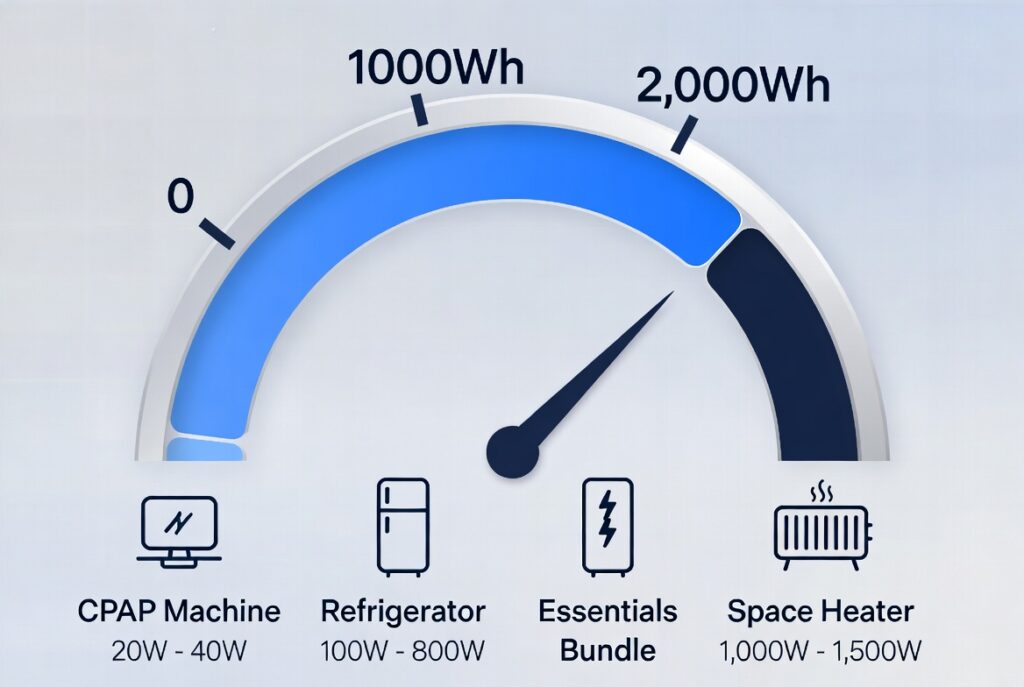
The numbers look identical but they measure completely different things. A space heater at 1,500W on a 2,000Wh battery dies in 70 minutes. A CPAP at 8W on the same 2,000Wh battery lasts 26 nights. Same battery, same inverter, completely different outcomes. The draw rate determines the duration. Every sizing failure, every “why did my battery die so fast” complaint, and every 3 AM dead battery traces back to confusing these two numbers.
This article covers the runtime formula, walks through real examples at every draw level, and explains why the same inverter gives dramatically different runtimes depending on what you plug in. For a broader look at Ontario generator options, see our solar generator Ontario guide. For a beginner overview, see our portable power station guide.
The Runtime Formula and How to Calculate Hours from Watt-Hours
The formula is: Runtime (hours) = (Wh x 0.85) / W. The 0.85 factor accounts for inverter efficiency loss. Converting DC battery power to 120V AC generates heat, and that heat represents energy that never reaches your appliance. You never get 100 percent of the stored energy out of the battery. The 15 percent loss is consistent across all major brands including Anker, Bluetti, EcoFlow, and Jackery.
On a 2,000Wh battery at 85 percent efficiency, the runtime by appliance is: CPAP at 8W gives approximately 212 hours or 26 nights. A full-size fridge at 80W gives approximately 21 hours. The essentials stack of fridge plus Starlink plus lights at 200W gives approximately 8.5 hours. A 1,500W space heater gives approximately 1.1 hours or 70 minutes. The same battery, the same formula, and four completely different outcomes based solely on the draw rate of the appliance.
Solar Generator Watt Hour and Why the Same Inverter Gives Different Runtimes
The inverter rating determines what you can plug in. The battery capacity determines how long it runs. A 2,000W inverter can start any appliance under 2,000W. But starting an appliance and sustaining it for hours are two different questions answered by two different specs. The table below shows this distinction clearly on a single 2,000Wh battery.
| Appliance | Draw (Watts) | Runtime on 2,000Wh |
|---|---|---|
| CPAP (no humidifier) | 8W | 212 hours (26 nights) |
| Full-size fridge | 80W | 21 hours |
| Essentials stack | 200W | 8.5 hours |
| Space heater | 1,500W | 1.1 hours (70 minutes) |
The same 2,000W inverter with a larger battery changes everything. A Bluetti AC200L at 2,048Wh runs the essentials stack for 8.5 hours. An EcoFlow DELTA Pro 3 at 4,096Wh runs the same essentials stack for 17 hours. The inverter is similar. The battery is double. The runtime is double. For the full appliance load list, see our 2000W solar generator load guide.
Amp-Hours Versus Watt-Hours and How to Convert Between Them
Some solar generators and battery systems display capacity in amp-hours (Ah) instead of watt-hours (Wh). The conversion formula is: Ah x Voltage = Wh. A 100Ah battery at 12.8V equals 1,280Wh. A 200Ah battery at 12.8V equals 2,560Wh. Always convert to watt-hours for runtime calculations because amp-hours without voltage is meaningless for comparing units at different voltages.
Battery aging also affects the solar generator watt hour capacity over time. After 3,000+ charge cycles, an LFP battery retains approximately 80 percent of its original capacity. A 2,000Wh battery at 80 percent health holds 1,600Wh effective. That reduces all runtime estimates by 20 percent compared to the original spec sheet. A fridge that ran for 21 hours on a new battery runs for approximately 17 hours on an aged one. For long-term care, see our solar generator maintenance guide.
The Orangeville Essentials Save
A first-time solar generator owner in Orangeville did the solar generator watt hour math before an expected winter storm. He had a 2,000Wh unit and calculated the runtime for every appliance he might plug in. He realized that running his microwave at 1,000W would consume 500Wh in just 30 minutes of use. That 500Wh was 25 percent of his total battery gone for reheating leftovers.
By choosing to skip the microwave entirely and only run his fridge and Starlink at a combined 120W, he stretched his battery for nearly 14 hours. He made it through the entire overnight outage with 15 percent capacity to spare. He had planned for 8 hours but the actual fridge cycling reduced the average draw below the continuous 120W estimate. Understanding the solar generator watt hour math turned what he expected to be a tight night into a comfortable margin.
He drove like he was trying to win a fuel economy challenge. Consistent, low-draw usage at 120W on a 2,000Wh battery is like cruising at 90 km/h in top gear instead of flooring it at 200 km/h. The engine is the same. The fuel consumption is completely different. Understanding the tank size let him plan his trip perfectly and arrive at sunrise with fuel to spare.
The Rockwood Space Heater Failure
A client in Rockwood bought a Bluetti AC200L at 2,048Wh and was thrilled that it could output 2,400W continuously. He plugged in a 1,500W electric space heater during a February blackout. He expected it to keep his bedroom warm until morning. He saw the 2,400W inverter rating and assumed the unit could handle 1,500W for hours.
The battery died in 70 minutes. He was convinced the unit was defective and wanted to return it. The math was straightforward: 2,048Wh x 0.85 efficiency = 1,741 usable Wh. At 1,500W draw, that gives 1,741 / 1,500 = 1.16 hours. The unit performed exactly as designed.
He drove a sports car at 200 km/h and was shocked when it ran out of fuel before leaving the county. The 2,400W inverter is the engine horsepower. The 2,048Wh battery is the fuel tank. A powerful engine with a standard tank empties fast at full throttle. Understanding solar generator watt hour math would have told him before the purchase that a space heater is a 70-minute appliance on a 2,000Wh battery, not an overnight solution. For the full outage protocol, see our solar generator outage protocol.
Solar Generator Watt Hour Verdict and How to Size Your Battery Correctly
This solar generator watt hour guide comes down to three buyer profiles based on draw rate and required runtime.
- CPAP users who only care about runtime should focus on watt-hours, not watts. Your draw is 8W to 50W. A Jackery Explorer 300 Plus at 288Wh runs a CPAP without humidifier for 4 nights. An Anker SOLIX C1000 at 1,056Wh runs it for 2 weeks. Buy the biggest battery your budget allows. For full CPAP math, see our solar generator for CPAP guide.
- Home backup users running the essentials stack at 200W need to match battery size to outage duration. A 2,000Wh unit gives 8.5 hours. A 4,000Wh unit gives 17 hours. If your Ontario outages last overnight, you need at least 2,000Wh. If they last 24+ hours, you need 4,000Wh or expansion batteries. For the step-by-step protocol, see our solar generator outage protocol.
- Anyone tempted to run a space heater should do the solar generator watt hour math first. A 1,500W heater on a 2,000Wh battery lasts 70 minutes. That 70 minutes of warmth costs you 8.5 hours of fridge, Starlink, and phone charging on the same battery. Use a propane portable heater for warmth and save the battery for electronics and refrigeration.
Frequently Asked Questions
Q: Is 2,000Wh the same as 2kWh?
A: Yes. The k simply means 1,000, so 2,000Wh and 2kWh are identical measurements. Some manufacturers use kWh on their spec sheets while others use Wh. Always compare in the same unit to avoid confusion when shopping across brands.
Q: Why does my unit show Ah instead of Wh?
A: Amp-hours is an older measurement used primarily for 12V lead-acid battery systems. Multiply Ah by the battery voltage to get Wh. For example, 100Ah at 12.8V equals 1,280Wh. Always convert to Wh for accurate runtime calculations because Ah alone does not account for voltage differences between systems.
Q: Does battery aging reduce watt-hours?
A: Yes. After 3,000+ charge cycles, an LFP battery retains approximately 80 percent of its original capacity. A 2,000Wh battery at 80 percent health effectively holds 1,600Wh. This reduces all runtime estimates by 20 percent compared to the original spec sheet numbers.
NEC Article 480 covers battery storage systems including capacity ratings, labeling requirements, and consumer disclosure standards for portable power equipment. All units must display accurate Wh or kWh capacity ratings on the spec sheet. Current standards are published at nfpa.org.
CEC Section 64 governs portable battery storage equipment and capacity labeling requirements in Ontario. All units sold in Ontario must meet CSA or UL certification standards for accurate capacity disclosure. The Electrical Safety Authority (ESA) provides current compliance guidelines at esasafe.com.
This build is engineered within the 48V DC Safety Ceiling. Diagnostic logic is based on 20+ years of technical service experience. All structural and electrical installations must be verified by a Licensed Professional and comply with your Local AHJ. See our legal and safety disclosure for full scope.
About the Author
Robert Bertrand spent 20 years as a service advisor in the automotive industry (Lexus and Nissan), where precision diagnostics, wiring integrity, and documentation standards were non-negotiable. He brings that same technical discipline to GridFree Guide, where he researches, tests, and documents off-grid solar systems for Ontario conditions. Based in Rockwood, Ontario, every article is built on verified specifications, manufacturer data, and the real-world climate constraints of Canadian off-grid living.
As an Amazon Associate I earn from qualifying purchases. This site also contains affiliate links to other products and services. GridFree Guide earns a small commission at no extra cost to you.