
What Is a Portable Power Station and How Does It Work
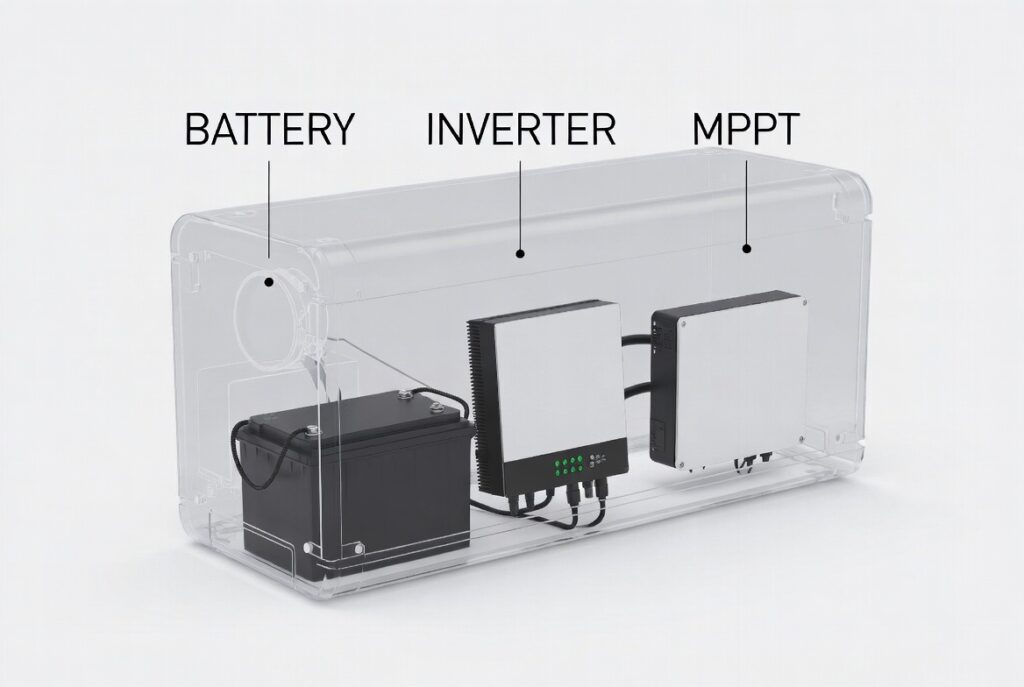
Understanding what is a portable power station is the first step toward reliable backup power for any Ontario household. A portable power station is a rechargeable LFP battery with a built-in pure sine wave inverter, MPPT charge controller, and multiple AC, DC, and USB output ports in a single portable enclosure. It requires no fuel, produces zero emissions, and runs safely indoors. It is not a gas generator. It is not a phone power bank. It sits between the two as an all-in-one backup system.
You charge a portable power station three ways. A wall outlet is fastest at 1 to 5 hours depending on unit size. Solar panels take 3 to 8 hours in Ontario summer at 5 peak sun hours. A car 12V outlet is slowest at 5 to 30+ hours and is practical only for topping up. Once charged, you plug in your appliances and press the power button. There is no pull cord, no choke, no oil, and no exhaust.
Portable power stations range from 250Wh emergency kits at $300 CAD to 4,000Wh whole-home backup units at $5,000 CAD. The size you need depends on your loads, your outage duration, and whether you need to carry the unit or keep it stationary. For a broader look at Ontario generator options, see our solar generator Ontario guide.
The Three Components Inside Every Portable Power Station
The battery is the storage core. Most modern portable power stations use LiFePO4 chemistry, which delivers 3,000 to 3,500+ charge cycles to 80 percent capacity. That is approximately 10 years of daily use. LFP is the safest lithium chemistry available. It is extremely difficult to trigger thermal runaway compared to the NMC lithium in phones and laptops. The battery stores DC power and determines how long the unit runs before needing a recharge.
The inverter converts DC battery power to 120V AC for your household appliances. High-quality units use pure sine wave inverters that deliver clean power safe for all electronics including laptops, CPAP machines, and OLED TVs. Modified sine wave inverters produce rough power that can damage sensitive equipment and should be avoided. The charge controller uses MPPT technology, which is 15 to 25 percent more efficient than older PWM methods. The MPPT controller constantly adjusts to extract maximum power from connected solar panels under changing light conditions.
Portable Power Station Versus Gas Generator and Why the Comparison Matters
The portable power station exists because gas generators cannot be used indoors. Gas generators produce lethal carbon monoxide as a combustion byproduct. Every Ontario winter, CO poisoning deaths occur from generators placed in garages, basements, and near open windows. A portable power station produces zero emissions and operates safely on a kitchen counter, a nightstand, or a living room shelf. For a full comparison, see our solar generator versus gas generator comparison.
| Feature | Portable Power Station | Gas Generator |
|---|---|---|
| Indoor Safe | YES (zero emissions) | NEVER (lethal CO) |
| Noise Level | Silent to whisper | 70+ dB |
| Maintenance | Almost zero | Oil, plugs, fuel stabilizer |
| Fuel Source | Sun, wall outlet, car | Gasoline or propane |
| Startup | Push button | Pull-start or electric start |
Gas generators win on one metric: unlimited runtime with fuel. A portable power station is limited by battery capacity. However, for Ontario households that need indoor-safe, silent, maintenance-free backup power during ice storms, the portable power station is the correct tool. The gas generator belongs in the shed for heavy mechanical loads like sump pumps and well pumps.
How a Portable Power Station Differs from a Phone Power Bank
A phone power bank holds 5 to 50Wh of energy and delivers it through USB ports at 5W to 20W. It charges phones and tablets. It cannot run household appliances because it has no AC inverter. A portable power station holds 250 to 4,000+ Wh and delivers power through AC outlets, DC ports, and USB ports simultaneously. The AC inverter is the component that separates the two categories.
A portable power station inverter is rated for 300W to 3,600W of AC output. A power bank USB converter is rated for 5W to 20W. Attempting to draw 1,200W from a 10W device exceeds its capacity by 120 times. The result is not just a failed appliance start. It is permanent damage to the power bank’s internal circuitry. For indoor placement details, see our indoor solar generator guide.
The Milton Plug-and-Play Surprise
A first-time buyer in Milton purchased an Anker SOLIX C1000 during the January 2026 ice storm. She had never owned any generator or backup power device. Her neighbour told her it was safe to use indoors and she bought it based on that recommendation alone. She expected setup to require tools, wiring, or at least reading a manual.
Setting up the portable power station consisted of pressing one button and plugging in her lamp. There was no choke, no pull cord, no oil to check, and no fuel to pour. She had the lamp running within 30 seconds of opening the box. She told the neighbour she expected it to be like a car that needed fluids and a warm-up period before it would work.
A portable power station is the electric vehicle of the generator world. There is no combustion engine to maintain, no starter motor to fail, and no exhaust system to rust. You press the power button and the electricity is there. For non-technical buyers in Ontario, the simplicity of a portable power station is the feature that matters most during a stressful outage.
The Rockwood Power Bank Confusion
A client in Rockwood bought a $50 phone power bank from a big-box store and attempted to use it during a power outage. He plugged his full-sized coffee maker into a USB-to-AC adapter connected to the power bank. He assumed that any device with a battery could run any appliance. He did not understand the difference between a power bank and a portable power station.
The power bank did not just fail to run the coffee maker. It shut down permanently. The 1,200W draw from the coffee maker through the adapter exceeded the power bank’s 10W output capacity by 120 times. The internal circuitry was damaged beyond recovery by the overcurrent event.
Trying to run a coffee maker on a phone power bank is like trying to jump-start a diesel truck with a pack of AA batteries. The voltage might be similar but the current capacity is not even in the same category. A portable power station has a proper inverter rated for 300W to 3,600W of AC output. A power bank has a USB converter rated for 5W to 20W. The difference is the inverter, and the inverter is what makes a portable power station capable of running household appliances.
Portable Power Station Size Classes and Where to Start in Ontario
The right size depends on your loads, your budget, and how long you need to run without a recharge. Ontario outages from ice storms typically last 24 to 72 hours. The four size classes below cover every use case from a 72-hour emergency kit to a full whole-home backup system.
- Emergency kit and apartment backup at $300 to $500 CAD. Buy a 300Wh class unit like the EcoFlow RIVER 2 or Jackery Explorer 300 Plus. It handles phones, LED lights, and CPAP without humidifier for 3+ days. Fits in a closet or go-bag. For more options, see our best small solar generator guide.
- Home backup essentials at $800 to $1,200 CAD. Buy a 1,000Wh class unit like the Anker SOLIX C1000. It runs fridge, Starlink, and CPAP for 8 to 10 hours per charge. This is the starting point for most Ontario households. For appliance details, see our 2000W solar generator load guide.
- Full home backup at $2,000 to $5,000 CAD. Buy a 2,000Wh to 4,000Wh class unit like the Bluetti AC200L or EcoFlow DELTA Pro 3. It bridges 24 to 48 hour Ontario outages on a single charge. Expandable with additional batteries for multi-day coverage.
Frequently Asked Questions
Q: Can I charge a portable power station while using it?
A: Yes. This is called passthrough charging where the unit simultaneously accepts input and delivers output. It is the recommended configuration when solar panels are connected during daytime use. Some units also function as a UPS with sub-20ms switchover when plugged into a wall outlet.
Q: How long does a portable power station hold its charge in storage?
A: Most LFP units self-discharge at 2 to 3 percent per month and retain 80 to 90 percent charge after 6 months. Check and top up to 80 percent every 3 to 6 months for long-term storage. Never store at 0 percent or 100 percent. For the full protocol, see our solar generator maintenance guide.
Q: Is a portable power station waterproof?
A: Most are not. They have open cooling vents that allow water ingress. Keep the unit indoors or under cover at all times. Water damage is not covered under any manufacturer warranty.
NEC Article 702 covers optional standby systems including portable power stations used for residential backup. All portable power equipment must comply with applicable overcurrent protection and grounding requirements. Current standards are published at nfpa.org.
CEC Section 64 governs consumer electrical equipment and portable power systems in Ontario. All portable power stations must be CSA or UL certified for residential use. The Electrical Safety Authority (ESA) provides current compliance guidelines and safe-use resources at esasafe.com.
This build is engineered within the 48V DC Safety Ceiling. Diagnostic logic is based on 20+ years of technical service experience. All structural and electrical installations must be verified by a Licensed Professional and comply with your Local AHJ. See our legal and safety disclosure for full scope.
About the Author
Robert Bertrand spent 20 years as a service advisor in the automotive industry (Lexus and Nissan), where precision diagnostics, wiring integrity, and documentation standards were non-negotiable. He brings that same technical discipline to GridFree Guide, where he researches, tests, and documents off-grid solar systems for Ontario conditions. Based in Rockwood, Ontario, every article is built on verified specifications, manufacturer data, and the real-world climate constraints of Canadian off-grid living.
As an Amazon Associate I earn from qualifying purchases. This site also contains affiliate links to other products and services. GridFree Guide earns a small commission at no extra cost to you.