
How to Use a Solar Generator During Power Outage and Why Preparation Wins
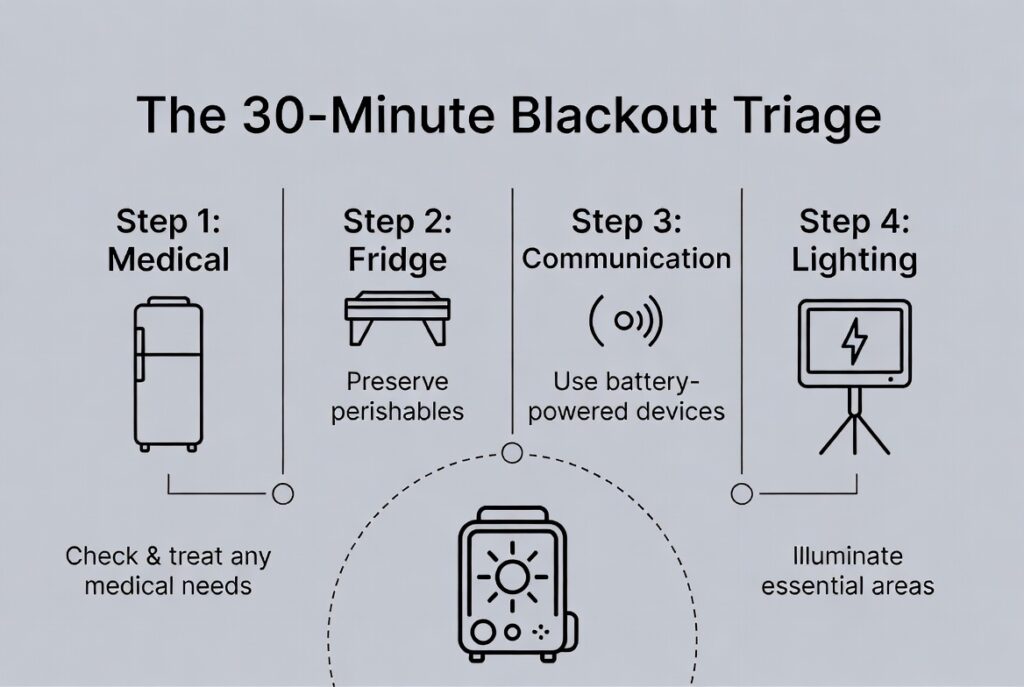
Using a solar generator during power outage events requires a protocol because the battery is a finite resource and every watt you waste is a watt your fridge does not get. The protocol has three phases: stabilize in 30 minutes, manage for 24 hours, recover when power returns. Each phase has specific steps. Skipping any one of them turns a $2,000 generator into dead weight when the lights go out.
Preparation before the outage determines success during the outage. A dead battery discovered at midnight cannot be charged during a storm. A disabled auto-shutoff setting shuts down the fridge at 3:00 AM without warning. A corroded extension cord carrying 800W to a refrigerator is a fire risk that only shows under load. Every one of these failures is preventable with 30 minutes of preparation before storm season.
The load triage below ranks every household device by priority. The three-phase protocol tells you exactly what to do in the first 30 minutes, the first 24 hours, and after power returns. For a broader look at Ontario generator options, see our solar generator Ontario guide.
The Load Triage Priority Table for Ontario Outages
When the grid goes down, the battery is a finite fuel tank. Every appliance you plug in reduces the runtime for everything else. The triage table below ranks loads by survival priority. Level 1 loads stay plugged in until the battery dies. Level 4 loads should never touch the generator unless solar recharge is actively incoming. For a full appliance-by-appliance load list, see our 2000W solar generator load guide.
| Priority | Load Type | Examples | Why |
|---|---|---|---|
| Level 1 | Medical and Food | CPAP (8-50W), insulin fridge (15-30W), main fridge (60-150W) | Life-critical. No compromises. |
| Level 2 | Communication | Starlink (75-100W), router (10W), phone charging (10-15W) | Emergency updates and contact. |
| Level 3 | Lighting and Sanity | LED lights (5-10W per room), tablet or small TV (30-70W) | Normalcy for the household. |
| Level 4 | Comfort (Avoid) | Kettles (1,200W), hair dryers (1,500W), space heaters (1,500W) | Drains battery in under 90 min. |
The total Level 1 and Level 2 load combined runs approximately 190W to 260W. At 200W average draw, a 2,048Wh battery lasts approximately 8.5 hours per charge. A single Level 4 appliance at 1,500W drains the same battery in 75 minutes. The triage is not optional during a solar generator during power outage scenario. It is the difference between 8 hours of essentials and 75 minutes of comfort.
Solar Generator During Power Outage Phase 1 and the 30-Minute Fridge Rule
Health Canada states that food stays safe in a closed unpowered fridge for only 4 hours. A full closed freezer holds for 24 to 48 hours. A half-full freezer holds for 12 to 24 hours. Plugging in the fridge within 30 minutes of the outage buys an additional 24+ hours of food safety. That 30-minute window prevents $200 to $500 in spoiled food. For safe indoor placement, see our indoor solar generator guide.
Before plugging in the fridge, check that the SOC is above 80 percent. Open the app and disable the auto-shutoff timer. Route extension cords rated at 10AWG or 12AWG from the generator to the kitchen and living area. Position the unit indoors in a ventilated location. For medical device users, the CPAP or insulin fridge takes priority over the kitchen fridge. Phase 1 for medical users is the medical device, not the food. For CPAP-specific runtime, see our solar generator for CPAP guide.
Phase 2 Management and the Ontario Grey Streak Strategy
If daylight is available, deploy solar panels immediately. Even 40W of dappled sun through Ontario tree cover offsets the Starlink draw and extends total runtime. A Renogy 100W panel in partial shade produces 30W to 50W actual output. That is enough to keep communication devices running without touching the battery reserve. Monitor SOC throughout the day. If SOC drops below 30 percent, shed Level 3 loads immediately.
On day 2 of a grey streak without sun, unplug Starlink and switch to phone data used sparingly. The Starlink dish draws 75W to 100W continuous, which is the largest single non-essential load. Removing it extends battery life by 4 to 6 hours on a 2,048Wh unit. The fridge thermal mass trick helps as well. Set the fridge to its coldest setting before the storm hits. This turns the food into cold mass that reduces compressor cycling during the outage and stretches the battery further. For more on seasonal solar output, see our cloudy weather solar output guide.
The Caledon Quarterly Test Success
A homeowner in Caledon treats his EcoFlow DELTA Pro 3 like mission-critical equipment. Every quarter, he runs a load test by powering his microwave and a shop vacuum for 5 minutes. He checks the SOC display accuracy, verifies the inverter fires under load, and inspects every extension cord in his outage kit. He has done this for 14 months without finding a problem.
During his October test, 2 days before a massive windstorm, he discovered that his primary 12AWG extension cord had a corroded ground pin. The corrosion was invisible from the outside. It only showed when he pulled the plug from the generator and inspected the contacts under a flashlight. A corroded ground pin on a cord carrying 800W to a refrigerator is a fire risk that would have gone undetected until the actual outage.
Quarterly load testing is like checking your spare tire air pressure before a road trip. It is useless to discover the spare is flat when you are already stranded on the shoulder of Highway 410. He replaced the cord for $40. When the power failed 2 days later, his fridge stayed at a perfect 4 degrees C for the entire 36-hour blackout because every component in the chain had been verified under load.
The Guelph Insulin Fridge Failure
A client in Guelph kept a small solar generator specifically for his wife’s insulin fridge. The insulin requires constant refrigeration between 2 and 8 degrees C. He positioned the generator beside the medical fridge and plugged it in when the power went out during a summer heatwave. He went to bed confident the unit would run all night.
He woke up to a dead generator and a warm fridge. The unit’s eco mode auto-shutoff was enabled in the app. Because the tiny insulin fridge only drew 15W when the compressor was running and 0W between cycles, the generator interpreted the low intermittent draw as a phantom load and shut itself off. The insulin reached 14 degrees C by morning, well above the safe storage threshold.
Leaving eco mode enabled for a critical medical load is like having an auto-start-stop feature on an ambulance. It saves fuel at the stoplight, but it is a disaster when you need the engine to stay running without interruption. After disabling eco mode in the app, the generator ran the insulin fridge continuously for 72 hours on the next outage without shutting down. The fix took 10 seconds. The consequence of not knowing about it during a solar generator during power outage event could have been a medical emergency.
Solar Generator During Power Outage Verdict and the Furnace Question
This solar generator during power outage protocol splits into three profiles based on your household needs and the loads you must protect.
- Rural Ontario homeowners on well water or long Hydro One feeder lines should buy an EcoFlow DELTA Pro 3 or Bluetti AC200L. Print this protocol and tape it to the generator. Test quarterly. Disable eco mode permanently. For more options, see our best solar generator for home backup guide.
- Medical users with CPAP or insulin refrigeration should prioritize the medical device over the kitchen fridge in Phase 1. Use a dedicated small generator like the Anker SOLIX C1000 for the medical load and a separate unit for the kitchen if possible. Test the eco mode setting before every storm season. For CPAP runtime math, see our solar generator for CPAP guide.
- Homeowners who want to run their gas furnace should know that most gas and propane furnaces require a neutral-ground bond to fire the electronic igniter. Standard solar generators use floating neutral and will not start the furnace without a bonding plug adapter. Verify your furnace requirements with an electrician before relying on a solar generator for heating. For sustained warmth during an outage, use a propane portable heater and save the battery for electronics and refrigeration.
Frequently Asked Questions
Q: Can I run my gas furnace from a solar generator?
A: Most gas and propane furnaces require a neutral-ground bond to fire the electronic igniter. Standard solar generators use floating neutral, which means the furnace will not start without a specific bonding plug adapter. Consult an electrician to verify your furnace requirements before relying on a solar generator during power outage events for heating.
Q: How many extension cords do I need?
A: At least two heavy-duty cords rated at 12AWG or 10AWG. Run one to the kitchen for fridge and freezer. Run the second to the living area for CPAP and Starlink. Never daisy-chain multiple cords together because this reduces the effective wire gauge and creates a fire risk at high draws.
Q: Should I leave the generator plugged into the wall between outages?
A: Only if your unit has UPS mode like the Bluetti AC200L or EcoFlow DELTA Pro 3. In UPS mode, the unit passes grid power through to your appliances and takes over within 20ms when the grid fails. If your unit does not have UPS mode, store it at 80 percent SOC and plug it in manually when the power goes out. For long-term storage care, see our solar generator maintenance guide.
NEC Article 702.6 requires a transfer switch to prevent backfeeding from portable generators into the utility grid. Backfeeding through a wall outlet can energize downed power lines and kill utility workers. All transfer switch installations must comply with NEC requirements and be performed by a licensed electrician. Current standards are published at nfpa.org.
CEC Section 64 outlines similar requirements for preventing backfeed from portable generators into the Ontario grid. A listed and certified transfer switch is mandatory for any generator connection to household wiring. The Electrical Safety Authority (ESA) provides current compliance guidelines and transfer switch resources at esasafe.com.
This build is engineered within the 48V DC Safety Ceiling. Diagnostic logic is based on 20+ years of technical service experience. All structural and electrical installations must be verified by a Licensed Professional and comply with your Local AHJ. See our legal and safety disclosure for full scope.
About the Author
Robert Bertrand spent 20 years as a service advisor in the automotive industry (Lexus and Nissan), where precision diagnostics, wiring integrity, and documentation standards were non-negotiable. He brings that same technical discipline to GridFree Guide, where he researches, tests, and documents off-grid solar systems for Ontario conditions. Based in Rockwood, Ontario, every article is built on verified specifications, manufacturer data, and the real-world climate constraints of Canadian off-grid living.
As an Amazon Associate I earn from qualifying purchases. This site also contains affiliate links to other products and services. GridFree Guide earns a small commission at no extra cost to you.