
Can You Run Solar Generator Indoors and Why the Answer Is Yes
You can run solar generator indoors safely because the unit produces zero carbon monoxide, zero exhaust, and zero combustion byproducts of any kind. Gas generators produce lethal CO and kill people indoors every Ontario winter. They must be kept at least 20 feet from any opening to the home. Solar generators have no combustion engine, no fuel tank, and no exhaust port. They are safe in any indoor room at any temperature above 0 degrees C.
LFP chemistry is the safest lithium type available. Thermal runaway is extremely difficult to trigger with LFP compared to NMC or NCA lithium in phones and laptops. The fire risk from a properly maintained LFP solar generator is lower than the fire risk from a scented candle. However, safe does not mean careless. Indoor placement has rules for ventilation, surface stability, and heat management that this article covers in detail.
Every Ontario winter, the news reports CO poisoning deaths from gas generators placed in garages, basements, and near open windows. Solar generators eliminate that risk entirely. For a full side-by-side comparison, see our solar generator versus gas generator comparison. For a broader look at Ontario generator options, see our solar generator Ontario guide.
The Indoor Safety Comparison Between Solar and Gas Generators
The difference between gas and solar generators indoors is the difference between lethal and safe. Gas generators produce carbon monoxide as a combustion byproduct. CO is odorless, colourless, and kills within minutes in an enclosed space. There is no safe way to run a gas or propane generator inside a home, garage, or any attached structure.
| Feature | Gas/Propane Generator | Solar Generator (LFP) |
|---|---|---|
| Emissions | Carbon monoxide (lethal) | Zero |
| Indoor Safe | NEVER | YES |
| Noise Level | 55 to 75 dB | 0 to 30 dB |
| Fire Risk | High (fuel and heat) | Low (LFP chemistry) |
| Ontario Winter Solution | Shed with ventilation | Living room or bedroom |
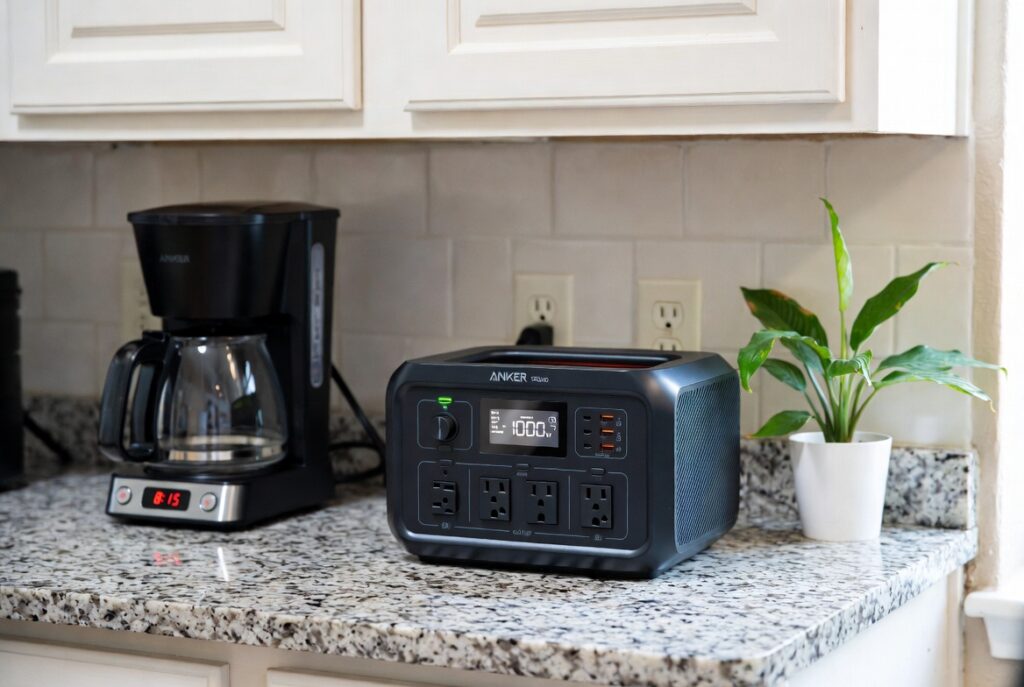
Solar generators sit on a kitchen counter, a nightstand, or a living room shelf. They run in total silence at low loads. They produce no smell, no fumes, and no risk of CO poisoning. The table above makes the safety gap clear. For anyone asking whether you can run solar generator indoors, the answer is an unqualified yes.
Run Solar Generator Indoors Placement Rules and Ventilation Requirements
When you run solar generator indoors, maintain a minimum 6-inch clearance around all cooling vents on the intake and exhaust sides. Do not place the unit inside sealed cabinets, closets, or enclosed furniture. The cooling fans need unrestricted airflow to dissipate inverter heat. A unit pushed against a couch cushion or tucked behind curtains will overheat at moderate loads. For vent cleaning protocols, see our solar generator maintenance guide.
Heavy units require stable placement. A Bluetti AC200L weighs 62.4 lbs. The vibration from cooling fans at high loads can cause heavy units to shift slightly on smooth surfaces like granite countertops or polished wood shelves. Always place on a stable, non-slip surface. Keep the unit away from curtains, bedding, and flammable materials. Remember that the AC outlets on the unit are live whenever the inverter is on. If children or pets share the space, position the outlets against a wall or use outlet covers.
Heat Output at High Loads and What to Expect in Small Rooms
At loads above 1,000W, the inverter generates measurable heat through the exhaust fans. In a small closed room measuring approximately 10 by 12 feet, a unit running 1,000W continuous can raise ambient temperature by 2 to 3 degrees C over 6 to 8 hours. This is safe and poses no fire risk. It is simply a byproduct of the inverter converting DC battery power to AC. At loads under 200W, heat output is negligible and most users will not notice it. For more on fan noise at different loads, see our solar generator noise level guide.
The temperature rise matters most in bedrooms overnight. A CPAP user running 80W in a closed 10 by 12 foot bedroom for 8 hours will notice approximately 3 degrees C of warming by morning. Opening the bedroom door eliminates the rise while keeping the unit safely indoors away from freezing temperatures. For CPAP-specific runtime math, see our solar generator for CPAP guide.
The Milton Ice Storm Bedroom Success
A family in Milton used an Anker SOLIX C1000 during a 24-hour winter outage. They brought the unit into the master bedroom to power a CPAP and charge two phones. The room measured approximately 10 by 12 feet with the door closed. The total draw was approximately 80W continuous from the CPAP plus intermittent phone charging.
Halfway through the night, the room felt noticeably warmer. The inverter running at 80W continuous generated enough exhaust heat to raise the temperature in the small, closed bedroom by approximately 3 degrees C over 8 hours. The family did not expect a battery to produce perceptible warmth. The heat was not dangerous but it was measurable and noticeable under blankets in a closed room.
Running a solar generator at load indoors is like sitting in a parked car with the heater on. The engine produces heat as a byproduct of doing work. It is safe, but you need to account for the thermal output in small enclosed spaces. Opening the bedroom door or cracking a window eliminates the temperature rise entirely while still keeping the unit safely indoors away from freezing temperatures. When you run solar generator indoors overnight for CPAP, leave the door open.
The Rockwood Kitchen Cabinet Thermal Shutdown
A client in Rockwood tried to hide his EcoFlow DELTA Pro 3 inside a decorative wooden kitchen cabinet. He wanted backup power available but did not want the unit visible on the counter. The cabinet had a closed back, solid sides, and a hinged door. He ran the unit from inside the cabinet with the door closed.
While running a coffee maker at 1,500W, the unit triggered a thermal protection shutdown within 5 minutes. Because no fresh air entered the sealed cabinet, the exhaust fans were recirculating 50 degrees C air back into the intake. The unit could not cool itself. The BMS shut down all output to prevent heat damage to the inverter and cells.
Blocking the vents on a solar generator is like placing cardboard in front of a car radiator. The engine can produce all the power it wants, but if it cannot reject heat, it overheats and shuts down. The fix was simple. He removed the cabinet door and drilled 4-inch ventilation holes in the back panel. The unit now runs the coffee maker without triggering a thermal fault. A 6-inch clearance around all vents is the minimum for any indoor placement when you run solar generator indoors at loads above 200W.
Run Solar Generator Indoors Verdict and Ontario Winter Strategy
Indoor use is the recommended configuration for every Ontario solar generator from November through March. Keeping the unit inside solves the 0 degrees C charging lockout automatically. It puts backup power within arm’s reach of your fridge, CPAP, and Starlink. It eliminates extension cords running through snow to a shed. For the full winter protocol, see our solar winterize guide.
- CPAP and phone charging overnight. Buy a Jackery Explorer 300 Plus or Anker SOLIX C1000. Place on the nightstand or beside the bed. At loads under 100W, there is no heat buildup and no fan noise. This is the safest, quietest backup configuration. For runtime math, see our solar generator for CPAP guide.
- Kitchen and living room backup during outages. Buy an Anker SOLIX C1000 or Bluetti AC200L. Place on a stable counter or shelf with 6-inch clearance around all vents. Do not hide inside cabinets. Run fridge, Starlink, and lights from the kitchen counter in total silence with zero CO risk.
- High-draw home backup with large appliances. Buy a Bluetti AC200L or EcoFlow DELTA Pro 3. Place in a hallway or utility room with ventilation. At loads above 1,000W, expect fan noise and heat output. Position the unit outside the primary living space and use extension cords to reach appliances.
Frequently Asked Questions
Q: Can I use a solar generator in the basement?
A: Yes, but keep it off the cold concrete floor. Use a wooden pallet or shelf to prevent thermal transfer from the cold ground. Cold concrete can drop the battery temperature below the 0 degrees C charging threshold even when the basement air temperature is above freezing.
Q: Is there a fire risk with LFP batteries?
A: LiFePO4 is the safest lithium chemistry available. It is extremely difficult to trigger thermal runaway compared to NMC or NCA lithium found in phones and laptops. Keep the unit away from flammable materials and never cover the vents, but the fire risk from LFP is lower than the fire risk from a scented candle on your shelf.
Q: Do I need a CO detector for a solar generator?
A: No, because solar generators produce zero carbon monoxide. However, you should have a CO detector anyway if you have gas appliances, a fireplace, or an attached garage. A CO detector protects your home from all combustion sources, not just generators.
NEC Article 706 covers energy storage systems including indoor placement requirements, fire safety clearances, and ventilation standards for battery-based equipment. All indoor installations must maintain manufacturer-specified clearances from combustible materials. Current standards are published at nfpa.org.
CEC Section 64 governs indoor use of portable electrical equipment in Ontario residential settings. All solar generators used indoors must be CSA or UL certified with functional cooling and thermal protection systems. The Electrical Safety Authority (ESA) provides current compliance information at esasafe.com.
This build is engineered within the 48V DC Safety Ceiling. Diagnostic logic is based on 20+ years of technical service experience. All structural and electrical installations must be verified by a Licensed Professional and comply with your Local AHJ. See our legal and safety disclosure for full scope.
About the Author
Robert Bertrand spent 20 years as a service advisor in the automotive industry (Lexus and Nissan), where precision diagnostics, wiring integrity, and documentation standards were non-negotiable. He brings that same technical discipline to GridFree Guide, where he researches, tests, and documents off-grid solar systems for Ontario conditions. Based in Rockwood, Ontario, every article is built on verified specifications, manufacturer data, and the real-world climate constraints of Canadian off-grid living.
As an Amazon Associate I earn from qualifying purchases. This site also contains affiliate links to other products and services. GridFree Guide earns a small commission at no extra cost to you.