
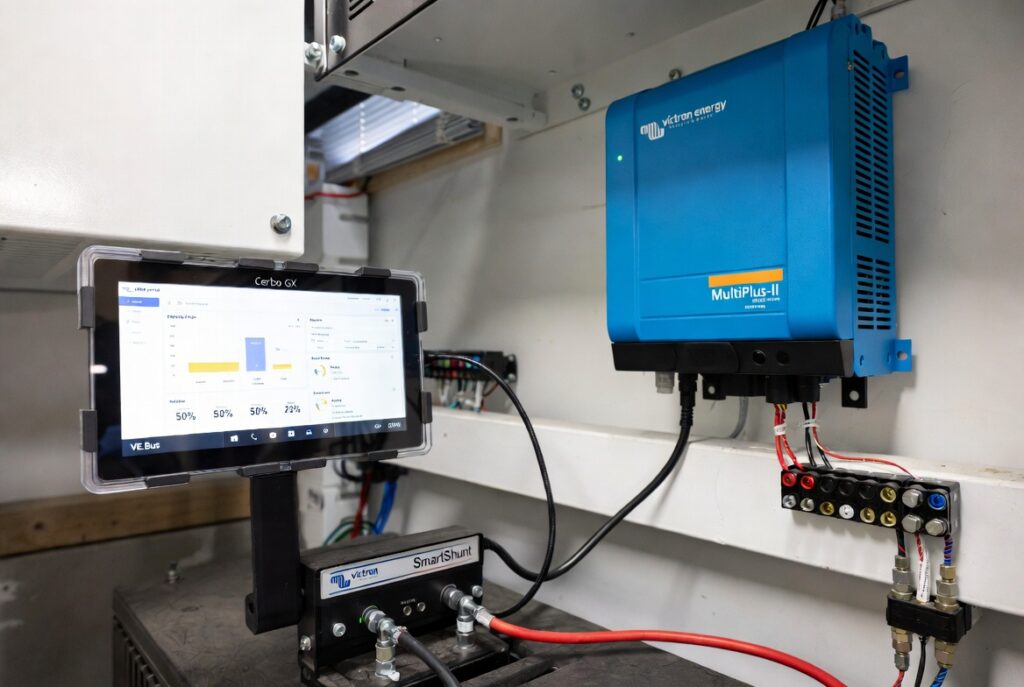
The victron solar ontario installation error that arrives most often in service calls is not a failed component or a dead inverter but an inverter negative lead bolted directly to the battery terminal rather than to the system bus side of the SmartShunt, because a first-time installer in Wellington County made exactly this connection and their Cerbo GX displayed 98 percent SoC while their microwave was running and their lights were on. A 98 percent reading under confirmed inverter load is physically impossible, and it can only mean the SmartShunt is receiving zero current data from the inverter.
The SmartShunt is a Coulomb-counting instrument that measures every ampere of current flowing into and out of the battery bank, and it works correctly only when every current path to and from the bank passes through it.
When the inverter negative connects directly to the battery negative instead of through the shunt, the inverter draws current from the battery without the shunt detecting a single ampere of that draw. The Cerbo GX receives zero inverter current data, cannot calculate the correct SoC, and displays the commissioning-day baseline indefinitely. The Wellington County fix took 5 minutes: the inverter negative lead was unbolted from the battery terminal and moved to the system bus side of the SmartShunt. The Cerbo GX immediately displayed correct real-time SoC data , the bank had dropped to 73 percent during the diagnostic period , and the time-to-empty reading showed 8.3 hours of remaining autonomy.
The victron solar ontario wiring rule that prevents this error is one sentence: the battery negative terminal connects to one thing only , the SmartShunt battery terminal. Every other negative lead (inverter negative, MPPT negative, DC load bus negative, Cerbo GX negative) connects to the system bus side of the SmartShunt. This rule applies regardless of how many components are in the system, and it is the first wire to run before any other component is connected. See our Ontario solar sizing guide before beginning any victron solar ontario installation.
The four components of an Ontario Tier 2 build: MultiPlus-II, MPPT 100/50, SmartShunt, Cerbo GX
| Component | Function | Connection to Cerbo GX |
|---|---|---|
| MultiPlus-II | Inverter/charger: battery DC to 120V AC, accepts generator AC for charging, handles transfer switching | VE.Bus cable |
| MPPT 100/50 | Solar charge controller: up to 100V array input, 50A output at 12V, maximum power point tracking | VE.Direct cable |
| SmartShunt | Coulomb-counting battery monitor: all current in and out flows through it , battery negative only | VE.Direct cable |
| Cerbo GX | System brain: VE.Bus + VE.Direct hub, VRM remote monitoring portal, generator auto-start, temperature monitoring | Central hub |
The four Victron components are designed to communicate with each other as a system, not to function as standalone parts. The MultiPlus-II converts the battery bank DC to 120V AC for home loads and accepts generator or grid AC input for bulk charging through the internal charger. The MPPT 100/50 tracks the maximum power point of the array across the full irradiance range , including Ontario overcast conditions where every watt of recovery matters , and delivers up to 50A of charging current to the bank. The SmartShunt and Cerbo GX are the monitoring and communications layer that converts all of this into readable data accessible from any browser.
The victron solar ontario monitoring premium adds approximately $600 to $800 over an equivalent non-monitored system. For a remote Ontario property accessed every 1 to 4 weeks, this premium is justified by the remote fault detection the Muskoka result demonstrates , a 15 percent production anomaly detected from a Toronto office before it became a physical failure. First-time installers should commission each component individually using the VictronConnect app before connecting the VE.Bus and VE.Direct cables. The Cerbo GX does not require a constant internet connection , it logs data locally and uploads to VRM when connectivity is available. See our Ontario solar system planning guide for the full Tier 2 specification.
The victron solar ontario wiring sequence: why the SmartShunt position is the one rule that cannot be wrong
The correct victron solar ontario wiring sequence starts with the SmartShunt, not the inverter. Run the battery negative cable from the battery negative terminal to the SmartShunt battery terminal , this is the only connection the battery negative terminal makes. From the SmartShunt system bus terminal, run all other negative leads: the MultiPlus-II negative, the MPPT 100/50 negative, the DC load bus negative, and the Cerbo GX negative. This ensures every ampere of current, in both charge and discharge directions, passes through the SmartShunt for accurate Coulomb counting. Once this wiring is complete, connect the VE.Bus cable from the MultiPlus-II to the Cerbo GX and the VE.Direct cables from the MPPT and SmartShunt to the Cerbo GX.
The SmartShunt bypass error produces one specific diagnostic symptom: SoC does not decrease under confirmed inverter load. If the Cerbo GX shows the inverter running but the SmartShunt shows zero inverter current draw, the inverter negative is not routed through the shunt. The fix is always the same 5-minute operation: unbolt the inverter negative from the battery terminal and move it to the SmartShunt system bus side. No reconfiguration, no software changes, no component replacement. The Wellington County property owner had been operating on incorrect SoC data since commissioning day , the first accurate reading appeared within seconds of the rewire. See our Ontario battery inverter guide for the full negative bus wiring specification.
The victron solar ontario Cerbo GX advantage: remote monitoring, generator auto-start, and early fault detection
A property owner in Muskoka was monitoring their victron solar ontario system from their Toronto office via the VRM portal on a clear January day in 2024. The VRM dashboard showed MPPT harvest at approximately 85 percent of the expected output for confirmed clear-sky irradiance , 15 percent below the commissioning-day baseline the Cerbo GX had been logging since the system went live. No other system had reported anomalies that day, and the irradiance data confirmed it was a clean production day. The anomaly was isolated to one MPPT input string.
Remote diagnosis via VRM showed normal open-circuit voltage from the array but lower-than-expected current output, indicating increased resistance somewhere in the DC array circuit. On a Tuesday inspection visit, the owner found an MC4 connection on one panel output that had developed high resistance from repeated freeze-thaw thermal cycling. The connection was warm to the touch from resistive heating under current flow , the first sign that the housing was beginning to degrade. Tightening the MC4 collar and confirming the locking tab re-seated restored the MPPT harvest to 100 percent of the baseline on the same afternoon.
His comment: “The VRM caught it before it could fail completely. I fixed it on a Tuesday visit instead of a Saturday emergency call in the dark.” The Cerbo GX historical baseline is what made the detection possible , without commissioning-day production data logged against daily irradiance, the 15 percent anomaly would have been invisible until the connection failed completely and the panel dropped to zero output. The generator auto-start feature adds a parallel layer of protection: configured at 20 percent SoC, the Cerbo GX sends a dry-contact start signal to the generator during a gray streak event, providing a bulk charge without the owner being present. See our Ontario MC4 connector guide for the full freeze-thaw connection protocol.
The Wellington County commissioning error: what happens when the SmartShunt is bypassed
The Wellington County installer was building his first off-grid system in fall 2023. He ran the inverter negative to the battery negative terminal because it was the most physically convenient connection point on the bus bar, and the result looked correct: all components powered on, the Cerbo GX showed all green, and the VRM portal displayed a full 100 percent SoC reading. The first hint of a problem was that the SoC reading never changed , not after an evening of lights and entertainment, not after running the microwave at breakfast, not after two days of operation. The Cerbo GX consistently showed 98 to 100 percent.
The diagnosis took 3 minutes with a clamp meter. Zero amps on the SmartShunt under inverter load; full inverter draw on the battery cable that bypassed the shunt. The inverter was drawing correctly from the battery bank , the bank was depleting correctly , but the SmartShunt could not see any of it. The Cerbo GX was calculating SoC from MPPT charge current and zero inverter discharge current, producing a reading that was permanently near commissioning charge level. The correct bank SoC at the time of diagnosis was approximately 73 percent , not 98 percent.
The fix was moving one cable. The inverter negative was unbolted from the battery terminal and bolted to the system bus side of the SmartShunt. The Cerbo GX updated within seconds: 73 percent SoC, time-to-empty 8.3 hours at current load, inverter current draw confirmed at 14.2A. The property owner now had a working monitoring system for the first time since commissioning day. The victron solar ontario lesson from Wellington County: always verify SmartShunt current in both directions during commissioning , charge current from the MPPT and discharge current from the inverter , before closing up the enclosure. See our Ontario solar storage guide for the full commissioning checklist.
NEC and CEC: Ontario permit requirements for Victron off-grid installations
NEC 690 governs permanent victron solar ontario installations. The MultiPlus-II must be rated for the DC input voltage and the AC output current of the specific installation. All DC conductors from the battery bank must be sized for 125 percent of maximum continuous current, and the Class T fuse must be installed within 18 inches of the battery positive terminal per NEC 690.9. The MPPT 100/50 array input voltage must accommodate the cold Voc of the Ontario winter array: STC Voc multiplied by 1.08 at -10 degrees C for all panels in series. Contact the NFPA at nfpa.org for current NEC 690 requirements applicable to Victron off-grid systems.
CEC Section 64 governs all permanent Ontario electrical installations. A permanently wired Victron off-grid installation requires an ESA permit before installation begins. The ESA inspector will verify DC conductor sizing, overcurrent device placement, MultiPlus-II AC output wiring, and generator transfer switch configuration. The generator auto-start dry-contact connection from the Cerbo GX is a low-voltage DC signal circuit and does not require separate permit coverage beyond the main installation permit. Contact the Electrical Safety Authority Ontario at esasafe.com before beginning any permanently wired victron solar ontario installation.
Pro Tip: During victron solar ontario commissioning, verify SmartShunt current in both directions before closing the enclosure. Turn on the inverter with a known load (a 100W lamp works well) and confirm the SmartShunt shows negative current (discharge). Then confirm the MPPT shows positive current (charge) on the next available solar input. If the inverter load produces zero SmartShunt current, the inverter negative is bypassing the shunt. This 60-second test catches the Wellington County error before it produces weeks of incorrect SoC data. The Cerbo GX live current display is the tool , no additional instruments required.
The victron solar ontario verdict: four components, one wiring rule, and why the Cerbo GX is not optional
- Ontario property owner building a permanent off-grid residence: the four-component Victron spec is the correct specification. MultiPlus-II, MPPT 100/50, SmartShunt, and Cerbo GX. Wire the SmartShunt first: battery negative to shunt only, all other negatives to the system bus side. Commission each component individually via VictronConnect before connecting VE.Bus and VE.Direct cables. The Wellington County result confirms: the wiring error costs 5 minutes to fix when caught at commissioning; it costs weeks of incorrect SoC data if not caught.
- Ontario remote property owner (cabin or cottage accessed every 1 to 4 weeks): the Cerbo GX VRM portal is the justification for the entire Victron premium. The Muskoka result confirmed a 15 percent production anomaly detected remotely before it became a connection failure , fixed on a Tuesday visit instead of a weekend emergency in the dark. Without the Cerbo GX and VRM commissioning-day baseline data, this fault would have progressed undetected to a melted MC4 housing or a complete panel disconnect. The $600 to $800 monitoring premium pays for itself in the first prevented emergency service call.
- Ontario property owner who asks whether the Cerbo GX is optional: no. Without the Cerbo GX, the victron solar ontario system has no centralised display, no VRM remote monitoring, no generator auto-start capability, and the SmartShunt can only be read via local Bluetooth using the VictronConnect app. For any property accessed remotely, the Cerbo GX is not an upgrade , it is the monitoring system that justifies the Victron ecosystem premium over standalone components. A Victron system without the Cerbo GX is a monitored system with the monitoring removed.
Frequently Asked Questions
Q: What is the correct wiring sequence for a Victron solar system in Ontario?
A: The victron solar ontario wiring sequence starts with the SmartShunt: connect the battery negative terminal to the SmartShunt battery terminal only , this is the only connection the battery negative makes. All other negative leads (MultiPlus-II inverter negative, MPPT 100/50 negative, DC load bus negative, Cerbo GX negative) connect to the system bus side of the SmartShunt. Then connect the VE.Bus cable from the MultiPlus-II to the Cerbo GX, and VE.Direct cables from the MPPT 100/50 and SmartShunt to the Cerbo GX. Commission each component individually via VictronConnect before connecting the VE.Bus and VE.Direct network. The Wellington County result confirms the consequence of skipping the SmartShunt wiring rule: a plausible-looking installation that is functionally unmonitored for inverter current.
Q: Why is my Victron SmartShunt showing incorrect state of charge?
A: If the SmartShunt shows SoC that does not decrease under confirmed inverter load , a reading that stays near 98 to 100 percent while loads are actively running , the inverter negative is bypassing the shunt. The inverter draws current directly from the battery without the shunt detecting any of it.
The Cerbo GX receives zero inverter discharge data and cannot calculate the correct SoC. The fix is a 5-minute rewire: unbolt the inverter negative from the battery terminal and move it to the system bus side of the SmartShunt. No reconfiguration required , the Cerbo GX will display correct SoC within seconds of the rewire. Verify the fix by confirming negative current on the SmartShunt live display under a known inverter load.
Q: Do I need a Cerbo GX for a Victron off-grid system in Ontario?
A: Yes. Without the Cerbo GX, the victron solar ontario system has no centralised display, no VRM remote monitoring portal, no generator auto-start capability, and no commissioning-day baseline data for early fault detection. The SmartShunt can be read locally via Bluetooth and the VictronConnect app, but this requires physical presence and does not provide the historical logging that made the Muskoka anomaly detectable. For a remote Ontario property, the Cerbo GX is the monitoring system , the $300 to $400 component cost is recovered in the first prevented emergency service call. A Victron installation without the Cerbo GX is technically functional but operationally blind for any property owner who is not on-site daily.
This build is engineered within the 48V DC Safety Ceiling. Diagnostic logic is based on 20+ years of technical service experience. All structural and electrical installations must be verified by a Licensed Professional and comply with your Local AHJ. See our legal and safety disclosure for full scope.
About the Author
Robert Bertrand spent 20 years as a service advisor in the automotive industry (Lexus and Nissan), where precision diagnostics, wiring integrity, and documentation standards were non-negotiable. He brings that same technical discipline to GridFree Guide, where he researches, tests, and documents off-grid solar systems for Ontario conditions. Based in Rockwood, Ontario, every article is built on verified specifications, manufacturer data, and the real-world climate constraints of Canadian off-grid living.
As an Amazon Associate I earn from qualifying purchases. This site also contains affiliate links to other products and services. GridFree Guide earns a small commission at no extra cost to you.