
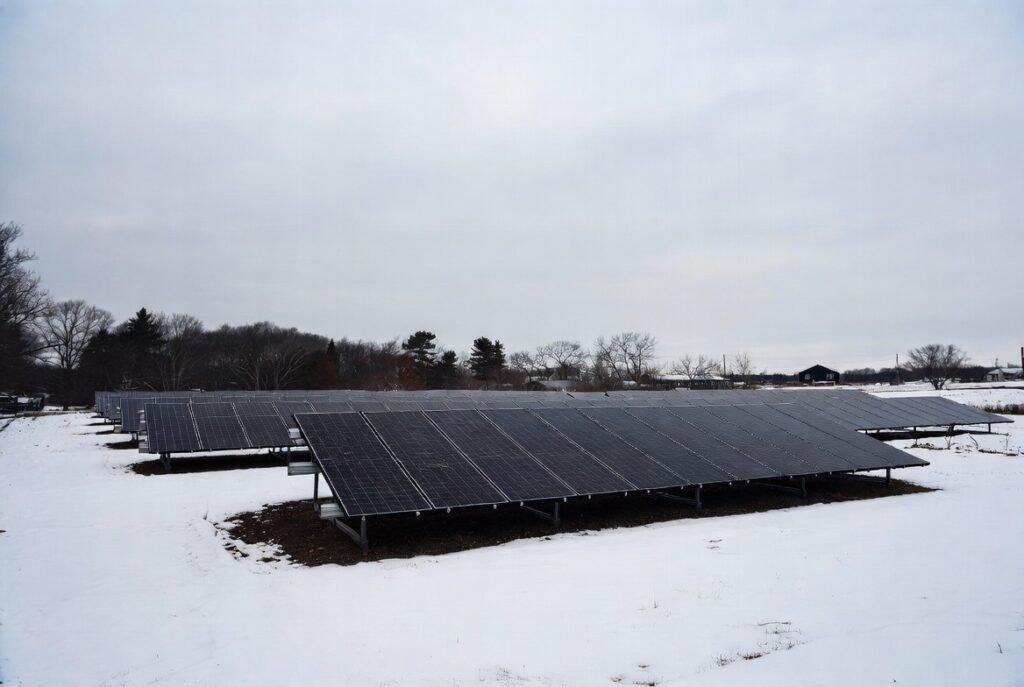
The most dangerous winter solar Ontario mistake is sizing a battery bank for the 4.0 PSH summer average, because a property owner in Wellington County installed a 400W array expecting approximately 1,600Wh of daily charging in January, which is what 400W times 4.0 PSH times 0.85 system efficiency produces in July, but the actual January harvest was approximately 600Wh per day because Ontario January peak sun hours collapse to 1.5. His Victron SmartShunt confirmed his panels were functioning correctly and also confirmed that his bank was depleting at roughly three times the rate he had planned for.
He had sized the system carefully using the Ontario annual average of 4.0 PSH, which is the correct figure for net metering payback calculations and long-term yield estimates. But battery bank sizing and gray streak autonomy calculations use the worst month, not the annual average. In Ontario, the worst month is January at 1.5 PSH. His SmartShunt showed only 3A to 5A of charging current flowing into the 200Ah bank on clear January days while the system drew approximately 8A net under normal household load. Over a 4-day Ontario gray streak, that deficit compounded to a near-total discharge.
The fix required no hardware change. He added a generator protocol triggered at 35 percent SoC per SmartShunt, recalculated his gray streak autonomy using the 1.5 PSH reality, and accepted that his 400W array would carry approximately 30 to 40 percent of daily load in January with the generator covering the rest. The winter solar Ontario lesson was not that his system was wrong , it was that his planning figure had been wrong from the start. See our Ontario solar sizing guide before any winter solar Ontario system calculation.
The winter solar ontario PSH reality: why January output is 30 percent of your summer harvest
| Month | Ontario PSH | 100W panel output | 400W array output | Design use |
|---|---|---|---|---|
| July | 5.0 PSH | ~425Wh | ~1,700Wh | Peak production, yield estimates |
| Annual average | 3.5-4.0 PSH | ~300-340Wh | ~1,200-1,360Wh | Payback calculations, HRSP sizing |
| January | 1.5 PSH | ~127Wh | ~510Wh | Bank sizing, gray streak autonomy |
| December | 1.3 PSH | ~110Wh | ~442Wh | Worst-case northern Ontario planning |
January peak sun hours in southern Ontario average 1.5, compared to 4.0 to 5.0 in July. This means a 100W panel that delivers approximately 425Wh on a clear July day produces only approximately 127Wh on a clear January day (100W times 1.5 PSH times 0.85 system efficiency). For a 400W array, this translates to approximately 510Wh in January versus approximately 1,700Wh in July. This is the fundamental design reality for any winter solar ontario system. The annual average of 3.5 to 4.0 PSH is correct for yield estimates and payback calculations but incorrect for battery bank sizing and gray streak autonomy. Always use 1.5 PSH for any Ontario winter solar ontario sizing calculation.
The Wellington County property owner made exactly this error. His summer yield estimate used 4.0 PSH. His January bank sizing should have used 1.5. The 63 percent difference between those two numbers is what drained his bank to near-zero on the first gray streak of the season.
The low January sun angle compounds the PSH reduction. In southern Ontario at 43 to 45 degrees north latitude, the solar noon sun angle in January is approximately 20 to 25 degrees above the horizon. A fixed panel tilted at 35 degrees for summer performance sits nearly perpendicular to the January sun, reducing effective collection area significantly.
Tilting to 60 to 70 degrees for winter aligns the panel face more directly with the low sun angle and improves January output by approximately 15 to 25 percent on clear days. This tilt adjustment also allows snow to slide off naturally, recovering production that a snow-covered flat panel loses entirely. See our solar system planning ontario guide for the complete Ontario PSH planning framework.
The cold Voc boost: why panel voltage rises in January and why that changes your wiring
While January reduces total daily energy output, it increases panel voltage. Solar panels are semiconductors and their open-circuit voltage increases as temperature decreases. At -10 degrees C, panel Voc is approximately 1.08 times the STC value. A 22.5V STC Voc panel produces approximately 24.3V at -10 degrees C. On a two-panel 48V series string, that is approximately 48.6V in January conditions. Array wiring sized to the 45V STC string voltage is undersized for the 48.6V January cold Voc on the coldest production days. This is the reason Ontario winter solar array wiring must be sized to the cold Voc calculation rather than the STC rating on the panel datasheet.
Embed 10 AWG solar cable reference with note to confirm upgrade to 8 AWG for cold Voc conditions on Ontario arrays. See our solar wire gauge ontario guide for the complete cold Voc array wiring calculation.
The cold Voc boost also affects MPPT tracking. The Victron MPPT 100/30 tracks the maximum power point of the panel, which at -10 degrees C sits at a higher voltage than the STC datasheet suggests. This higher tracking voltage allows the MPPT to extract more power from the panel on cold clear days than a PWM controller that simply clips the voltage to battery level. The winter solar ontario advantage of MPPT over PWM is most pronounced on the coldest clear January days when the cold Voc boost is largest. On a -10 degrees C clear January morning, the MPPT is extracting every available milliamp from panels operating at their highest voltage of the year.
The winter solar ontario battery problem: why standard LFP blocks charging from November through March
The LFP charge block is the winter solar ontario battery problem that standard spec sheets do not emphasize. Every standard LFP battery blocks all charging current when cell temperature drops to approximately 0 degrees C. The BMS activates the charge protection circuit to prevent lithium plating damage that would permanently reduce cell capacity. In an unheated Ontario garage at -15 to -25 degrees C from November through March, the bank cannot receive any charging current from the solar array regardless of how much the panels produce. The MPPT 100/30 is in bulk mode, the array is producing, and the bank is receiving nothing because the BMS has cut all incoming current.
The Battle Born heated LFP is the correct winter solar ontario battery standard for any bank in an unheated space. Its internal self-heating element activates at approximately 2 degrees C cell temperature, raises cells to 5 to 7 degrees C, and then opens the BMS to charging current. At -20 degrees C ambient in a Wellington County unheated garage, the heated LFP accepts a full charge from every amp the winter solar ontario array produces.
A property owner in Halton Hills, Halton Region specified every component for 1.5 PSH from day one of her fall 2024 Tier 2 build. She used Battle Born heated LFP 200Ah at 48V, cold Voc wiring sized to 1.08 times STC Voc, and panels tilted to 65 degrees for winter on an adjustable ground mount. Her first January, the SmartShunt confirmed approximately 510Wh per clear day, matching the 400W times 1.5 PSH times 0.85 efficiency calculation exactly. No over-discharges. No frozen battery bank. Generator triggered at 35 percent SoC exactly as the gray streak protocol specified. Her comment: “The first winter was exactly what the numbers said it would be. That was the goal.”
See our solar battery heater ontario guide for the complete Battle Born heated LFP specification.
The 4-day gray streak: sizing the battery bank and the generator protocol for 96 hours of darkness
The 4-day Ontario gray streak is the design event for winter solar ontario bank sizing. During a 4-day overcast period in Wellington County or Halton Hills, panel output may be 5 to 15 percent of clear-sky output, approximately 25 to 75Wh per day from a 400W array. The battery bank must carry the full household load for 96 hours from stored capacity. At a standard Tier 2 running load of approximately 1,040W, a 200Ah 24V bank provides approximately 18 hours of full autonomy at 80 percent DoD. A 4-day gray streak requires either a larger bank, a generator protocol, or both. When the SmartShunt time-to-empty drops below 6 hours, run the generator for a 90-minute bulk charge.
The gray streak generator protocol replaces guesswork with measurement. The MPPT 100/30 shows what the panels are contributing. The SmartShunt shows the net amp deficit and calculates how long the bank will last at that specific deficit. A property owner who checks the SmartShunt time-to-empty at sunset each day of a gray streak has complete information about whether a generator run is needed that night. The Wellington County property owner who sized for 4.0 PSH discovered this discipline the hard way. The Halton Hills property owner who sized for 1.5 PSH from day one had the same tools and never needed an unplanned generator run through an entire Ontario winter.
See our solar power outage guide for the complete gray streak management protocol.
NEC and CEC: Ontario permit requirements for winter-rated solar installations
NEC 690 and NEC 70 (NFPA 70, the National Electrical Code) govern Ontario solar installations including winter solar ontario systems. All wiring must be rated for the maximum system voltage including the cold Voc boost at the minimum design temperature, which is -10 degrees C for the Ontario January planning standard. Array conductors must be sized for 125 percent of maximum continuous current at the cold Voc design voltage, not the STC voltage. All outdoor wiring must use UV-resistant, sunlight-resistant rated cable with temperature ratings appropriate for Ontario winter conditions. Contact the NFPA at nfpa.org for current NEC 690 requirements for winter-rated Ontario solar installations.
CEC Section 64 governs electrical installations in Ontario. Any permanent solar installation, including winter solar ontario systems with heated battery banks and cold Voc-rated wiring, requires an ESA permit at $300 to $400 before installation begins. The permit scope covers the array wiring, charge controller connections, battery bank wiring, inverter installation, and all DC and AC interconnections. A licensed electrician must complete the installation and schedule the ESA inspection before the system is commissioned. Contact the Electrical Safety Authority Ontario at esasafe.com before beginning any permanent winter solar ontario installation.
Pro Tip: If you have a ground-mount array, adjust the tilt to 60 to 70 degrees for November through February and back to 30 to 35 degrees for March through October. The winter tilt does two things simultaneously: it points the panel face more directly at the low January sun (approximately 20 to 25 degrees above the horizon at solar noon in Wellington County) and it creates a steep enough angle for snow to slide off under its own weight rather than accumulating on the panel face. The Wellington County property owner who made this tilt adjustment after his first winter recovered approximately 20 percent more January harvest from the same 400W array with no other hardware changes.
The winter solar ontario verdict: design for 1.5 PSH, heat the bank, and watch the SmartShunt
- Ontario property owner who sized their system for summer PSH and is experiencing winter underperformance: recalculate battery bank autonomy using 1.5 PSH January output. If the 400W array produces approximately 510Wh on clear January days and the daily load is 2,500Wh, the array covers approximately 20 percent of daily consumption in January. Add a SmartShunt generator protocol triggered at 35 percent SoC. No hardware change is required if the battery bank already provides 4-day autonomy at winter load. The planning figure was wrong, not the equipment. The Wellington County result: generator protocol added, 1.5 PSH recalculated, system performed correctly through the remaining winter without changes.
- Ontario property owner specifying a new winter solar ontario system: use 1.5 PSH for all bank sizing and gray streak calculations from day one. Specify Battle Born heated LFP for any bank in an unheated space. Size array wiring to the 1.08 cold Voc calculation (not STC). Tilt panels to 60 to 70 degrees for winter if using an adjustable ground mount. Install the MPPT 100/30 and SmartShunt from commissioning day. The Halton Hills result: first January matched SmartShunt predictions exactly, no unplanned generator runs, no frozen bank, “the first winter was exactly what the numbers said it would be.”
- Ontario property owner experiencing battery charging failures in November despite functioning solar panels and correct MPPT voltage: check whether the battery bank is in an unheated space below 0 degrees C. A zero-amp SmartShunt reading with correct MPPT voltage is the BMS charge block signature confirmed in WP#418. The panels are producing. The MPPT is tracking. The BMS is blocking every amp of incoming current because cell temperature is below 0 degrees C. Upgrade to Battle Born heated LFP or relocate the battery bank to a conditioned space that stays above 5 degrees C year-round. The SmartShunt confirms the fix on the first clear morning after the heated LFP is installed , charging current resumes at -12 degrees C ambient.
Frequently Asked Questions
Q: How much solar power does a 400W array produce in Ontario in January?
A: A 400W array in Ontario produces approximately 510Wh on a clear January day, compared to approximately 1,700Wh on a clear July day. The difference is Ontario’s January average of 1.5 peak sun hours versus the summer average of 4.0 to 5.0. At 1.5 PSH with 0.85 system efficiency, a 100W panel delivers approximately 127Wh per day. Sizing a battery bank or calculating gray streak autonomy using the summer PSH average of 4.0 will produce a system that is undersized by approximately 63 percent in January. Always use 1.5 PSH for any winter solar ontario bank sizing calculation.
Q: Why does my solar system work fine in summer but underperform in winter?
A: There are four reasons Ontario winter solar systems underperform versus summer expectations. First, January PSH is 1.5 versus 4.0 to 5.0 in summer, reducing daily output to approximately 30 percent of peak summer production. Second, the low sun angle in January reduces the effective collection area of fixed-tilt panels. Third, standard LFP batteries block all charging current below approximately 0 degrees C cell temperature, meaning a bank in an unheated garage cannot charge at all from November through March. Fourth, array wiring sized for summer STC voltage may be undersized for the cold Voc boost of 1.08 times STC at -10 degrees C, causing resistive losses on the coldest clear days.
Q: Do solar panels produce more or less voltage in cold Ontario winters?
A: Solar panels produce more voltage in cold conditions. At -10 degrees C, the open-circuit voltage (Voc) is approximately 1.08 times the standard test condition (STC) value. A panel with a 22.5V STC Voc produces approximately 24.3V at -10 degrees C. On a two-panel 48V series string, the cold Voc is approximately 48.6V in January conditions. This voltage increase means the MPPT 100/30 can extract slightly more power from cold panels than warm ones at the same light level. It also means array wiring must be sized for the cold Voc, not the STC voltage , undersized wiring on an Ontario winter solar system operates at its thermal limit on the coldest clear days of the year.
This build is engineered within the 48V DC Safety Ceiling. Diagnostic logic is based on 20+ years of technical service experience. All structural and electrical installations must be verified by a Licensed Professional and comply with your Local AHJ. See our legal and safety disclosure for full scope.
About the Author
Robert Bertrand spent 20 years as a service advisor in the automotive industry (Lexus and Nissan), where precision diagnostics, wiring integrity, and documentation standards were non-negotiable. He brings that same technical discipline to GridFree Guide, where he researches, tests, and documents off-grid solar systems for Ontario conditions. Based in Rockwood, Ontario, every article is built on verified specifications, manufacturer data, and the real-world climate constraints of Canadian off-grid living.
As an Amazon Associate I earn from qualifying purchases. This site also contains affiliate links to other products and services. GridFree Guide earns a small commission at no extra cost to you.