
The most important cloudy solar Ontario number is 10 to 25 percent, because a property owner in Orangeville, Dufferin County ran a 400W array through a 3-day November overcast stretch expecting meaningful daily charging and his Victron SmartShunt recorded 38Wh on day 1 and 52Wh on day 2, against a daily household consumption of approximately 2,500Wh. His panels were contributing approximately 1.5 to 2 percent of daily load while the battery bank carried the remaining 98 percent of all household energy for those three days. The problem was not his panels, his charge controller, or his wiring.
On a fully overcast November day in Dufferin County, the irradiance reaching the panel surface drops to approximately 50 to 100W per square metre versus the 1,000W per square metre of the standard test condition.
His 400W array was performing exactly as the physics required. The cloudy solar Ontario result was not a malfunction. It was physics.
He triggered the generator on the afternoon of day 3 when the SmartShunt showed 32 percent SoC and a time-to-empty reading of approximately 4 hours. The generator ran for 90 minutes, restoring the bank from 32 percent to approximately 85 percent SoC at 50A bulk charge rate through the MultiPlus-II. His system had the right components for the situation: battery bank, generator protocol, SmartShunt management. What it did not have was the planning expectation that cloudy solar Ontario days mean the battery bank is doing the work, not the panels.
The planning correction required no hardware change. He recalculated his gray streak bank sizing using a 4-day autonomy figure at approximately 2,500Wh daily consumption rather than assuming the panels would carry any meaningful portion of daily load during overcast conditions. The cloudy solar Ontario reality is not a flaw in the system. It is an inherent property of diffuse light physics. Design the bank for 4-day autonomy from storage and treat every gray-day panel contribution as a bonus that slows the bank’s descent. See our Ontario solar sizing guide before any cloudy solar Ontario bank sizing calculation.
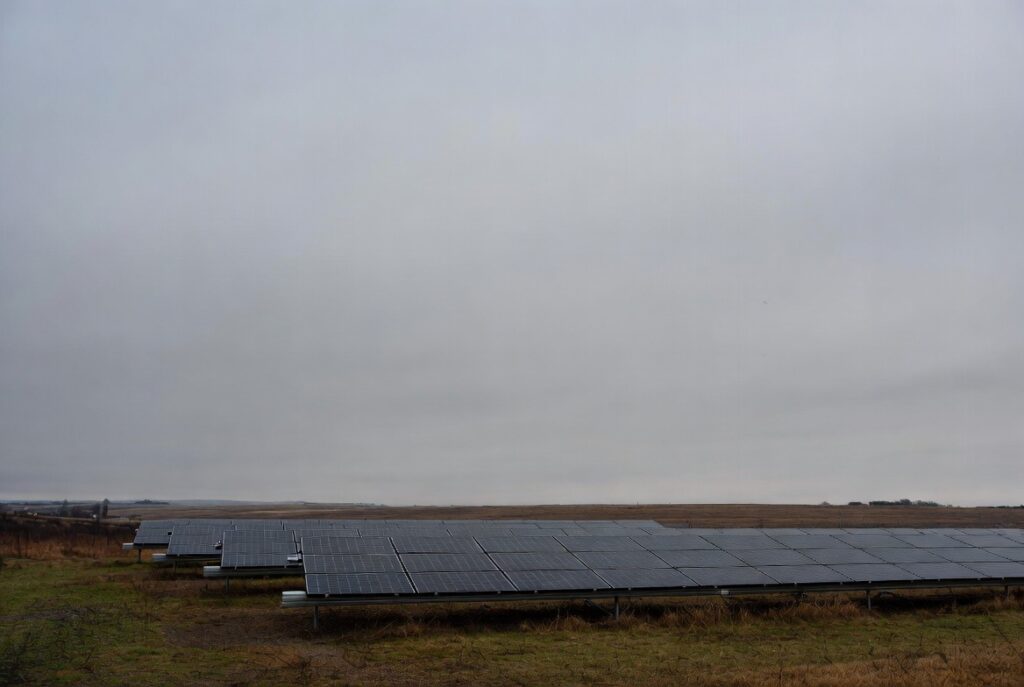
[Feature image: Ontario rural property on a flat gray overcast November day, solar panels on a ground mount, diffuse flat light, no direct sunlight visible, no brand logos readable, photorealistic, 16:9]
Alt text: cloudy solar Ontario
The cloudy solar ontario output reality: what a 400W array actually produces on a gray November day
| Sky condition | Irradiance (W/m²) | 400W array output | % of 2,500Wh daily load | Ontario verdict |
|---|---|---|---|---|
| Clear July day | ~1,000 W/m² | ~1,700Wh | 68% | Array covers majority of daily load |
| Clear January day (1.5 PSH) | ~800 W/m² peak | ~510Wh | 20% | Array covers roughly one meal’s energy |
| Light overcast | ~200-400 W/m² | ~80-200Wh | 3-8% | Array is a trickle , bank carries load |
| Full overcast (gray streak) | ~50-150 W/m² | ~40-100Wh | 1.5-4% | Array is statistical noise , bank does all work |
On fully overcast days in Ontario, the irradiance reaching the panel surface drops to approximately 50 to 150W per square metre , just 5 to 15 percent of the 1,000W per square metre standard test condition. A 400W array on a full overcast day produces approximately 40 to 100Wh, far below its rated capacity. For context, the same 400W array on a clear January day at 1.5 peak sun hours produces approximately 510Wh. The cloudy solar Ontario design reality is that even a clear winter day produces more than a fully overcast summer day. Always plan battery bank sizing and gray streak autonomy around the overcast case, not the clear-sky average.
The Ontario gray streak runs for 4 days on average during the worst November and January events. At 40 to 100Wh per day from a 400W array against approximately 2,500Wh daily consumption, the panels cover 1.5 to 4 percent of daily load. The battery bank covers the rest. This is not a system failure. It is the fundamental physics of diffuse light, and it is why Ontario off-grid system design always uses 4-day autonomy as the bank sizing target rather than any average or clear-day calculation. See our winter solar Ontario guide for how clear January days compare to overcast January days in the full seasonal picture.
The cloudy solar ontario panel choice: why monocrystalline outperforms polycrystalline in diffuse Ontario light
On cloudy days, the light reaching the panel is blue-shifted diffuse radiation rather than the full-spectrum direct beam of clear-sky conditions. Monocrystalline silicon has a better spectral response to the blue-shifted diffuse spectrum. A property owner in Guelph specified Renogy 100W monocrystalline panels explicitly for low-light performance on her fall 2024 Tier 2 build. Her neighbour had an older polycrystalline 400W array on the same approximate roof pitch and azimuth. During a February overcast week, her SmartShunt showed approximately 55 to 80Wh per overcast day. Her neighbour’s polycrystalline system produced approximately 25 to 40Wh per day under the same conditions.
The monocrystalline advantage is real but modest in absolute terms. Neither 55 to 80Wh nor 25 to 40Wh represents meaningful coverage of a 2,500Wh daily load. The advantage matters at the margin: over a 5-day overcast event, the additional 30 to 40Wh per day from monocrystalline panels versus polycrystalline adds approximately 150 to 200Wh of total harvest , roughly one extra hour of delayed generator run time. She commented: “Neither of us was making real power. But my bank lasted one extra day before the generator was needed.”
That one extra day was the entire value of the monocrystalline choice in diffuse light. For most Ontario Tier 2 builds, specifying monocrystalline panels is the correct default regardless of whether low-light performance is the primary concern, because the same panels that perform better in diffuse light also perform better in partial shading, at low angles of incidence, and in the early morning and late afternoon hours that make up a significant portion of the Ontario annual harvest. See our solar system planning ontario guide for the complete panel selection framework.
MPPT vs PWM in diffuse light: why the charge controller matters on overcast days
The Victron MPPT 100/30 outperforms PWM in diffuse light because of how each controller responds to fluctuating panel output. A PWM controller clips panel voltage to the battery charging voltage , approximately 27.6V for a 24V system. On a clear day this wastes relatively little energy. On a cloudy day when panel voltage barely exceeds battery voltage, the PWM clips at the battery voltage threshold and discards whatever small voltage differential remains above it. The MPPT continuously tracks the actual maximum power point of the panel regardless of battery voltage, following the shifting MPP as cloud cover changes second to second.
The practical MPPT advantage in diffuse light is approximately 20 to 30 percent more energy extracted versus an equivalent PWM controller on the same array. On a day producing only 40Wh through PWM, the MPPT 100/30 would extract approximately 48 to 52Wh from the same array under the same overcast sky. Over a 5-day gray streak at 40Wh average PWM production, the MPPT advantage accumulates to approximately 40 to 60Wh of additional harvest. Like the monocrystalline advantage, this matters at the margin , not as a solution to the gray streak, but as a tool that slows the bank’s descent and delays the generator run by one additional day over a prolonged cloudy solar Ontario event.
The gray streak protocol: SmartShunt management and the generator trigger for 4-day Ontario overcast events
The 4-day Ontario gray streak protocol starts with the SmartShunt time-to-empty display. Check it at sunset each day of any overcast stretch. If the reading shows less than 6 hours remaining, run the generator for a 90-minute bulk charge. The MultiPlus-II built-in charger at 50A bulk restores approximately 2,400Wh to a 24V system in 90 minutes and buys 2 to 3 more days of bank autonomy.
The net amp deficit during a full overcast day on a typical Tier 2 system is approximately -8A to -10A on a 24V system, with 2A to 3A of panel input against 10A to 12A of load draw. At -10A net deficit from a 200Ah Battle Born heated LFP bank, the bank depletes approximately 20 percent SoC per day.
The gray streak load shedding protocol extends bank life between generator runs. Shed the dishwasher, clothes washer, electric dryer, and workshop tools first. Keep the furnace blower (80W), well pump (870W running), chest freezer (45W), lighting (30W), and router (15W) , these total approximately 1,040W running load. This drops the net deficit and buys additional hours of autonomy per day. The Battle Born heated LFP bank accepts the generator charge at any Ontario winter temperature regardless of the garage ambient, which means the gray streak protocol works identically in November and January. See our solar battery monitor guide for the complete SmartShunt gray streak management protocol.
NEC and CEC: Ontario permit requirements for off-grid solar systems
NEC 690 and NEC 70 (NFPA 70, the National Electrical Code) govern off-grid solar installations in Ontario, including the charge controller, battery bank, inverter, and all associated wiring. All wiring must be sized for 125 percent of maximum continuous current. The battery bank positive terminal requires a Class T fuse sized for 125 percent of maximum continuous discharge current. DC disconnect switches must be accessible, clearly labelled, and rated for the system voltage. All outdoor wiring must be UV-resistant and sunlight-resistant rated. Contact the NFPA at nfpa.org for current NEC 690 requirements for Ontario off-grid solar installations.
CEC Section 64 governs electrical installations in Ontario. Any permanent solar installation, including off-grid systems with battery banks and MPPT charge controllers, requires an ESA permit at $300 to $400 before installation begins. The permit covers all DC and AC wiring, the charge controller installation, battery bank connections, and inverter integration. A licensed electrician must complete the installation and schedule the ESA inspection. Contact the Electrical Safety Authority Ontario at esasafe.com before beginning any permanent cloudy solar Ontario installation.
Pro Tip: If you have a ground-mount array, physically tilt the panels toward the brightest section of the overcast sky during gray streak events. On a full-overcast Ontario day, the brightest patch is typically toward the southeast at solar noon in Wellington County and Halton Region. Even a 5 to 10W improvement from better diffuse light alignment adds approximately 40 to 80Wh over an 8-hour overcast day. That additional harvest is not transformational, but over a 5-day gray streak it accumulates to approximately 200 to 400Wh , enough to delay one generator run by several hours. The Orangeville property owner made this adjustment after his first winter and added approximately 200Wh of additional gray-streak harvest per overcast day from his ground-mount system.
The cloudy solar ontario verdict: design for the gray streak, use MPPT, and let the SmartShunt manage the bank
- Ontario property owner who sized their system expecting meaningful gray-day panel output: recalculate gray streak bank sizing for 4-day full autonomy from storage with zero panel contribution. Add a SmartShunt if not already installed , the time-to-empty display is the only reliable management tool during a cloudy solar Ontario gray streak. Add a generator protocol triggered at 30 percent SoC. No hardware change to the array or charge controller is required if the bank already provides 4-day autonomy. The Orangeville result: same hardware, same panels, same array, corrected planning expectation, correct gray streak management protocol, no more surprise discharges.
- Ontario property owner specifying a new system: specify monocrystalline panels for diffuse light performance, MPPT 100/30 for maximum gray-day harvest, and Battle Born heated LFP for a bank that accepts charging current at every Ontario winter temperature. Install the SmartShunt from commissioning day for gray streak time-to-empty management. The mono and MPPT advantages do not solve the cloudy solar Ontario reality , they reduce the bank depletion rate during gray streaks by approximately 30 to 40 percent versus polycrystalline panels with a PWM controller, buying one to two extra days of autonomy over a 5-day overcast event. The Guelph result confirms the margin: one extra day before the generator run.
- Ontario property owner with a ground-mount array who wants to maximize gray-day harvest: tilt the array toward the brightest section of the overcast sky during gray streak events. On a full-overcast Ontario day, the brightest sky patch is typically toward the southeast at solar noon. A 5 to 10W improvement from better diffuse light alignment adds approximately 40 to 80Wh over an 8-hour overcast day , enough to offset one additional hour of normal household load. Combined with monocrystalline panels and the MPPT 100/30, this ground-mount tilt adjustment extracts the maximum available harvest from every cloudy solar Ontario day without any additional hardware cost.
Frequently Asked Questions
Q: Do solar panels work on cloudy days in Ontario?
A: Yes, but their output drops to approximately 10 to 25 percent of rated capacity. A 400W array on a fully overcast Ontario day produces approximately 40 to 100Wh, compared to approximately 510Wh on a clear January day at 1.5 peak sun hours. That output covers approximately 1.5 to 4 percent of the daily consumption for a typical Tier 2 Ontario property. The panels are producing on cloudy days , they simply cannot keep up with household demand. The battery bank carries the load during gray streak events, and the SmartShunt time-to-empty display is the tool that tells you how long the bank can sustain operation before a generator run is needed.
Q: How much power does a 400W solar array produce on a cloudy day in Ontario?
A: On a fully overcast Ontario day, a 400W array produces approximately 40 to 100Wh depending on cloud thickness. On a light overcast day with thin cloud cover, the same array may produce 80 to 200Wh. For context, a clear January day at Ontario’s 1.5 peak sun hours produces approximately 510Wh from the same 400W array. The cloudy solar Ontario reality is that the overcast output is negligible against a typical Tier 2 daily consumption of approximately 2,500Wh. The monocrystalline panel advantage in diffuse light adds approximately 30 to 40Wh per overcast day versus polycrystalline, and the MPPT 100/30 adds another 8 to 12Wh versus a PWM controller , both worthwhile margins on a 5-day gray streak.
Q: Is monocrystalline or polycrystalline better for cloudy Ontario weather?
A: Monocrystalline panels outperform polycrystalline in diffuse light due to better spectral response to the blue-shifted diffuse radiation on overcast days. The Guelph data confirms this: a monocrystalline 400W array produced approximately 55 to 80Wh per overcast day versus approximately 25 to 40Wh from an equivalent polycrystalline array on the same roof pitch during the same February week. Both figures are far below daily household consumption, but the monocrystalline advantage extended bank autonomy by approximately one extra day over a 5-day overcast event. For any Ontario Tier 2 build, monocrystalline is the correct default choice regardless of the primary performance concern.
This build is engineered within the 48V DC Safety Ceiling. Diagnostic logic is based on 20+ years of technical service experience. All structural and electrical installations must be verified by a Licensed Professional and comply with your Local AHJ. See our legal and safety disclosure for full scope.
About the Author
Robert Bertrand spent 20 years as a service advisor in the automotive industry (Lexus and Nissan), where precision diagnostics, wiring integrity, and documentation standards were non-negotiable. He brings that same technical discipline to GridFree Guide, where he researches, tests, and documents off-grid solar systems for Ontario conditions. Based in Rockwood, Ontario, every article is built on verified specifications, manufacturer data, and the real-world climate constraints of Canadian off-grid living.
As an Amazon Associate I earn from qualifying purchases. This site also contains affiliate links to other products and services. GridFree Guide earns a small commission at no extra cost to you.