
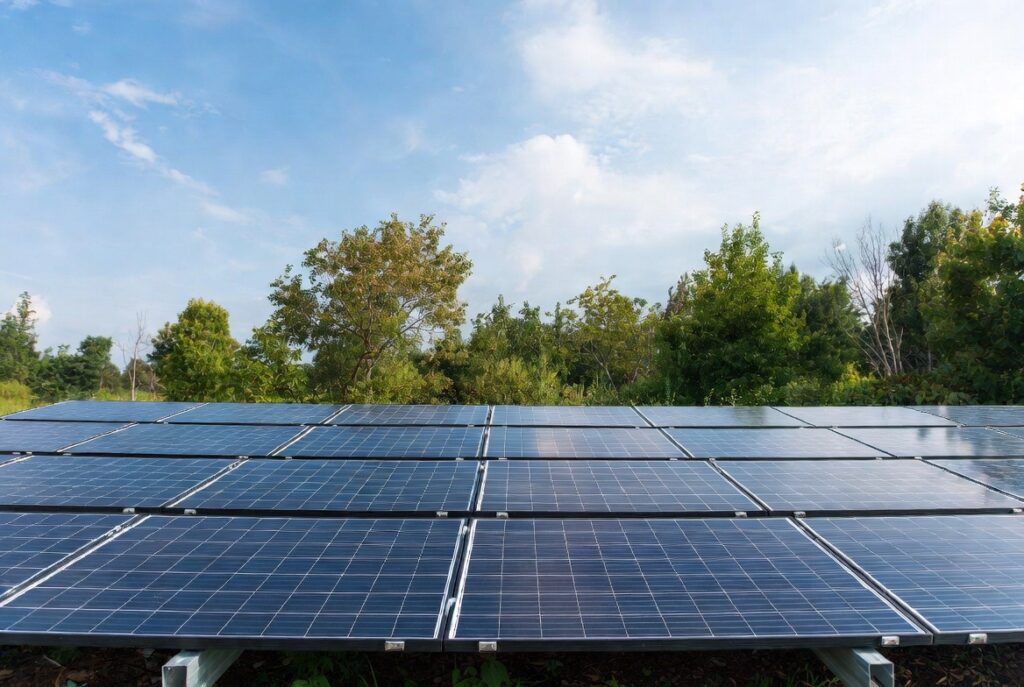
The most misdiagnosed summer solar ontario problem is low output on a clear July day, because a property owner in Guelph ran a perfectly functioning 400W roof-mount array on a cloudless July afternoon and his Victron SmartShunt recorded only 1,650Wh of daily harvest instead of the 1,870Wh the clear-day calculation predicted. The cause was not a failed panel, a bad connection, or a shading event. It was a 60 degrees C cell temperature on a black shingle roof that was 35 degrees C above the standard test condition baseline, producing a 12.25 percent output loss through heat derating alone.
His SmartShunt confirmed the diagnosis on the same day. On cool June mornings before the roof had heat-soaked, the same array produced close to its calculated output. On hot July afternoons after four hours of direct sun on the black shingle roof, the SmartShunt showed the derating clearly in the real-time wattage display. The panels were producing approximately 351W at midday peak versus the 400W he had calculated. The problem was not his hardware. It was his roof.
The fix for roof-mount heat derating is not a new panel or a new controller. Proper standoffs that create a rear ventilation gap of at least 4 to 6 inches allow convective airflow to carry heat away from the panel back surface. This reduces cell temperature by approximately 5 to 8 degrees C versus flush-mount, recovering approximately 7W to 11W from a 400W array on a hot July day. The summer solar Ontario lesson was not that roof-mount systems fail in heat. It was that the gap between the panel and the roof is the difference between 55 degrees C and 60 degrees C cell temperature. See our Ontario solar sizing guide before any summer solar Ontario harvest calculation.
The summer solar ontario temperature problem: why hot panels lose output on clear July days
| Cell temperature | Degrees above STC | Derating | 400W array output | Mount type |
|---|---|---|---|---|
| 25 degrees C (STC) | 0 | 0% | 400W / ~1,870Wh | Rated condition only |
| 45 degrees C | 20 | 7.0% | 372W / ~1,741Wh | Ground-mount with airflow |
| 55 degrees C | 30 | 10.5% | 358W / ~1,676Wh | Roof-mount with standoffs |
| 60 degrees C | 35 | 12.25% | 351W / ~1,644Wh | Flush roof-mount, black shingles |
| 65 degrees C | 40 | 14.0% | 344W / ~1,611Wh | Flush roof-mount, worst case |
The temperature coefficient for most monocrystalline Renogy 100W solar panels is approximately -0.35 percent per degree C above 25 degrees C. Ambient Ontario July temperatures of 28 to 35 degrees C do not predict cell temperature , panels absorb solar radiation and always run hotter than ambient. A roof-mount panel on black shingles can reach 55 to 65 degrees C in Ontario July, while a ground-mount panel with rear airflow runs at approximately 40 to 50 degrees C.
The derating is easy to calculate: subtract 25 from the cell temperature, multiply by 0.35 percent, and apply to rated output. At 60 degrees C, the loss is 35 times 0.35 percent equals 12.25 percent , 49W gone from a 400W array on every clear July afternoon.
The summer solar ontario heat derating problem is invisible without data. A 12.25 percent output loss does not trigger any alarm, does not trip any protection, and does not appear as a fault in any MPPT display. The array looks healthy because it is healthy. The SmartShunt reveals the derating by comparing expected harvest against actual harvest on clear days: the Guelph property owner calculated 1,870Wh for a clear July day at 5.0 PSH and measured 1,650Wh. The 220Wh gap is the heat derating in Wh per day at his specific roof temperature. See our cloudy solar Ontario guide for the opposite end of the output spectrum and how diffuse light compares to heat-derated clear days.
The temperature coefficient: how to calculate your Ontario July heat derating loss
The derating calculation requires one measurement: the panel cell temperature. A thermal camera or an infrared thermometer pointed at the panel back surface gives the cell temperature within a few degrees.
Without a thermal tool, use the rule of thumb: flush roof-mount on black shingles adds approximately 25 to 35 degrees C above ambient in full Ontario July sun. At 32 degrees C ambient plus 30 degrees C roof loading, cell temperature reaches approximately 62 degrees C. The derating at 62 degrees C is 37 times 0.35 percent equals 12.95 percent, or approximately 52W from a 400W array. The Victron MPPT 100/30 tracks the shifting maximum power point as the panel heats up, extracting whatever power remains , but it cannot recover the watts lost to thermodynamics.
The standoff fix recovers a meaningful portion of the derating. A 4 to 6 inch gap between the panel back and the roof surface allows convective airflow, reducing cell temperature by approximately 5 to 8 degrees C versus flush-mount. At 55 degrees C instead of 60 degrees C, the derating drops from 12.25 percent to 10.5 percent , recovering approximately 7W per panel or 28W from a 400W array on a hot July day. Over a 10-hour clear July day, that recovery adds approximately 60 to 90Wh of additional summer solar ontario harvest from the same panels with no other hardware change. See our solar system planning ontario guide for the full array specification framework that includes mount type selection.
The summer solar ontario mount decision: why ground-mount panels run cooler and produce more
A roof-mount panel on black shingles experiences double heat loading. The panel front absorbs solar radiation from above. The black shingle surface below absorbs solar radiation independently and radiates heat upward into the panel back surface. This double loading drives cell temperatures to 55 to 65 degrees C in Ontario July. A ground-mount panel with open airflow on all four sides is cooled by ambient air movement across both surfaces, running approximately 10 to 15 degrees C cooler than a flush roof-mount in the same outdoor conditions. A property owner in Rockwood, Wellington County installed a Tier 2 ground-mount system with open rear ventilation, and the results on a matched comparison day confirmed every degree of that difference.
On the same clear July day as the Guelph roof-mount comparison, ambient temperature in Rockwood was approximately 32 degrees C. His ground-mount panel cell temperature was approximately 45 degrees C, measured via thermal camera , 15 degrees C cooler than the Guelph roof-mount at 60 degrees C. His SmartShunt harvest was 1,810Wh versus 1,870Wh expected: approximately 3.2 percent derating versus 12.25 percent. The ground-mount produced 160Wh more per day than the Guelph roof-mount from identical 400W arrays under identical weather conditions.
His comment: “I thought ground-mount was just more work to install. It turned out to also be about 10 percent more power every hot summer day.”
Over an Ontario July with 31 clear days, that 160Wh daily advantage adds approximately 4,960Wh of additional summer solar ontario harvest from the same panel count. The tradeoff is installation cost and site planning , ground-mount systems require more conduit run length, more structural hardware, and a clear site footprint. For most Ontario Tier 2 properties with available cleared land, the summer output recovery and winter snow-slide tilt advantage together justify the ground-mount specification. See our winter solar Ontario guide for how the 60 to 70 degree winter tilt compounds the ground-mount advantage across all four seasons.
The SmartShunt heat diagnostic: distinguishing heat derating from actual panel faults
The SmartShunt distinguishes heat derating from actual panel faults by comparing hot-day versus cool-morning harvest data. A panel with heat derating shows lower output during hot afternoon hours but returns to near-rated output on cool clear mornings before the panels have heat-soaked. A panel with an actual fault shows reduced output at all times regardless of temperature. To run the diagnostic: note the SmartShunt MPPT real-time wattage reading at 8 AM on a clear morning and again at 1 PM on the same day. If the 1 PM reading is 10 to 15 percent below the 8 AM reading with no clouds or shading, the cause is heat derating.
If both readings are equally low, investigate the panel, wiring, or connections.
The SmartShunt daily harvest log also confirms the derating pattern over time. A correctly performing array shows consistent Wh per clear-sky PSH in spring and fall but lower Wh per PSH in July and August when cell temperatures peak. This seasonal variation is normal summer solar ontario behavior for any roof-mount system without adequate rear ventilation. If the low-Wh pattern appears in May or September when temperatures are moderate, investigate the system for panel faults, shading, or connection issues rather than attributing the loss to heat derating. The summer solar ontario derating pattern always correlates with hot weather , a system fault does not.
NEC and CEC: Ontario permit requirements for solar panel installations
NEC 690 and NEC 70 (NFPA 70, the National Electrical Code) govern all photovoltaic installations in Ontario, including both roof-mount and ground-mount systems. Array wiring must be sized for 125 percent of maximum continuous current at the STC short-circuit current (Isc), and all outdoor wiring must use UV-resistant and sunlight-resistant rated cable. Roof-mount installations must additionally comply with local building codes for structural loading, fire access pathways, and setback requirements from roof edges and ridgelines , these requirements vary by municipality across Ontario. Contact the NFPA at nfpa.org for current NEC 690 requirements for Ontario roof-mount and ground-mount solar installations.
CEC Section 64 governs electrical installations in Ontario. Both roof-mount and ground-mount permanent solar installations require an ESA permit at $300 to $400 before installation begins. The permit covers all DC wiring, the charge controller installation, battery bank connections, and inverter integration. Ground-mount systems additionally require trenched conduit runs from the array to the building, which must be included in the permit scope and inspected before backfilling. A licensed electrician must complete the installation and schedule the ESA inspection before the system is commissioned. Contact the Electrical Safety Authority Ontario at esasafe.com before beginning any summer solar ontario installation.
Pro Tip: In Ontario July, the peak summer solar Ontario efficiency window is between 8 AM and 11 AM, before the panels have fully heat-soaked from direct sun. A panel that starts the day at 28 degrees C ambient (near-STC performance) climbs to 55 to 65 degrees C by early afternoon as the roof and panel mass absorb heat. If you need to run high-draw loads , well pump, workshop compressor, clothes washer , schedule them in the morning window when the panels are producing closest to their rated output. The Guelph property owner shifted his well pump cycle to 8:30 AM and his workshop compressor to 9 AM after the SmartShunt data showed the 8 AM versus 1 PM wattage gap clearly. His morning load-matching improved his overall system autonomy by approximately 45 minutes per day in July.
The summer solar ontario verdict: calculate the derating, choose your mount, trust the SmartShunt
- Ontario property owner with a roof-mount array on black shingles experiencing unexplained low July output: run the SmartShunt hot-vs-cool diagnostic to confirm heat derating is the cause. If morning output is at rated output and afternoon output is 10 to 15 percent lower with no clouds or shading, the cause is heat derating. Install 4 to 6 inch standoffs to create a rear ventilation gap, reducing cell temperature by 5 to 8 degrees C and recovering approximately 7 to 11W from a 400W array on hot July days. No panel replacement, no controller replacement. The Guelph result: standoff installation, cell temperature dropped from 60 to 52 degrees C, approximately 11W recovered per panel, SmartShunt confirmed the additional harvest on the next clear July day.
- Ontario property owner specifying a new system with site flexibility: choose ground-mount over roof-mount whenever the site permits for summer solar ontario performance. The 10 to 15 degrees C lower cell temperature of a ground-mount with rear airflow recovers approximately 3 to 5 percent more output versus a flush roof-mount on hot summer days. Over an Ontario July with 31 clear days, that recovery adds approximately 4,900 to 7,000Wh of additional summer harvest from the same 400W Renogy 100W panel array. Pair with the MPPT 100/30 and SmartShunt to confirm the ground-mount advantage in the first week of July data. The Rockwood result: 1,810Wh versus 1,650Wh from the Guelph roof-mount on identical weather days.
- Ontario property owner who wants to maximize morning harvest during high-draw events: schedule manually controlled high-draw loads between 8 AM and 11 AM in July, before the panels heat-soak and the summer solar ontario temperature derating reaches its midday peak. The SmartShunt wattage display confirms the morning window: 8 AM output is typically 5 to 8 percent higher than 1 PM output on identical-irradiance clear days. The well pump, workshop compressor, and clothes washer all benefit from the cooler panel performance in the morning hours. The 10 AWG array cable run from ground-mount array to the charge controller also runs cooler in the morning, reducing resistive losses in the array run before midday heat loading compounds both the panel derating and the wire resistance.
Frequently Asked Questions
Q: Why does my solar array produce less power on hot sunny days than on cool spring days?
A: Solar panels lose approximately 0.35 percent of rated output for every degree C above the 25 degrees C standard test condition. On a black shingle roof in Ontario July, panel cell temperature regularly reaches 55 to 65 degrees C, producing a 10.5 to 14 percent output reduction. A 400W array at 60 degrees C produces approximately 351W rather than the rated 400W. The same array in May or September at 35 degrees C cell temperature loses only 3.5 percent , producing approximately 386W. The SmartShunt reveals this seasonal pattern clearly: consistent Wh per PSH in spring and fall, reduced Wh per PSH in July and August. This is heat derating, not a panel fault.
Q: How much output does a 400W array lose to heat derating on an Ontario July afternoon?
A: On a flush roof-mount with black shingles at 60 degrees C cell temperature, a 400W array produces approximately 351W , a loss of 49W or 12.25 percent of rated output due to heat derating. At 55 degrees C cell temperature with proper standoffs, the same array produces approximately 358W, losing approximately 42W or 10.5 percent. A ground-mount array at 45 degrees C cell temperature produces approximately 372W, losing only approximately 28W or 7 percent. The difference between the best-case ground-mount (372W) and worst-case flush roof-mount (344W at 65 degrees C) is approximately 28W , equivalent to adding one full 28W panel at no extra panel cost simply by improving the mount configuration.
Q: Does a ground-mount solar system really outperform a roof-mount in Ontario summer?
A: Yes, with real data to confirm it. The Rockwood ground-mount array ran approximately 15 degrees C cooler than the Guelph roof-mount on the same July day, producing 1,810Wh versus 1,650Wh , a 160Wh daily advantage from the same 400W of panels under identical weather conditions.
Over 31 clear July days, that accumulates to approximately 4,960Wh of additional summer solar ontario harvest. The ground-mount advantage also extends to winter, where the adjustable tilt of 60 to 70 degrees allows snow to slide off and improves January output by approximately 15 to 25 percent versus a fixed 35-degree roof-mount. The installation cost is higher and the site requires cleared ground, but for Ontario Tier 2 properties with available land, ground-mount outperforms roof-mount in both the hottest and coldest months of the year.
This build is engineered within the 48V DC Safety Ceiling. Diagnostic logic is based on 20+ years of technical service experience. All structural and electrical installations must be verified by a Licensed Professional and comply with your Local AHJ. See our legal and safety disclosure for full scope.
About the Author
Robert Bertrand spent 20 years as a service advisor in the automotive industry (Lexus and Nissan), where precision diagnostics, wiring integrity, and documentation standards were non-negotiable. He brings that same technical discipline to GridFree Guide, where he researches, tests, and documents off-grid solar systems for Ontario conditions. Based in Rockwood, Ontario, every article is built on verified specifications, manufacturer data, and the real-world climate constraints of Canadian off-grid living.
As an Amazon Associate I earn from qualifying purchases. This site also contains affiliate links to other products and services. GridFree Guide earns a small commission at no extra cost to you.