
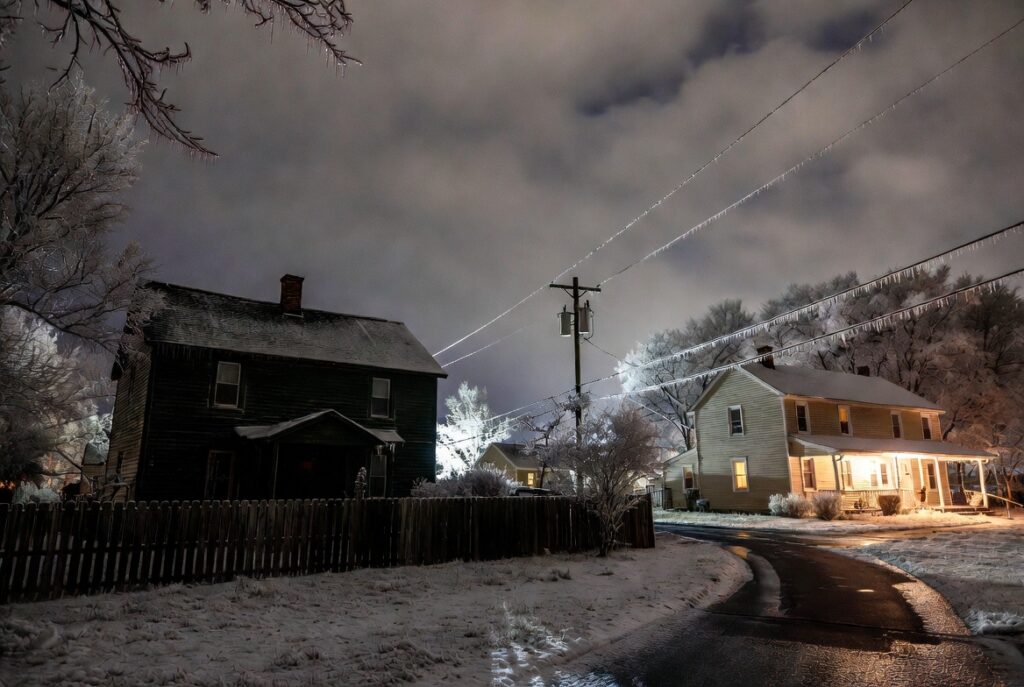
The most important solar power outage fact in Ontario is the one most HRSP homeowners never learn until the December ice storm arrives, which is that a grid-tied solar array with 18 panels and a $30,000 installation automatically shuts off the moment Hydro One loses power on the street, because Ontario law requires every grid-tied inverter to disconnect from the grid within 2 seconds of detecting a loss of voltage.
That legal requirement leaves the HRSP homeowner with no power and no heat in exactly the conditions where backup power matters most. The December 2022 ice storm took down Hydro One service across Centre Wellington for 38 hours. A property owner on the same road as the Fergus outage had a standard 6kW grid-tied array installed the previous spring. His system had produced good summer numbers.
The moment Hydro One failed at 11 PM on December 22, his 18 panels went dark and his house went cold. His furnace stopped calling for heat. His well pump would not cycle. The anti-islanding protection in his grid-tied inverter had done exactly what Ontario law required it to do.
The property owner next door had a different setup. His Victron MultiPlus-II and 200Ah Battle Born heated LFP bank had been commissioned in September. When Hydro One failed, the MultiPlus-II detected the grid loss and switched all household loads to the battery bank in under 20ms. His furnace blower cycled on its next call for heat without interruption. His well pump ran its next cycle with the SoftStart Well reducing the startup surge to approximately 900W. His chest freezer held temperature through the night without a degree of drift.
I reviewed his SmartShunt data the following morning. After 38 hours of normal household operation drawing approximately 1,040W running load, the SmartShunt showed 41 percent SoC remaining in the 200Ah bank. He ran his generator for 90 minutes, the MultiPlus-II built-in charger brought the bank back to 94 percent at 50A bulk rate, and he returned to full battery autonomy before the grid came back. His HRSP neighbor spent the night at a hotel in Guelph. See our Ontario solar sizing guide before specifying any solar power outage system for an Ontario property.
The solar power outage reality: why anti-islanding shuts off every grid-tied array the moment Hydro One fails
| System type | During Hydro One outage | Transfer speed | Furnace / pump | Ontario verdict |
|---|---|---|---|---|
| Grid-tied HRSP (no battery) | Panels shut off within 2 seconds | N/A , goes dark | No power | Zero outage benefit. Anti-islanding required by law. |
| Battery-backed off-grid (MultiPlus-II) | Continues from battery bank | Under 20ms | Runs normally | Full outage immunity. SmartShunt tracks autonomy. |
| Hybrid (HRSP + separate battery backup) | HRSP shuts off, battery backup runs critical loads | Under 20ms | Runs normally | Best of both paths. Higher total cost. |
| Generator only (no solar) | Runs when started manually | Manual start delay | Runs when running | No solar credits. No autonomous transfer. |
The governing standard for grid-tied inverters in Ontario is IEEE 1547, the Ontario Electrical Safety Code, and IESO interconnection requirements. All grid-tied inverters must disconnect from the grid within 2 seconds of detecting a loss of voltage. This requirement exists to prevent live voltage from reaching downed Hydro One lines where crews are working to restore service. If a grid-tied array in Fergus kept pushing power into a downed line while a Hydro One lineman was working on that line in Centre Wellington, the lineman could be electrocuted. Anti-islanding is not a flaw in the HRSP system. It is a mandatory safety standard that protects the crews who restore power to every property in the province.
The result for HRSP homeowners is absolute: no exceptions, no workarounds, and no panels producing during any solar power outage without a battery-backed islanding-capable inverter. The homeowner with 18 HRSP panels and a $30,000 array in Fergus had the same power situation as the neighbour with no solar at all , zero electricity, zero heat, zero water pressure for 38 hours. His system earns excellent net metering credits during normal grid operation. It is the correct financial choice when the grid connection already exists at zero marginal cost. It is simply not a solar power outage solution. See our grid tied ontario guide for the full HRSP financial analysis.
The solar power outage solution: how the MultiPlus-II keeps every load running in under 20ms
The Victron MultiPlus-II is not subject to anti-islanding requirements because it does not export power to the Hydro One grid. In off-grid mode, it draws from the Battle Born heated LFP bank and powers the household circuits independently of the grid. When Hydro One fails, the MultiPlus-II detects the grid loss and completes the transfer to battery-backed operation in under 20ms. That transfer speed is below the threshold at which digital clocks reset. It is below the threshold at which a furnace controller registers a power interruption. It is below the threshold at which a submersible well pump controller drops its cycle.
A property owner in Erin Township, Centre Wellington experienced a 19-hour Hydro One outage beginning at approximately 2 AM in the winter of 2024. The MultiPlus-II transfer was invisible. His furnace blower did not miss a single heat call through the night. His well pump cycled normally at approximately 900W startup with the SoftStart Well installed. His Victron SmartShunt recorded every amp-hour in and out of the Battle Born heated LFP bank through the night, showing 67 percent SoC when he woke at 6:30 AM to a warm house and normal water pressure.
He learned the grid had been down for 19 hours only when he looked out the window and saw his neighbour’s dark house. No generator run was needed , the 200Ah bank at 67 percent SoC held approximately 7 more hours of normal autonomy before any action was required. The grid restored before he needed to start the generator. His comment: “I had no idea the grid was down. I woke up and everything was just working.” The under 20ms transfer also protects against brownouts, the gradual voltage drops that often precede full Hydro One failures in rural Ontario during ice loading events. See our off-grid inverter ontario guide for the complete MultiPlus-II specification.
The gray streak protocol: how to manage the battery bank through a 4-day Ontario outage
A 4-day Ontario ice storm solar power outage requires a shift from normal operation to deliberate load management. The Big Three loads to keep running are the furnace blower (80W), the well pump with SoftStart Well (900W startup, 870W running), and the chest freezer (45W average). Together with LED lighting (30W) and a router (15W), these total approximately 1,040W running load. At 1,040W average draw from a 200Ah 24V bank with approximately 1,920Wh usable at 80 percent DoD, full autonomy runs approximately 18 hours before the bank needs a generator top-up.
The SmartShunt tracks the depletion in real time. When SoC drops below 30 percent, run the generator for a 90-minute bulk charge at 50A through the MultiPlus-II built-in charger.
The discretionary loads to shed during a gray streak solar power outage are the dishwasher, clothes washer, electric dryer, workshop tools, and any non-essential load over 500W. Each load shed extends battery autonomy proportionally. The SmartShunt time-to-empty display converts the current draw into a tangible countdown , a property owner at 35 percent SoC drawing 1,040W has approximately 4 to 5 hours before the generator is needed, while the same 35 percent SoC at 600W running load gives approximately 7 to 8 hours. Load management is the skill that makes a 200Ah bank last through a 4-day Ontario ice storm without daily generator runs.
The Fergus result confirms this: 38 hours of normal household operation, 41 percent SoC remaining, one 90-minute generator run to restore full autonomy. See our off-grid setup guide for the complete Ontario gray streak protocol.
Anti-islanding: the Ontario law that protects Hydro One linemen and shuts off your HRSP panels
Anti-islanding protection is a legal requirement under IEEE 1547 and the Ontario Electrical Safety Code for all grid-tied inverters. The requirement exists because a solar array that continued generating during a grid outage would push live voltage back into downed distribution lines. Hydro One crews working to restore power in Centre Wellington or Erin Township during a December ice storm have no way to confirm which lines are energised unless every grid-tied source has disconnected. A 6kW HRSP array is large enough to energise a downed line. The 2-second disconnect requirement removes any doubt for crews working in hazardous winter conditions.
This protection cannot be bypassed. A grid-tied inverter that did not implement anti-islanding would fail ESA inspection and IESO interconnection approval in Ontario. There is no setting, no switch, and no workaround that allows a standard grid-tied HRSP inverter to continue producing power during a Hydro One solar power outage. The only path to outage-immune solar power is an islanding-capable battery-backed inverter such as the MultiPlus-II, which operates independently of the grid in off-grid mode and is not required to shut down when Hydro One fails because it is not exporting to the Hydro One network. See our solar battery heater guide for the winter battery bank standard that pairs with the MultiPlus-II for Ontario outage protection.
NEC and CEC: Ontario permit requirements for battery-backed solar outage systems
NEC 690 and NEC 70 (NFPA 70, the National Electrical Code) govern battery-backed solar installations in Ontario. A battery-backed off-grid system is not subject to IESO grid interconnection requirements because it does not export power to the Hydro One distribution system. The system still requires an ESA permit covering the inverter installation, battery bank wiring, DC disconnect switch, AC distribution panel connections, and any generator input wiring. All permanent wiring must comply with NEC 690 conductor sizing and fusing requirements. The inverter AC output wiring must be sized for 125 percent of the inverter’s continuous output current. Contact the NFPA at nfpa.org for current NEC 690 requirements for battery-backed solar power outage systems.
CEC Section 64 governs electrical installations in Ontario. Any permanently wired battery-backed solar installation requires an ESA permit at $300 to $400 before installation begins. The permit covers the inverter, DC disconnect, battery bank wiring, generator input connections, and AC distribution panel connections. A licensed electrician must complete the installation and schedule the ESA inspection. Operating a permanent battery-backed solar system without an ESA permit invalidates the property insurance coverage for the electrical installation. Contact the Electrical Safety Authority Ontario at esasafe.com before beginning any permanent solar power outage system installation in Ontario.
Pro Tip: The most revealing test for any Ontario off-grid system is the first Hydro One outage after commissioning. Note the SmartShunt SoC reading at the moment the grid fails, then check it again at the moment the grid restores. The difference is your actual autonomy consumption for that outage duration. The Erin Township property owner started at 100 percent SoC, endured a 19-hour outage, and ended at 67 percent SoC, consuming approximately 33 percent of his 200Ah bank through 19 hours of normal operation. That is 1,920Wh times 0.33 equals approximately 634Wh consumed in 19 hours, or approximately 33Wh per hour, which is well below the 1,040W running load calculation. Real Ontario households cycle loads and the average draw is always lower than the peak running load.
The solar power outage verdict: battery-backed for outage immunity, grid-tied for credits, not both at the same time
- Ontario property owner with a grid-tied HRSP system who wants solar power outage protection: add a separate battery-backed MultiPlus-II system as a dedicated off-grid layer for critical loads. The HRSP system continues earning net metering credits during normal grid operation. The MultiPlus-II draws from the Battle Born heated LFP bank and powers the Big Three loads automatically during any Hydro One outage. Confirm the SmartShunt idle draw at commissioning and calculate gray streak autonomy for the furnace blower, well pump with SoftStart Well, and chest freezer at approximately 1,040W running load.
- Ontario property owner specifying a new system and wanting both solar power outage protection and net metering credits: the hybrid path provides both at higher total cost. Size the battery bank for 18 to 22 hours of autonomy at 1,040W from a 200Ah bank. Size the HRSP array for annual net metering credits on the main house load. The SoftStart Well is mandatory for any system where the well pump will cycle on battery during outages , the 2,800W startup surge without it can trip the inverter on the first pump cycle of any outage.
- Ontario property owner who wants solar power outage protection and is not connected to the grid: the complete Tier 2 off-grid system is the correct specification and provides maximum outage immunity. The MultiPlus-II with Battle Born heated LFP bank and SoftStart Well delivers the Fergus and Erin Township results: invisible transfers under 20ms, normal household operation through any duration outage, and SmartShunt-managed autonomy that tells you exactly when to run the generator. No HRSP application. No IESO interconnection. No anti-islanding shutdown during any Hydro One solar power outage event.
Frequently Asked Questions
Q: Does solar power still work during a Hydro One outage in Ontario?
A: Grid-tied HRSP solar panels automatically shut off when the grid fails due to mandatory anti-islanding requirements under IEEE 1547 and the Ontario Electrical Safety Code. This is a legal requirement that cannot be bypassed , it protects Hydro One linemen from live wires during restoration work. A battery-backed system with the Victron MultiPlus-II is not subject to anti-islanding shutdown because it does not export power to the grid. The MultiPlus-II operates from the Battle Born heated LFP bank during any Hydro One solar power outage and transfers all household loads in under 20ms.
Q: How long will a battery bank last during a 4-day Ontario ice storm outage?
A: A 200Ah 24V Battle Born heated LFP bank provides approximately 18 hours of full autonomy at the standard Ontario Tier 2 running load of approximately 1,040W (furnace blower 80W, well pump with SoftStart 870W running, chest freezer 45W average, lights and router 45W combined). Over a 4-day solar power outage, that means one generator run per day of approximately 90 minutes at 50A bulk charge through the MultiPlus-II built-in charger. Real households cycle loads and average draw is typically lower than the peak running load, as the Erin Township result confirms: 19 hours of normal operation consumed only 33 percent of the 200Ah bank.
Q: Does the Victron MultiPlus-II keep running during a grid failure?
A: Yes, the Victron MultiPlus-II transfers to battery-backed operation in under 20ms when Hydro One fails , faster than a digital clock can register. It operates in off-grid mode drawing from the Battle Born heated LFP bank and does not require anti-islanding shutdown because it does not export to the Hydro One grid. The furnace blower, well pump (with SoftStart Well for the startup surge), and chest freezer all continue operating normally through any duration solar power outage. The SmartShunt monitors remaining SoC in real time, allowing the property owner to calculate when a generator run is needed without guessing at remaining capacity.
This build is engineered within the 48V DC Safety Ceiling. Diagnostic logic is based on 20+ years of technical service experience. All structural and electrical installations must be verified by a Licensed Professional and comply with your Local AHJ. See our legal and safety disclosure for full scope.
About the Author
Robert Bertrand spent 20 years as a service advisor in the automotive industry (Lexus and Nissan), where precision diagnostics, wiring integrity, and documentation standards were non-negotiable. He brings that same technical discipline to GridFree Guide, where he researches, tests, and documents off-grid solar systems for Ontario conditions. Based in Rockwood, Ontario, every article is built on verified specifications, manufacturer data, and the real-world climate constraints of Canadian off-grid living.
As an Amazon Associate I earn from qualifying purchases. This site also contains affiliate links to other products and services. GridFree Guide earns a small commission at no extra cost to you.